
Marquetry Furniture: A Buyer’s Guide 2026


A homeowner often notices marquetry before knowing its name. It might be a sideboard with a flowering pattern that seems to glow under lamplight, or a dining table whose surface looks composed rather than uniformly finished. The first reaction is usually visual. The second is tactile. The top feels smooth, but the design has depth because it was built from material, not brushed on as decoration.
That distinction matters. Marquetry furniture sits at the meeting point of cabinetmaking, surface design, and decorative art. It rewards a closer look, and it asks better questions from a buyer. Is the pattern made from separate veneers? Is the surface flat and stable? Will the piece suit daily life, or does it need collector-level care?
For homeowners drawn to craftsmanship, marquetry offers something rare in modern interiors. It carries history, but it doesn't have to feel museum-like. A well-chosen marquetry piece can anchor a formal room, soften a refined coastal space, or add a sense of artistry to a clean-lined interior.
The Art of Marquetry Furniture in Your Home
A patterned wood surface can fool the eye. At first glance, it may look painted, printed, or stained into the top of a cabinet. Then the grain shifts, the colors change with the light, and the design reveals itself as something far more exacting.

Marquetry furniture is decorative furniture made with veneers or other inlaid materials arranged into patterns and images. Historical accounts describe the technique as using not only wood but also bone, ivory, tortoise shell, mother-of-pearl, and bronze on furniture such as chests, sideboards, cabinets, and tables, as outlined in this history of marquetry's early development.
Why marquetry feels different from ordinary decoration
Paint sits on top of a surface. Marquetry becomes the surface. That's why it has such presence in a room. The grain itself does the visual work, creating contrast, movement, and detail without relying on a heavy applied motif.
A floral spray on a cabinet door, for example, may be built from many pieces chosen for color, figure, and direction of grain. A geometric border may look restrained from across the room, yet reveal remarkable precision at close range.
Practical rule: If a wood design looks richer the closer someone stands to it, there's a good chance craftsmanship, not just finish, is doing the work.
Where homeowners most often encounter it
Marquetry appears best on surfaces that invite viewing and touch. Common examples include:
- Dining tables: Tops that become a conversation piece without needing extra ornament.
- Sideboards and credenzas: Large flat fronts that show off pattern beautifully.
- Cabinets and occasional tables: Smaller pieces where detail can feel especially jewel-like.
Homeowners who appreciate painted furniture often respond to marquetry for a similar reason. Both bring artistry to case pieces, though the method is entirely different. For readers who enjoy decorative surfaces more broadly, this look at hand-painted furniture offers a useful contrast in how craftsmanship can transform wood furnishings.
From Renaissance Courts to Modern Heirlooms
A homeowner opens the door of a quiet study, runs a hand across a cabinet front, and notices something unusual. The pattern does not sit on the wood like decoration added at the end. It feels born from the surface itself. That reaction links a modern room to one of the most refined traditions in European furniture.
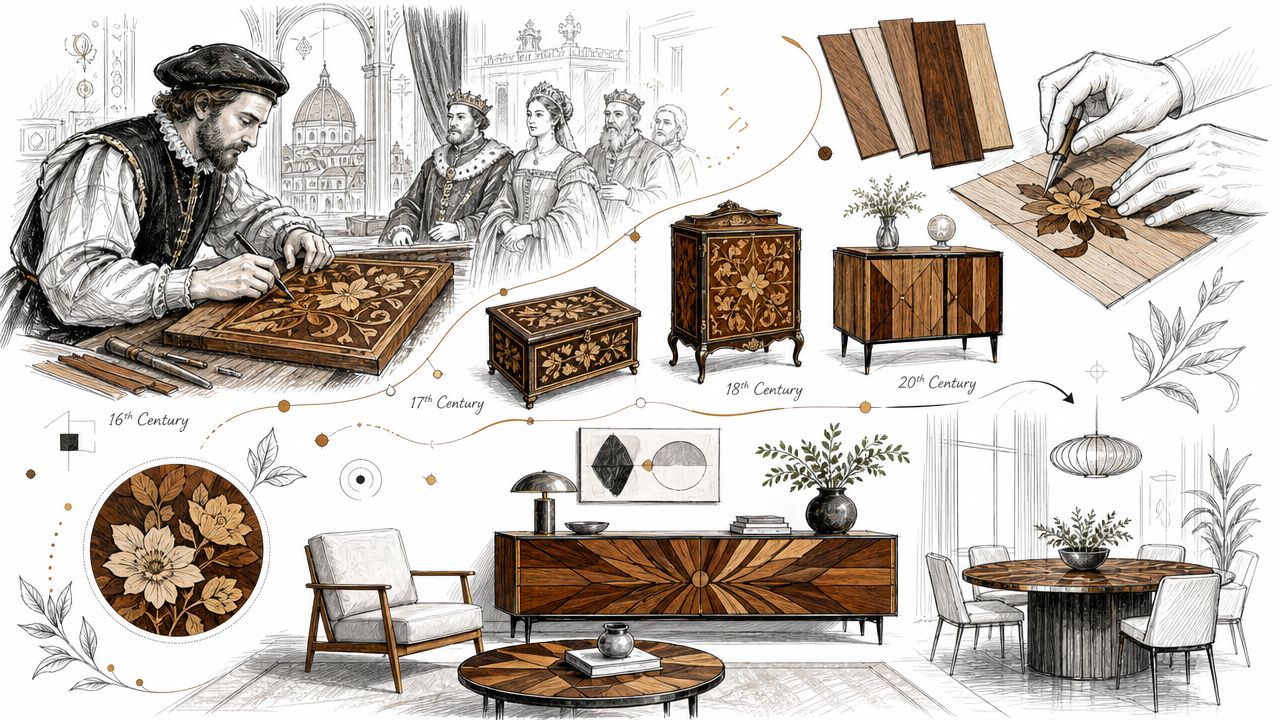
Recognizable marquetry took shape in Renaissance Europe, first in Italy, then in major trading and craft centers such as Antwerp, before gaining wider acceptance in England. This overview of marquetry's origins helps trace that early movement. The history matters because marquetry was never ordinary ornament. It developed in workshops serving patrons who expected furniture to show learning, taste, and control of expensive materials.
Courts and collectors prized it for a simple reason. Marquetry let a cabinetmaker draw with wood. A flower could be built from warm fruitwood, dark walnut, or pale holly. A border could create rhythm the way stone flooring or parquet does in a grand hall. Homeowners who enjoy understanding handmade cement tile often respond to marquetry for the same reason. The pattern is constructed piece by piece, not applied as an afterthought.
By the 17th and 18th centuries, the craft reached a high point in continental Europe, especially in France and Italy. Workshops produced furniture with scrolling foliage, trophies, outdoor scenes, and formal geometry, all assembled from carefully cut veneers. Some methods even created paired designs from the same packet of veneers, producing matching positive and negative compositions known as partie and contre-partie, as described in this marquetry history and technique reference.
That legacy still shapes how a good piece feels in a home today.
For a discerning owner, the appeal is not only historical. Marquetry carries the discipline of old cabinetmaking into present-day living. A sideboard can anchor a dining room without shouting for attention. A bedside chest can add warmth and detail where painted or printed decoration would feel flat. The best modern examples respect the old logic of the craft while pairing it with strong cabinet construction and suitable timber choices, which is why it helps to understand how hardwood selection affects furniture longevity and style.
This is the bridge many guides miss. Antique marquetry teaches the eye what excellence looks like. Modern marquetry gives a homeowner the chance to live with that standard every day, with the added benefits of custom scale, practical use, and the potential to become the next family heirloom.
How to Identify True Marquetry Craftsmanship
The easiest mistake a buyer can make is assuming any decorative wood surface qualifies as marquetry. Many don't. Some are painted effects. Some are printed finishes. Some are other forms of inlay. True marquetry has a specific construction.
Historical experts describe marquetry as assembling many individually cut pieces of wood veneer into a predetermined pattern or image, which is why it has been called “painting in wood,” as explained in this Wallace Collection guide to marquetry technique.
What to look for with the naked eye
A careful viewer can usually spot several signs of authentic marquetry:
- Hair-thin joins: Separate veneer pieces meet in fine seams rather than broad painted lines.
- Directional grain changes: Leaves, petals, borders, and fields often catch light differently because each piece was oriented intentionally.
- Material-built imagery: The design appears composed from fragments rather than laid over the wood afterward.
- A controlled surface: The top should feel flat, not lumpy or heavily textured.
The effect resembles other handmade surface arts. People who've spent time understanding handmade cement tile often recognize a similar principle. Individual pieces or components create the pattern itself, so variation and precision are both part of the beauty.
Marquetry vs inlay at a glance
The two terms are often blurred together, but they aren't interchangeable.
| Characteristic | Marquetry | Inlay |
|---|---|---|
| Primary method | Built from many fitted veneer pieces forming a picture or pattern | Set into a carved recess in a base material |
| Typical visual effect | Broad decorative surfaces, pictorial scenes, geometric fields | Lines, bands, motifs, or contrasting inserts |
| Material thickness | Usually thin veneer work | Can involve thicker contrasting materials |
| Common location | Table tops, cabinet fronts, panels | Edges, borders, small motifs, structural accents |
Simple checks a homeowner can make
A showroom inspection doesn't require specialist training. It requires patience.
First, stand back and read the composition. Then move close and follow one edge of the pattern. If the design resolves into individually fitted shapes, that's encouraging. Next, look across the surface from an angle. Unevenness, lifting, or visible ridges can signal trouble.
Buyer's note: The best marquetry rewards two distances. It reads cleanly from across the room and reveals workmanship up close.
For homeowners comparing premium wood pieces, it also helps to understand veneer, substrate, and hardwood construction more broadly. This guide to choosing the right hardwood for longevity and style adds useful context for judging what sits beneath a decorative face.
Choosing Your Investment Quality Marquetry Piece
A marquetry purchase should be approached the way a buyer approaches custom upholstery or fine cabinetry. Beauty matters first, but structure decides whether that beauty will age well.

A key practical use case for marquetry is on flat, veneerable furniture and architectural surfaces. Expert makers apply it to case furniture, panels, and cabinetry, where a smooth substrate allows precise veneer adhesion and visible grain contrast creates the final image, as noted in this specialist explanation of marquetry applications.
What separates a strong piece from a risky one
Flatness is the first checkpoint. Marquetry depends on stable support underneath. If a cabinet top or door panel shows distortion, the decorative work may already be under stress.
Then study the seams. They should look intentional and crisp, not wide or wandering. The pattern should also suit the form of the furniture. A dramatic top can work on a dining table, while a quieter field may better serve a sideboard or chest.
A thoughtful buyer might use general antique research, including resources on how to value antiques, to frame questions about age, condition, and originality. That mindset helps even when purchasing newly made furniture, because condition and craftsmanship still drive long-term satisfaction.
A practical buying checklist
- Check the plane of the surface: Sight across the top and door fronts for rippling or movement.
- Inspect corners and borders: These reveal whether the maker maintained control at the most demanding points.
- Match the piece to its job: Dining, display, storage, and occasional use place different demands on decorated surfaces.
- Ask about finish and care: A beautiful piece becomes frustrating if the owner doesn't understand its maintenance needs.
Antique character or modern craftsmanship
Some buyers love the romance of older marquetry. Others prefer the reliability of a new piece made in a historically informed style. Both can be good choices if expectations are realistic.
Modern buyers also benefit from learning how furniture descriptions communicate construction, finish, and intended use. This article on how to read furniture product descriptions and buy with confidence helps decode the terms that often appear vague at first glance.
A marquetry piece is best treated as investment-quality furniture, not because every example is collectible, but because the right one combines artistry, structure, and permanence.
Preserving the Beauty of Your Marquetry Heirloom
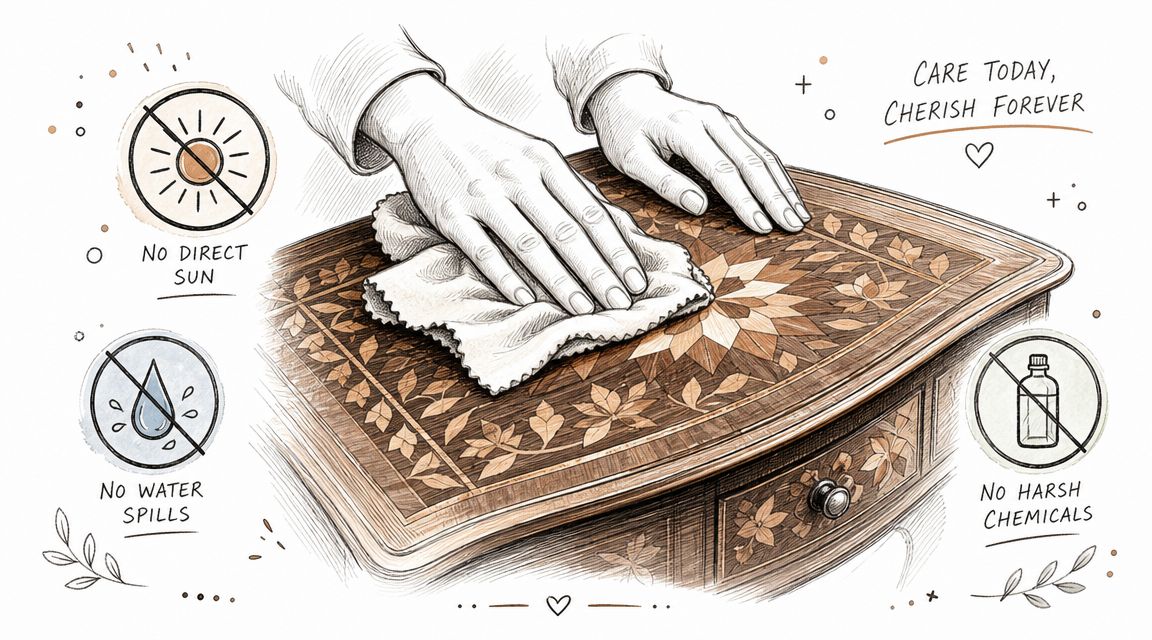
Marquetry furniture asks for gentler care than an ordinary wood surface. The reason is simple. Its decorative face is built from thin veneers, and thin veneers can react badly to heat, moisture, and abrasive treatment.
Conservation and repair are a major underserved part of marquetry ownership. Independent craft coverage notes that the skill itself is endangered, with fewer than 100 professional practitioners remaining in the UK, which makes expert repair knowledge scarcer for owners of fine pieces, according to this discussion of marquetry as an endangered art.
Daily care that protects the surface
Routine care should be calm and light-handed.
- Dust with a soft dry cloth: Grit is the enemy of polished decorative surfaces.
- Keep liquids brief: Don't let condensation, spills, or damp cloths linger on the top.
- Avoid heat exposure: Hot serving pieces and nearby heat sources can stress veneer and adhesive.
- Skip aggressive refinishing habits: Heavy sanding can destroy the very pattern that makes the piece valuable.
Placement matters more than many owners realize
A marquetry cabinet near a sunny window or directly beside a heating vent lives a harder life than the same cabinet in a stable part of the room. Moisture swings and heat buildup can encourage lifting, shrinking, or finish stress.
A marquetry surface should be cleaned like fine furniture and protected like artwork.
For homeowners building a broader wood-care routine, this guide to wood furniture care gives a useful foundation for handling fine surfaces with more confidence.
When repair enters the picture
Lifting veneer, chipped sections, fading, and earlier poor repairs all deserve specialist judgment. Well-meant DIY work often causes the greatest harm, especially if someone sands through the decorative face or uses unsuitable adhesive.
The safest approach is restraint. Stabilize the piece, protect it from further environmental stress, and seek a conservator or restoration professional familiar with marquetry rather than general furniture repair alone.
Integrating Marquetry into Modern and Traditional Interiors
Many homeowners admire marquetry but hesitate to live with it. The worry is understandable. They assume it belongs only in formal rooms with polished antiques and heavy drapery. In practice, marquetry is far more adaptable.
Its real power lies in concentration. One decorated piece can do the visual work of several accessories, which makes it especially useful in interiors that need character without clutter.
Where marquetry works beautifully today
In a traditional room, marquetry can reinforce layered richness. A sideboard with floral or foliate patterning fits naturally among well-upholstered seating, classic casegoods, and warm wood finishes.
In a more edited interior, the same principle works with restraint. A geometric marquetry console in a quiet dining room becomes an art object with function. A bedside chest with subtle veneer patterning can soften a room that might otherwise feel too stark.
- Coastal interiors: Use lighter-toned marquetry to bring warmth without heaviness.
- Modern farmhouse rooms: Let one statement case piece balance simpler upholstered forms.
- Timeless traditional spaces: Pair marquetry with classic silhouettes for a collected look.
Balance is the secret
Marquetry tends to look best when the room gives it space to breathe. If the furniture surface is highly detailed, surrounding textiles and accessories can stay quieter. If the pattern is restrained, other decorative layers can come forward.
Wall art can help create that balance. Homeowners exploring pieces that complement traditional craftsmanship often find useful styling ideas in collections of handcrafted canvas art, especially when deciding how much ornament a room can carry without feeling crowded.
The goal isn't to make every piece special. It's to give one or two pieces the room to matter.
For anyone still deciding where personal taste lands, this comparison of contemporary vs traditional design styles can help clarify which type of marquetry will feel harmonious at home.
Frequently Asked Questions About Marquetry
Is marquetry furniture durable enough for everyday use
Yes, if the piece is well made and used appropriately. A cabinet, sideboard, or occasional table often carries marquetry very well. Dining and writing surfaces can also perform beautifully, but they need sensible protection from standing water, heat, and rough abrasion.
Can marquetry be refinished
Sometimes, but refinishing is where many pieces are ruined. Because the decorative layer is thin, aggressive sanding can remove detail permanently. Gentle conservation and finish revival are often safer than full stripping.
Does all patterned wood furniture count as marquetry
No. Some furniture uses printed decoration, painted faux grain, or simpler contrasting inserts. True marquetry is built from individually cut pieces fitted together to create the design.
Is antique marquetry always better than new marquetry
Not automatically. Older pieces may have remarkable artistry, but they can also carry movement, previous repairs, or finish problems. New work can offer greater stability and easier day-to-day ownership if it's made with care.
What should a buyer inspect first
Start with overall flatness, seam quality, and condition around edges or corners. Then consider whether the piece's intended use suits a decorated veneer surface.
Can damaged marquetry always be repaired
Not always invisibly, and not always economically. Repair depends on the extent of loss, the materials involved, and the skill of the craftsperson handling it. Early intervention usually preserves more options.
Does marquetry only suit formal homes
No. It works in traditional interiors, but it can also enhance quieter spaces. A single marquetry accent often brings enough pattern and warmth to enrich a room without making it feel stiff.
For homeowners across South Georgia and North Florida who want expert help choosing heirloom-quality furniture, Lott's Furniture offers a rare balance of family service and design knowledge. Shoppers can explore a digital catalog online, then visit the showroom in Fernandina Beach, FL, for a closer look at craftsmanship from brands such as Lexington, Hooker Furniture, and Stressless. Most vendors support personalization through the Special Order Program, including fabrics, finishes, and comfort options, and the brand's style quizzes, mattress guide, and in-store associates make selection easier. Every piece also benefits from white-glove in-home delivery and a rigorous multi-point inspection before it reaches the home. Start with an online style consultation or stop by the showroom to see what lasting craftsmanship looks like in person.


