
Platform Bed Advantages for a Better-Designed Bedroom


A bedroom can feel crowded even when it holds only the essentials: a bed, a dresser, and a narrow path between them. A platform bed can change that feeling by bringing the mattress support into the bed frame itself, often with a cleaner profile and fewer separate pieces. But the label alone doesn't guarantee useful storage, the right height, or a match for every mattress.
The most useful platform bed advantages come from treating the bed as a complete system. Its support surface, mattress, clearance, finished height, cleaning access, and style all affect how well it serves the room. A thoughtful choice can make a bedroom feel more personalized and practical, without asking comfort to take a back seat.
Why Platform Beds Reshape the Bedroom
A platform bed changes how the mattress meets the room. Instead of relying on a separate foundation, the frame supports the mattress directly with a solid deck or slats. That can simplify the furniture arrangement and give the bed a more integrated look, while the open space beneath some designs can also make a small room feel less visually heavy.

The look is only one part of the decision. An open frame may leave room for bins, while a low design may leave little useful clearance. A solid deck and slats can behave differently beneath a mattress, and the mattress itself still plays the central role in pressure relief and comfort. A platform is a foundation choice, not a promise of a particular sleep experience.
Think of the bed as part of the floor plan
A bed anchors the room, so its footprint and profile affect how the rest of the furniture feels. Before choosing a style, consider where the bed sits, how people move around it, and whether drawers, bedside tables, or a reading chair need room nearby. Lott's bedroom furniture arrangement guide can help shoppers think through circulation and placement before committing to a frame.
Personal style matters, too. A clean-lined wood frame can suit a calm, natural room, while an upholstered headboard may bring a softer, more finished feel. For anyone gathering ideas for a room with a playful or equestrian touch, Bridle Up Hope Shop offers horse bedroom styling tips that can help connect a theme with the rest of the decor.
The right platform bed doesn't just hold a mattress. It can combine foundation, visual anchor, and, in some designs, storage. The advantage comes from choosing a construction that fits the room and the mattress, rather than assuming every platform bed will solve the same problem.
Understanding the Platform Bed Core
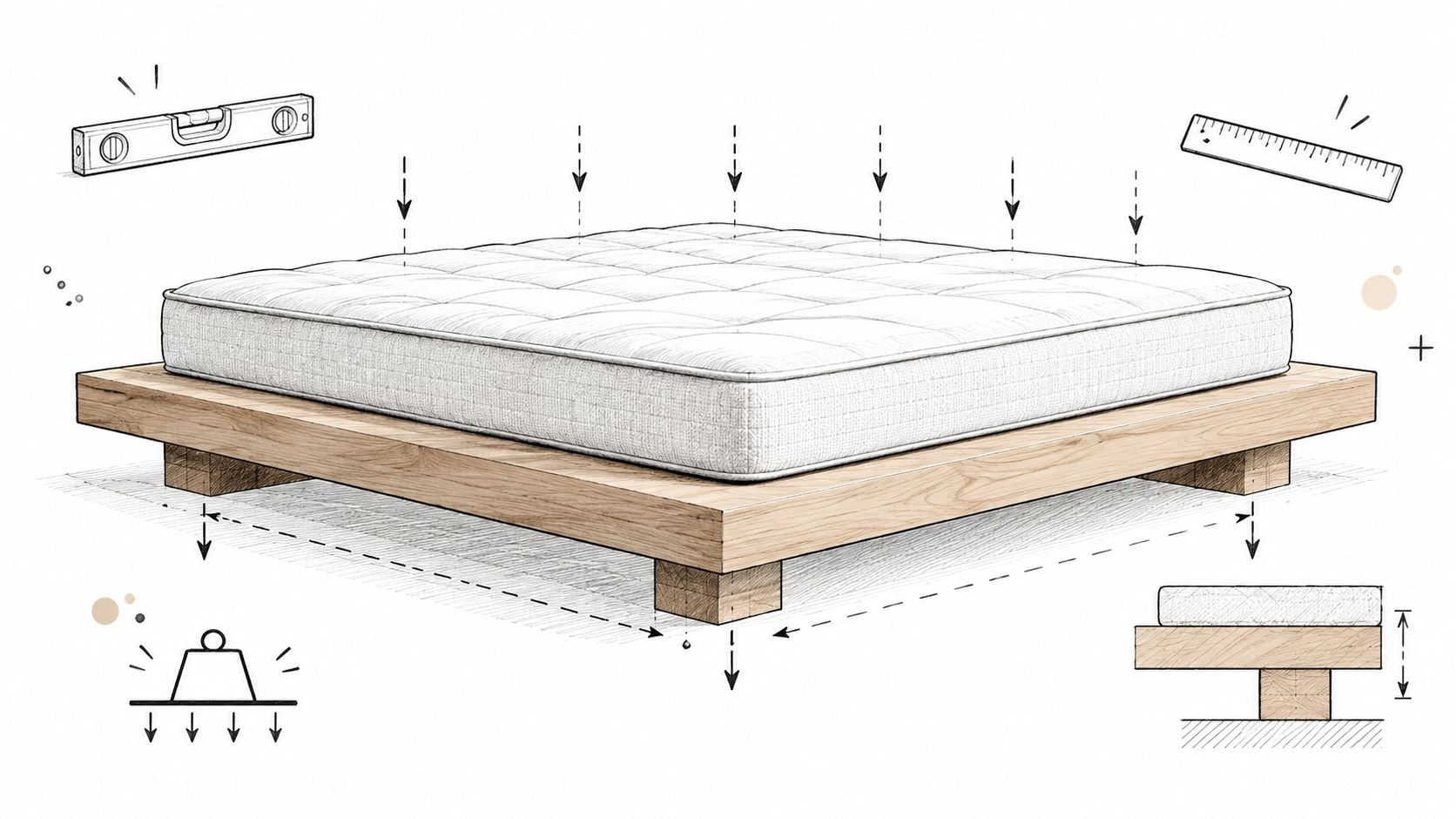
A useful way to picture a platform bed is as a well-designed floor for the mattress. The mattress rests on the platform just as furnishings rest on a floor, but the surface beneath it still matters: it can be firm and continuous, or it can consist of closely spaced supports. That structure influences how the mattress is held, while the mattress remains the main source of pressure relief and sleeping comfort.
Start with the support surface
A rigid deck provides a continuous surface beneath the mattress. It can be a good fit when the mattress maker calls for solid support, but shoppers should check whether the design and ventilation meet the mattress requirements. A slatted platform leaves spaces between its supports, which can allow airflow beneath the mattress. Those slats need to be appropriately spaced and structurally sound for the mattress they'll hold.
Neither construction is automatically superior. The right choice depends on the mattress, the frame's engineering, and the person's comfort preferences. A mattress that requires a solid base may not be suitable for a slatted frame, while a slatted system that meets the mattress maker's requirements may be a practical match for another design.
Then consider how the frame works in the room
The platform's overall height affects the room's appearance and how the sleeper gets in and out of bed. Under-bed clearance determines whether the space can hold bins or bedding, while integrated drawers create storage with a different kind of access. The frame's center support and the way the mattress sits on the deck or slats matter for structural stability.
Access matters in a more everyday way, too. A mattress resting inside a deep frame may feel different to lift or make than one sitting closer to the edge. A detailed comparison of when a box spring may be needed can help clarify how an integrated platform differs from a separate foundation.
The platform category tells shoppers something about the frame's support approach. It doesn't, by itself, establish the frame's height, storage capacity, comfort, or compatibility. Those come from the specific design and its pairing with the mattress.
Evaluating Support and Mattress Compatibility
“Better support” can sound like a simple promise, but a comfortable bed depends on two parts working together. The mattress largely determines how the body feels against the sleep surface, including pressure relief, while the platform needs to provide the support the mattress was designed to receive. A firm base can be stable without being comfortable for every sleeper.
A solid deck offers continuous support, but a mattress maker may specify a particular foundation rather than any flat surface. Slats can be a suitable alternative when they meet the manufacturer's requirements. If they're too far apart, a mattress may dip between supports or material may press into the gaps, so spacing and slat dimensions aren't minor details.
Check the mattress requirements before choosing a frame
For example, Sealy specifies that queen-, king-, and California-king-size mattresses on a frame need rigid center support with at least five legs, including a center leg. Its guidance for mattresses placed directly on slats calls for slats at least 3 inches wide and no more than 4 inches apart. These are Sealy's requirements, not universal dimensions for every mattress, so shoppers should confirm the exact rules for their own model in the Sealy mattress foundation warranty guidance.
A practical compatibility check looks like this:
- Read the warranty requirements: Look for instructions about solid decks, foundations, center supports, and slat spacing.
- Inspect the frame construction: Confirm that the supports match the mattress maker's specifications, including at the center of the bed.
- Test the complete pairing: If possible, try the mattress on the proposed base. Notice whether the surface feels comfortable for the sleeper's body type and preferred position.
Practical rule: A platform can provide the right structure without making an overly firm mattress feel pressure-relieving.
Side sleepers or lighter-weight sleepers, for example, may find a very rigid pairing less comfortable, even if the frame itself is well made. A mattress that feels supportive to one person may create pressure or joint discomfort for another. That's why shoppers should assess the mattress and platform as a combination, not treat firmness as an automatic benefit of the frame. For a softer finishing touch in the room, custom photo blanket sizing for queen beds can also help with planning the bedding around a queen-size setup.
Choosing Storage That Fits Your Room
Under-bed storage can help reclaim space, but the word “platform” doesn't tell a shopper how much usable room the bed provides. The clearance between the floor and the frame, the depth of any drawers, and the access route all affect what can be stored. A bedroom that needs a place for spare linens has different needs from one where seasonal items are tucked away and seldom touched.
One industry guide describes approximately 14 inches of clearance as typical for an average platform bed that isn't especially low or high (platform bed clearance guide). Treat that as a point of orientation, not a guarantee for a particular frame. Measure the space on the actual bed and compare it with the containers or items intended to fit there.
Three storage formats, three different routines
An open platform keeps the area flexible. It can suit a room where the owner already has lidded bins and wants to store extra bedding out of sight, provided the clearance and access allow it. The trade-off is that bins need to be pulled out by hand, and the room may collect dust beneath the bed if that area isn't cleaned.
A frame with integrated drawers can make frequently used items easier to reach. It may suit someone who wants socks, pajamas, or spare sheets close to the bed, but drawers need room to open and the storage space is limited to the built-in compartments. A low-clearance frame may look grounded and clean-lined, though it leaves little or no room for larger containers.
| Storage Format | Best For | Key Measurement | Possible Trade-Off |
|---|---|---|---|
| Open under-bed space | Bedding, bins, and seasonal items | Floor-to-frame clearance and bin height | Items need to be pulled out, and access may be awkward |
| Integrated drawers | Frequently used clothes or linens | Drawer depth and space to open each drawer | Less flexibility for oversized items |
| Low-clearance frame | A compact, visually simple look | Clearance beneath the lowest frame edge | Limited room for containers |
A common misstep is buying containers first and hoping they fit afterward. Measure the frame's usable height and width, then account for the space needed to move items in and out. For more ideas on coordinating storage with bedroom furniture, explore Lott's guide to bedroom furniture storage features.
Balancing Height Style Comfort and Care
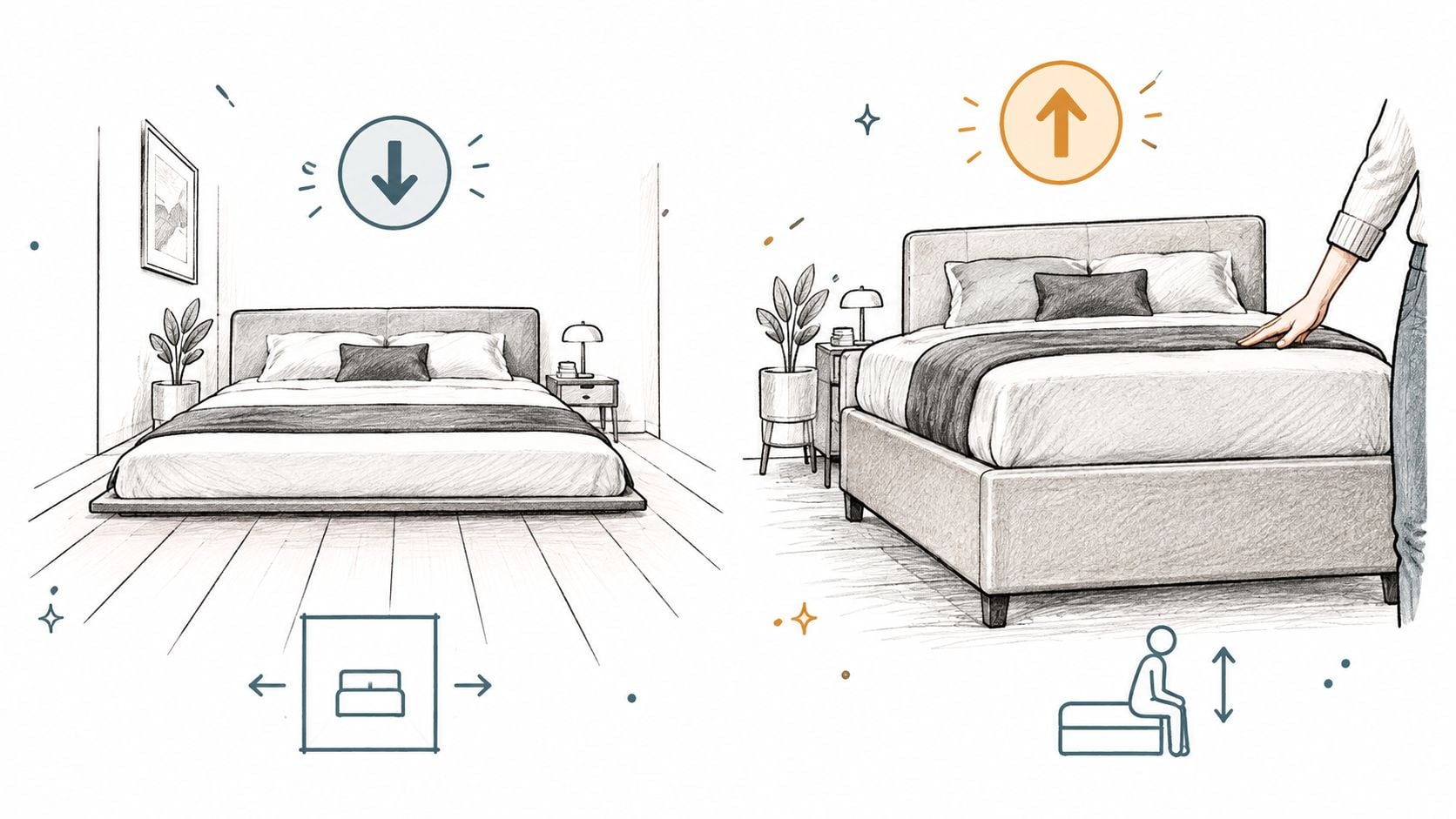
A lower-profile bed can make a bedroom feel open by reducing the visual bulk around the mattress. But a bed's height also affects the everyday movement of sitting down, standing up, and reaching the floor. Style and ergonomics aren't separate decisions: the frame, mattress thickness, and any foundation together create the height a person uses.
Measure the finished bed, then try the movement
A CDC-hosted experimental study found that participants showed better longitudinal balance at medium bed heights of 51–66 cm, measured from the floor to the relevant bed surface (CDC-hosted bed height study). This offers a useful reference for people who are considering transfer comfort, including older adults and those with reduced lower-extremity strength. It isn't a universal ideal for every sleeper or every bed.
The final mattress-top height is what matters, not the height of the frame alone. A very low bed can make standing require more hip and knee flexion, while a very high one may make it harder to place the feet securely on the floor. Before settling on a configuration, measure the completed setup and test sitting down and standing up in the position the bed will occupy.
Make cleaning access part of the design
An open, hard, cleanable platform surface may be simpler to reach than a fabric-covered box spring. That can reduce one difficult-to-clean foundation component and make it easier to see and access the space beneath the bed. Bedroom dust and allergen sources still require attention: research on bedroom environments notes that movement in bed can resuspend airborne particles, while mattresses and box springs can serve as reservoirs for dust-mite allergens; the precise contribution to inhalation exposure remains uncertain (research on bedroom particles and allergen reservoirs).
A platform bed isn't an allergy treatment. Mattress encasements, regular laundering, humidity control, and vacuuming remain important parts of bedroom care. A separate Sydney study measured mean Der p 1 dust-mite allergen concentrations of 38.9 micrograms per gram of fine dust on beds, compared with 22.4 on bedroom floors and 13.7 on living-room floors. In a larger study of 616 families, 68% of beds, 65% of bedroom floors, and 56% of living-room floors exceeded the proposed 10-microgram-per-gram level used in that research as a threshold for asthma symptoms (Sydney dust-mite allergen research). Those findings explain why accessible cleaning and moisture management matter, but they don't show that a platform bed itself reduces allergens.
For style, the same practical thinking applies. An upholstered headboard can soften the room's look; shoppers can explore options for an upholstered headboard while keeping the finished bed height and cleaning routine in mind. Long-term value depends on material quality, construction, warranty, and mattress fit, as well as whether the platform replaces a separate foundation that the mattress doesn't require.
Who Benefits Most from a Platform Bed
A renter furnishing a smaller bedroom may appreciate a bed with a clean profile that doesn't add the visual weight of a separate foundation. If the chosen frame leaves useful clearance, open space underneath can also accommodate bins without adding another cabinet. But that benefit depends on measured dimensions and a clear plan for reaching what's stored there.
A family managing a compact room may value integrated drawers for items used often, such as spare sheets or children's clothing. The arrangement can reduce the need for another storage piece, although the drawer layout has to suit the room's clearances and the household's routine. A drawer that can't open fully because it meets a wall or nightstand won't be convenient storage.
Match the bed to the household
A coastal or vacation-home owner might favor a frame that keeps extra linens within reach and is straightforward to clean between stays. Someone who prioritizes personal comfort may care more about mattress compatibility and the feel of the complete sleep surface than about under-bed space. For that shopper, a platform is a promising option only if its support construction suits the mattress.
Other shoppers may need more caution. A person with a mattress that requires a specific foundation should confirm the requirements before selecting a frame. Someone who needs substantial built-in storage should compare drawer capacity with actual household items, while a person who depends on a particular bed height should measure and test transfers rather than choose by appearance alone.
Platform beds can serve many different rooms, but the best choice depends on what the room and its sleepers need every day. A modest room may benefit from a light visual profile, while another may need more clearance or easier access to drawers. Comfort, mobility, mattress type, cleaning habits, and personal style all belong in the same decision.
Buy Compare and Set Up with Confidence
A clear buying process starts with measurements and ends with testing the bed in its intended role. Rather than beginning with a favorite finish, shoppers can narrow the choices by room fit, mattress requirements, finished height, and storage needs. That makes it easier to compare appearance without overlooking daily function.
Follow a practical checklist
Measure the room and the route in. Record the space available for the bed, the mattress footprint, and the doorways or stairways the frame must pass through. Consider whether the room layout leaves enough space to walk around the bed and open any drawers.
Confirm mattress requirements. Check the warranty and construction guidance for the specific mattress. Note whether it requires a solid deck, a particular support system, or specified slat dimensions.
Compare the support and storage. Look at the deck or slat arrangement, center support, usable clearance, and drawer access. For size-planning help, Lott's mattress size comparison guide can help shoppers match the bed to the mattress they already own or plan to buy.
Test the finished height and feel. If possible, try the mattress on its intended base, sit at the edge, and stand up. Check that the height feels manageable and that the mattress-foundation pairing suits the sleeper's comfort preferences.
Inspect the details before ordering. Open drawers, check the fit of storage compartments, and review the frame's materials and finish. Anyone interested in building or finishing a bed can also find sturdy bed finish pro advice for thinking through the final appearance.
Lott's Furniture serves South Georgia and North Florida, with showrooms in Waycross and Fernandina Beach, Florida. Shoppers can move between the digital catalog and showroom visits, use Style Quizzes, interactive Style Guides, and the Mattress Guide, and ask in-store associates for help comparing design and comfort choices. The Special Order Program offers personalized designs, and most vendors support selections such as fabrics, finishes, and comfort levels. Core brands available include:
- La-Z-Boy and Smith Brothers for upholstered furnishings and custom choices.
- Lexington for bedroom and home furnishings.
- Stressless for seating and comfort-focused design.
Lott's white-glove, in-home delivery brings the selected furniture into the home, and every piece undergoes a rigorous multi-point inspection before it reaches the customer.
Visit Lott's Furniture to compare platform bed styles, check mattress compatibility, and explore custom fabrics, finishes, and comfort options. Shoppers can begin with the digital tools or visit the Fernandina Beach showroom for personal guidance on building a bedroom that feels comfortable, considered, and ready for everyday life.


