
What Is an Adjustable Bed Frame and Is It Right


You're propped on two pillows to read, one slips, your neck aches, and your partner wants the bed flat to sleep. That nightly negotiation is exactly where shoppers start asking what is an adjustable bed frame and whether it solves a comfort problem or just adds a motor. The answer is simpler than the feature lists suggest. It's engineered furniture that changes the shape of support under a mattress, and understanding that shape helps a homeowner judge fit, feel, and long-term value before visiting a showroom.
What an Adjustable Bed Frame Actually Does in Your Bedroom
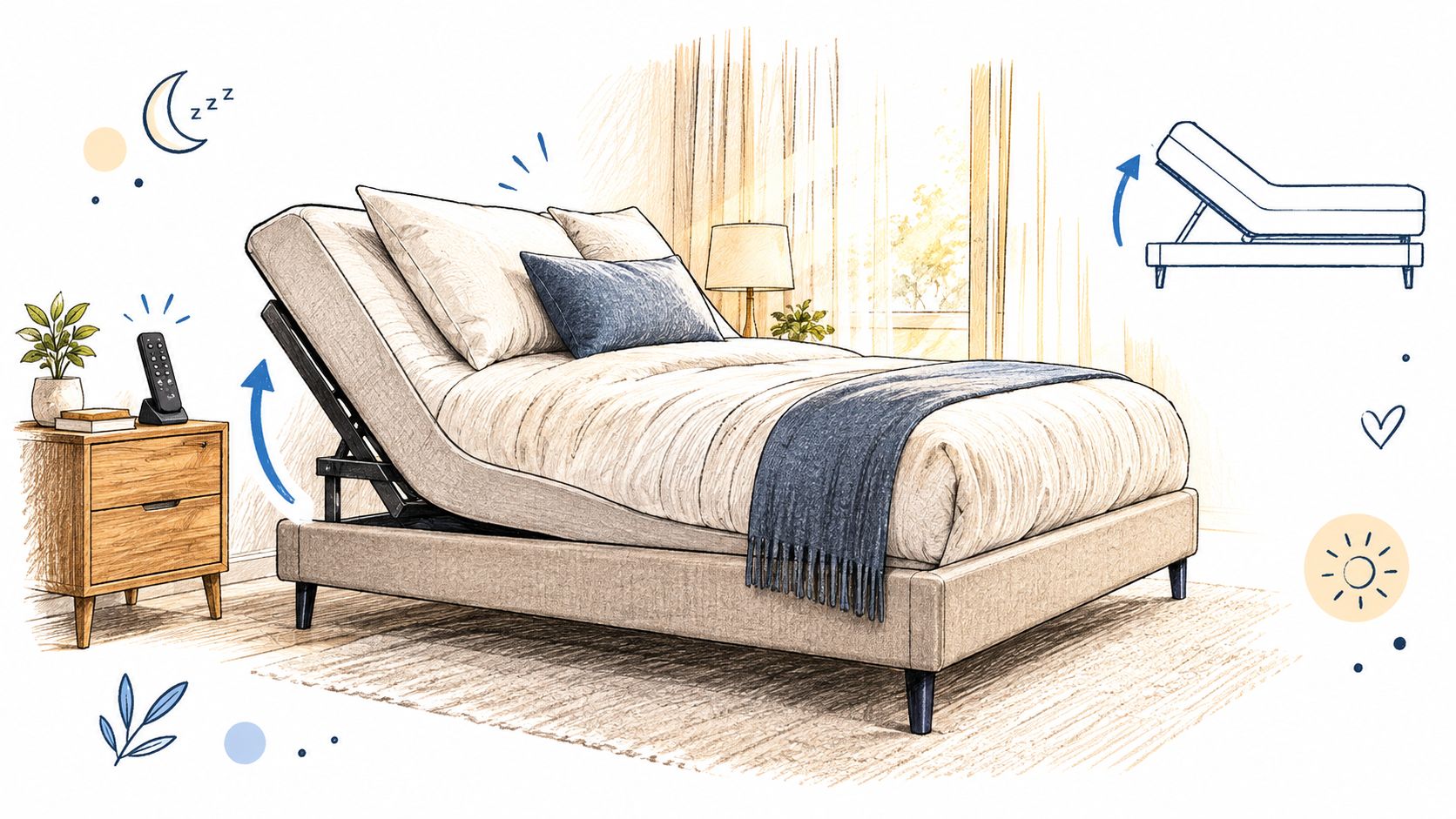
A flat foundation does one job. It holds a mattress level. An adjustable bed frame does something different. It's a hinged, articulated support platform designed to change the angle of sections beneath a mattress rather than remaining permanently flat, as described in the foundational articulated bed patent documentation.
Think of a recliner stretched out into a bed. The platform divides into connected zones that pivot at hinges, so the surface can support lying flat, reclining to read, or sleeping with the upper body and legs raised.
The Three Zones Under the Mattress
Foundational designs divide the platform into three connected sections, a back-supporting section, a central section, and a leg-supporting section. The mattress sits on top and follows the movement. It doesn't tilt as a rigid board. It bends where the platform bends.
That distinction matters in the bedroom. A reader can raise the back section without stacking pillows. A sleeper who prefers slight elevation can keep that angle all night. A couple can return everything flat in the morning, and the bed looks like any well-made bed.
- Back section raised: Supports reading, watching television, or an inclined sleep position.
- Leg section raised: Creates a more flexed posture and redistributes pressure through the lower body.
- Both sections raised: Combines head and foot elevation for a contoured resting position.
- Flat position: Functions like a conventional foundation for sleepers who want a level surface.
Controls vary by model. Many current bases use a wired or wireless remote, and some add app control. The mechanism underneath stays the same in principle. The frame supplies controllable geometry, while the mattress supplies cushioning and pressure distribution. Confusing those two jobs leads to the most common disappointment, expecting the base alone to fix a mattress that doesn't fit the sleeper.
How Adjustable Bases Evolved From Hospital Beds to Living Room Furniture
Shoppers often hesitate because they picture a hospital room. That image has a real origin, but it no longer describes the furniture in a modern bedroom. The technology started as furniture engineering adapted from reclining and medical-bed mechanisms, then moved steadily toward residential comfort.
A U.S. patent published in 1973 describes movement from a neutral horizontal position to an oblique position with the foot end raised, or to a folded position where the back section can become oblique or nearly vertical. Later documentation describes a similar architecture using a backrest frame and a thigh and leg frame connected to a seat frame, moving from horizontal into an upright, seated posture.
From Manual Cranks to Programmable Controls
The next shift was control, not geometry. A patent record shows an adjustable bed design with a priority date of March 10, 1998, and U.S. publication on August 15, 2000, in the electronically controlled residential bed patent record. Another adjustable bed frame patent was published on December 6, 2011, while related systems introduced memory-based control and vibration motors.
The base still raises the head, raises the foot, or combines both. What changed is how easily a sleeper returns to a preferred position.
That history explains today's showroom language. Preset positions are memory applied to hinges. A button labeled for television viewing or inclined sleep recalls angles the mechanism could already reach. The engineering isn't new marketing. It's the same articulated principle refined over decades, now dressed to sit inside an upholstered bed or a curated sanctuary bedroom rather than a clinical ward.
Understanding that lineage helps shoppers sort substance from extras. Motors, remotes, and presets improve convenience. The underlying value remains a sleeping surface that can be repositioned deliberately, night after night, without rearranging pillows.
The Core Parts That Make an Adjustable Frame Work
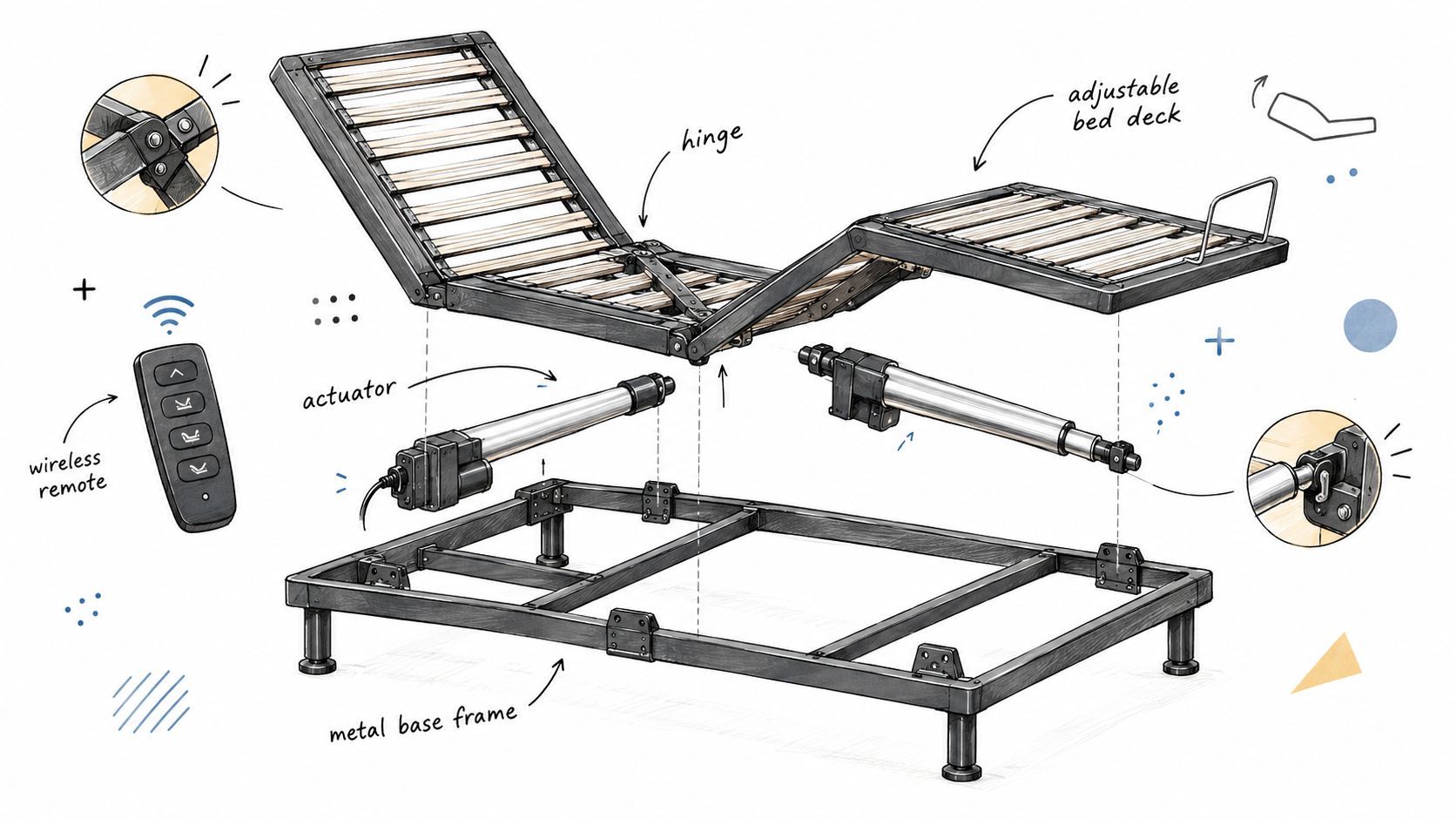
A shopper doesn't need an engineering degree to evaluate a base. Five parts explain almost everything felt during a showroom test, from how smoothly the head rises to how low it lowers at midnight.
The frame and deck sections carry the load. Hinges connect those sections and define where the mattress bends. Electric linear actuators do the lifting on most modern models, pushing and pulling the sections into position with controlled, steady force.
Controls and Safety Details Worth Testing
- Remote or app control: Raises and lowers head and foot sections, stores presets, and returns the base flat.
- Retaining bar: Helps keep the mattress from sliding as sections articulate.
- Emergency lowering: Allows the base to return flat during a power interruption on models equipped for it.
- Protected wiring and pinch awareness: Keeps cords managed and reminds households to keep the moving joints clear.
Household adjustable bed manuals may be designed around UL 962 requirements for household and commercial furnishings, so documented compliance and a dependable power connection deserve attention during selection, as noted in the pilot trial summary on head-of-bed elevation and base safety.
Practical rule: A quiet actuator and a stable deck matter more every night than a long list of novelty settings.
Platform thinking helps here. Slatted and flat supports behave differently under a mattress, and readers comparing support surfaces may find useful context in Ocodile on floor bed design. For an adjustable base, the test is specific. Sections should move smoothly without excessive noise or lateral shifting, and the mattress should follow without bunching, sliding, or lifting away at the hinge points.
What an Adjustable Base Can and Cannot Do for Sleep and Comfort
Elevation changes body geometry. Head elevation can reduce the gravitational collapse of upper-airway tissues and may alter respiratory mechanics, while leg elevation can redistribute pressure and support a more flexed posture. That is the honest starting point, a comfort tool with promising findings, not a medical treatment.
What the Field Studies Actually Found
In a home study using a 12-degree incline, objective tracking recorded a 7% relative reduction in snoring duration, 4% fewer awakenings, and a 5% increase in deep sleep proportion, according to the four-week inclined sleep home study. A separate eight-week field study reported 21 additional minutes of total sleep, 5 additional minutes of REM sleep, fewer awakenings, and reduced wake time after sleep onset in the eight-week adjustable base field study.
Results aren't uniform. A later 42-person field study found no objective sleep change, although participants reported 15% better perceived sleep quality, 18% greater morning refreshment, and 28% less back pain, as summarized in the controlled field study comparison of adjustable base outcomes.
- Reasonable expectations: Easier reading posture, a repeatable incline, pressure redistribution, and a position that feels easier to settle into.
- Unreasonable expectations: A guaranteed cure for apnea, reflux disease, or chronic pain.
- Better personal test: Gradual elevation, judged by fewer awakenings, less morning discomfort, or quieter breathing.
Persistent pain, breathing problems, numbness, or reflux deserve clinical evaluation, not a furniture purchase alone. Readers focused on back comfort can pair this overview with guidance on choosing a mattress for back pain relief, because base angle and mattress support work together. There's no universal setting that suits every body. Position, mattress flexibility, sleep position, and underlying health all change the outcome.
Mattress Compatibility and What to Check Before You Buy
The most expensive mistake is assuming the current mattress will bend happily for years. An adjustable frame flexes a mattress repeatedly at the same hinge points. Some constructions handle that movement well. Others resist, bunch, or develop damage, and the manufacturer's warranty may not cover adjustable-base use at all.
Memory foam, latex, and many pocket-coil hybrid mattresses are generally more suitable because their materials flex section by section. Traditional continuous-coil and Bonnell-coil designs may not flex safely, a distinction summarized in consumer guidance on adjustable bed and mattress compatibility. Specific construction always overrides a general category, so written manufacturer permission matters.
A Pre-Purchase Compatibility Checklist
- Manufacturer permission: Confirm the mattress maker explicitly permits adjustable-base use.
- Thickness and weight: Verify both fall within the base limits so actuators aren't strained.
- Retaining hardware: Ask whether the frame needs a retaining bar or sheets designed to stay in place while flexing.
- Room clearance: Measure around the bed because the foot section moves upward or outward during articulation.
Readers weighing foam options can compare constructions through top memory foam mattress picks before testing combinations in person. It's also worth understanding what the base replaces, which is why the explanation of box springs and bed support helps shoppers separate foundation support from mattress comfort.
Sometimes replacing the mattress matters more than upgrading the base. Motorization can't correct a surface that doesn't suit the sleeper's body. A medium, supportive feel on a compatible mattress, paired with modest elevation, often serves a homeowner better than advanced electronics under the wrong mattress.
Configurations That Fit Your Household and Sleeping Style
Configuration choices sound technical until they're matched to a household. A solo reader, a couple with different habits, and a homeowner furnishing a guest room don't need the same base, even if all three want head elevation.
The first decision is unified versus split. A unified base moves the whole sleeping surface together. A split design lets each side articulate independently, so one partner can sit up to read while the other stays flat. That independence usually requires two separate mattress sections, which changes sheet shopping and the feel at the center of the bed.
Adjustable Frame Configurations Compared
| Configuration | Best For | Key Trade-Off |
|---|---|---|
| Unified electric base | Solo sleepers and couples who share positions | Both partners accept the same angle |
| Split king or split queen | Partners with different reading, incline, or sleep preferences | Two mattresses, two remotes, a center seam |
| Basic head and foot elevation | Households wanting core positioning without extras | Fewer presets and convenience features |
| Feature-rich electric base | Readers who value memory presets, lighting, or vibration | More controls to learn and maintain |
Size planning belongs in the same conversation. Shoppers comparing footprints can use the mattress size comparison guide to see how twin long, queen, king, and split layouts occupy a room before measuring doorways and nightstand clearance.
Manual versus electric is the other practical divide. Manual mechanisms exist in the category's history, but most residential shoppers choose electric actuators for repeatable, low-effort adjustment from bed. In the showroom, associates can demonstrate each configuration side by side, flat, inclined, and fully raised, so the decision is based on felt comfort rather than a spec sheet. That's custom comfort in practice, matching geometry to real nightly habits.
Smart Buying Considerations Price Warranty and Delivery
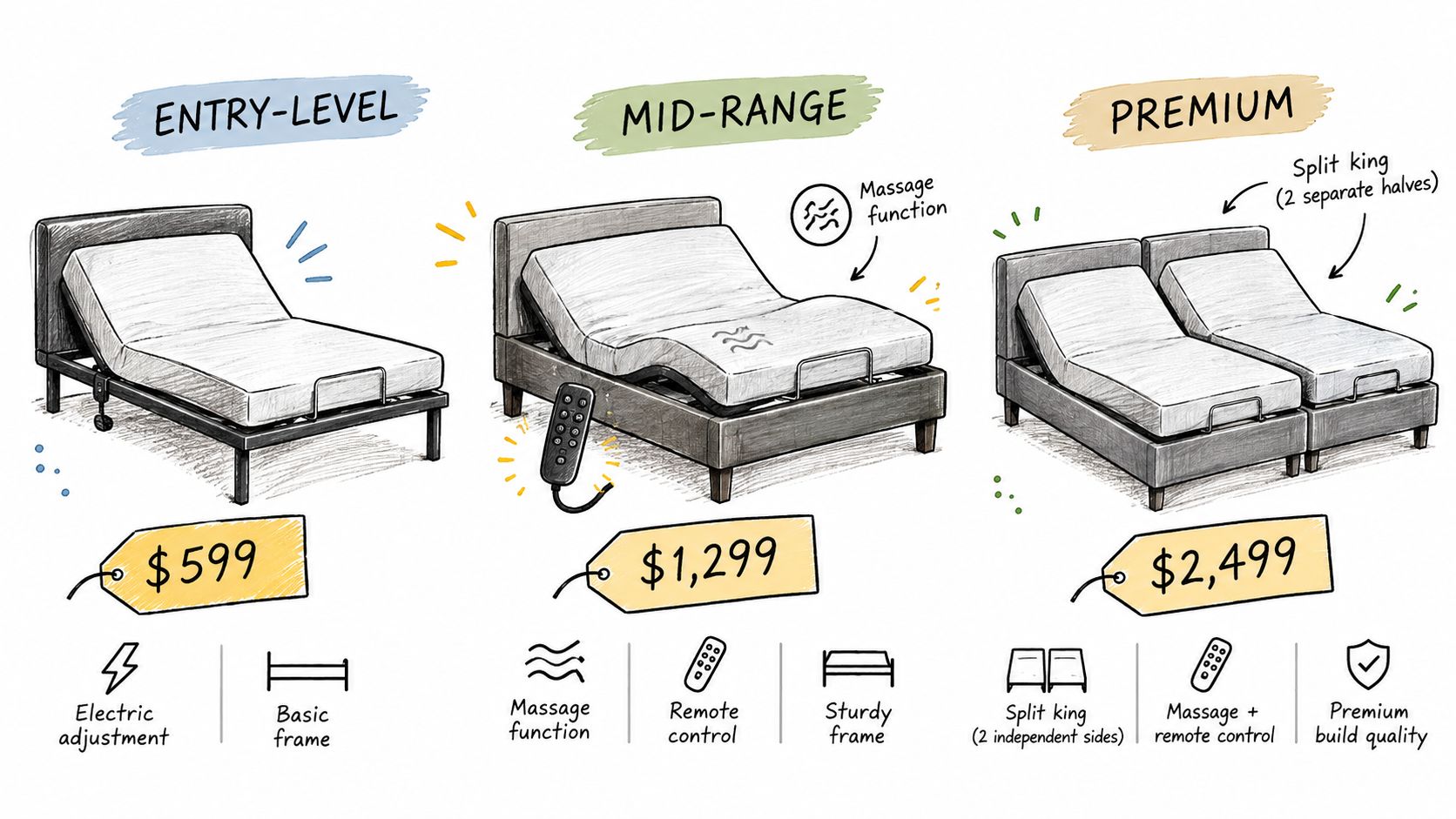
Price tiers make more sense after configuration. Entry-level electric models cover head and foot elevation. Mid-range designs add presets and convenience features. Premium split-king setups combine independent control with advanced electronics. Shoppers should compare what's covered, not just what's listed, since warranty terms for motors, electronics, and frame structure can differ within the same product.
Weight, Room Fit, and the Delivery Plan
Weight capacity includes the sleepers and the mattress, and one technical overview reports typical total capacities of about 500 to 750 pounds for standard models, while heavy-duty designs may support 1,000 pounds or more, according to the adjustable frame capacity and specification overview. Exceeding a stated limit can strain the lift mechanism or cause permanent damage. Split configurations can carry separate per-side limits, so the manufacturer's exact rating should be verified before ordering.
- Measure first: Confirm doorway access, ceiling height, and space for the foot section to articulate.
- Check outlets: Place the base within reach of dependable power without pinching cords.
- Test the pair: Evaluate frame and intended mattress together, not in isolation.
Customization extends beyond the base. Through the Special Order Program, most vendors support personalized fabrics, finishes, and comfort levels for the surrounding bedroom, including performance fabrics from brands such as La-Z-Boy and Smith Brothers and heirloom-quality case pieces from Lexington. Every piece undergoes a rigorous multi-point inspection, and the white-glove mattress delivery standard covers in-home placement across South Georgia and North Florida, with the frame and controls checked before final positioning.
Bringing It All Together With Lott's
An adjustable bed frame is an articulated platform that lets a mattress support flat sleep, inclined sleep, and upright reading from the same bed. It suits homeowners who read or watch television in bed, prefer a repeatable incline, or share a bed with a partner whose ideal position differs. It serves households poorly when the mattress can't flex, the room can't accommodate movement, or the buyer expects medical results furniture can't promise.
Three Questions Shoppers Ask Late
Does it feel like a hospital bed? Not in a modern bedroom setup. Inside a finished bed frame with quality bedding, it reads as bedroom furniture, and flat it behaves like a standard foundation.
What happens during a power outage? That depends on the model. Buyers should confirm emergency-lowering capability before purchase and keep the remote accessible.
Will the existing mattress work? Only the mattress manufacturer can answer definitively. Written compatibility and warranty terms should be checked before money changes hands, and the complete mattress buying guide helps shoppers evaluate a replacement if the current mattress isn't approved.
The most reliable next step is a physical test. Shoppers can browse the digital catalog, complete a Style Quiz, review the Mattress Guide, then visit the Fernandina Beach, FL or Waycross showroom where in-store associates demonstrate split and unified bases with compatible mattresses. That smooth move from online research to in-person testing, backed by white-glove delivery and multi-point inspection, turns an abstract spec into a confident, investment-quality decision.
Visit Lott's Furniture to explore adjustable bases, compatible mattresses, and Special Order bedroom options, then book a showroom visit in Fernandina Beach or Waycross or start an online style consultation for personalized guidance. The Lott's team serves South Georgia and North Florida with expert in-store help, digital Style Quizzes and Mattress Guide tools, and white-glove in-home delivery after a rigorous multi-point inspection.


