
Best Mattress for Back Pain Relief: Expert Guide 2026


That dull pull across the lower back often shows up before the coffee starts brewing. A person rolls to the side, plants both feet on the floor, and takes a moment before standing up straight. By bedtime, the same question returns: is the mattress helping, or making things worse?
For many households across South Georgia and North Florida, buying a mattress for back pain relief feels unusually personal. The options sound similar, the labels can be confusing, and well-meaning advice from friends often points in opposite directions. Some people hear “firmer is better.” Others try something plush and wake up stiffer than before.
A calmer approach helps. The right choice usually comes from matching support, pressure relief, sleep position, and the condition behind the pain. Digital tools can narrow the field before a showroom visit. Thoughtful in-store testing can confirm what the body responds to. For shoppers exploring customized comfort, many retailers also offer special order options with personalized comfort levels, fabrics, and finishes, plus custom upholstery timelines that are typically 5 to 6 weeks for special orders while in-stock options are available sooner, according to Living Spaces' overview of special orders. The distinction matters because a special order is generally a stocked design brought in by request, while a custom order lets the customer choose elements like frame or upholstery, as outlined in Woodstock Furniture Outlet's explanation.
Your Path from Restless Nights to Lasting Relief
A familiar pattern plays out in bedrooms all over the region. Someone wakes up sore, shifts around trying to find a better position, and starts wondering whether the mattress that once felt fine has stopped giving proper support. The pain may be mild during the day, then sharper after a long night in one spot.
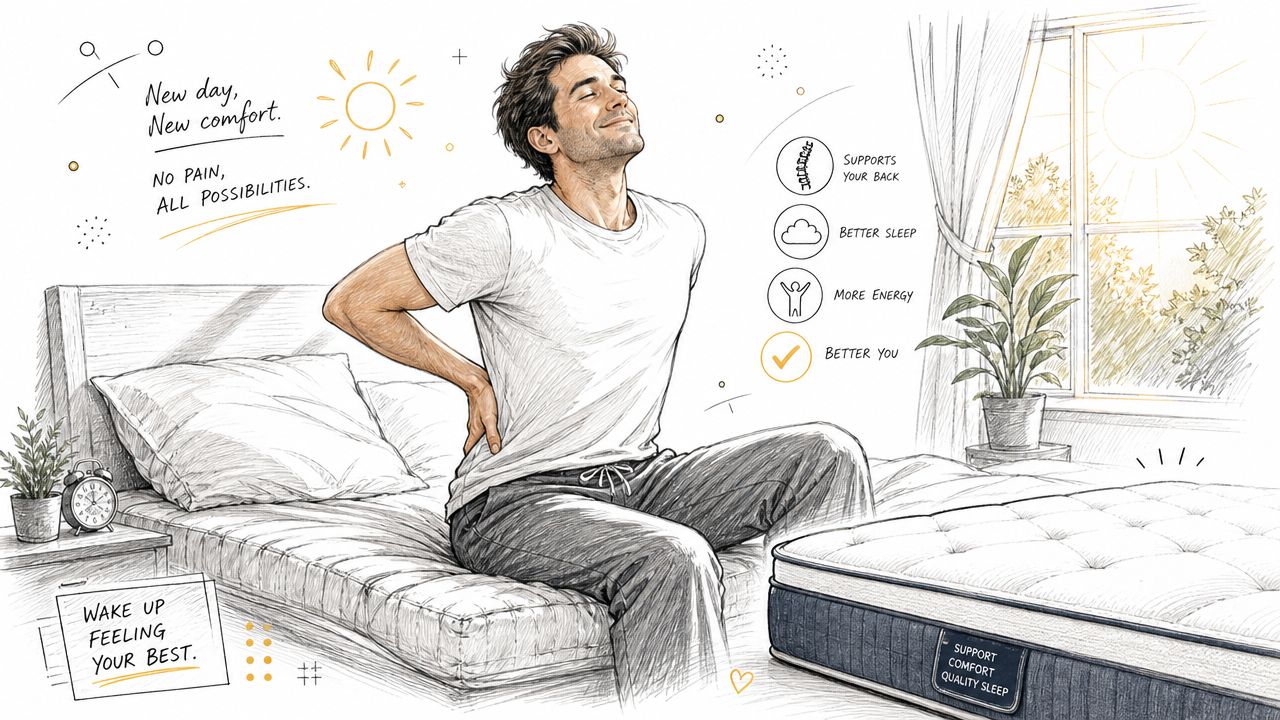
That uncertainty is what makes mattress shopping stressful. A person isn't just picking a bedroom item. The decision affects sleep, energy, and how the body feels first thing in the morning. For people dealing with radiating leg pain along with back discomfort, broader education can help too. Resources on effective sciatica relief in Overland Park add useful context on how nerve-related pain can feel different from general back strain.
Why the decision feels so hard
Shoppers usually run into three points of confusion:
- Firmness and support get treated like the same thing. They aren't.
- General advice gets applied to specific conditions. That can lead to poor choices.
- People focus on brand language instead of body response. Terms like plush, firm, and orthopedic only matter if they match how the spine rests overnight.
A household may also be trying to coordinate style, comfort, and convenience at the same time. That's why the best shopping experience tends to blend digital browsing with in-person testing. Many families start with style quizzes or an online mattress guide, then visit a showroom in Fernandina Beach, FL to compare feel in real life. That online-to-showroom path saves time and makes the process less overwhelming.
Practical rule: Morning pain that eases after moving around often points people back to the sleep surface first.
A warmer, more useful way to shop
A mattress for back pain relief shouldn't be chosen by slogan. It should be chosen by fit. The body needs alignment, cushioning in the right places, and materials that hold their shape over time. That's true whether the shopper prefers a clean modern bedroom, a coastal retreat, or a more traditional space with heirloom-quality furniture from names such as Hooker Furniture, Lexington, or Stressless.
The most reassuring part is that a clearer process exists. Start with symptoms, sleep style, and mattress age. Then test support, not just showroom softness. Add guidance from a trained associate if the pain has a pattern or diagnosis behind it. That's often what turns a restless night into a recoverable morning.
The Science of Spinal Alignment and Comfort
The spine needs steady support all night. A simple way to think about it is a bridge. If the middle drops too low, the structure strains. If the surface pushes up too hard in the wrong places, pressure builds. A mattress has to hold the body up without forcing it out of its natural shape.
That's where many people get turned around. Support is the mattress's ability to keep the body from sagging. Firmness is how the bed feels when a person first lies down. A mattress can feel cushy on top and still be supportive underneath. Another can feel hard at first touch and still fail to support the hips and shoulders well.
Support and firmness are not the same
A good mattress for back pain relief usually does two jobs at once:
- Keeps the spine level: especially through the hips and lower back
- Relieves pressure points: especially around shoulders and hips
- Holds shape over time: so support doesn't fade quickly
The clearest evidence supports that middle ground. A systematic review of 39 independent studies concluded that a medium-firm mattress was most effective for chronic low back pain, with users reporting a 48% decrease in pain intensity and a 55% improvement in sleep quality after four weeks.
That finding helps, but people still need to interpret it correctly. Medium-firm isn't a magic label. It describes a balance. Too soft, and the body sinks unevenly. Too hard, and the surface can create pressure and keep muscles tense.
The feel on top and the structure underneath
Construction matters as much as the comfort label. Responsive foams, supportive coil systems, and stable edge-to-edge design all influence whether the mattress keeps the body aligned through the night. For readers exploring adjustable setups, this guide on the benefits of an adjustable base and enhanced comfort and well-being adds another layer to that decision.
People also get curious about air-adjustable designs. For broader context on how those systems can affect comfort and pressure relief, Aspen Falls Wellness offers a useful guide to air beds.
The best showroom test isn't “Does this feel soft?” It's “Does this keep the body quiet and supported after several minutes in a normal sleep position?”
What a shopper should notice while lying down
A mattress is doing its job when these signals show up:
- The lower back doesn't feel like it's collapsing.
- The shoulders don't feel jammed upward.
- The hips don't sink deeper than the rest of the torso.
- The body feels settled, not braced.
That's the starting science. The next step is choosing the material that delivers that balance.
Decoding Mattress Types for Optimal Back Support
Mattress materials change how support is delivered. Two beds can carry the same firmness label and feel completely different because the inner construction responds differently to weight, pressure, and movement. For those seeking a mattress for back pain relief, understanding the mechanics matters more than memorizing showroom tags.
How the main mattress categories behave
Some materials contour closely. Others push back faster. Some isolate motion well for couples, while others feel easier to move around on during the night. This side-by-side comparison helps narrow the field.
Mattress Type Comparison for Back Pain Relief
| Mattress Type | Primary Benefit for Back Pain | Best For | Potential Consideration |
|---|---|---|---|
| Memory foam | Close contouring that reduces pressure at the shoulders and hips | Sleepers who want body-hugging relief and motion control | Some people may prefer a more responsive surface |
| Latex | Responsive support with contouring that doesn't feel overly sink-in | Sleepers who want cushioning with easier repositioning | Feel is springier and more buoyant than foam |
| Innerspring | Strong surface push-back and familiar lift | Sleepers who prefer a more traditional feel | Comfort depends heavily on the quality of the top layers and support core |
| Hybrid | Combines contouring comfort layers with coil support underneath | Shoppers who want balanced pressure relief and support | Construction quality varies widely between models |
For readers comparing these constructions in more detail, this explanation of memory foam versus innerspring mattresses is a useful next read.
Where each type tends to shine
Memory foam can work well for people whose pain is tied to pressure points. The foam molds more closely around curves, which may help a side sleeper whose shoulder and hip need more give. The tradeoff is that some sleepers don't like the deeper cradle.
Latex often appeals to people who want contouring without that held-in feeling. It compresses under pressure, then rebounds quickly. That can help someone who changes positions often during the night.
Innerspring designs can still be a good fit if the support system is stable and the comfort layers are thoughtfully built. The challenge is that a basic spring unit with thin padding may feel supportive at first touch but create pressure over time.
Hybrid models often make sense for mixed needs. They pair cushioning layers with a stronger coil base, which can create a balanced feel for couples or combination sleepers.
A material isn't “good for backs” by itself. What matters is how that material distributes weight, prevents sagging, and fits the person sleeping on it.
A room should support recovery too
The mattress sits at the center of the sleep setup, but the room around it shapes comfort as well. Many households pair a new sleep surface with coordinated bedroom pieces that create a calmer retreat. Brand collections from Hooker Furniture, Bassett, and Lexington often help create that curated, finished look without sacrificing function.
For shoppers who want more than an off-the-floor option, special order programs can also widen the choices. Many vendors support personalized comfort levels and design selections, which can be helpful when standard models feel close, but not quite right.
Tailoring Your Choice to Your Body and Sleep Style
You can watch two people lie on the same mattress in the showroom and see two completely different results. One person's hips stay level and shoulders relax. The other person's lower back tightens within minutes. That is why broad advice like “just buy medium-firm” often falls short for families trying to solve real back pain.
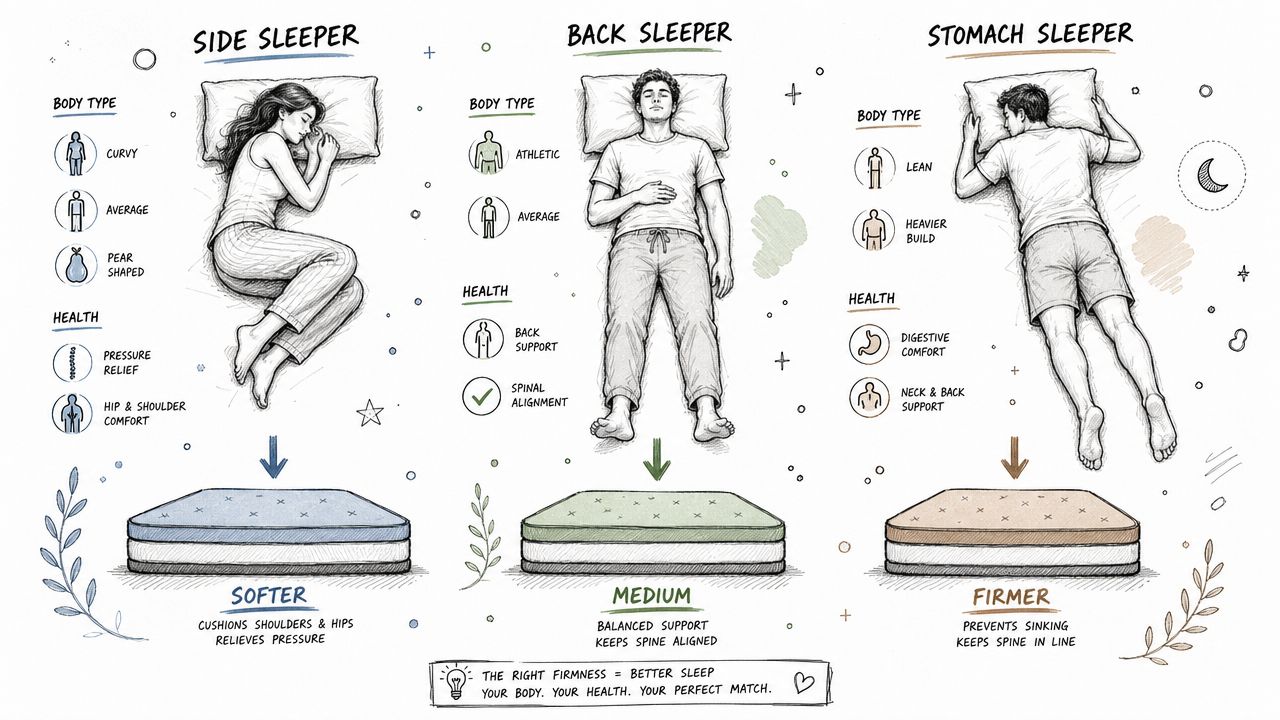
A mattress has to match both your body and the way you sleep. Body weight changes how much you sink into the surface. Shoulder width and hip shape affect where pressure builds up. The reason behind the pain matters too. General soreness after a long workday is different from pain tied to scoliosis, arthritis, or a disc problem.
Sleep position changes what support should feel like
Appliance and furniture experts often give the same practical warning. A mattress should resist sagging under the heaviest parts of the body. From there, the comfort needs change by position.
Side sleepers usually need more cushioning at the shoulder and hip so those joints can settle without pulling the spine off line. Back sleepers often do best with steadier support through the waist and pelvis, with enough surface comfort to avoid pressure under the shoulders and tailbone. Stomach sleepers usually need the flattest feel of the three, because too much sink under the midsection can increase lower-back strain.
A simple way to picture it is this. Your mattress works like a roadbed under a bridge. If one section sinks more than the rest, the whole structure has to compensate.
The right feel depends on the cause of the pain
A more personal approach is important. Someone with general lower-back tightness may feel better on a supportive, slightly firmer surface. Someone with scoliosis or uneven pressure points may need more cushioning in very specific areas so the body is not fighting the mattress all night.
Older adults often notice this difference quickly because joints become less forgiving with time. A mattress that once felt “supportive” can start to feel hard at the shoulders, hips, or ribs, especially for side sleepers. Comfort and support are not opposites. They need to work together.
For a more practical breakdown of how build and pressure patterns affect mattress feel, Lott's Furniture also offers a guide on which mattress is right for your body type.
A mattress can feel firm in the showroom and still be a poor fit at home if it presses too hard on one area or lets another area sink too far.
Three common examples
- A side sleeper with hip tenderness: usually does better with enough cushioning to reduce pressure at the hip and shoulder, while still keeping the waist supported.
- A back sleeper with recurring lower-back soreness: often needs a steadier surface that keeps the pelvis from dipping and helps the lumbar area stay neutral.
- A stomach sleeper who wakes up stiff: usually benefits from a flatter, firmer feel that limits sink through the abdomen.
The goal is not to force your body to adapt to the mattress. The goal is to choose a mattress that meets your body where it is now, with your habits, your pain pattern, and the positions you sleep in night after night.
The Lott's Experience From Showroom to Bedroom
A lot of back pain decisions are made in the first ten minutes after waking up. You swing your legs over the side of the bed, stand up, and can tell right away whether the mattress helped your body rest or made it work all night.

At Lott's Furniture, the goal is not merely to point you toward a mattress that feels nice for thirty seconds in a showroom. The goal is to help you sort out a harder question. Will this bed still feel supportive after your muscles fully relax, after your hips settle in, and after you turn to the position you sleep in at home?
That difference matters. A mattress test works a lot like trying on walking shoes. A pair can feel fine standing still, then start rubbing or throwing you off balance once you spend real time in it. Mattresses behave the same way with the spine.
What a strong shopping process looks like
The most helpful path usually starts with narrowing the field before you ever step into the store, then slowing down once you do.
- Start with your real pattern: come in knowing where the pain shows up, which position you fall asleep in, and whether you wake during the night to shift away from pressure.
- Test the mattress in your usual position: lie down long enough for your body to settle. Ten minutes tells you far more than a quick sit on the edge.
- Notice alignment, not just softness: a mattress should let the heavier parts of the body sink enough for comfort without pulling the lower back out of line.
- Shop as a household if needed: couples should test together if motion, different body sizes, or different comfort needs are part of the problem.
- Consider the full sleep setup: pillow height, bed base, and getting in and out of bed all affect how the back feels in the morning.
This is one place local guidance helps. Families across South Georgia and North Florida often come in expecting to shop by firmness label alone, then realize the better question is how a specific mattress behaves under their body.
Sometimes the problem is age, not category
Even a mattress that was a good fit years ago can stop doing its job. Foams soften. Coils lose consistency. Small body impressions begin to act like ruts in a dirt road. You may not notice the change night to night, but your back often does.
If your bed has visible sagging, deeper impressions where you sleep, or a worn center that makes you drift inward, it may no longer be giving steady support. In that case, the discussion changes. You are no longer choosing between comfort levels. You are replacing a surface that has started to bend your body into the wrong shape.
That is why the showroom visit should focus on relief at home, not just first touch.
Delivery and setup matter more than people expect
A mattress can be the right choice and still disappoint if it is set up poorly. An uneven base, rushed placement, or missing support under the frame can change how the mattress performs from the first night. For readers who want to see how that part works, Lott's explains its furniture delivery and assembly process in practical terms.
Special-order options can help here too. Some shoppers need a particular comfort build, a different feel on each side for partners, or bedroom pieces that make getting in and out of bed easier on a sore back. From showroom to bedroom, the best result comes from matching the mattress to the person, then making sure the whole setup supports that choice once it reaches home.
Your Questions Answered and Next Steps
The last stage of mattress shopping usually isn't about features. It's about reassurance. People want to know whether a topper can solve the problem, whether couples can split firmness, and how long it may take to know if the new bed is working.

Can a topper fix back pain
Sometimes, but only in a narrow situation. A topper can slightly change the surface feel of a newer mattress that still has good structural support underneath. It cannot repair deep sagging, broken support, or a mattress that has already lost alignment.
If the body is dipping into worn spots, adding foam on top usually masks the issue instead of correcting it.
What if partners need different firmness levels
That's one of the clearest reasons to ask about customization. Many retailers work with vendors that support personalized comfort levels through special order programs. Split configurations can help one partner get a firmer surface while the other gets more cushioning, without forcing a compromise that suits neither person well.
For couples also shopping for a coordinated bedroom retreat, that same customization path can extend into upholstered beds, benches, and other design details for a more curated sanctuary.
How important is a trial period
It matters because a supportive mattress can feel unfamiliar at first. The body sometimes needs time to settle into a surface that's correcting alignment problems instead of accommodating them. A trial period gives shoppers space to judge the mattress by actual sleep, not just first impression.
A practical prep step is reading a mattress buying checklist before heading out. This guide with tips for buying a new mattress helps organize those final decisions.
Some painful mornings come from choosing the wrong firmness. Others come from choosing a mattress that was never right for that body, that sleep position, or that condition in the first place.
The takeaway that helps most people
A mattress for back pain relief isn't one universal product. It's a match between the person and the support system.
The most reliable process usually includes these steps:
- Identify whether the pain is general low back discomfort or tied to a specific condition.
- Consider sleep position before choosing firmness.
- Check the age and sagging of the current mattress.
- Test mattresses long enough to notice alignment, not just softness.
- Use online tools and in-store guidance together for a clearer decision.
For shoppers in South Georgia and North Florida, that combination of expert guidance, customization, and omnichannel ease tends to remove a lot of the guesswork. Digital catalogs and style quizzes help narrow the field. In-store associates help translate body feedback into a smarter choice. Special order options help refine comfort and design when standard choices don't quite fit.
A better morning usually starts with a better fit. Explore Lott's Furniture online, use the style consultation tools and mattress guidance to narrow the options, then visit the Fernandina Beach showroom for a hands-on comfort test and white-glove delivery planning.


