Save 50% Off MRSP on Lexington | Shop the Catalog >

Round vs Rectangular Dining Table Guide


A dinner party is on the calendar, the menu is planned, and the dining chairs are polished. Then the table becomes the problem. Guests squeeze past the sideboard, chairs collide at the corners, and the person seated at the end can barely join the conversation. The room looks finished, but it doesn't function as a comfortable place to gather.
The choice between a round vs rectangular dining table is therefore more consequential than a style preference. Table geometry controls how people move, where they sit, how conversation flows, and whether the room can adapt when everyday meals become holiday hosting. The right decision begins with the room's proportions and the household's habits, then moves into finish, construction, and personalized comfort.
Setting the Stage for Your Dining Room
A homeowner choosing between a round and rectangular table should first consider the entire dining environment, not a tabletop in isolation. A beautiful table can still feel misplaced if it blocks the route between the kitchen and living area, crowds a swinging door, or leaves too little space for chairs to move.
A family with young children may value a clear path around the table and fewer hard corners. A household that hosts extended family may need a longer surface, flexible end seating, or an extension mechanism. A couple in a compact breakfast area may care more about eye contact and easy movement than formal place settings.
The room decides before the showroom does
The room's outline provides the first answer. A square or compact dining area often benefits from a round silhouette because the curved perimeter creates a more even circulation zone. A long or narrow room usually favors a rectangle because its straight edges follow the architecture instead of competing with it.
Traffic patterns matter just as much. A table placed near a kitchen, patio door, or hallway must allow people to pass without forcing seated diners to pull in their elbows. Architectural features, including built-in storage, columns, fireplaces, and door swings, can change the usable footprint more than the room's stated dimensions suggest.
Practical rule: The best dining table leaves enough room for people to live around it, not merely enough room for the tabletop to fit.
Social dynamics deserve equal attention. Round tables place diners at a similar distance from the center, which supports relaxed conversation and a sense of equality. Rectangular tables create distinct end positions and a directional arrangement, making them better suited to formal dinners, traditional dining rooms, and gatherings where the table needs a clear visual axis.
The dining room planning guide offers a useful starting point for assessing furniture scale, circulation, and the relationship between dining and adjacent living zones. The central design decision remains simple: a round table prioritizes shared conversation and fluid movement, while a rectangular table prioritizes capacity, alignment, and hosting flexibility.
Mastering Dining Room Space Planning
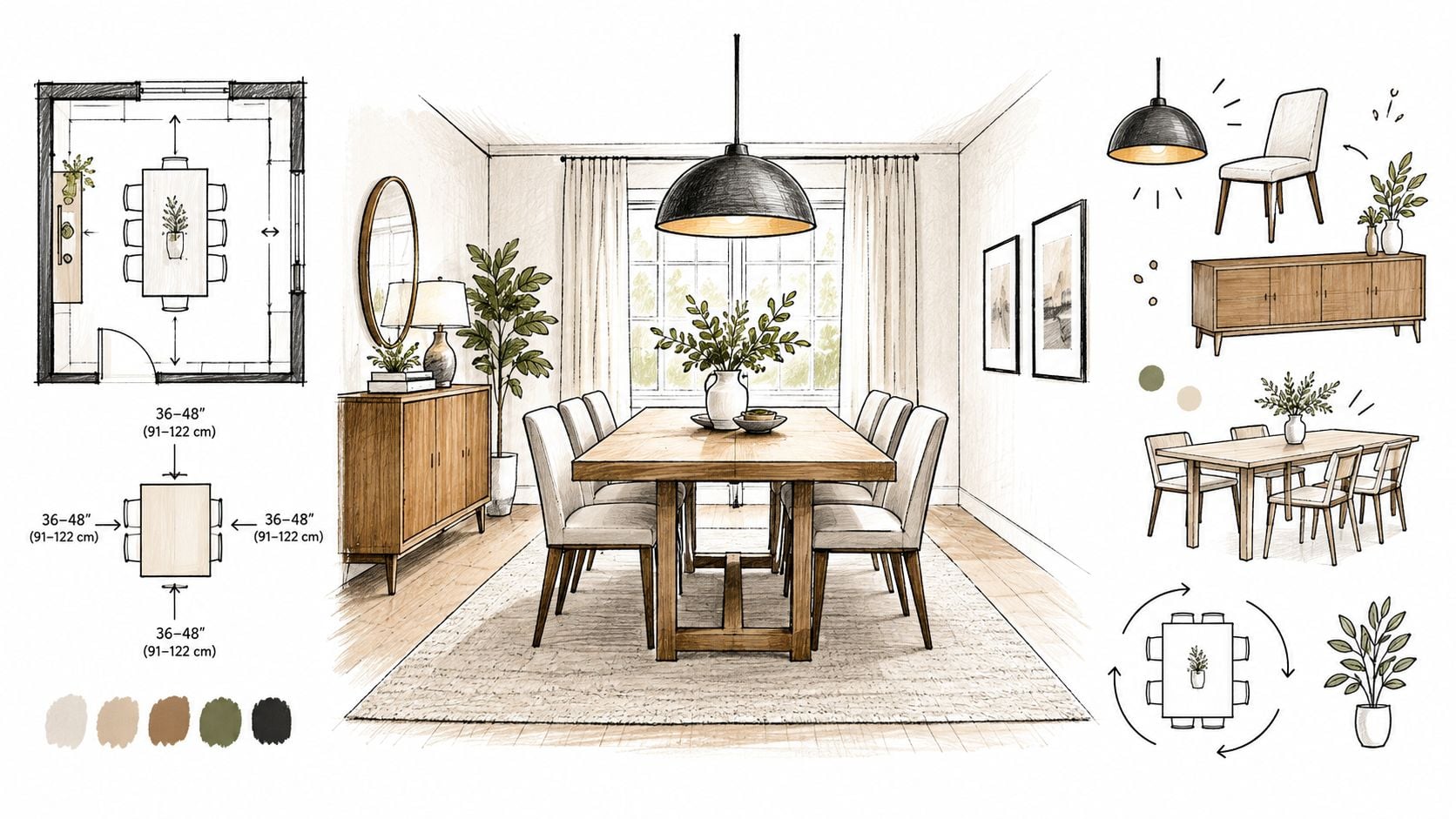
A dining table has to work after the chairs are occupied. Measure the complete living footprint, including pulled-out chairs, diners' elbow room, and the route needed to carry serving dishes behind seated guests. A tabletop that fits on paper can still make every meal feel cramped.
A common planning rule calls for about 36 inches of clearance between the table edge and the nearest wall or substantial piece of furniture. Allowing roughly 36 to 40 inches gives chairs room to move while maintaining a usable passage behind seated diners, as reflected in this dining table clearance guidance.
Measure the room in layers
Start with the empty room, then build the plan around how people use it.
Record the overall footprint. Measure wall to wall and note narrow points, openings into other zones, and shared space with a kitchen or family room.
Mark fixed obstacles. Include built-in buffets, radiators, stair edges, columns, vents, islands, and doors. A door needs operating space beyond the width of its closed panel.
Map circulation routes. Trace the paths from the kitchen to the table, from the table to the living area, and from the room to exterior doors. Each route should remain open when chairs are occupied.
Add the chair zone. Measure from the tabletop edge to every wall or obstruction. This distance must support both chair movement and passage behind diners.
Test the footprint. Use painter's tape or flattened cardboard to mark the table and chair positions. Walking through the outline exposes bottlenecks that a product photograph cannot show.
The dining table size guide helps compare tabletop dimensions with intended seating. Check vertical proportion as well. A standard dining table is generally around 28 to 31 inches tall, a height that suits typical dining chairs and everyday meals. Match the table to the chair seat height, arm clearance, lighting, and the scale of nearby case goods. For useful context on how dining tables developed and why familiar proportions persist, see this summary of dining table design evolution. A well-planned table supports the room's traffic, not just its floor plan.
Comparing Seating Capacity and Social Dynamics
A family of four can feel crowded around the wrong table, while a larger household may find a generous rectangle easier to manage. Shape controls more than seat count. It determines who faces whom, how far conversation travels, where serving dishes sit, and whether occupied chairs interrupt the route between the kitchen and dining area.
A 36 to 44 inch round table seats about four diners, a 44 to 54 inch round table accommodates about four to six, and a 54 to 60-plus inch round table suits about six to eight, depending on chair width and comfort. Rectangular tables around 60 x 36 inches commonly seat four to six, 72 x 36 to 40 inches seat six to eight, and 84 to 120-plus inches suit eight to twelve people or frequent entertaining, as outlined in this dining table dimension guide.
Dining Table Dimensions and Seating Capacity
| Table Shape | Standard Dimensions | Comfortable Seating |
|---|---|---|
| Round | 36 to 44 inch diameter | About 4 diners |
| Round | 44 to 54 inch diameter | About 4 to 6 diners |
| Round | 54 to 60-plus inch diameter | About 6 to 8 diners |
| Rectangular | Around 60 x 36 inches | About 4 to 6 diners |
| Rectangular | Around 72 x 36 to 40 inches | About 6 to 8 diners |
| Rectangular | 84 to 120-plus inches | About 8 to 12 diners |
Allow about 24 inches of horizontal table edge per diner as a practical planning benchmark, consistent with this dining table shape and seating guidance. A rectangle uses that edge efficiently along two long sides, so it gains capacity in a predictable way. A larger round top increases the distance across the table, which can make conversation and serving less comfortable before the additional surface becomes useful.
Geometry changes the mood
Round tables create a conversation-first arrangement. Every seat has a comparable relationship to the center, and no diner occupies a formal head position. The result suits intimate dinners, card games, homework, and family meals where everyone should remain part of the same exchange. A pedestal base also gives chairs more freedom to shift, provided the surrounding circulation remains clear.
Rectangular tables create stronger visual order. End seats carry more presence, long sides support a clear place-setting arrangement, and serving pieces can run along the tabletop without occupying the center of every conversation. This geometry works well for formal entertaining, larger family meals, and homes with strong architectural lines, including open-plan layouts where the table follows the room's primary axis.
The table's material and construction shape the experience as much as its outline. This resource on family togetherness through woodworking examines how craftsmanship and shared use can give a dining table lasting emotional importance.
For households that host larger gatherings, Lott's dining tables and chairs for ten offers a useful capacity reference. Choose round for four to six diners when equal conversation and easy chair movement lead the decision. Choose rectangular for six or more regular diners, future expansion, or a room that demands a strong linear arrangement.
Matching Table Shapes to Room Layouts and Styles
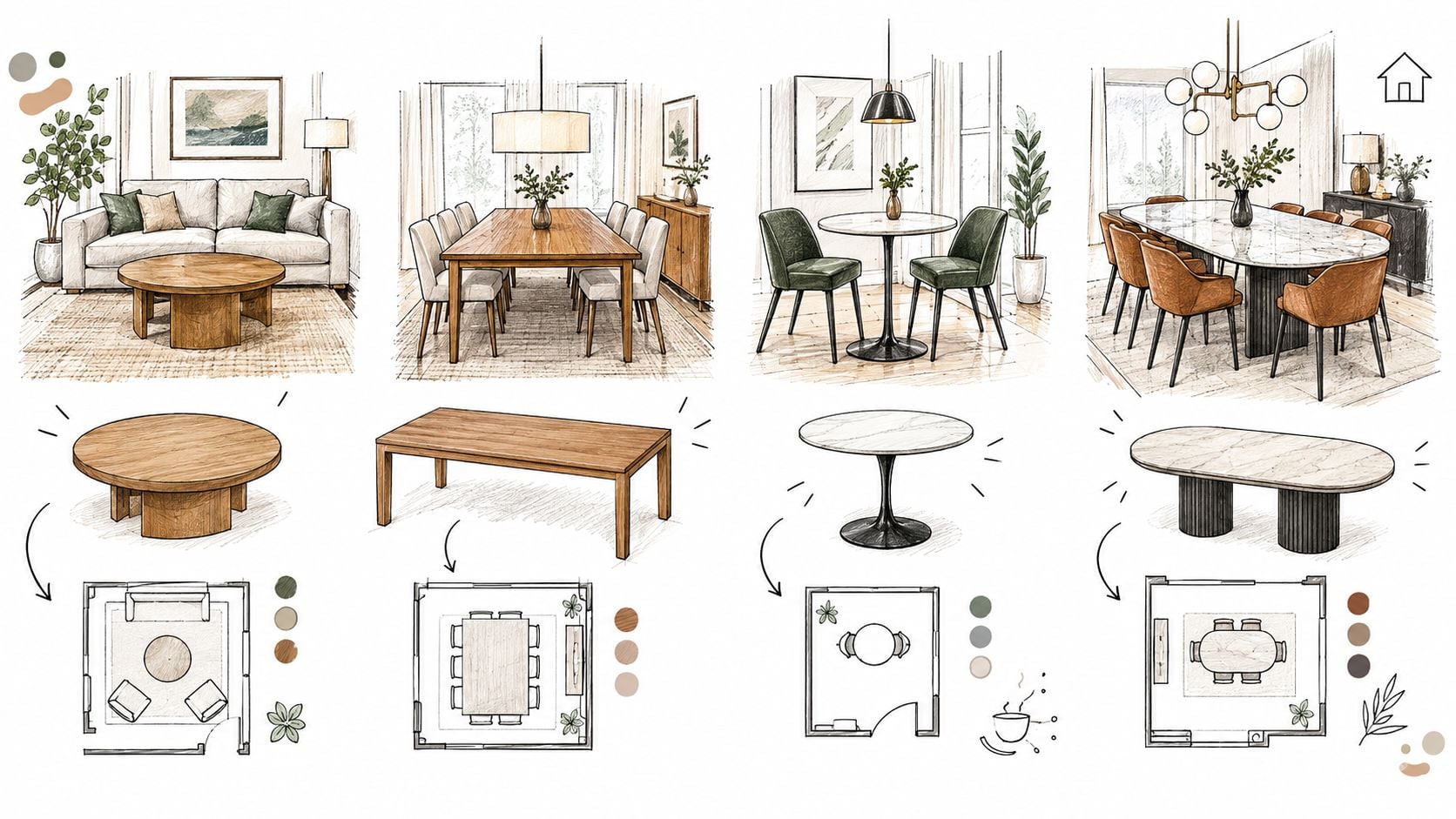
A square breakfast room with chairs brushing the walls needs a different table from a long dining room that connects the kitchen to the living area. Start with traffic flow, then choose a silhouette that supports the room's architectural lines and the way people gather. Materials, lighting, and chair proportions should reinforce that decision rather than compete with it.
Round tables suit small or square rooms especially well. Their lack of corners improves movement and reduces the chance of bumping into an edge, while the continuous outline can make a tight area feel less crowded. A pedestal base strengthens the effect by keeping the support centered and giving chairs more freedom to shift. The result is an intimate arrangement where conversation remains shared rather than divided by formal end positions.
Let architecture establish the axis
Rectangular tables work best in long or narrow dining rooms because their straight edges follow walls, flooring, windows, and nearby furniture. They also establish a clear relationship with a kitchen island or sideboard. In an open-plan room, the longer form can anchor the dining zone while preserving a direct sightline between cooking and living areas.
A round table can succeed in a long room when it has a defined role. Place it in a window alcove, breakfast nook, or transition point between living and kitchen zones, where its central shape creates a welcoming destination. Forced into the room's longest direction, it leaves awkward strips of unused floor. Positioned as a distinct island, it gives the space a social center and keeps circulation legible.
The guide to maximizing dining space with table shapes and seating arrangements is useful for rooms with mixed zones, banquettes, or furniture that serves more than one purpose. It helps connect the tabletop's geometry to seating access and daily movement.
Shape and regional style
South Georgia and North Florida homes often combine relaxed living with polished entertaining. A weathered wood rectangular table supports a Modern Farmhouse setting beside woven textures, upholstered seating, and warm architectural finishes. Its substantial presence also suits a traditional dining room.
A sleek round pedestal table fits Coastal Chic interiors, where open circulation, softened edges, and lighter visual weight create an airy atmosphere. Choose a refined painted surface, visible natural wood grain, or subtle cerused treatment to give the circle lasting character without making the room feel formal or temporary.
Lighting should follow the table's geometry. A centered pendant reinforces a round table's shared social focus, while a linear fixture follows a rectangular table's length. Seasonal references such as cozy winter lighting styles can add warmth without visual clutter. The strongest room design makes shape, movement, and atmosphere operate as one considered composition.
Choosing the Right Table for Your Lifestyle
A dining table must work through an ordinary weekday before it earns a place in a formal dinner setting. One household may use it for breakfast, homework, crafts, and shared meals. Another may need a compact everyday surface that welcomes friends without consuming the room. Choose the shape around the life the table will serve most often.
A round table is my first recommendation for a compact household that values conversation and relaxed seating. Its center-focused geometry keeps everyone in the same social exchange and avoids a dominant head position. It also works well when people can circulate from several sides. In a narrow room or a layout with one primary passage, a rectangle usually handles traffic more cleanly.
Match the table to the household
A young family often benefits from a round table in a square breakfast area. Fewer corners simplify movement around the perimeter, but the finish and construction deserve equal attention. Choose a surface that tolerates daily wear and chairs that remain steady through frequent use. This guide to kid-friendly and pet-friendly furniture helps families assess upholstery, cleanability, and practical durability across the dining ensemble.
A frequent entertainer should usually choose a rectangle. Straight edges organize place settings, serving dishes, and shared platters with greater predictability. An extendable design is the strongest choice when the household wants a restrained daily footprint and additional capacity for gatherings. It preserves circulation during the week while giving hosts room to adapt.
An empty-nest household may prefer a round table for weekly dinners with friends. The shape supports lingering conversation and gives every seat comparable social weight. If larger events remain occasional, daily comfort and open circulation matter more than maintaining an oversized surface.
The 24-inch-per-diner and 36-to-40-inch clearance benchmarks from the seating capacity section above still apply during this lifestyle assessment. Allow about 24 inches of horizontal edge space per diner for comfortable place settings, and maintain 36 to 40 inches of clearance around the table so chairs can move and people can pass.
Think in seasons of use
A table should accommodate change. Children grow, work patterns shift, relatives visit, and one room may eventually serve more than one generation. A household that rarely hosts today may still benefit from a rectangular table if future capacity matters. A household that expects to remain small may find a large rectangle visually excessive and inconvenient every day.
A dining table earns its place by making ordinary meals feel easy and special occasions feel possible.
Prioritize the most frequent use, then add flexibility where it earns its space. Round supports intimacy and balanced conversation. Rectangular supports expansion, clearer traffic planning, and structured hosting. Select the geometry that fits the room's circulation and the household's real calendar, not the table that looks impressive in a showroom vignette.
Elevating Your Space with Customization and Quality
Shape establishes the foundation, but customization determines whether the table feels made for the home. A finish that coordinates with existing flooring, a base that preserves legroom, and chairs that offer comfortable seating can transform a correct table into a lasting centerpiece.
The Special Order Program gives households more control than a fixed floor model. Most participating vendors support personalized designs that may include:
- Wood finishes: Select a tone that works with flooring, cabinetry, trim, or adjoining furnishings.
- Edge profiles: Choose a tabletop edge that feels architectural, relaxed, traditional, or subtly refined.
- Comfort levels: Coordinate cushion firmness and chair construction with the way the household lingers at meals.
- Performance fabrics: Families can explore worry-free upholstery options from brands such as La-Z-Boy and Smith Brothers.
- Coordinated collections: Lexington and Hooker Furniture offer design language that can extend from the dining table into surrounding case goods and living spaces.
A premium table shouldn't be treated as a disposable accent. Investment-quality construction, carefully selected materials, and a finish suited to daily use give the piece a better chance of becoming an heirloom rather than a short-lived compromise. The goal isn't a surface that fills the room. It's a piece with enough presence to anchor family rituals over time.
Expert guidance removes costly uncertainty
The gallery's Style Quizzes can help identify whether a room leans toward Coastal Chic, Modern Farmhouse, or Timeless Traditional design. Style Guides and interactive lookbooks then help homeowners evaluate scale, texture, and coordination before committing to a complete dining arrangement.
In-store associates remain valuable when a decision depends on touch and proportion. They can help compare chair widths, examine finish samples, assess pedestal versus leg bases, and test whether a table feels comfortable at seated eye level. The Mattress Guide is also available as part of the broader design-help experience, giving shoppers a named resource for comfort decisions elsewhere in the home.
The online catalog and physical showroom should work as one continuous experience. A shopper can research silhouettes and finishes digitally, then visit the Fernandina Beach, FL showroom to examine construction and sit in coordinating chairs. That smooth transition between online browsing and in-person guidance gives the homeowner more confidence without turning the process into guesswork.
Experiencing the Furniture Difference
A well-chosen table deserves a purchasing process that protects the design decision from measurement through placement. The gallery serves homeowners across South Georgia and North Florida, with showrooms in Waycross, GA, and Fernandina Beach, FL for shoppers who want to experience furniture in person.
A practical path begins with the room:
- Bring the measurements. Include wall lengths, door swings, fixed furniture, and the intended traffic paths.
- Define everyday seating. Determine how many people dine regularly and how often additional guests arrive.
- Compare silhouettes in person. Walk around both shapes, pull out chairs, and assess how the base affects legroom.
- Review finishes and customization. Use the Special Order Program to coordinate wood tones, edges, upholstery, and comfort.
- Confirm placement and delivery details. The final table should arrive with a clear room destination and a planned route into the home.
The Lott's Delivery Standard protects the final stage. Every piece undergoes a rigorous multi-point inspection before it reaches the customer. Professional white-glove, in-home delivery places the furniture in the room of choice and ensures the table and chairs are positioned for immediate enjoyment, rather than leaving the homeowner to manage a heavy installation alone.
Brand selection can extend beyond dining tables. Households may compare Lexington, Hooker Furniture, and Stressless as part of a broader furnishing plan, with associates helping the dining area relate naturally to adjacent rooms. The digital catalog remains available for continued browsing, while showroom visits provide the tactile experience that photographs cannot replace.
The final choice is straightforward. Round is the stronger recommendation for compact, square, conversation-centered spaces. Rectangular is the stronger recommendation for long rooms, larger households, and flexible entertaining. Once the geometry is right, customized finishes, supportive seating, and dependable in-home service turn the table into a curated sanctuary for daily life.
Lott's Furniture offers round and rectangular dining tables, Special Order customization, Style Quizzes, expert in-store associates, and a digital catalog that connects with showrooms in South Georgia and North Florida. Visit Lott's Furniture to arrange an online style consultation or explore the Waycross and Fernandina Beach showrooms for a dining table chosen around the room, the household, and the way guests gather.