Genuine Leather Reclining Sofa: A Buyer’s Guide


A living room often has to serve several roles at once. It may be the place for morning coffee, family conversations, movie nights, afternoon naps, and welcoming guests, so a sofa needs to look refined without becoming too precious for daily use. A genuine leather reclining sofa can provide that balance, but only when the leather, construction, mechanism, and service terms match the way the household lives.
The most satisfying choice feels custom-made rather than merely large or luxurious. It supports the body in motion, fits the room when fully extended, and uses upholstery that can age gracefully with proper care. For homeowners across South Georgia and North Florida, the decision also needs to account for humidity, sunlight, salt air, delivery access, and the practical realities of frequent use. A useful starting point is this guide to choosing living room furniture, followed by a closer look at what “genuine leather” really means.
The Heart of Your Home Choosing a Genuine Leather Reclining Sofa
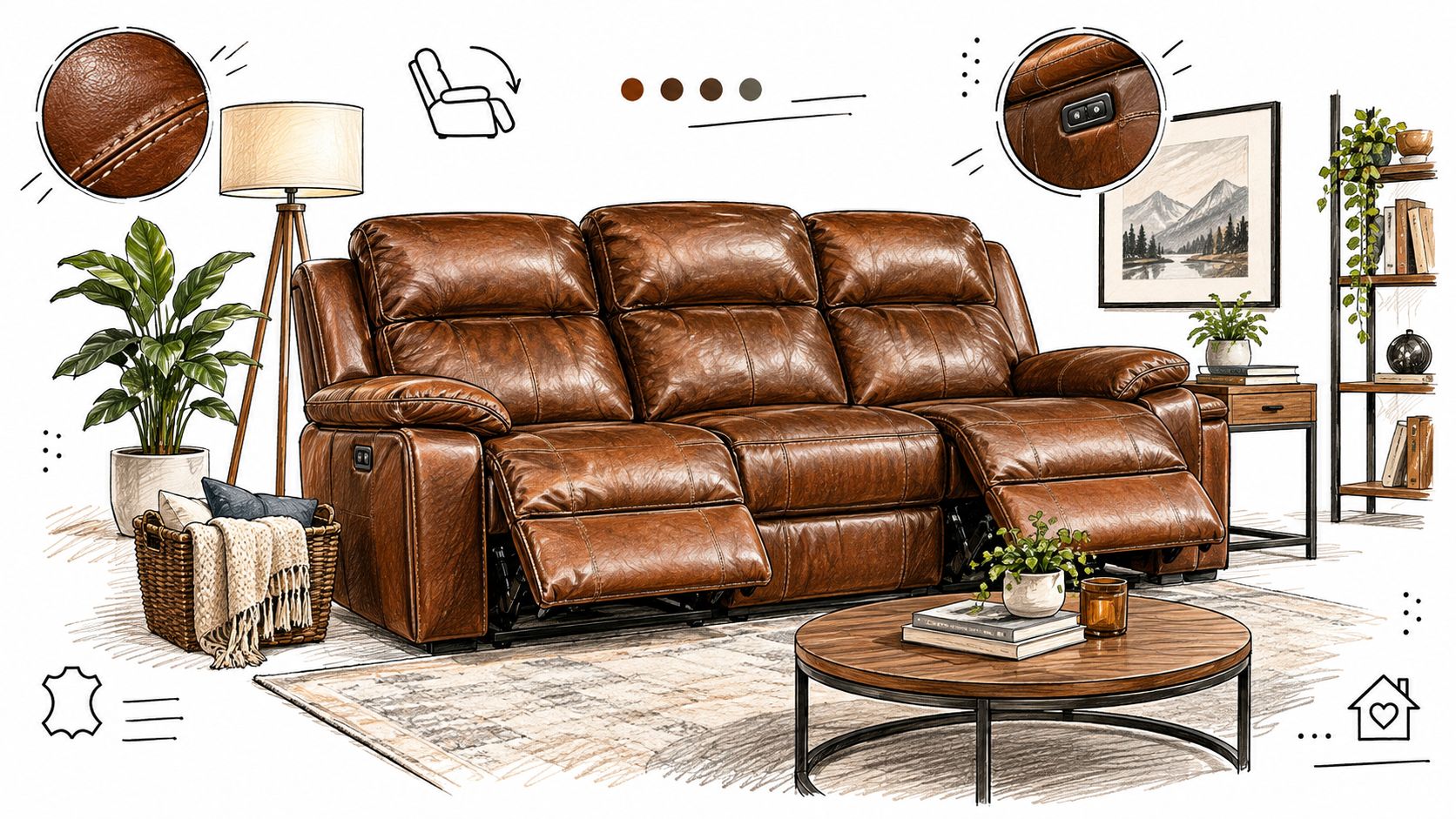
A homeowner may enter a showroom looking for a brown reclining sofa that feels substantial, then discover that appearance is only the first decision. The room may have coastal artwork, warm wood, and a relaxed family atmosphere, yet the sofa still needs enough structure for conversation and enough movement for long evenings. A reclining design can become the room's anchor, but it shouldn't dominate the space when upright or block circulation when extended.
Consider a family choosing between a smooth, protected leather surface and a more natural finish with visible variation. The first option may feel easier to manage around regular activity, while the second may appeal to someone who wants the sofa to develop character. Neither choice is automatically correct. The right answer depends on whether the sofa serves a formal sitting room, a media room, a vacation home, or the household's primary gathering space.
Comfort should support the room's purpose
A well-suited sofa should work in more than one position. Upright seating needs to feel composed and supportive, while reclined seating should allow the head, back, pelvis, legs, and feet to settle without forcing the body into a single posture. The sofa's arms, seat depth, back height, and headrest all influence whether the experience feels comfortable or merely soft during a brief showroom trial.
Room planning matters just as much. Measure the wall, pathways, doorways, and the sofa's fully open footprint. A reclining sofa that looks perfectly proportioned in a photograph may feel cramped if the footrest reaches into a walkway or if the back cannot move freely.
Practical rule: A sofa should be judged in its upright and fully reclined positions, not only by its showroom silhouette.
At Lott's Furniture, the experience connects local service with broad design choice. Homeowners can browse the digital catalog, use Style Quizzes for direction, and then visit the showroom in Fernandina Beach, FL, to sit, recline, compare finishes, and speak with in-store associates. That transition is especially useful for a substantial purchase, because photographs can't reveal pressure behind the knees, the feel of a finish, or the steadiness of a mechanism.
Understanding the Real Meaning of Genuine Leather Grades
The phrase genuine leather confirms that real leather is present. It doesn't, by itself, identify the hide layer, surface treatment, thickness, or amount of leather used throughout the sofa. A product can carry that description while differing substantially from another sofa in feel, appearance, maintenance, and expected service life.
Leather terminology becomes clearer when separated into two questions. The first concerns the hide itself. The second concerns what manufacturers do to its surface.
Grade and finish answer different questions
Full-grain leather retains the natural grain and visible character of the hide. Top-grain leather is also taken from the stronger outer portion, but it may be refined or lightly corrected for a more consistent appearance. Corrected or protected surfaces can offer a more uniform look and practical resistance to everyday marks, while aniline finishes preserve a more natural feel and show more of the hide's individual character.
Split leather comes from a lower layer of the hide and can still be real leather, but it shouldn't be treated as equivalent to full-grain or top-grain upholstery. Bonded or reconstituted leather is different again, because it uses leather fibers combined with binders and a surface coating. It should not be presented as genuine leather merely because real leather fibers are present.
A useful explanation of these distinctions appears in this guide to full-grain versus top-grain leather sofas. The central lesson is simple: grade describes the leather, while finish strongly influences how that leather behaves in the home.
Coverage can matter more than the label
Genuine leather reclining sofas belong to an international bovine-leather system rather than a supply chain created specifically for recliners. Around 1999–2001, the approximately 1.5 billion cattle worldwide generated about 5.7 million metric tonnes of raw hides on a wet-salted basis, with an average hide weighing 18.1 kilograms, according to the Food and Agriculture Organization's overview of bovine hides and leather. After processing, about 44% of light bovine leather, approximately 4.84 billion square feet, moved into products including furniture, garments, travel goods, and handbags.
That shared system helps explain why leather sourcing, tanning, finishing, and panel selection can vary from one sofa to another. A reclining sofa may use leather on the seat, back cushions, arms, and footrest, while matching vinyl or polyurethane appears on the outside back and sides. That construction can be reasonable when it's disclosed clearly, but it shouldn't be confused with full-leather upholstery.
Before ordering, the showroom conversation should establish:
- Leather grade: Ask whether the upholstery is full-grain, top-grain, corrected, split, or another specified type.
- Panel coverage: Confirm which surfaces use genuine leather and whether sides, backs, or recliner panels use polyurethane or vinyl.
- Finish: Ask whether the surface is aniline, semi-aniline, pigmented, coated, or otherwise protected.
- Warranty language: Review coverage for peeling, cracking, seam failure, cushions, frame components, and the reclining mechanism separately.
A buyer isn't just asking, “Is it real leather?” The more useful question is, “Which parts are real leather, what protects the surface, and how will each part be serviced?”
Evaluating Recliner Mechanisms and Ergonomic Comfort
A reclining sofa is an ergonomic system with moving parts, not a stationary sofa with an added footrest. The backrest, seat tilt, lumbar contour, headrest, linkage, and footrest need to work together. If one element moves without the others, the body may slide forward, lose lumbar contact, or experience pressure behind the knees.
Supported recline has a meaningful relationship with spinal loading. Cornell's ergonomics material indicates that lumbar-disc pressure and back-muscle activity are lowest during supported recline at approximately 110°–130°. The Cornell ergonomics reference also emphasizes the importance of coordinated seat tilt and backrest movement so the pelvis stays supported.
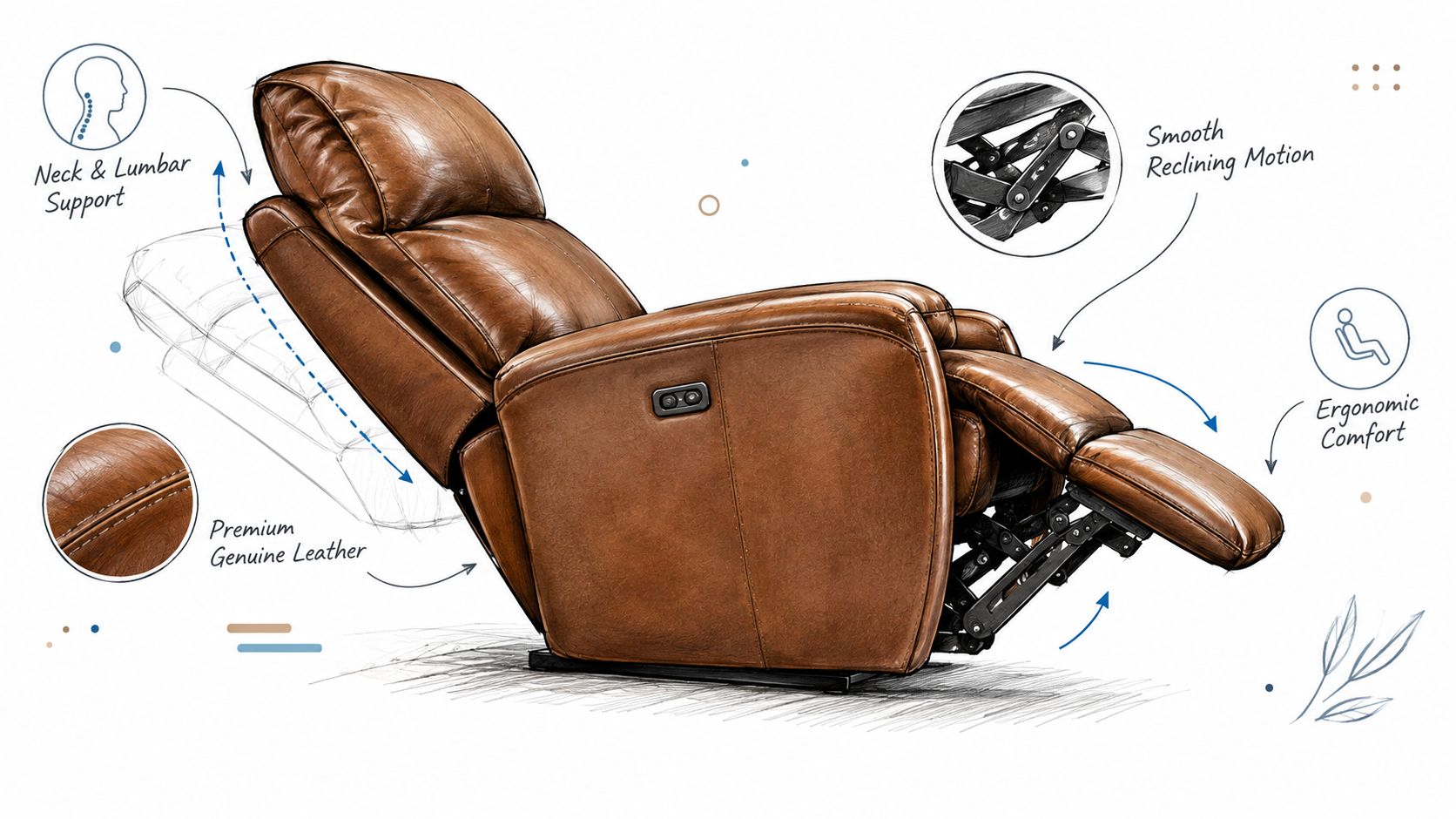
Test the complete motion
A showroom trial should take longer than a quick sit. The body often notices problems only after remaining in one position long enough for pressure or loss of support to become obvious.
- Begin upright. Check whether the seat supports the pelvis without pushing the shoulders forward.
- Raise the footrest. Watch for pressure behind the knees and confirm that the heels have enough clearance.
- Continue into deeper recline. The lumbar contour should remain in contact with the lower back instead of leaving a gap.
- Check the upper back. The backrest should support the thoracic region, not only the lumbar area.
- Adjust the headrest. The head and neck should remain supported without forcing the chin upward.
- Try both sides. One-sided loading can reveal frame movement, lateral play, clicking, or an uneven mechanism.
Power models deserve their own questions. Ask where the controls sit, whether headrest and footrest adjustments operate independently, how cords are protected, and what the warranty covers if the motor or control stops working. A smooth movement is valuable, but it doesn't prove that the internal structure has been tested for long-term cycling.
Separate comfort testing from durability evidence
Leather abrasion testing and recliner mechanism testing measure different risks. ISO 17076-2:2011 describes a Martindale ball-plate method for upholstery leather, including semi-aniline, pigmented, and coated leather. During the dry test, samples are inspected in 100-rub increments, with the reported result based on the rubbing required to produce finish breakdown in at least four locations, typically using duplicate specimens, as described in the ISO 17076-2 standard information.
That result addresses surface-finish wear. It doesn't establish frame strength, stitching quality, electrical performance, or linkage durability. A U.S. General Services Administration test method applies a combined 200-pound load, with 150 pounds on the seat and 50 pounds attached to the center of the backrest, while cycling the recliner through its positions for 25,000 cycles or until failure, whichever comes first. The method also includes an ottoman impact test using a 75-pound weight through 12 inches, with 20 repetitions, as detailed in the GSA upholstered-furniture test method.
For shoppers comparing electric recliner sofas, the practical takeaway is to request the actual test method and result. “High durability” isn't enough without knowing whether the claim refers to leather abrasion, mechanism cycling, stability, or something else.
Comparing Leather to Alternative Upholstery Materials
Genuine leather and fabric address different household needs. Leather offers a distinctive hand, natural variation, and a surface that can develop patina. Its considered appearance suits traditional, transitional, and coastal interiors. Fabric provides wider choices in color and pattern, a softer textile feel, and an easier way to coordinate pillows, rugs, and window treatments.
Microfiber and other synthetic upholstery can suit rooms where a consistent surface and straightforward routine cleaning matter most. That may include a playroom, rental, guest room, or home where uniform appearance is more important than natural variation. Compare maintenance, repair options, and long-term appearance rather than treating the choice as only natural versus synthetic.
The trade-off is practical, not ideological
A protected leather surface can work well on a frequently used reclining seat because touch points can be wiped according to the manufacturer's instructions. Leather still demands attention to its finish, sunlight, body oils, and unsuitable cleaning products. Aniline leather may feel exceptionally supple, yet it generally shows marks and absorbs spills more readily than a protected finish.
Ask what the label means by leather construction. A sofa may use leather on the primary contact areas while using a matching material elsewhere, or it may use leather throughout the upholstered exterior. Those choices affect appearance, repair expectations, and price. Ask whether the quoted abrasion result applies to the surface finish, the upholstery material, or a complete construction. A test focused on finish wear does not answer every question about how the sofa will perform in daily use.
Fabric can hide small scratches because it has no leather surface to abrade, although spills may travel into fibers and seams. Synthetic upholstery may retain a consistent color and require less attention at first, while its long-term behavior depends on the backing, coating, and construction. No material is maintenance-free, as explained in this comparison of leather vs fabric upholstery.
A sofa's value comes from the relationship between material, frame, mechanism, repairability, and care requirements.
Choose for the room's real workload
A busy media room with reclining seats repeatedly stresses seat fronts, footrests, arm caps, and moving seams. A formal living room may support a more delicate surface because it receives less contact. Pet owners should ask how scratches will show and what the warranty excludes instead of relying on a broad “pet-friendly” label.
Families should also consider replaceable cushions, serviceable mechanisms, and accessible upholstery repairs. Those features may matter more than a flawless appearance at delivery.
A well-made leather sofa can become more distinctive with age, depending on its finish and the owner's expectations. Shoppers who want every panel to remain visually uniform may prefer protected leather or textile. Those who welcome natural variation may prefer full-grain or aniline leather and accept marks as part of the piece's character.
Compare the complete ownership experience: feel, cleaning, room fit, serviceability, and warranty coverage after ordinary use. Leather is not automatically superior to every alternative.
Essential Care and Maintenance for Long-Lasting Beauty
Leather care begins with the finish specified by the manufacturer. A protected surface, semi-aniline leather, and aniline leather shouldn't receive the same conditioner or cleaning routine. Applying an unapproved product can leave residue, alter sheen, weaken the finish, or make future repairs more difficult.
South Georgia and North Florida add environmental considerations. Humidity, sunscreen, perspiration, salt air, and prolonged heat can gradually weaken or discolor a surface finish even when the underlying hide remains structurally sound, as outlined in this leather-performance testing guidance.
A manageable routine protects the surface
- Remove loose debris: Vacuum seams, folds, footrest transitions, and the spaces around moving sections with a suitable upholstery attachment.
- Blot spills promptly: Use a clean, absorbent cloth and avoid aggressive rubbing that can spread moisture or disturb the finish.
- Use approved products: Follow the manufacturer's instructions for cleaner and conditioner, especially on coated or corrected leather.
- Limit direct exposure: Position the sofa away from prolonged direct sunlight, intense heat, and vents that dry or heat one area repeatedly.
- Keep moving parts clear: Prevent crumbs, cords, toys, and pet items from entering the mechanism or becoming pinched beneath the footrest.
- Test cautiously: Apply any new care product to a hidden area first, then allow the surface to dry before evaluating the result.
Steam requires particular caution. Heat and moisture can affect leather finishes, adhesives, and internal materials, so a steam cleaner shouldn't be used on leather upholstery unless the manufacturer expressly approves it. For general household research, a guide to top steam cleaners for 2026 can help clarify equipment differences, but it shouldn't replace the sofa's care instructions.
Ask for the care specification before purchase
The showroom file should identify the leather grade and location, corrected versus aniline finish, abrasion test standard and result, finish adhesion, lightfastness, and approved cleaning conditioner. Buyers should also ask whether care guidance addresses coastal conditions, sunscreen, salt exposure, and frequent reclining contact.
The guide to cleaning leather furniture at home can help establish a routine, but the manufacturer's instructions remain the controlling reference. Regular inspection also helps. Loose stitching, unusual movement, a separating seam, or a new patch of finish wear deserves attention before a small issue becomes a larger repair.
Customizing Your Sofa with the Special Order Program
A sofa becomes more personal when its comfort and finish are selected around the home rather than accepted as a fixed package. Lott's Furniture's Special Order Program gives shoppers a route to personalized designs, and most vendors support choices involving fabrics, finishes, and comfort levels. That flexibility can be especially useful for a reclining sofa, where upholstery appearance and seat support need to work together.
The selection may include leather colors, grain character, protective finishes, cushion firmness, arm styles, wood finishes, and configuration details. A household that prefers upright support may need a different comfort profile from one that wants deep, relaxed lounging. A coastal home may call for a lighter palette, while a traditional room may benefit from richer brown leather and substantial wood accents.
Customization should solve a real need
Customization is most valuable when it answers a specific question:
- How should the seat feel? Firm, balanced, or more relaxed cushioning changes how the body settles during extended sitting.
- Which surfaces need protection? A high-use seat may call for a finish chosen for practical maintenance rather than maximum natural character.
- How should the sofa relate to the room? Arm scale, leg or base treatment, and color influence whether the piece feels fitted or oversized.
- What must remain serviceable? Power controls, removable components, cushions, and access points deserve attention before the order is placed.
Core brands available through the broader Lott's collection include:
- La-Z-Boy, for familiar motion-seating formats and broad configuration choices.
- Smith Brothers, for custom upholstery and comfort customization.
- Stressless, for ergonomic seating with a distinct design language.
- Lexington, for coordinated room furnishings.
- Hooker Furniture, for complementary case goods and accent pieces.
The point isn't to choose a brand from a list without testing it. The point is to use the available range to create a sofa that suits the homeowner's posture, room, and design direction.
Guidance makes customization easier
The Style Quizzes can help identify directions such as Coastal Chic, Modern Farmhouse, or Timeless Traditional. Interactive style guides can support decisions about scale and layered textures, while the Mattress Guide offers a separate resource for understanding comfort levels and support technologies when the furnishing project includes a bedroom.
In-store associates add the human judgment that digital tools can't fully provide. They can help compare swatches, test recline geometry, clarify leather coverage, and review warranty language. Shoppers can begin in the digital catalog, save ideas, and continue in a showroom without treating online and in-person shopping as separate experiences.
The Lott's Furniture Experience From Showroom to Your Home
A substantial furniture purchase benefits from a process that combines research with physical testing. Lott's Furniture serves homeowners across South Georgia and North Florida through showrooms in Waycross, GA, and Fernandina Beach, FL, alongside a digital catalog that supports browsing from home. The transition from online inspiration to showroom evaluation is designed to be straightforward.
Style Quizzes and digital guides help narrow the visual direction, while associates can assist with material questions, comfort preferences, layout measurements, and special orders. That combination creates room for both inspiration and verification. A buyer can explore a curated sanctuary online, then sit in a recliner, inspect the seams, operate the controls, and compare leather surfaces in person.
The service continues after selection. Lott's white-glove, in-home delivery places furniture in the room of choice, and every piece undergoes a rigorous multi-point inspection before reaching the customer. That attention matters for a reclining sofa because the final check should cover upholstery condition, seams, movement, controls, and placement.
A genuine leather reclining sofa deserves more than a product title and a quick test. It deserves clear specifications, thoughtful customization, ergonomic evaluation, and dependable delivery.
Lott's Furniture offers genuine leather reclining sofa options, Special Order customization, Style Quizzes, expert showroom guidance, and white-glove in-home delivery across South Georgia and North Florida. Visit Lott's Furniture online or in Fernandina Beach, FL, to begin an online style consultation and arrange a showroom visit where the leather, comfort, and reclining motion can be evaluated firsthand.