
Mattress with Frame: Setups, Sizing and Buying Guide


A homeowner finally finds a mattress that feels right in the showroom, gets it home, and sets it on the frame that's been in the bedroom for years. Two months later there's a dip in the middle, a creak at the corner, and a question no one asked at checkout. Was that frame ever built for this mattress?
That gap between a good mattress and a good night's sleep is usually the support underneath it. A mattress with frame should be judged as one system, because slat spacing, center support, perimeter fit, and total height decide whether the surface stays level, quiet, and covered by its warranty. The sections ahead turn those checks into a simple decision rule for every setup, from a traditional foundation to an adjustable base. Shoppers across South Georgia and North Florida can use the same checks at home, then test the result in person.
Mattress With Frame Setups Compared at a Glance
A mattress with frame is the sleep surface paired with the support system it rests on, whether that's a box spring, a platform, an adjustable base, or a storage bed. Each pairing changes height, support, and warranty terms, so the mattress and frame should be chosen together rather than in isolation.
Think of the mattress as the cabin where a sleeper lives and the frame as the chassis carrying the load. A comfortable cabin on a flexing chassis still rides badly. The table below compares the five setups shoppers ask about most.
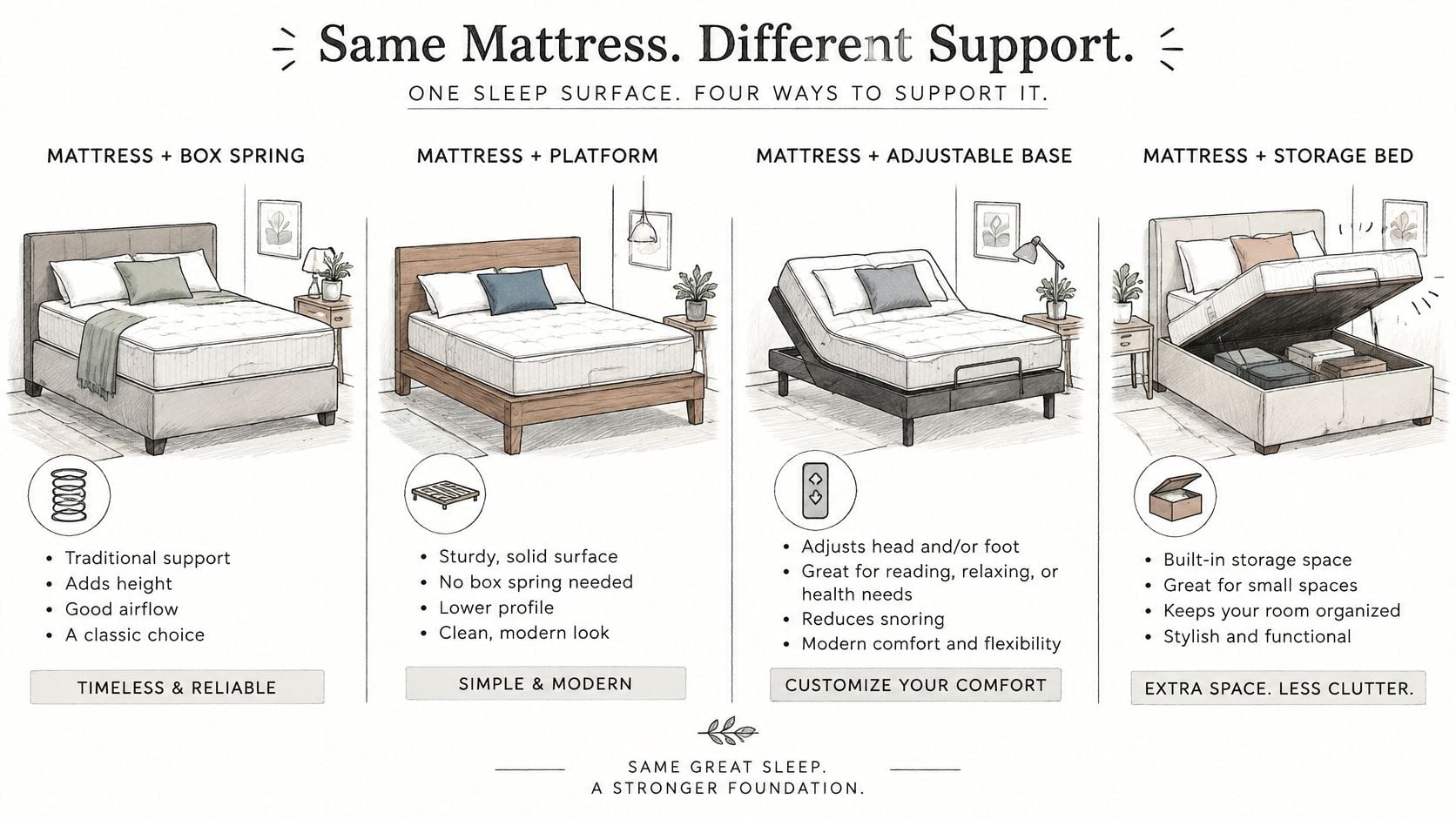
| Setup | What Is Included | Best For | Watch For |
|---|---|---|---|
| Mattress only on existing frame | Your current frame and slats | Replacing a mattress on a sound frame | Old or wide-slat frames can void the mattress warranty |
| Mattress with box spring | Mattress plus a matching foundation | Traditional look and a higher bed | Added height; foundation must match the mattress |
| Mattress on platform frame | Solid or slatted platform, no box spring | Low profile and modern rooms | Slat spacing and center support must be checked |
| Mattress with adjustable base | Motorized base that raises head and feet | Reading in bed and easing back pressure | Needs a power outlet and a base rated for the mattress |
| Mattress in storage bed | Frame with drawers beneath the mattress | Small bedrooms needing storage | Limited under-bed clearance for tall mattresses |
How to Read the Comparison
Three details decide whether a row fits a given bedroom:
- Tested foundation: Note the foundation the manufacturer tested the mattress with, because that's the pairing the warranty assumes.
- Total height: Add frame height, foundation height, and mattress thickness, then check that total against nightstand height and ease of getting in and out of bed.
- Fixed or moving base: Confirm whether the base stays flat or bends, since a mattress built for a flat surface may not flex safely on an adjustable base.
Each option carries a clear trade-off. Mattress only keeps the current bed and avoids a new purchase, but it needs a full frame check first. A box spring adds height and a traditional look, yet it must match the mattress. A platform gives a low, clean profile, though slat and center-support checks are essential. An adjustable base adds elevation for reading and can ease back pressure, but it needs an outlet and a rated base. A storage bed adds drawers for smaller rooms, while reducing under-bed clearance for tall mattresses.
Practical rule: Keep an existing frame only after it passes the slat, center-support, and fit checks in the sections ahead.
Associates in Waycross and Fernandina Beach can talk through each option, and the Mattress Guide lets South Georgia and North Florida homeowners compare comfort and support before a visit. Every choice here is value-focused when the support system protects the mattress for its full service life.
Frame Types and Materials That Hold Up Over Time
No finish can fix a weak frame. A beautiful headboard on undersized rails still flexes, squeaks, and lets the mattress sag, so structure comes first and style second. The table below puts the common frame types side by side.
| Frame Type | Common Materials | Support Strength | Best Match |
|---|---|---|---|
| Metal platform | Powder-coated steel tube | High with center legs | Foam, latex and hybrid mattresses |
| Solid wood | Hardwood or engineered wood | High and stable | Traditional and transitional bedrooms |
| Upholstered | Wood frame with fabric or leather | Moderate to high | Family and coastal rooms using performance fabrics |
| Slatted | Wood or metal slats | Set by slat spacing and thickness | Innerspring and hybrid mattresses on firm support |
| Adjustable base | Steel motor frame with wood or metal top | Good when rated for the mattress | Readers and sleepers wanting elevation |
What the Materials Actually Do
Steel tube gives load strength in a slim profile, which is why metal platforms and adjustable bases rely on it. Hardwood and engineered wood give stability and a durable, furniture-grade finish that suits an heirloom-quality bedroom. Lighter-duty builds can still work, but joints, fasteners, and rail thickness deserve a closer look before purchase.
Examples from a curated lineup make the differences concrete. Lexington and Hooker Furniture anchor solid wood designs, Bassett covers classic wood frames, and upholstered frames from Smith Brothers suit rooms where fabric choice matters. Shoppers weighing a low-profile wood or metal platform can review the advantages of a platform bed setup before comparing materials in the showroom.
The Spec That Decides Durability
For foam, latex, and hybrid mattresses, slat spacing is the primary structural specification. According to the Sleep Sage bed frame guide, slats spaced approximately 3 inches or less form a practical benchmark, but the mattress manufacturer's warranty limit should control. Wider gaps let the mattress deform between supports, concentrating load in small areas and causing premature sagging.
Queen and king frames add a second requirement. A rigid center rail with floor-contacting legs carries the middle of the wider span. Without that longitudinal support, the frame flexes under load, loading becomes uneven, and the mattress loses support faster at the center where sleepers lie.
Before purchase, shoppers should verify three variables and get the answers in writing:
- Maximum permitted slat gap: Confirm the limit in the mattress warranty, then measure the frame's actual spacing.
- Slat width and thickness: Wider, thicker slats resist bending better than narrow, thin ones at the same spacing.
- Center-support legs: Count the legs, check their placement along the center rail, and confirm each one touches the floor.
Those three checks are more technically meaningful than judging a frame by appearance or a stated weight capacity alone. A frame that passes them protects the mattress. A frame that fails one of them puts comfort and warranty coverage at risk, no matter how handsome the headboard looks.
Matching Mattress Size and Frame Fit
A mattress can carry the right size label and still sit poorly in its frame. Treat size, clearance, and support as one compatibility check: the mattress should fit the rails without excessive gaps, and the frame should support its full span. The table pairs standard mattress sizes with their matching frames and notes where center support is required.
| Mattress Size | Matching Frame | Center Support Needed |
|---|---|---|
| Twin | Twin | Optional |
| Full | Full | Optional |
| Queen | Queen | Yes, rigid center rail with floor-contacting legs |
| King | King | Yes, rigid center rail with floor-contacting legs |
| California King | California King | Yes, rigid center rail with floor-contacting legs |
Queen, king, and California king frames need center support because their wider spans can flex under load. Twin and full frames span a shorter distance, so a center rail is optional, though it can add stability. If you are still choosing a size, use this guide to match mattress size to room and sleeper before measuring the frame.
Fit Is a Safety Specification
A correct size label does not guarantee a safe fit. The U.S. Consumer Product Safety Commission business education FAQ says the gap between a mattress edge and the frame edge should not exceed 1.5 inches when the mattress is pushed into a corner of the frame. Larger gaps can create an entrapment hazard, especially for children.
The same fit check matters beyond children's beds. A mattress that slides on a platform, leaves a gap against an upholstered rail, or sits loosely on an adjustable base can wear unevenly and feel unstable at the edges. Check clearance before choosing by appearance.
The In-Home Fit Check
- Measure the actual mattress. Use a tape measure for its length and width rather than relying only on the box label, since actual dimensions can differ slightly from nominal sizes.
- Center the mattress on the frame. Similar clearance on both sides helps show whether the mattress sits squarely.
- Press each corner and edge down. Hand pressure can reveal gaps that open when the bed is in use.
- Measure the gap at all four perimeter edges. Push the mattress into one corner, then check the opposite edges against the 1.5-inch limit.
- Recheck after a week of normal use. Settling, sliding, or bedding changes may open a gap that was not present on delivery day.
Thickness Changes Compatibility
Thickness is easy to overlook. A thicker mattress or added topper raises the sleep surface, affecting adjustable-base fit, bedding on a platform, and the guardrail clearance on a bunk. Federal safety guidance for bunk beds requires the upper guardrail to extend at least 5 inches above the thickest manufacturer-recommended mattress and foundation, according to the U.S. Consumer Product Safety Commission business education FAQ.
A thicker mattress feels luxurious in the showroom and eats into engineered clearance at home.
Before settling on a combination, confirm mattress thickness, foundation height, intended sleeper age, and frame type. These details help catch fit problems such as a guardrail sitting too low or a mattress drifting on its base.
Comfort and Support Across Frame Setups
Comfort isn't a single number on a tag. Two sleepers can lie on the same mattress with frame and report opposite results, because body shape changes how a surface carries the spine. Firmness labels are a starting point, not a verdict.
A study summarized in a World Sleep Society abstract hosted by the University of Lancashire followed 59 healthy participants and found that participants with higher body weight achieved more neutral alignment on firmer mattresses, while participants with lower body weight tended to align better on softer mattresses. Shorter participants were better aligned on softer mattresses, whereas a medium mattress better supported neutral alignment in taller participants.
Translating Alignment Into a Shopping List
Sleep position adds the second layer. Side sleepers need shoulder and hip relief so the spine stays straight instead of bending at the waist. Back sleepers need lumbar support that fills the small of the back without pushing the hips up. Stomach sleepers need a firm surface that keeps the hips from sinking and arching the lower back.
Four decisions should be settled before buying:
- Firmness level: Match it to body weight and height first, then adjust for personal preference.
- Edge support: Sit on the edge in the showroom, since weak edges shrink the usable sleep surface.
- Sleep position: Test the mattress in the position slept in, not flat on the back for ten seconds.
- Frame behavior: Decide whether the base stays rigid or bends, because a flexible or sagging platform changes how the surface feels.
That last point surprises people. The frame shapes comfort as much as the mattress does. A firm mattress on a flexing slat system feels softer and less supportive in the middle, while the same mattress on a rigid base feels true to its label. La-Z-Boy adjustable options suit readers who want elevation, and Bassett frames suit shoppers who want a firm, stable base. Readers comparing models across brands can also consult HearSmart's mattress rankings as one more reference point before testing in person.
Guidance Before the Showroom Test
The Mattress Guide explains comfort levels and support technologies, the Style Quizzes match design preferences to real rooms, and in-store associates in Waycross and Fernandina Beach can set two firmness levels side by side for a direct comparison. Through the Special Order Program, many vendors allow customization of comfort levels, so personalized comfort doesn't require settling for whatever is on the floor.
Three questions make a showroom visit productive. Does the spine feel straight in the usual sleep position? Does the edge hold firm when sitting to dress? Does the frame under the test mattress match the frame at home? A mattress with frame that answers yes to all three is ready for a longer test lie.
Keeping Cool in Warm Coastal and Vacation Homes
On a humid night, a cool-touch cover may feel pleasant at first, yet warmth can build underneath as the bed holds body heat. Temperature depends on the whole stack, from the foundation up to the cover. The mattress construction, base, room conditions, and clearance beneath the frame all affect how well heat and moisture can escape.
The problem can affect couples sharing a bed. The Consumer Reports mattress buying guide reports that 25% of respondents struggled with overheating when sleeping beside a sweaty partner, according to a 2025 survey.

Where the Heat Gets Trapped
Innerspring designs generally retain less heat than foam because coils leave room for air to move. The rest of the setup still matters: a solid base, dense foam foundation, impermeable protector, humid room, or mattress close to the floor can limit airflow and offset some of the benefit.
In coastal homes, heat and moisture often share the same route. When air cannot circulate beneath the mattress, humidity can linger against its underside. An open slatted or platform frame creates a path for air to move. For more guidance, see these best mattress options for hot sleepers, then check how each mattress pairs with its base.
A Cool-Sleep Decision Guide by Situation
- Hot sleepers: Consider breathable coil or hybrid construction with an open slatted or platform frame. Choose a protector that does not restrict airflow, unless you need a barrier that does.
- Couples with different temperature preferences: Compare mattress constructions together. Foam that feels comfortable to one partner may hold too much warmth for the other.
- Coastal and humid homes: Give air room to move beneath the bed, and manage moisture in the room. Still, humid air can make breathable materials feel less comfortable.
- Vacation properties: Choose a base that allows airflow beneath the mattress, especially when a room may remain closed between stays. This is worth considering when furnishing coastal vacation properties with Global.
Use construction as the decision rule, not the cover's feel alone. Ask what the mattress and foundation are made of, then check whether the frame allows air to move underneath. Coils, open slats, and clearance above the floor support airflow. A cool-feeling cover over dense foam on a solid base may still leave heat trapped. Lott's Furniture associates can help shoppers examine those layers in person, from mattress construction to the frame below.
Maintenance and Frequently Asked Questions About Your Mattress With Frame
Upkeep keeps a mattress with frame performing the way it did on delivery day. Rotate or flip the mattress as its manufacturer advises, since some models are built one-sided and should only rotate. Vacuum or wipe slats and rails each season, tighten frame bolts, and inspect center legs and rails for wobble or cracks.
Compatibility sits underneath all of that maintenance. A National Institute of Standards and Technology publication on mattress flammability testing notes that mattresses and foundations are generally paired as a matched set, and a poorly matched foundation can reduce mattress performance and service life and may affect fire performance. The foundation named in the warranty is part of the purchase, not an accessory.
Cleaning belongs on the same calendar as bolt-tightening. Households building a deeper cleaning routine can compare schedules in the mattress care guidance for Dublin families, then adapt the timing to a humid coastal climate where moisture deserves extra attention.
Questions Shoppers Ask Most
Can the mattress sit directly on slats? Only if the manufacturer approves it and slat spacing stays within its stated limit. Approval without the spacing check still risks sagging.
Is a box spring or bunkie board required? Check the mattress warranty before buying. Some mattresses require a specific foundation, some allow platforms, and guessing wrong can void coverage.
Does the frame affect the warranty? Yes. Manufacturers may void coverage when the foundation is unsuitable, because the mattress was tested and rated on a particular support. A mattress tested with one foundation may perform differently with another foundation or without one.
How does a failing frame show itself? Watch for creaking that bolt-tightening doesn't fix, a visible dip along the center rail, or a mattress that shifts across the frame during the night. Each symptom points to support breaking down underneath an otherwise sound mattress.
When is replacement due? Replace the mattress when a sag doesn't rebound after lying back down, and replace the frame when it flexes visibly under load. Shoppers weighing timing can review the guidance on how long mattresses last before deciding whether one component or both need to go.
Compatibility check: Can this mattress sit on slats, what's the maximum slat spacing, is a bunkie board required, and are the center legs adequate for the size and sleeper weight?
Those four questions, plus the perimeter-gap measurement, answer most follow-up concerns before they arise. Checking an existing frame before a white-glove delivery also prevents the frustrating outcome of a new mattress arriving to a base that can't support it.
Delivery, Customization and Booking Your Showroom Visit
The truck is in the driveway, the hallway is clear, and the old box spring is still sitting where the new bed needs to go. That last hour is part of the purchase, not an afterthought. Lott's Furniture offers in-home delivery, and each order is fully inspected and placed exactly where the customer wants it. The white-glove team puts the bed in the room of choice rather than leaving boxes at the door.
Every piece goes through a rigorous multi-point inspection before it reaches the customer. Homeowners comparing what that visit includes can review what white-glove mattress delivery covers before they pick a date.
Customization Through the Special Order Program
Most of Lott's Furniture's vendors offer special orders. Custom Order lets customers shape furniture to style, comfort, and budget for every room. Designers walk shoppers through fabric designs that match their upholstery needs. Through the Special Order Program, many vendors support choices across fabrics, finishes, arm styles, and comfort levels, so an upholstered frame can look like the rest of the bedroom instead of a mismatched add-on.
Upholstered frames from Smith Brothers and La-Z-Boy include performance fabrics that stand up to kids and pets, which suits family bedrooms and busy coastal homes. Lexington and Hooker Furniture cover the wood finishes that anchor a traditional or transitional room. Lott's Furniture lists mattresses with shop options by size, comfort, type, and brand, so a shortlist can be built before anyone drives to a showroom. A frame is the safety and durability system under the mattress. Customizing the look still starts with a base that is built for the size and the sleeper, not with a fabric swatch alone.
Moving Between Website and Showroom
Homeowners can browse the digital catalog, work through the Mattress Guide and Style Quizzes at home, then visit the Waycross or Fernandina Beach showroom to press an edge, sit on the side, and look at rails and center support in person. Finishing the order online afterward is just as straightforward. Chat with experts from the sofa if a fabric or finish question comes up before the trip.
Reading about support builds understanding. Pressing down on a platform and watching it hold firm builds confidence. A catalog photo cannot show whether a rail flexes. Lott's Furniture serves homeowners across South Georgia and North Florida, pairing local service with the brands on both showroom floors.
What to Have Ready on Delivery Day
Fit questions, including slat spacing, thickness, and perimeter gaps, belong in the buying decision, not in a last-minute list on the driveway. On delivery day, four logistics items keep the visit moving:
- Room dimensions, so placement can be confirmed before the bed is assembled.
- The access route through doors, halls, and stairs, cleared in advance.
- The existing foundation identified for removal, if it is being replaced.
- A clear spot in the room of choice, so the inspected piece can be set where it will be used.
A well-chosen bed rewards that preparation for years. Visit a showroom in Waycross or Fernandina Beach and test the mattress and frame together before buying. Use the Mattress Guide and Style Quizzes first, then talk with the team in the showroom or chat with experts online about fabrics, finishes, and comfort.
A mattress with frame chosen as one system sleeps better and holds up longer when the frame is treated as the support system, not a separate afterthought. From the Special Order Program and Mattress Guide to white-glove, in-home delivery across South Georgia and North Florida, the path is built around comfort that fits the room and the sleeper. Visit Lott's Furniture to browse the digital catalog, take a Style Quiz, or plan a trip to the Waycross or Fernandina Beach showroom to test a complete setup in person.

