Save 50% Off MRSP on Lexington | Shop the Catalog >

Best Mattress for Hot Sleepers: A Buyer’s Guide


You wake up at 2:13 a.m. and the routine starts again. One leg escapes the covers. You flip the pillow to the cool side. A few minutes later, you're warm again, wide awake again, and wondering whether the problem is your room, your sheets, or the mattress under you.
For many hot sleepers, the mattress is the missing piece. It sits closest to your body for hours at a time, and some materials hold heat in a way that makes the whole night feel stuffy. Others are built to let heat move away from you, so your bed feels less like a heat trap and more like the calm center of a restful room.
That's why broad roundups only help so much. A list of model names can be useful, but it doesn't explain why one bed feels comfortable and another feels muggy after a short time. If you've been comparing options online, a practical resource like Best Mattress for Hot Sleepers can help frame the conversation. Day to day, simple habits matter too, especially if you want your current setup to perform better while you shop. Our own guide to summer mattress care and cooling habits is a smart companion for that.
We've helped shoppers across South Georgia and North Florida sort through this exact frustration. The good news is that cooling mattress design has come a long way, and the right choice usually becomes much clearer once you understand how heat gets trapped, and how better materials solve it.
Table of Contents
- Your Guide to a Cooler Night's Sleep Starts Here
- Why Your Mattress Can Feel Like a Furnace
- Decoding Modern Cooling Mattress Technologies
- Matching a Cooling Mattress to Your Sleep Style
- Creating a Complete Sanctuary for Cool Sleep
- How to Test a Mattress in Our Showrooms
- Your Cooling Mattress Questions Answered
Your Guide to a Cooler Night's Sleep Starts Here
Heat at night can make a good mattress feel like the wrong mattress. That's why the best mattress for hot sleepers isn't just the softest bed, the firmest bed, or the one with the flashiest cooling label. It's the one that matches your body, your sleep position, and the way the mattress handles warmth over the course of the night.
Many shoppers assume overheating means they need to give up comfort. They worry that a cooler mattress will feel too firm, too springy, or too plain. In practice, that isn't how modern designs work. You can find pressure relief, support, and better temperature regulation in the same mattress. The trick is knowing which features actually affect airflow and which ones are just marketing language.
What hot sleepers usually need most
A better mattress for temperature control usually does a few things well:
- It reduces heat buildup instead of holding warmth directly beneath your shoulders, hips, and back.
- It allows airflow through the core of the mattress, not just across the top fabric.
- It fits your sleep position so you don't sink too far into heat-holding layers.
- It works with your room and bedding rather than fighting against them.
Practical rule: If a mattress feels cozy for the first few minutes but starts to feel stuffy later, the issue is often heat retention in the comfort layers, not the room temperature alone.
Shoppers in South Georgia and North Florida often tell us the same thing. They've read reviews, compared materials, and still aren't sure what will feel different in person. That's understandable. Cooling performance can sound technical until you break it into plain, useful ideas.
A cooler night's sleep usually starts with one decision. Choose a mattress that helps your body release heat instead of storing it.
Why Your Mattress Can Feel Like a Furnace
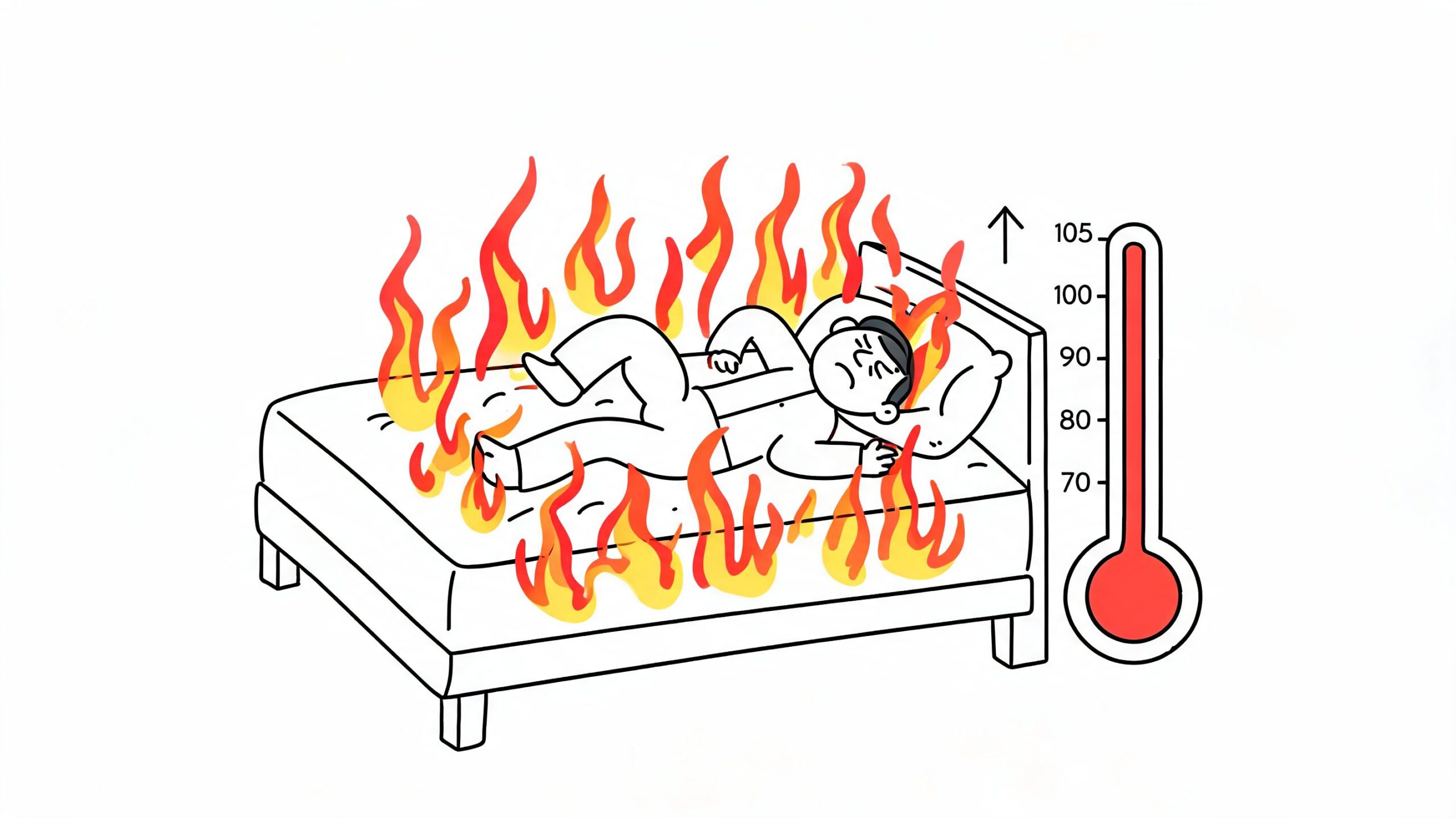
Some mattresses hold warmth the way a heavy winter coat holds body heat. That can be pleasant for a few minutes. It's much less pleasant at midnight when you're trying to settle into deeper sleep.
Heat gets trapped close to your body
Your body gives off heat all night. If the surface under you can't release that heat, it starts to collect in the exact spots where you press most into the mattress. Shoulders, hips, lower back, and legs become warm zones.
That's why people often say, “The bed feels hot, not the room.” They're noticing the microclimate right around their body. A mattress that limits air movement can make that pocket of warmth linger longer than it should.
Why dense foam often sleeps warmer
Traditional memory foam is a common example. It contours closely, which many people love for pressure relief, but that same close hug can reduce breathing room around the body. NCOA's cooling mattress analysis notes that traditional memory foam can trap heat and raise the surface temperature by 10 to 20 degrees Fahrenheit after a person lies on it, while top cooling mattresses show minimal increases of only 6 to 7.5 degrees.
That difference helps explain why two mattresses can feel similar in a showroom at first, then behave very differently later in the night.
Consider this perspective:
- Dense, close-conforming foam acts a bit like insulation. It surrounds more of your body and slows heat release.
- More open, breathable construction gives warmth somewhere to go.
- Your sink depth matters because the deeper you settle in, the more contact your body has with heat-holding material.
A mattress doesn't have to feel firm to sleep cooler. It has to manage heat better.
Readers often get confused at this point. They assume “cooling” means a chilly surface. Usually, it means the mattress avoids becoming progressively warmer while you rest. That's a much more useful kind of comfort.
Decoding Modern Cooling Mattress Technologies
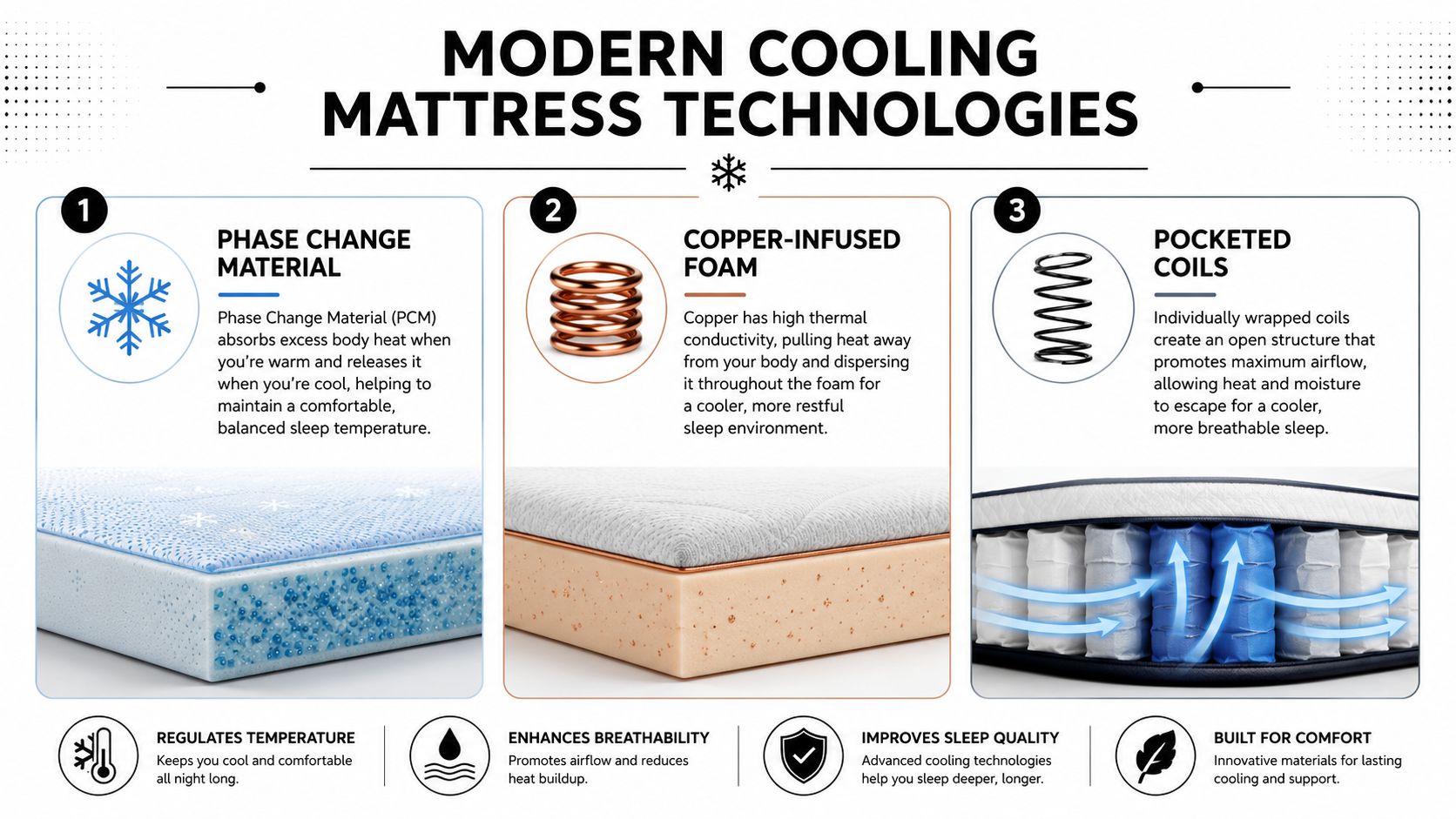
Cooling mattresses use a few different strategies. Some create airflow. Some move heat away from the surface. Some reduce the “stuck in the bed” feeling that lets warmth accumulate. The best mattress for hot sleepers often combines more than one of these approaches.
If you've seen the phrase “hybrid mattress” and wondered whether it's just another buzzword, our explainer on what a hybrid mattress is gives useful background. For hot sleepers, the construction matters a lot.
Hybrid mattresses and moving air
A hybrid mattress combines foam comfort layers with a coil support core. That coil system creates open space inside the mattress, which helps air move more freely than it can through an all-foam bed. Mattress Nerd's cooling mattress testing reports that hybrid mattresses excel for hot sleepers because their pocketed coil systems create open air channels that promote convective airflow, and a top-performing hybrid raised the temperature by only 7 degrees Fahrenheit, while traditional memory foam can exceed 15°F.
The term “convective airflow” sounds more intimidating than it is. It means air can circulate through the interior of the mattress instead of getting blocked by dense material.
Hybrids are often a strong match for people who want:
- Pressure relief with less heat retention
- A more lifted, supported feel
- Better airflow through the core
- A balance of cushioning and structure
Store-floor insight: If you lie on a hybrid and feel more “on the mattress” than “in the mattress,” that often helps with temperature comfort too.
Gel infused and open cell foams
Foam itself isn't the enemy. The structure of the foam matters.
Modern cooling foams may use gel infusion, open-cell design, or specialty covers intended to pull warmth away from the body more efficiently than older dense foams. In plain language, these materials are trying to do two jobs at once. They cushion pressure points and avoid acting like a heat sponge.
Shoppers should slow down and ask better questions at this stage. A mattress can contain foam and still sleep comfortably if the layers are engineered for airflow and paired with a breathable overall build. What matters is not just the word “foam,” but how much of it there is, how dense it feels, and what sits underneath it.
Latex and naturally breathable comfort
Latex appeals to many hot sleepers because it tends to feel buoyant rather than contouring. That responsive feel can leave more space around the body, which many people describe as fresher and less enclosed.
Latex also tends to suit shoppers who want:
| Technology | How it helps with cooling | Best fit for |
|---|---|---|
| Hybrid coils | Creates internal airflow channels | Sleepers who want support and breathability |
| Gel or open-cell foam | Aims to disperse warmth more effectively than dense traditional foam | People who still want cushioning and contouring |
| Latex | Feels springier and less heat-hugging | Shoppers who dislike the “sinking” sensation |
Many shoppers need more than a generic firmness choice. That's where customization becomes valuable. A Special Order Program can open the door to personalized comfort levels and, with many vendors, choices that align support with cooling-focused materials. That matters if you want a mattress that feels personal rather than approximate.
Matching a Cooling Mattress to Your Sleep Style
A cooling mattress only works well if it also supports your body correctly. If the feel is wrong, you may sink too much, create extra heat buildup, or wake up sore even if the surface feels cooler.

That's why the best mattress for hot sleepers should be chosen through both lenses. Temperature regulation matters. Proper support matters just as much. If you want a head start, a guide like choosing the right mattress for your sleeping style helps narrow the field before you visit a store.
Side sleepers need pressure relief without heat buildup
Side sleepers usually need more cushioning at the shoulders and hips. The challenge is that softer comfort layers can also increase sink, and more sink can increase warmth around the body.
A good solution is often a mattress that feels pressure relieving on top but still has a supportive, breathable core underneath. Many side sleepers do well with a cooling hybrid or a responsive latex design that softens impact without swallowing the body.
Back and stomach sleepers often need a firmer feel
Back sleepers usually benefit from support that keeps the midsection from dipping too far. Stomach sleepers often need even more resistance through the center of the mattress. In both cases, a more supportive feel can reduce excess body immersion, which often helps with temperature comfort too.
That doesn't mean every hot sleeper should buy the firmest bed in the showroom. It means you want enough support to keep your body lifted and aligned.
Couples and combination sleepers benefit from customization
Combination sleepers have a special challenge. They move, rotate, and change pressure points throughout the night. Good Housekeeping's cited survey data notes that 62% of hot sleepers over 45 also switch positions nightly, yet only 15% of standard mattresses offer firmness customization to address both temperature spikes and changing support needs.
That's a useful reminder that “best overall” doesn't always mean “best for you.”
A personalized approach often makes more sense for:
- Couples with different comfort preferences
- Shoppers who sleep hot and also have back support concerns
- People whose sleep position changes during the night
- Those who want one mattress to solve more than one comfort problem
The right cooling mattress should fit the way you sleep, not just the way a product page describes itself.
Expert guidance matters in this context. Style Quizzes can help identify the broader bedroom feel you're after, while a Mattress Guide and experienced in-store associates help translate your sleep habits into a mattress that feels personalized, not generic. In many cases, Special Order options from select vendors allow more control over comfort levels, giving combination sleepers and couples a far better chance at a lasting fit.
Creating a Complete Sanctuary for Cool Sleep
A mattress does most of the heavy lifting, but it doesn't work alone. Sheets, pillows, protectors, bed frames, and even the visual openness of the room all shape how your bed feels at night.
Your bedding can help or hurt
The fastest way to undermine a cooling mattress is to cover it with heavy, less breathable layers. If your bed feels warm despite a good mattress, look up before you look down. Your sheets and protector may be holding onto heat.
Natural, breathable fabrics usually feel more comfortable for hot sleepers than slick, less breathable options. If you're comparing fabrics, this guide to cotton sheets for hot sleepers is a helpful starting point. For a more complete overview of layers that sit between you and the mattress, our own guide to bedding, mattress protectors, and comforters can help you build a cooler setup from the top down.
A cooler sleep environment usually includes:
- Breathable sheets that don't feel heavy or overly slick
- A lighter comfort layer so heat doesn't collect under thick bedding
- A pillow that releases warmth well instead of trapping it around your head and neck
- A protector chosen carefully so it guards the mattress without turning the surface stuffy
Your bed frame and bedroom setup matter too
Airflow under the mattress matters more than many shoppers expect. A bed frame with a more open structure can support better circulation around the mattress than a fully enclosed base. If you're furnishing a whole room, design and comfort meet here.
An airy bedroom can feel more restful in both temperature and appearance. A slatted or visually lighter bed from brands such as Hooker Furniture, Lexington, or Bassett can complement a cooling mattress while helping the room feel less heavy overall. These details matter if you're creating a curated sanctuary instead of swapping one item in isolation.
A cool bedroom isn't built from one product. It comes from several breathable choices working together.
That broader view also makes shopping easier. Instead of asking one mattress to solve every comfort issue, you create a system that supports cooler rest night after night.
How to Test a Mattress in Our Showrooms
Online research is useful, but temperature comfort becomes much easier to judge when you can lie down and compare materials side by side. A showroom visit should feel clarifying, not overwhelming.
Start online and build a shortlist
Before visiting, narrow your options using digital tools. A good first step is reviewing practical advice on tips for buying a new mattress. That gives you language for firmness, support, and materials, so the store visit feels more focused.
If the retailer offers a Mattress Guide, use it. It helps you arrive with better questions, such as whether you prefer buoyant support or deeper contouring, and whether you need cooling plus pressure relief, cooling plus lumbar support, or cooling plus customization for two sleepers.
What to do once you lie down
Many shoppers test a mattress too quickly. They sit on the edge, bounce once, and decide. That won't tell you much about heat management or full-body support.
Do this instead:
- Lie down in your normal sleep position and stay there long enough to notice pressure points.
- Roll to your second-most-common position if you move during the night.
- Pay attention to sink depth. Do you feel gently cradled, or swallowed by the top layers?
- Notice the surface and the support separately. A mattress can feel plush on top and still keep you lifted underneath.
- Ask the associate to compare similar models with different constructions, such as hybrid versus all-foam.
Finish with delivery confidence
The best showroom experience connects digital research and in-person testing without pressure. That's where omnichannel ease matters. You should be able to browse online, use style tools, visit a showroom in Fernandina Beach, FL, and continue the conversation with knowledgeable associates who can help you sort through what felt best.
White-glove service matters too, especially for an investment piece like a mattress. The strongest retailers don't stop at the sale. They pair your selection with in-home delivery and a rigorous multi-point inspection before the piece reaches your home. That kind of care is part of what makes a purchase feel settled and trustworthy from start to finish.
For shoppers in South Georgia and North Florida, that blend of online convenience and in-store guidance often makes the decision much easier.
Your Cooling Mattress Questions Answered
A few questions tend to come up near the end of the search. These are the ones we hear most often from shoppers trying to find the best mattress for hot sleepers.
Quick answers that clear up common confusion
Some people want a simple rule like “firm sleeps cooler” or “foam always sleeps hot.” Real life is a little more nuanced than that. Construction, materials, support, and bedding all work together.
Others hope a topper will solve everything. Sometimes it helps. Sometimes it adds another layer that changes the feel without fixing the underlying issue. That's why it helps to look at the full sleep system before spending more money on accessories.
If you're waking up hot every night, look at the mattress first, then the bedding around it. That order saves time.
Frequently asked questions for hot sleepers
| Question | Answer |
|---|---|
| Is a firm mattress always cooler than a soft one? | Not always. Firmer mattresses can reduce deep sink, which may help some sleepers feel cooler, but the materials matter more than firmness alone. A breathable plush hybrid may sleep cooler than a dense firm foam bed. |
| Are hybrid mattresses usually a good choice for hot sleepers? | Often, yes. Their coil systems create room for airflow, which many hot sleepers notice right away in the overall feel. |
| Can a cooling topper fix a hot mattress? | It can improve the surface feel, but it won't always solve heat trapped in the mattress core. If the underlying bed retains heat, the improvement may be limited. |
| Do cooling covers make a real difference? | They can help with the immediate surface feel, especially at first contact. They work best when paired with breathable internal construction. |
| What if I'm a hot sleeper and also need pressure relief? | Look for balance. A cooling hybrid or responsive latex model often gives both support and cushioning without the deep, heat-holding hug some sleepers dislike. |
| How should couples shop if one person sleeps hotter? | Start by identifying shared needs like support and motion comfort, then look for models or special-order options that offer a more personalized comfort setup. |
| Should I replace my bedding too? | Sometimes yes. Breathable sheets, a suitable protector, and a lighter comforter can help a cooling mattress perform the way it should. |
A cooler bed should feel supportive, breathable, and easy to settle into. If it only checks one of those boxes, keep looking.
If you're ready to compare cooling mattresses in person, browse the digital catalog or plan a showroom visit with Lott's Furniture. Our team serves South Georgia and North Florida with expert guidance, helpful Mattress Guide tools, Style Quizzes, and a Special Order Program that lets many vendors tailor comfort levels, fabrics, and finishes to your home. Visit our Waycross or Fernandina Beach, FL showrooms to test options firsthand, and count on white-glove in-home delivery plus a rigorous multi-point inspection before your new piece arrives.