Save 50% Off MRSP on Lexington | Shop the Catalog >

Innerspring Mattress vs Hybrid: Your 2026 Buying Guide

A lot of mattress shoppers arrive at the same point. They've read product pages, skimmed reviews, learned a few new words like pocketed coils and comfort layers, and still can't tell why one bed feels buoyant while another feels cushioned. Ultimately, the question usually isn't which mattress sounds more advanced. It's which one will feel right at midnight, at 3 a.m., and again six years from now.
That's why the innerspring mattress vs hybrid decision matters so much. These two categories may look similar from the outside, but they create very different sleep experiences. One leans into the classic lifted, springy feel many households grew up with. The other blends coils with deeper cushioning for a more adaptive surface.
The confusion is understandable. Hybrid mattresses have become a major part of the market, with the category valued at USD 3.62 billion in 2026 and projected to reach USD 6.39 billion by 2031, growing at a 12.05% CAGR from 2026 to 2031 according to hybrid mattress market projections from Mordor Intelligence. That growth reflects how many shoppers are searching for a balance of support and comfort rather than a one-note feel.
Navigating the World of Mattresses
A common scene plays out in homes across South Georgia and North Florida. One person wants the mattress to feel firm and supportive. The other wants enough cushioning to keep shoulders and hips from feeling sore. Both start searching for answers online, and within minutes they're buried under a pile of terms that sound more technical than helpful.
The innerspring mattress vs hybrid comparison often becomes the turning point. It's the fork in the road where shoppers stop asking, “What's on sale?” and start asking, “What fits the way this body sleeps?” That's a better question.
Why this choice feels harder than it should
Both mattress types use coils. That fact alone trips people up. If both have springs inside, many assume they'll feel nearly the same. They won't.
An innerspring usually delivers a more familiar, lifted feel. A hybrid uses coils too, but adds thicker comfort materials on top, which changes how the body settles into the bed. That extra material can soften pressure points, reduce the sharpness of movement, and create a more layered sensation.
Practical rule: If a mattress description focuses only on firmness and skips construction, it's leaving out the part that explains why two “firm” beds can feel completely different.
The better way to shop
Digital research helps narrow the field. In-person testing finishes the job. That combination matters because mattress feel is physical, not theoretical.
Useful prep often includes:
- Reading construction details: Look for coil style and how much comfort material sits above the support core.
- Using guided tools: A digital mattress guide and style quizzes can help organize preferences before a store visit.
- Testing with purpose: A showroom visit in Fernandina Beach, FL gives shoppers a chance to compare sensations side by side instead of guessing from marketing language.
For households building a curated sanctuary, this same blend of online planning and in-store confirmation often applies across the home. It's why thoughtful shoppers also compare heirloom-quality brands such as Stressless, Lexington, and Hooker Furniture in person before making a long-term decision.
The Anatomy of an Innerspring vs Hybrid Mattress
The simplest way to understand these mattresses is to think of them as two different recipes built around coils. The coil system is the base. What changes is how much material sits above it and how those coils behave under weight.
Early in the shopping process, a clear side-by-side table helps.
| Feature | Innerspring Mattress | Hybrid Mattress |
|---|---|---|
| Core construction | Coil-based support system with thinner top padding | Coil-based support system with thicker comfort layers |
| Comfort layer depth | Typically less than 2 inches | At least 2 inches of comfort materials |
| Coil style | Often continuous or tied coils | Usually individually wrapped pocketed coils |
| Feel | More lifted, springy, on-the-bed | More cushioned, contouring, balanced |
| Motion response | More bounce, more movement across the bed | Better motion isolation |
| Best known for | Traditional support and responsiveness | Blend of pressure relief and support |
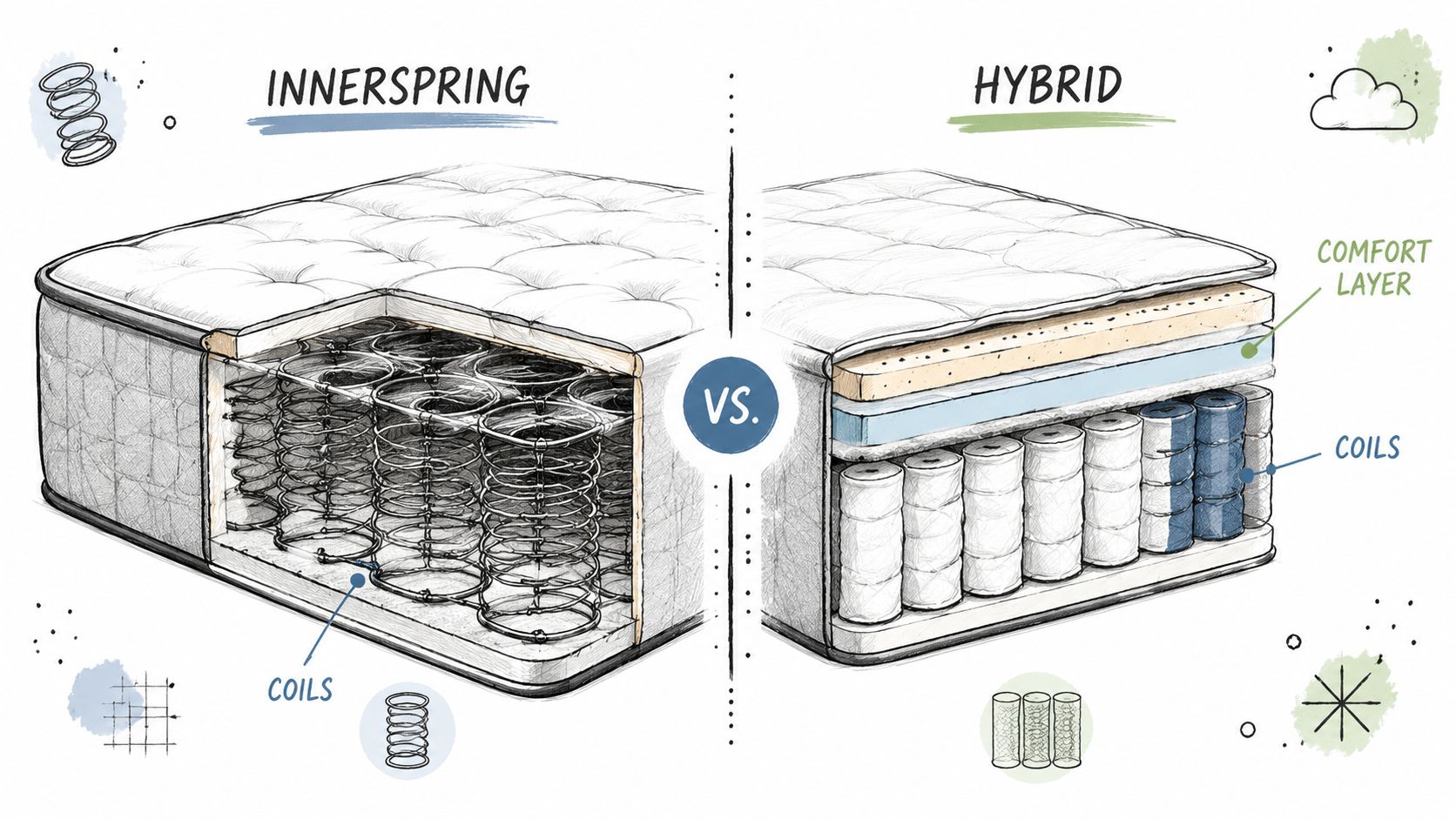
This visual helps clarify the structure.
What defines an innerspring mattress
An innerspring mattress is the traditional model many people recognize right away. Its identity comes from the spring unit. The comfort material on top is usually comparatively thin, so the sleeper feels more of the support system and less of a deep cradle.
That creates a surface many people describe as buoyant, responsive, or easy to move around on. Instead of nestling into the mattress, the body tends to rest more on top of it. For some sleepers, especially those who dislike sink or want a straightforward, familiar feel, that's a strong advantage.
What defines a hybrid mattress
A hybrid isn't just an innerspring with a little extra padding. It has a technical threshold. A hybrid mattress contains at least 2 inches of comfort materials in its top layers, while innerspring mattresses typically have less than 2 inches. Hybrids also almost exclusively use individually wrapped pocketed coils, which help isolate motion, as explained in this overview of what makes a hybrid mattress different and in this closer look at hybrid mattress construction.
That construction changes both feel and function. Instead of a single broad spring response, the mattress can react in a more localized way. If one sleeper shifts position, the entire bed is less likely to answer back.
A simple analogy that helps
An innerspring is like a well-built dining chair with a lightly padded seat. Support comes first, and comfort sits on top of that support.
A hybrid is closer to an upholstered accent chair with a structured frame underneath. The frame still matters, but the body notices the cushioning earlier.
Many shoppers don't need more jargon. They need to know whether they'll feel held up, eased in, or somewhere in between.
That distinction is the heart of the innerspring mattress vs hybrid conversation.
A Detailed Comparison of Key Performance Metrics
Specs matter only if they connect to sleep. The most useful comparison focuses on what the body notices after an hour, a full night, and repeated use over time.
Pressure relief and body contouring
Pressure relief is where hybrids usually stand apart. Their thicker comfort layers allow more contouring around the shoulders, hips, and other areas that press hardest into the mattress.
By contrast, innersprings tend to feel flatter and more direct. Some sleepers love that. Others wake up feeling like the mattress pushed back without enough cushion in the areas that needed it most.
A useful mental test is this. If a sleeper often shifts because a shoulder feels jammed or a hip feels tender, a surface with more contouring may feel noticeably better.
Bounce and ease of movement
Innerspring mattresses usually feel livelier. The surface responds quickly, and many people find that easier for changing positions, sitting up, or getting in and out of bed.
Hybrids can still be responsive, but the comfort layers soften the spring sensation. That doesn't automatically mean slow. It means the bounce feels more moderated.
This matters for:
- Combination sleepers: People who roll between positions often notice how quickly a mattress resets under movement.
- Those who dislike sink: A traditional innerspring can feel cleaner and more lifted.
- People who want cushioning without sluggishness: A well-balanced hybrid often lands in that middle ground.
Motion transfer for couples
This is one of the biggest practical differences. Because hybrids typically use pocketed coils and thicker comfort materials, they usually keep movement more contained. One sleeper turning over is less likely to ripple across the whole mattress.
Traditional innersprings often transmit more motion because their coil systems are more interconnected and their top layers are thinner. For light sleepers, that can be the deciding factor.
Edge support and usable sleep surface
Edge support gets oversimplified online. Many shoppers hear that innersprings have sturdy edges and hybrids have softer ones, then assume softness and weakness are the same thing. They aren't.
Traditional innersprings are known for sturdy edges, but many high-end hybrids now use reinforced perimeter coils and high-density foam zoning to match that durability while also improving pressure relief, according to this explanation of modern hybrid edge support engineering.
That's why edge testing matters in person. Sit on the side. Then lie near the perimeter. Those are two different experiences. A mattress can feel cushioned at the edge without collapsing at the edge.
Support and firmness perception
Support and firmness aren't the same thing, and many shoppers mix them together. A mattress can feel firm but still not support the body well in the right places. It can also feel cushioned on top while maintaining strong underlying support.
Shoppers trying to sort that out often benefit from a deeper read on how mattress firmness really works before buying.
Here's the practical distinction:
- Innerspring support feel: More immediate pushback, more lifted posture, less sink.
- Hybrid support feel: Support from beneath the body with a softer welcome at the surface.
Cooling and airflow
Both mattress types benefit from coil systems, which allow airflow through the interior. That makes both appealing to shoppers who don't want the denser feel of an all-foam bed.
Still, cooling isn't just about coils. It's also about how warm or cushioned the top layers feel to the individual sleeper. Some people perceive the cleaner, firmer surface of an innerspring as cooler because there's less contouring around the body.
Quick comparison checklist
| Metric | Innerspring Mattress | Hybrid Mattress |
|---|---|---|
| Pressure relief | More limited | Stronger contouring |
| Bounce | Higher | Moderate to balanced |
| Motion isolation | Lower | Better |
| Edge reputation | Traditionally strong | Increasingly strong in well-engineered models |
| Surface feel | On-the-bed | Blend of on-the-bed and in-the-bed |
| Best fit for shoppers who want | Traditional responsiveness | Balanced support with cushioning |
Who Sleeps Best on Which Mattress Type
A mattress category doesn't choose the sleeper. The sleeper chooses the feel. Sleep position, body build, and comfort preference all change the answer.
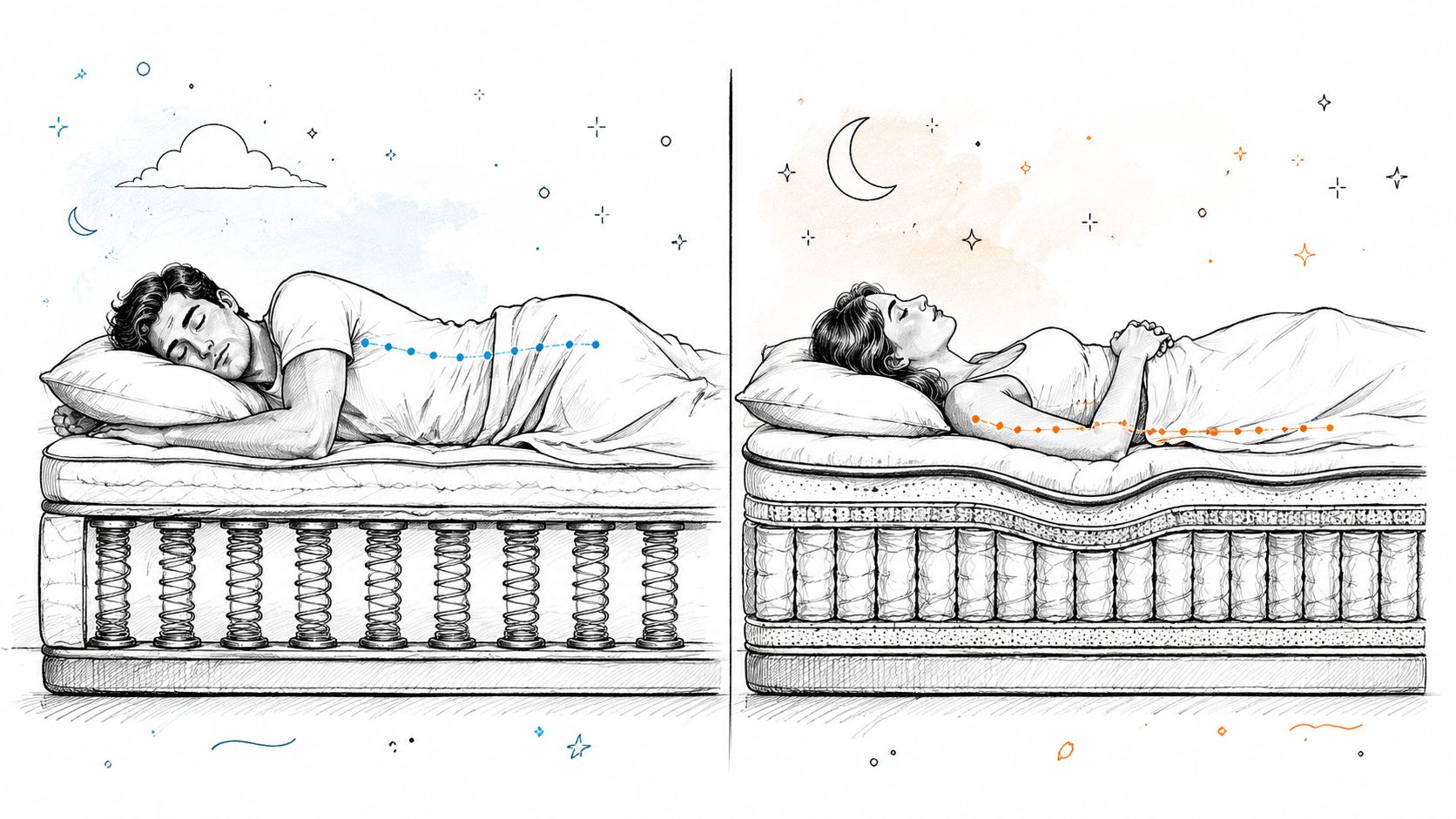
This side-by-side image helps translate the difference into body experience.
Side sleepers and pressure-prone sleepers
Hybrid mattresses are generally softer and provide greater pressure relief and contouring for side sleepers, while innerspring mattresses are typically firmer and offer the responsive bounce that suits back and stomach sleepers who prefer firm support, as described in this review of sleep position differences between hybrid and innerspring models.
That guidance makes practical sense. Side sleepers place more concentrated pressure on the shoulder and hip. A mattress with thicker comfort layers often helps those areas settle more naturally.
Back and stomach sleepers
Back sleepers often want even support that keeps the midsection from dipping too far while still feeling comfortable through the shoulders and lower back. Some prefer the traditional steadiness of an innerspring. Others prefer a firmer hybrid that adds a bit more surface comfort without losing alignment.
Stomach sleepers usually notice too much softness quickly. If the hips sink more than the chest, the lower back can feel strained. That's why many stomach sleepers gravitate toward the firmer, more lifted character of an innerspring or a clearly supportive hybrid.
A sleeper who says, “I don't want to feel swallowed by the bed,” is often describing feel preference more than firmness preference.
Couples and mixed preferences
Couples frequently need a compromise. One person may want cushioning. The other may want support and ease of movement. A hybrid often enters the conversation because it can satisfy both sides more gracefully than a very traditional innerspring.
This is also where personalization matters. Many mattress vendors support personalized comfort options through a Special Order Program, allowing adjustments to comfort levels much like custom choices available across home furnishings, from upholstery details to support preferences.
Body type and feel matching
Body type changes perception. A lighter sleeper may not press sufficiently into a very firm innerspring to feel comfortable. A heavier sleeper may need stronger support layers to keep the body from settling too far.
Shoppers trying to connect sleep style and build can sort through those variables with guidance on which mattress suits different body types.
A practical guide:
- Lighter sleepers: Often appreciate enough cushioning to engage the comfort layers.
- Average-build sleepers: Usually choose based on sleep position and feel preference.
- Heavier sleepers: Often benefit from substantial support and careful attention to how the mattress holds alignment near the midsection and edges.
For households also furnishing guest rooms, second homes, or full bedroom suites, the same personalized mindset often extends to trusted names such as La-Z-Boy, Smith Brothers, and Stressless, where comfort is rarely one-size-fits-all.
The Investment Quality and Value of Your Sleep
A mattress isn't just another household purchase. It's one of the few pieces in a home that affects the body every single night. That changes how value should be judged.
Upfront price versus useful life
An innerspring mattress can be a very sensible choice for shoppers who want a value-focused entry point and a classic sleep surface. For many homes, that's the right call. Guest rooms, vacation properties, and sleepers who strongly prefer a spring-forward feel may find it fits beautifully.
A hybrid often asks for more at the start, but the long-term picture can look different. According to this breakdown of innerspring and hybrid lifespan differences, innerspring mattresses average 6 to 8 years, while well-made hybrid mattresses offer 10+ years. The same source notes that a queen-size innerspring typically ranges from USD 500 to USD 1,800, while a queen-size hybrid ranges from USD 500 to USD 2,700.
That's why many shoppers evaluate a hybrid as an investment-quality choice rather than a simple upgrade. If the mattress maintains comfort and support longer, the higher opening price may feel more reasonable over time.
The role of durability in real value
Durability isn't only about whether coils are still intact. It's about whether the mattress still feels good enough to use with confidence. Surface comfort, edge integrity, and support consistency all matter.
Worth remembering: A mattress can still look presentable while no longer feeling supportive in the places that matter most.
That's one reason sleep shoppers increasingly think in terms of total use, not sticker shock. Those weighing the long view can explore more on why a high-quality mattress matters for long-term well-being.
Delivery and finish matter too
Value also includes what happens after the purchase. For many homeowners in South Georgia and North Florida, confidence comes from knowing the mattress will arrive through white-glove, in-home delivery, not as a curbside headache. It also matters that each piece goes through a rigorous multi-point inspection before reaching the home.
That same standard often guides bigger furnishing decisions, whether the room includes a mattress alone or a full bedroom anchored by brands like Lexington or Hooker Furniture.
How to Test an Innerspring vs a Hybrid Mattress
Online research can narrow the choices. It can't replace feel. The body notices things a product description can't fully explain, especially with innerspring mattress vs hybrid comparisons.
This is the moment where digital browsing and in-person testing should work together. A digital catalog, style quizzes, and a mattress guide help shoppers arrive prepared. The showroom visit confirms what the body prefers.

How to test with purpose
A quick sit on the edge isn't enough. A better test looks like this:
Lie in your usual sleep position
Stay on the mattress in the position most often used at home. Side sleepers should spend time on the shoulder and hip. Back sleepers should notice whether the lower back feels supported or strained.Give it time
Stay put for several minutes. The first impression often reflects surface feel. The better impression comes once the body settles.Roll and reset
Turn from side to back, or back to stomach, and notice how easy movement feels. Innersprings often feel quicker and springier. Hybrids often feel smoother and more cushioned.
What to pay attention to
Notice the practical details:
- At the shoulder and hip: Is there pressure, or does the surface give enough?
- At the edge: Does it feel steady when sitting and secure when lying near the perimeter?
- At the lower back: Does the mattress keep the torso level, or does something feel off?
Shoppers preparing for an in-store visit often benefit from these practical mattress buying tips.
For homeowners moving between online browsing and a showroom in Fernandina Beach, FL, that integrated process often makes the decision feel far less abstract.
Your Perfect Sleep Sanctuary Awaits at Lotts Furniture
The best answer in the innerspring mattress vs hybrid conversation is rarely universal. Some sleepers want the classic buoyant support of an innerspring. Others want the more adaptive comfort of a hybrid. Most want to stop guessing and choose the bed that feels right in their own body.
That's where a local, expert-guided experience matters. For shoppers across South Georgia and North Florida, the strongest path often starts online with style quizzes, the mattress guide, and a digital catalog, then moves into a showroom visit in Fernandina Beach, FL for hands-on testing. The process feels more grounded because it connects research with reality.
Customization also deserves a place in the decision. A thoughtful Special Order Program gives many shoppers access to personalized comfort options, just as custom fabrics, finishes, and support preferences shape the rest of a well-designed home. That approach turns mattress shopping from a transaction into a customized choice.
The finish matters too. White-glove, in-home delivery removes stress from the final step, and a rigorous multi-point inspection helps ensure the piece that enters the home is ready to become part of a curated sanctuary from the first night forward.
For homeowners ready to compare comfort in person, Lott's Furniture offers a convenient path from online research to showroom testing in Fernandina Beach, FL. Explore the digital catalog, take the style quizzes, use the Mattress Guide, and ask about the Special Order Program for personalized comfort options. For South Georgia and North Florida shoppers who want expert guidance, trusted in-store associates, and white-glove in-home delivery backed by a rigorous multi-point inspection, a showroom visit or online style consultation is the natural next step.