
Small Swivel Recliners: Sizes, Mechanisms and Fit Guide


A corner by the window looks empty enough for one more chair. The sofa fits, the side table fits, and there's still room to walk through, yet the first recliner that arrives can't turn without clipping the table and can't recline without the headrest hitting the wall. That mismatch is the central problem with small swivel recliners. A narrow label doesn't tell a homeowner whether the chair will rotate, recline, and support every person who uses it after delivery.
The better starting point is a full operating envelope and a proper seat test. Shoppers across South Georgia and North Florida furnishing apartments, bedrooms, nurseries, and coastal vacation homes need measurements that hold up in the room, not just on a product page. The smallest chair isn't automatically the best small-space choice.
Target Dimensions for Small Swivel Recliners
A practical screening range puts small swivel recliners at 28 to 33 inches wide, 32 to 36 inches deep, and 38 to 42 inches high across the back, according to Homestyler's compact recliner guide. The same guide puts seat height around 16 to 18 inches for flat-foot placement and a near-90-degree knee angle, with seat depth around 19 to 21 inches to preserve lumbar contact for many users. Those ranges are a screening benchmark, not a universal ergonomic standard. Each shopper's body still decides whether a specific model works.
| Measurement | Target range | What it controls |
|---|---|---|
| Overall width | 28 to 33 in | Floor footprint beside other seating |
| Overall depth | 32 to 36 in | Clearance from walls and walkways |
| Back height | 38 to 42 in | Head and neck support |
| Seat height | 16 to 18 in | Flat-foot placement and knee angle |
| Seat depth | 19 to 21 in | Lumbar contact and thigh support |
| Swivel radius | 14 to 17 in from center | Rotation room in the living area |
How to Read Each Small Swivel Recliner Measurement
Overall width determines whether two chairs can share a wall or flank a sofa without crowding circulation space. A chair at the low end leaves more breathing room for a table or lamp, but the internal seat width may feel restrictive. Overall depth matters differently because a closed chair only shows its starting position.
Back height controls whether the headrest meets the head or stops at the shoulders. Taller users often need the upper end of the range, while shorter users may find a tall back pushes the head forward. Seat height then decides whether feet rest flat or dangle, which changes pressure under the thighs.
Seat depth is the measurement shoppers most often underestimate. Excessive depth forces slouching because the pelvis can't stay supported at the back of the seat while knees align with the seat edge. Insufficient depth reduces thigh support and can make a chair feel perched rather than settled.
Screening rule: Treat "compact" as a claim to verify, not a dimension. The spec sheet decides.
What Closed Depth Does Not Show
Closed depth doesn't show how far the back reaches once reclined. A claimed wall-hugger feature should be judged by its actual required wall clearance, not by closed depth alone. Two chairs with identical closed depth can project very differently into a room.
Before comparing prices or fabrics, shoppers should write down five numbers for every model on the shortlist. That short record prevents a pretty finish from outranking a chair that cannot operate in the space.
- Seat width: Confirms elbow room inside the arms, not just outside width.
- Seat depth: Checks lumbar contact without forcing a slouch.
- Closed depth: Shows the everyday footprint against the wall.
- Fully reclined depth: Reveals how far the chair reaches into the room.
- Swivel radius: Shows the arc the arms and back need to turn cleanly.
That list turns a vague label into a usable comparison. It's also the record to bring into a showroom, because an associate can match those numbers to floor models instead of guessing from memory.
Swivel vs. Swivel-Glider Mechanisms Compared
Mechanism choice should come before color. A standard swivel rotates on a fixed base while the seat stays in place, and a swivel-glider adds forward-and-back motion on top of rotation. Both can recline, but they ask different things of the room.
| Feature | Swivel | Swivel-glider |
|---|---|---|
| Motion | Rotates on a fixed base | Rotates and glides forward and back |
| Clearance needed | Turning arc plus wall space at the back | Turning arc plus glide path in front and behind |
| Typical footprint | Smallest, can sit closer to a wall | Needs extra depth for the glide |
| Best fit | Tight rooms, shared seating, changing sightlines | One user who wants gentle motion |
| Check before buying | Swivel radius and base stability | Glide path distance and noise over time |
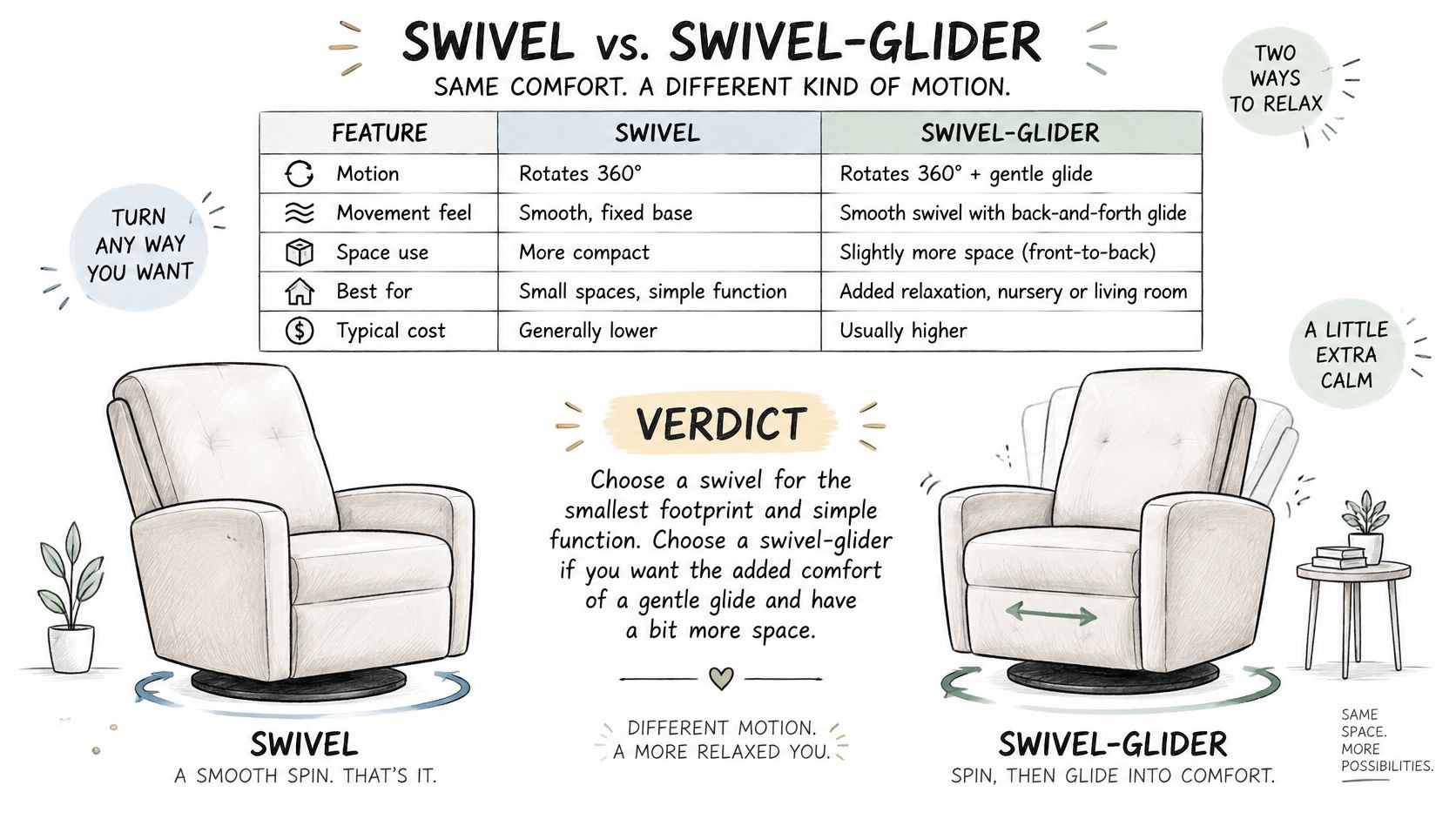
A glider's extra motion only helps if the room has space behind the chair as well as in front of it.
Clearance Needs for Swivel and Swivel-Glider Recliners
Consider a bedroom corner where a dresser door swings close to the chair. A swivel can turn toward a window and back without traveling, so the dresser door stays clear. A swivel-glider in that same corner may glide into the door's path even though its closed footprint looked safe on paper.
A living room tells a different story when seating faces both a television and a conversation area. There, rotation earns its keep every day, and a glider's gentle motion can suit a reader who stays seated for long stretches. Space behind the chair still decides whether that motion stays pleasant or becomes a constant negotiation with the wall.
Shoppers weighing motion style alongside operation should also review the power recliner versus manual recliner comparison before narrowing the list. Power and manual controls change how the recline feels, but they don't change the clearance the mechanism needs. Both decisions belong on the same worksheet.
Mechanism Feel, Noise and Brand Differences
- Swivel smoothness: Rotation should feel controlled, with no wobble at the base and no grinding through the turn.
- Glide quality: The back-and-forth path should start and stop without a clunk at either end.
- Noise over time: A quiet showroom glide can loosen with use, so shoppers should ask for a live demonstration and move the chair repeatedly, not once.
- Base stability: Weight should stay centered when leaning toward an arm or reaching for a table.
Brands carried at Lott's Furniture, including La-Z-Boy and Stressless, use different mechanisms across their lines, so the mechanism must be verified for each model rather than assumed from the brand name. A floor sample in one collection doesn't prove how another collection turns or glides. Model-specific testing protects the shopper from that assumption.
The decision rule stays simple. Choose a swivel when rotation and tight placement matter most. Choose a swivel-glider when gentle motion matters and rear clearance has already been measured with a tape, not estimated from closed depth.
How to Measure Swivel Clearance Before You Buy
Recent home-furnishing survey coverage in Euromonitor's home and garden trends report reported large-furniture purchases at 41% of purchases and small-furniture purchases at 39%, which underlines how deliberate furniture decisions have become across room sizes. Deliberate starts with a worksheet. Seven steps, done in order, show whether a chair fits and functions after delivery.
The Seven-Step Swivel Clearance Worksheet
- Measure the delivery path. Record the narrowest point across doorways, hallway turns, stairs, and any elevator opening. A chair that fits the room but can't reach it is still the wrong chair.
- Tape the footprint. Mark the manufacturer's width and depth on the floor with painter's tape. Stand back and check what remains for walking, not just what the chair occupies.
- Mark the swivel arc. Measure the radius from the center of the base, then add a hand's width for the arms. That arc is the space the chair claims every time it turns.
- Test the reclined position. Extend the tape to the fully reclined depth inside the marked space. Note how far the back projects into the room and what it now blocks.
- Check nearby furniture. Side tables, lamps, dressers, and door swings all compete with rotation. Move anything that sits inside the arc before assuming the chair is too large.
- Separate width from projection. A chair can be narrow yet reach far into the room when reclined, so narrow width and low projection are different virtues. Both need their own number.
- Record and compare. Write each measurement beside the spec sheet figure for every shortlisted model. Gaps between the two columns are where returns begin.
Shoppers planning a whole room around the chair can cross-check those figures against standard living room furniture dimensions for sofas, tables, and spacing. That keeps the recliner decision connected to the rest of the layout. A chair rarely fails alone; it usually fails against something beside it.
Measure the Body as Well as the Room
A frame that fits the floor plan may still offer shallow seat depth, short leg support, or tight elbow room for taller users. Measuring the room without measuring the sitter solves only half the problem. Both sets of numbers belong on the same page.
Placement standard: Lott's Furniture offers white-glove, in-home delivery, and each order is fully inspected through a rigorous multi-point inspection and placed exactly where the customer wants it.
That delivery standard matters here for a practical reason. The placement taped on the floor during the worksheet is the placement the delivery team works to on arrival, after the piece has passed inspection. Any recliner that clears all seven steps becomes a strong candidate for hands-on comfort testing.
Seat Height, Depth and Recline Comfort Checks
A recliner can fit the room and still leave its user perched, slouched, or without enough leg support. A 10-to-15-minute showroom sit helps reveal those fit problems. Sit fully back with the pelvis supported, feet resting naturally on the footrest, and knees aligned with the seat edge. Then check four contact points.
The Ten-Minute Small Swivel Recliner Test Sit
- Lumbar contact: The lower back should stay supported without sliding forward to keep the feet grounded.
- Headrest support: The head should rest comfortably, with the neck neutral and the chin level.
- Arm height: Elbows should rest on the arms without the shoulders lifting or drooping.
- Footrest length: When reclined, the calves should feel supported and the heels should not extend far beyond the footrest.
Check the motion while seated. Swivel, recline, return upright, and repeat. Listen for unusual noise and notice any catching or abrupt movement. The chair should feel controlled through the full sequence.
What Recline Angle Research Means for Comfort
Reclining can reduce spinal-disc stress when the chair provides appropriate support. An ergonomic seating guide summarized in a seating-interaction study reports that moving from 90 degrees upright to 110 degrees reclined can reduce that stress by approximately 40%. The support and the angle both matter.
The same study reports an initial comfort rating of 7.9 at 120 degrees, falling to 7.5 after two hours and 7.1 after four hours; muscle fatigue reached 0.45 mV after prolonged use. A short showroom sit cannot establish how comfortable a chair will feel over a long session.
Use the short test to identify poor support early. Seat geometry and cushion feel work together, so compare them rather than judging firmness alone. Shoppers can review custom upholstery foam choices as part of that decision.
Have each household user repeat the sit test. Different heights can change where knees, backs, and heads meet the chair. A fit that feels right for one person may leave another perched or slouched, so give every regular user time to check the seat.
The chair should feel supportive at the first sit and remain supportive through several minutes of swiveling and reclining. A loss of support during that test is a warning sign that the chair may not hold up through a full session.
Fabric, Leather and Foam Choices for Daily Use
A recliner used every day needs upholstery and cushioning suited to the household. Foam density and firmness describe different qualities: density relates mainly to durability, while IFD, the force required to compress foam to a specified percentage, indicates firmness. Two cushions can feel equally firm yet differ in expected service life.
An upholstery-process reference in European Commission technical specifications identifies common seat-foam densities of roughly 1.8 to 2.8 lb/ft³, equivalent to about 29 to 45 kg/m³, with approximate 25% IFD values of 25 to 50 lbf. For a heavily used recliner, ask for documentation on density, IFD, and fatigue or compression-set testing. ASTM D3574 constant-force pounding, ISO 3385 dynamic fatigue, and ISO 1856 permanent deformation each test a different property.
| Upholstery | Daily-use strengths | Watch for | Best for |
|---|---|---|---|
| Performance fabric | Stain resistance and easy wiping with a documented abrasion rating | Confirm the test method before comparing ratings | Kids, pets and shared family rooms |
| Top-grain leather | Wipes clean and develops a natural patina | Pet claws can scratch the surface; cooler feel | Long-term wear and easy-care households |
| Standard fabric | Softer feel and wider color range | Stains need quick treatment; rub rating varies | Bedrooms and low-traffic spaces |
Reading Abrasion Ratings on Recliner Upholstery
Abrasion ratings are comparable only when they use the same test method. Martindale cycles and Wyzenbeek double rubs are separate scales, so their numbers cannot be compared directly. Ask which method produced the rating and whether it is appropriate for residential, high-use seating.
For care and wear trade-offs, see this comparison of performance fabric and leather. Choose upholstery for the household's cleaning needs, then assess the cushioning separately.
Customizing Fabric, Finish and Comfort Level
A 2024 Furniture Today and Strategic Insights survey of 1,016 adults, cited in a PMC-hosted review, found 40% of consumers planning an upholstered-furniture purchase considered customization extremely or very important, and 65% of chair shoppers said they would consider placing a custom order, although only 23% of stationary or motion-chair purchasers selected custom options.
Lott's Furniture's custom order programs let customers tailor furniture to their style, comfort, and budget, and most of its vendors offer special orders. Designers can show customers fabric designs suited to their upholstery needs. Ask which fabric, finish, and comfort choices are available for the chair you are considering.
Matching a Small Swivel Recliner to Your Room and Household
A compact recliner can fit the floor plan and still fail the household. Match the chair's operating space and seat proportions to both the room and the people who will use it. These five situations show which trade-offs deserve attention.

Small Swivel Recliner Verdicts by Living Situation
- Tight apartment living room: A narrow footprint may help, but check the full turning arc and rear projection before choosing. The chair needs to rotate between the television and a window without blocking the sofa or a walkway.
- Bedroom corner: A swivel-glider can work for reading, provided its recline and glide paths clear the wall. Confirm those clearances with the measurement worksheet before deciding.
- Nursery: Prioritize a supportive seat for extended feeding sessions and upholstery that is practical to clean. Lott's Furniture designers can show you fabric designs suited to your upholstery needs.
- Coastal vacation home: Consider how the upholstery will handle sand and routine care. Choose a chair that suits the room's use and can be repositioned as needed.
- Mixed household: Seat depth and back support matter as much as width. A chair that fits the room may still feel too short for a taller person, so have each regular user assess the fit.
Check how the chair relates to the rest of the room, including table spacing and walkways, with this living room staging measurements and checklist. For more ideas on arranging a compact room, see living room furniture ideas for small spaces.
Why the Smallest Chair Can Be the Wrong Chair
Shrinking a recliner's frame can leave less room for comfortable support, particularly for taller occupants. A small swivel recliner should pass two checks: it must fit its operating space, and its seat must suit everyone who will use it. If either test fails, a slightly larger chair may be the better choice.
Lott's Furniture offers shopping in store and online, with thousands of specially hand-picked curated items. Use the online selection to identify options, then assess how the chair fits your household's needs. The right choice works for the room and the people who sit in it.
Shop Online, Confirm In Our Showroom and Book Your Visit
A compact swivel recliner can look right online and still feel too tight when you sit down. Use the digital catalog to narrow your options, then visit a showroom to check how the chair moves and fits your body before choosing.
A Three-Step Path from Digital Catalog to Showroom
- Shortlist in the digital catalog. Compare overall width, reclined depth, swivel range, upholstery, and listed availability. Keep models that suit your room and comfort needs.
- Visit the Fernandina Beach showroom. Try the swivel and recline motions, then check seat depth and cushioning. Each person who will use the chair should take a turn.
- Refine your choice with an associate. Lott's professional sales staff can help you compare your options. Style quizzes can also help narrow the look, including relaxed coastal and timeless traditional styles.
Lott's Furniture offers shopping in store and online. If you're furnishing a bedroom as well as a sitting area, the site's Mattress Guide can help you compare mattress options.
Special Orders, Service Area and Delivery
Most of Lott's Furniture's vendors offer special orders. Special Order lets you customize furniture to fit your style, comfort, and budget. Designers can show you fabric designs suited to your upholstery needs, while available choices vary by vendor.
Lott's sales teams are located in Georgia and Florida. For a showroom visit, bring the models you're considering and note which upholstery and comfort options you'd like to discuss.
- Bring your shortlist: Two or three candidates make it easier to compare how each chair feels.
- Bring every sitter: A chair that fits one person may not suit another.
- Ask about special-order options: Confirm which fabric, finish, and comfort choices are available for the model you prefer.
Choose a showroom visit in Fernandina Beach or shop online to explore Lott's Furniture's selection and special-order options.
Lott's Furniture offers in-store and online shopping, with special-order options to customize furniture for your style, comfort, and budget. Visit Lott's Furniture to browse the selection or plan a showroom visit.

