
Custom Upholstery Foam: The Ultimate Comfort Guide


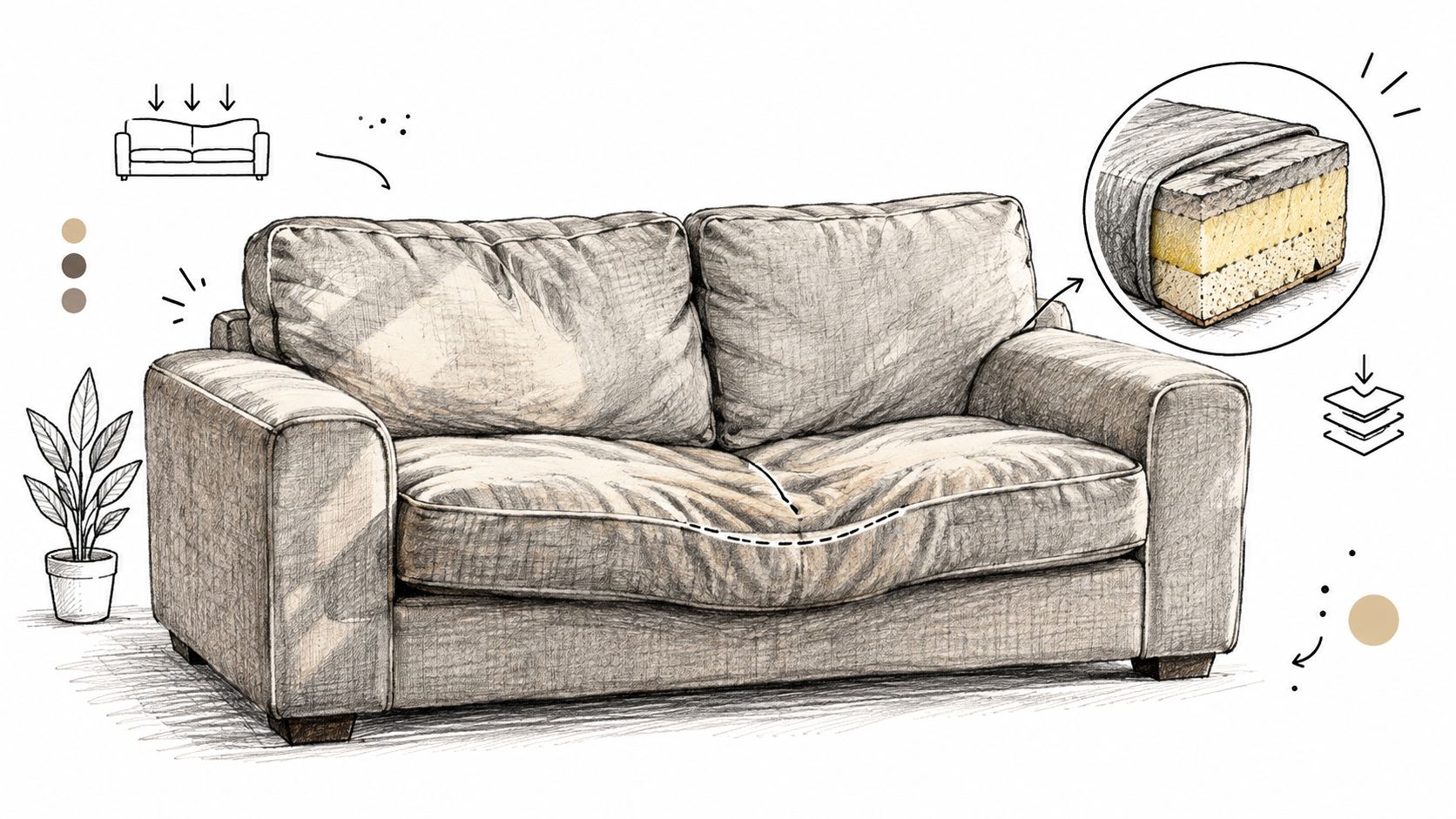
The sofa looked fine from across the room. Up close, however, one seat had developed a familiar hollow, the cushion rose at the edges, and every person who sat there shifted toward the center. That change rarely comes from fabric alone. The foam beneath the upholstery has lost some of its original support, and a standard replacement may only repeat the same problem.
Custom upholstery foam gives homeowners a more precise way to restore comfort. The replacement can be cut to the frame, matched to the cushion profile, and selected for both long-term durability and the sitting feel a household prefers. Density, firmness, thickness, construction, and daily use all matter, so the best choice isn't just the firmest or most expensive option.
Why Your Furniture Deserves Custom Upholstery Foam
A worn sofa cushion can change the rhythm of an entire room. The family gathers elsewhere, guests avoid a particular seat, and a once-inviting reading corner starts feeling unfinished. Replacing the cover may refresh the appearance, but it won't correct a foam core that has lost height, resilience, or dimensional stability.
Flexible polyurethane foam became a foundational upholstery material during the mid-20th century. It entered furniture cushions in 1957 and expanded during the 1960s, replacing fillings such as latex, excelsior, cotton batting, horsehair, and wool because it offered consistent shaping, low cost, and predictable cushioning performance. The material's established role is reflected in reported United States production of approximately 2.1 billion pounds, or about 953,000 metric tons, annually. This history of polyurethane foam helps explain why foam is now the default starting point for replacement sofa seats, dining-chair pads, benches, and made-to-measure cushions.
A cushion can be tailored to the frame
Loose natural fillings can be comfortable, but they don't offer the same precision when a cushion has an unusual angle, taper, or depth. Foam can be cut to the required length, width, thickness, contour, and profile, allowing an upholsterer to recreate the geometry of an existing frame instead of forcing the furniture to accept a generic size.
That distinction matters for a curved sofa, a deep sectional, a window seat, or an older chair whose dimensions no longer match current replacement cushions. Foam is also a thermoset polymer, so it does not melt and become a new cushion after curing. Accurate measuring and cutting at the fabrication stage are essential.
A homeowner updating an heirloom chair may need more than a fresh surface. The project may call for a shaped foam insert, a particular firmness, a durable cover, and enough thickness to keep the sitter from feeling the deck beneath. The result is custom comfort, not merely a new piece of padding.
Personalization extends beyond the insert
A successful upholstery project coordinates the foam with the rest of the furniture. Fabric texture, seam placement, cushion construction, and the support beneath the foam all influence the final experience. A useful starting point is a custom upholstery fabric selection that complements the room while allowing the cushion to function as intended.
Practical rule: A cushion should be judged as a complete system. Foam, cover, foundation, dimensions, and usage pattern all contribute to comfort.
Foam has served residential furniture for roughly seven decades since its furniture introduction in 1957, and its use isn't limited to one region or a narrow upholstery tradition. That long adoption makes it a familiar foundation for furniture restoration, but familiarity shouldn't lead to guesswork. The right replacement still depends on the individual frame and household.
Understanding Foam Density and Firmness for Lasting Comfort
Density and firmness answer different questions. Density describes how much polymer is contained in a given volume, while firmness describes the force needed to compress the foam. Treating them as synonyms is one of the easiest ways to order a cushion that lasts well but feels wrong, or feels comfortable initially but breaks down too soon.
A simple analogy helps. Density is the material's structural substance, similar to the build of a cushion's foundation. Firmness is the welcome a person feels when sitting down, whether the cushion yields gently or pushes back with more support. A high-density foam can feel soft, and a lower-density foam can feel firm.
Read the specification sheet, not the marketing label
Density is commonly expressed in pounds per cubic foot, or pcf, or in kilograms per cubic meter. The Polyurethane Foam Association reports that conventional foams at or above 2.0 pcf can achieve thickness loss below 5% under appropriate fatigue conditions, while industry guidance cautions that foams below approximately 30 kg/m³ aren't suitable for demanding seat-upholstery applications. The association's technical guidance provides useful context for comparing material performance.
Firmness should be verified through Indentation Force Deflection, or IFD, or Compression Force Deflection, rather than guessed from terms such as “soft” or “premium.” These tests record the force required to compress a standardized sample, commonly to 25%, 50%, or 65% of its original thickness. A written foam data sheet should identify density, 25% IFD, 65% IFD, and intended use.
A shopper researching sleep surfaces may also benefit from a separate explanation of choosing a cooler gel foam mattress. Mattress comfort and upholstery comfort aren't identical, but both illustrate why material composition and perceived feel must be evaluated separately.
Firmness affects the first sit, density supports the long haul
A cushion with suitable density generally resists height loss and permanent deformation better than a comparable lower-density option. Firmness controls the immediate sensation, pressure distribution, and support. A high-density cushion can therefore be plush, while a firm cushion isn't automatically durable.
Cushion thickness changes the experience as well. A thin cushion may need a different firmness from a deep seat because the sitter reaches the support structure sooner. Platform design, user weight, upholstery tension, and whether the cushion is reversible also influence the outcome.
The appropriate firmness isn't always the highest available. Excessive firmness can create pressure discomfort, particularly on a shallow seat or under a tightly fitted cover. The strongest specification is the one that balances density for longevity with IFD for feel.
Confirm the test method
Trade specifications often use a 25% indentation measurement, while some technical references use 40% compression. A firmness number without its test method can mislead, even when the number itself is accurate. This upholstery foam reference explains why the quotation should identify the measurement standard.
A practical request might read: “Please provide the foam density, 25% IFD, 65% IFD, thickness, and intended seating application.” That wording gives the fabricator enough information to recommend a cushion based on performance rather than a vague showroom adjective. For broader comfort decisions, homeowners can also consult a mattress firmness guide to see how support preferences differ across body types and sleeping positions.
Selecting the Ideal Foam for Your Furniture and Lifestyle
A formal dining chair and a family-room sofa may share the same upholstery vocabulary, but they don't face the same workload. One may host occasional gatherings, while the other absorbs nightly sitting, children climbing across it, pets jumping up, and different body weights landing in the same favorite places.
That makes lifestyle the bridge between technical data and a useful recommendation. The suitable foam for a quiet reading nook may feel too yielding in a busy living room, while a very firm high-density cushion may preserve shape but undermine the relaxed atmosphere a homeowner wants.
Compare the household scenarios
Published upholstery guidance commonly places everyday residential foam around 1.8 to 2.5 lb/ft³ with 28 to 35 ILD, while heavier-use seating may benefit from approximately 2.5 to 3.0 lb/ft³ and 35 to 45 ILD. These are starting points, not universal prescriptions, and the ranges should be confirmed with the manufacturer. This custom upholstery guidance presents the trade-off in a practical residential context.
| Furniture situation | Starting point for discussion | Main question |
|---|---|---|
| Occasional guest seating | A balanced residential specification | Does the cushion need daily resilience or mainly welcoming comfort? |
| Nightly family-room use | Higher density with an appropriate firmness | Can it support repeated loading without feeling hard? |
| Children or pets | Resilient construction and a cleanable cover | Will the cushion recover while the cover handles frequent activity? |
| Quiet reading nook | Softer firmness with suitable density | Does the seat invite relaxation without bottoming out? |
| Heavier user or concentrated seating | Higher-support specification reviewed with the fabricator | Does thickness, platform support, and firmness work together? |
Pets and children don't automatically require the firmest foam. They require a coordinated choice that considers repeated impact, spills, cleaning, cover construction, and whether the cushion can be turned or rotated. A pet-friendly furniture resource can help homeowners think about the surrounding upholstery system, not just the foam core.
Match comfort to construction
A reversible cushion distributes wear differently from a one-sided cushion. A loose seat may need a different shape and cover allowance from a tight seat, and a recliner cushion may require attention to movement and mechanism clearance. Body weight matters, but so do seat depth, cushion thickness, support deck, and the number of hours the furniture receives.
For a family that gathers on one sectional every evening, a durable density paired with moderate firmness may provide a better balance than an exceptionally firm insert. For a guest room chair, the specification can prioritize welcoming comfort while still avoiding a material intended only for light-duty padding. No label can replace a conversation about how the furniture is used.
The outer construction also deserves attention. Strong seams and suitable upholstery thread from B-Sew Inn can support a well-made cover, but thread strength won't correct a foam core that lacks the required density or recovery. Each component has a role, and the finished cushion performs only as well as the complete assembly.
Maximizing the Lifespan of Your Custom Upholstery Foam
Saturday night is movie night, and everyone drops into the same corner of the sectional. A month later, that favorite spot starts to feel different. The foam may still be sound, but daily habits can make one cushion age faster than the others. Long service comes from two parts working together: a foam choice that fits the household, and care that keeps wear from concentrating in one place.
That matters because foam does two jobs at once. Density supports durability over time, while firmness shapes the feel you notice the moment you sit down. Even a durable insert can look tired early if one seat handles all the use, if cushions never change position, or if a wet cleaning method leaves moisture trapped inside.
Good care is simple and repeatable. Flip and rotate cushions when the design allows it, because that spreads compression the way rotating tires spreads road wear. A reversible seat can follow a regular household routine. A one-sided or shaped cushion usually cannot be flipped, but it may still benefit from side-to-side rotation and occasional swapping with a less-used seat.
Build care around the people and animals at home
Different households put stress on foam in different ways. Children often bring quick spills, jumping, and frequent washing. Pets add hair, claws, and pressure along the same edges where they like to perch. A heavier user may create more concentrated compression in one zone, so it helps to check how the cushion feels across the whole surface, not just how it looks from the doorway.
A few habits make a noticeable difference:
- Rotate compatible cushions: Move the most-used seats into a new position, but only when the cushion shape and construction allow it.
- Clean the cover appropriately: Follow the upholstery care instructions so fabric, batting, moisture barriers, and foam are treated in ways they can tolerate.
- Protect the insert from saturation: Surface cleaning is usually safer than soaking, because trapped moisture can slow recovery and create problems inside the cover.
- Inspect the support beneath: A sagging deck or weakened foundation can make good foam feel unsupportive and can speed up uneven wear.
For practical cleaning methods, this guide on how to clean an upholstered sofa at home helps owners protect both the cover and the cushion beneath it. If washable protection would make maintenance easier in a busy home, pair rotation with shop stretch-fit cushion covers to shield the insert while keeping the outer layer easier to refresh.
Plan for end of life before disposal
Custom foam also creates offcuts during fabrication, so lifespan includes what happens after the cushion leaves the room. In 2020, 109 plants across the European Economic Area and the United Kingdom produced about 1.1 million tonnes of flexible polyurethane foam blocks. About 50%, roughly 550,000 tonnes, went into furniture, around 35% went into mattresses, and the rest went into other applications. The European industry brochure also estimated nearly 1.2 million tonnes of post-production trim foam globally in 2018, with a projected 1.3 to 1.5 million tonnes by 2023.
Clean, suitable offcuts can move into recycling and rebonding streams. Rebonded foam may be used in carpet underlay, padding, and support layers. For homeowners, the practical point is simpler: flexible polyurethane foam usually does not belong in standard curbside recycling. Ask the manufacturer, upholsterer, or a local specialist whether an old insert can be reused, accepted for processing, or directed to the right facility before it goes into general waste.
The Art of Measuring and Ordering Custom Foam Solutions
A replacement cushion succeeds when its measurements reflect the furniture rather than an idealized version of it. Foam is cut from larger blocks, and custom fabrication may involve unusual angles, tapers, notches, or contours. Small errors can create a cover that wrinkles, a seat that sits too high, or a cushion that refuses to settle into its frame.
The process becomes manageable when each measurement has a purpose. A homeowner doesn't need to become a foam engineer, but the order should include enough information for the fabricator to understand the frame, the cover, and the desired feel.

Measure the existing cushion and the space
The first step is to remove the old cushion and inspect both the insert and the cavity. If the old foam has collapsed, its current dimensions may be smaller than the original specification, so the frame and cover should be considered together. A guide to how to measure furniture can help organize the process before an order is placed.
A useful measurement sequence includes:
- Record the length and width: Measure the cushion at its broadest usable points, then compare those dimensions with the opening in the frame.
- Check thickness in several places: A worn cushion may have lost height unevenly, so one edge shouldn't be treated as the definitive thickness.
- Note the shape: Record rounded corners, bevels, tapers, angles, channels, notches, and any areas that must clear a mechanism.
- Examine the cover: A tight cover may require a different foam allowance from a loose cover, and an existing cover can reveal whether the insert has changed shape.
- Describe the foundation: A platform, webbing system, springs, or rigid deck changes how the foam feels beneath the sitter.
Photographs can help communicate details that numbers don't capture. A fabricator may also request a paper or cardboard template for an irregular cushion. That extra step can be worthwhile when the frame has a distinctive profile.
Specify the feel in writing
The order should separate the desired comfort from the material's durability. Instead of requesting only “firm” or “soft,” the homeowner should ask for density, 25% IFD, 65% IFD, thickness, and intended use. The written specification protects against a common misunderstanding, a cushion that meets a firmness label but uses a material unsuitable for the household's workload.
A useful description might be: “A supportive residential seat for nightly family use, with moderate firmness, suitable density, existing reversible cover, and the measured profile shown.” The final recommendation should account for seat depth, user weight, cushion construction, and platform support.
Use the Special Order Program for the complete design
Custom work isn't limited to the foam insert. Most vendors support personalized designs through a Special Order Program, including fabrics, finishes, and comfort levels. A homeowner restoring a La-Z-Boy recliner may need one approach, while replacement seats for Smith Brothers dining chairs may require another shape, cover, and firmness.
The same principle applies to larger furniture selections. Custom details can coordinate a room around brands such as:
- La-Z-Boy: Familiar motion and comfort-focused seating that may require careful attention to mechanism clearance.
- Smith Brothers: Upholstery choices that can be coordinated with custom cushion construction.
- Stressless: Seating where body support and movement should be evaluated together.
Once the specification is approved, installation should protect the finished piece. Professional in-home placement reduces the chance of forcing a shaped cushion into the wrong orientation or damaging the cover during fitting. A rigorous multi-point inspection before delivery also helps confirm that the ordered dimensions, upholstery, and finish meet the intended standard.
Experience Tailored Comfort at Lott's Furniture Today
Custom upholstery foam turns a vague complaint, “this seat isn't comfortable anymore,” into a series of useful decisions. Density addresses material longevity. Firmness addresses the first sitting experience. Dimensions, thickness, cover construction, foundation, and household activity determine whether those choices work together.
That framework is valuable whether a homeowner is renewing one cherished chair or planning a coordinated room. A formal space may call for structured seating, while a family room may need resilient cushions, performance-minded upholstery, and comfort that welcomes children, pets, and long evenings. A coastal or vacation home may also deserve particular attention to recovery and aging, especially where heat and humidity place additional demands on materials. ASTM D3574 provides a recognized framework for evaluating flexible polyurethane foam through tests covering density, IFD, airflow, resilience, tensile and tear strength, heat aging, recovery, and fatigue. The industry standards overview explains why performance testing gives a better comparison than showroom feel alone.
Comfort should be evaluated alongside safety
Fire performance is separate from softness, density, and durability. In the United States, upholstered furniture covered by 16 C.F.R. part 1640 must comply with TB 117-2013, which uses four test methods for cover fabric, resilient filling material, barrier material, and decking material. Each component is evaluated for char length, smoldering, and transition to open flaming. The Consumer Product Safety Commission guidance explains why a foam specification shouldn't be treated as proof of fire compliance.
Chemical transparency deserves the same calm, practical attention. A controlled exposure study of upholstered chairs found measured VOC exposure during normal use below referenced indoor-air criteria, while organophosphate flame retardants were released into air and dust. Exposure modeling indicated that children received roughly twice the average daily dose of adults, largely because of hand-to-mouth behavior. Families with nurseries, asthma-sensitive household members, or small rooms should ask about flame-retardant treatment, fabric, barrier layers, chemical disclosures, and ventilation after delivery. The upholstered-chair exposure study supports a nuanced approach, neither alarmist nor dismissive.
Local guidance makes customization easier
Lott's Furniture connects big-brand selection with small-town service for homeowners across South Georgia and North Florida. The Special Order Program supports personalized fabrics, finishes, and comfort levels, while Style Quizzes help shoppers clarify whether their preferences lean toward Coastal Chic, Modern Farmhouse, or Timeless Traditional. The Mattress Guide offers another structured way to think about firmness and support, and in-store associates can help translate those preferences into furniture decisions.
The shopping experience can move smoothly between the digital catalog and the showrooms in Waycross, GA, and Fernandina Beach, FL. A homeowner may research online, save ideas, then visit a showroom to feel the support of a Stressless recliner or examine the upholstery and construction of Lexington and Hooker Furniture pieces. That combination gives customers convenient access to design inspiration without losing the value of personal guidance.
Every delivered piece receives a rigorous multi-point inspection before it reaches the customer. Lott's white-glove, in-home delivery places the furniture in the room of choice and confirms that it is positioned for immediate enjoyment, bringing the same care to the final step that thoughtful foam selection brings to the seat itself.
Visit Lott's Furniture to discuss custom upholstery foam, personalized fabrics, finishes, and comfort levels with knowledgeable associates. Explore the digital catalog or visit the Waycross and Fernandina Beach showrooms for an online style consultation or in-person guidance, then enjoy white-glove in-home delivery backed by a multi-point inspection.