
How to Choose a Custom Upholstered Bench


The breakfast nook has room for another seat, but another chair would crowd the walkway. At the bedroom's footboard, a wood chest feels too formal for a place to pull on shoes. For a South Georgia or North Florida homeowner facing either problem, a custom upholstered bench offers a useful middle ground: purposeful seating with a softer, more personal finish.
Why a Custom Upholstered Bench Belongs in Your Home
A bench should solve a real room problem before it becomes a fabric decision. In a breakfast nook, that might mean seating the household along an uninterrupted wall. In an entry, it might mean a comfortable landing spot for bags and a seat for removing shoes, without turning the passage into an obstacle course.
The same idea works differently in a bedroom. A custom upholstered bench can soften the space around a substantial bed without competing with the headboard. In a living room, it can provide occasional seating while keeping a view or conversation area visually open.
Custom Bench Choices Start With Purpose
With a custom order, the conversation can include length, depth, fabric, cushion construction, trim, and base finish, rather than stopping at the dimensions of a stock piece. The available choices depend on the manufacturer and frame, so custom doesn't always mean every dimension can change.
That distinction matters. A homeowner might need a different-length frame, or might only need an existing silhouette upholstered in a fabric that coordinates with nearby dining chairs.
- Dining seating: Prioritize comfortable access to the table and a cushion suited to meals.
- Entryway seating: Keep the arrival routine and surrounding doors in mind.
- Bedroom seating: Consider softness, visual texture, and the relationship to the bed.
- Living-room seating: Decide whether the bench should blend into the upholstery or provide contrast.
Upholstered furniture has a substantial place in residential interiors. Its share of U.S. residential furniture sales moved from approximately 33% in 1980 to 30% in 2000, then rose to 35% in 2010 and 39% in 2017, a 9-percentage-point recovery from the earlier low, according to Furniture Today's historical upholstery sales comparison. Those figures describe the broader category, not bench sales specifically.
Separate Indoor Comfort From Outdoor Requirements
An upholstered dining or bedroom bench shouldn't automatically become porch furniture. For a patio or uncovered gathering area, homeowners can compare outdoor benches for every setting through Lounge Wagon before choosing seating intended for that environment.
For indoor projects, Lott's design associates serve South Georgia and North Florida, with showrooms in Waycross, GA, and Fernandina Beach, FL. The useful starting point is a room photograph and a clear description of the problem. From there, the decisions follow a practical sequence: fit, style, fabric, cushion, written approval, and placement.
A successful bench doesn't need to command the room. It needs to make the room easier to use.
Measure the Space Before You Customize a Bench
In a dining room, a bench may fit neatly against the wall and still block a chair or narrow the path to the kitchen. We start by measuring how people use the room, not just the spot where the bench will sit.
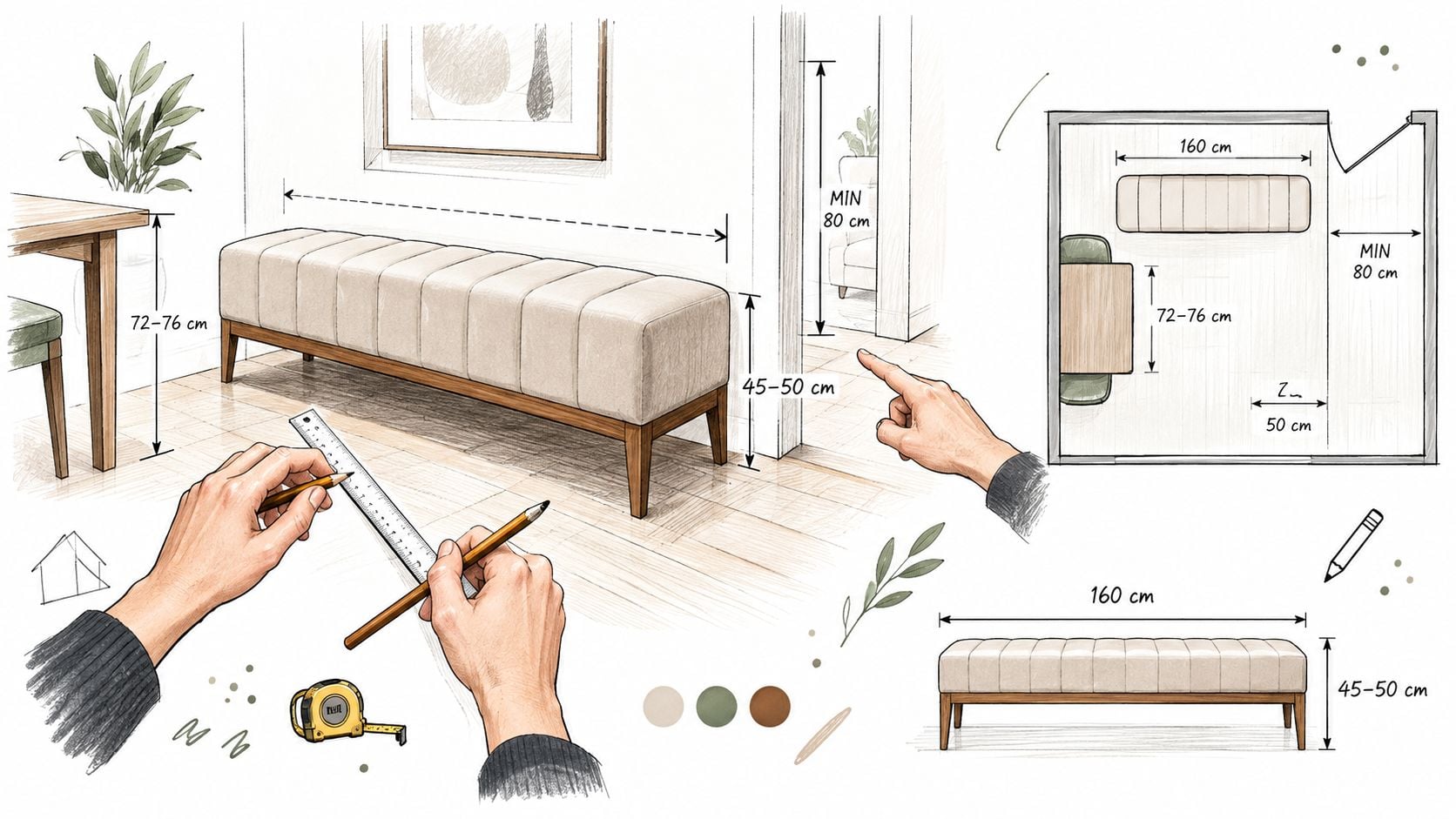
Sketch the space and mark the proposed bench location, nearby walls, doorways, table height, and the number of people who will use it. Include furniture that will remain in the room. These details help us assess the bench alongside the table, chairs, and everyday walking routes.
Test the Finished Bench Height and Depth
For dining, measure finished seat height, including the cushion. The bare frame height won't tell you whether someone can sit comfortably beneath the table. Check the seat depth too, so the bench supports a comfortable position without extending into a walkway.
A cardboard or foam mock-up can help you test the proposed footprint and height before upholstery begins. Use a stable support for any seated test. Cardboard is useful for checking dimensions, not for bearing someone's weight.
- At the dining table: Check knee clearance and whether diners can stand without the seat edge pressing behind their knees.
- Beside the entry door: Open the door fully, then check access to the console, closet, and hallway.
- Around living-room furniture: Walk the usual route, including when nearby seating is occupied.
Our guide to placing living-room furniture can help you assess the bench as part of the room's full arrangement.
Check Construction Before Upholstery Begins
A well-supported frame transfers weight through rails, corner blocks, and legs, rather than relying on foam or fasteners alone. Ask how the maker supports the seat and reinforces its joints.
Wood can expand and contract across the grain as conditions change through the seasons. The frame should allow for that movement. If it is restricted, joints and fasteners may experience stress, and the wood may crack or warp.
Before fabric is cut, ask for a written cutting plan that identifies pattern direction, centerline matching, repeats, welts, and seam locations. A swatch shows color and texture, but it cannot show where a large motif will sit across the finished seat.
Keep the approved dimensions and construction details available for delivery. Check the bench against the written order, noting any rocking, uneven leg contact, loose upholstery, exposed staples, puckered seams, or unexpected cushion compression. Once measurements and construction details are approved, we can move to fabric and finish choices with the room's requirements clear.
Choose Style Finish and Legs That Fit the Room
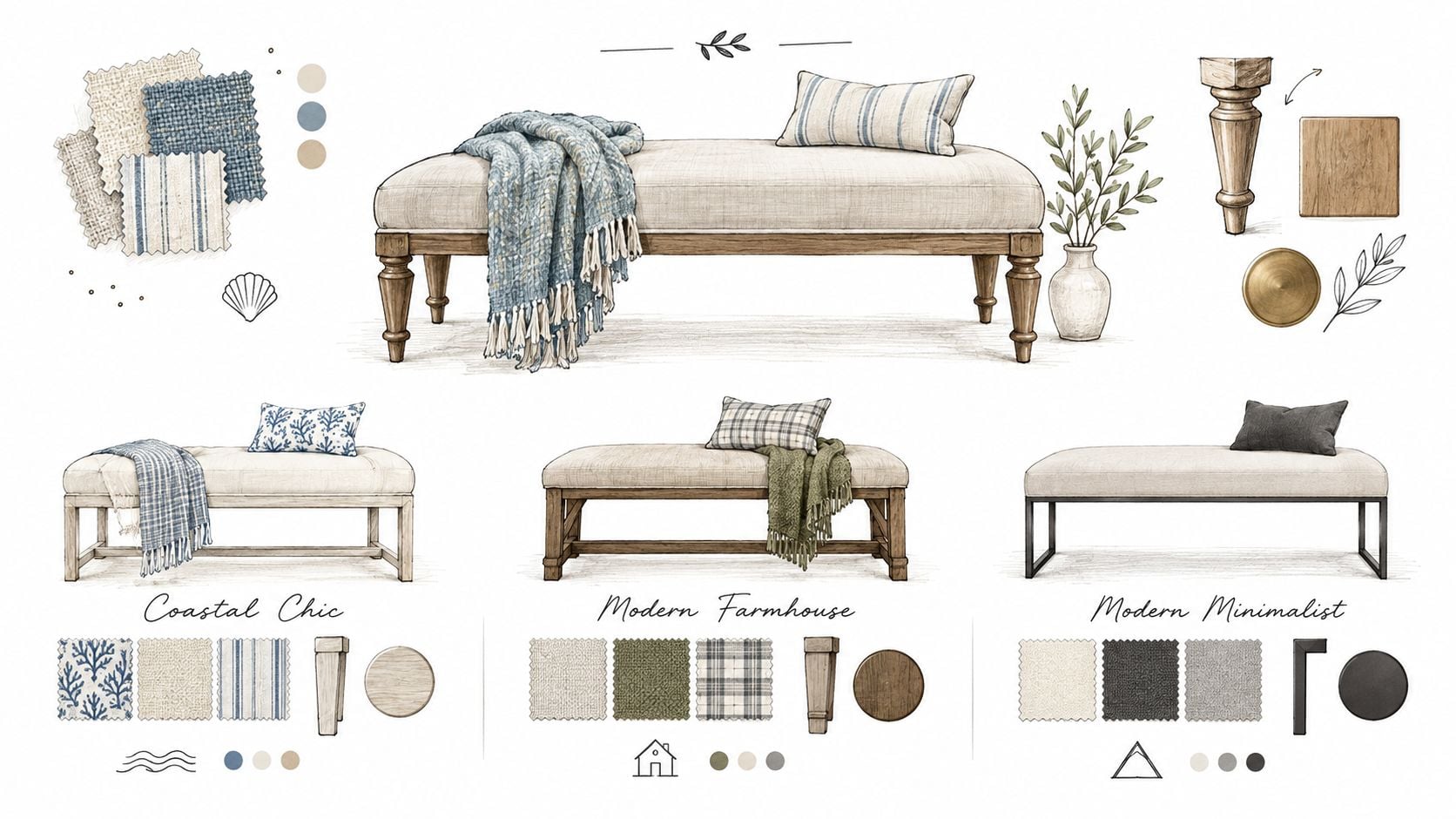
A pale textured seat on warm wood legs creates a different impression from the same fabric above a dark, simple base. Name the intended style before narrowing the product selection. That keeps an appealing showroom piece from becoming an awkward match at home.
Lott's Style Quizzes and interactive style guides offer a starting vocabulary: Coastal Chic, Modern Farmhouse, or Timeless Traditional. These labels aren't decorating rules. They help homeowners explain what feels comfortable and identify which details deserve a closer look.
Compare Bench Bases by Their Visual Effect
For a Fernandina Beach vacation home, Coastal Chic might mean a relaxed textile and a lighter-looking base. Lott's ideas for coastal accent chairs can help establish a coordinated upholstery direction without making every seat identical.
Modern Farmhouse can accommodate warm wood, straightforward profiles, and a fabric that feels inviting rather than precious. Timeless Traditional may call for turned legs, more defined trim, or a finish that relates closely to an existing dining table.
| Room direction | Base to consider | Design trade-off |
|---|---|---|
| Coastal Chic | Tapered wood legs with a restrained finish | An airy appearance versus a more grounded contrast |
| Modern Farmhouse | Warm wood with uncomplicated lines | Familiar texture without excessive decorative detail |
| Timeless Traditional | Turned or shaped wood legs | More ornament versus a quieter upholstered seat |
| Modern dining | Simple plinth or metal-accent base | A clean profile versus visible leg detail |
These are design starting points, not manufacturer availability promises. A finish sample should be compared with the actual table or nearby cabinetry.
Use Brand References Without Assuming Identical Options
Lott's associates can use familiar furniture collections to clarify the desired result:
- La-Z-Boy: A reference for upholstered comfort and available performance-fabric programs.
- Smith Brothers: A starting point for custom upholstery, fabric selection, and comfort discussions.
- Lexington: A useful reference when coordinating seating with dining or other case pieces.
Specific bench configurations, fabrics, and finishes require confirmation. A brand's upholstery options shouldn't be assumed to apply to every frame.
For beach houses and family dining rooms, ask what a proposed wood finish can tolerate, how it should be wiped, and what its warranty excludes. Pale stains deserve especially careful sample review because appearance and maintenance expectations need to agree.
The digital catalog helps narrow silhouettes before a visit. In Waycross or Fernandina Beach, associates can help compare finish samples and similar seating profiles. The resulting specification should name the style, base material, finish color, and whether the bench must match an existing table or merely complement it.
Specify Fabric and Cushion Comfort for Real Life
At a breakfast nook, a bench may face daily spills and repeated use; a bedroom seat may be used only now and then. Those rooms call for different fabrics and cushions, so the highest performance rating is a use-case decision, not an automatic upgrade.
Consumer research found that 88% of furniture shoppers considered performance fabric important, 92% prioritized easy maintenance and cleaning, and 78% expected furniture to last approximately 15 years, according to Home News Now's consumer purchase insights.
Match Abrasion Testing to Your Use
Start by considering traffic and exposure. For an occasional-use bedroom bench, hand, meaning how the fabric feels, and visual texture may matter most. A family-room seat or busy dining nook calls for closer attention to cleaning, abrasion, and seam performance.
ACT lists 15,000 Wyzenbeek double rubs or 20,000 Martindale cycles as benchmarks for low-traffic private use. For high-traffic applications, its benchmarks are 30,000 double rubs or 40,000 cycles. Wyzenbeek and Martindale are different test methods, not interchangeable units, as explained in ACT's woven upholstery abrasion guidance.
Ask for the test method, ASTM D4157 or ASTM D4966, as well as the abradant, pressure, and endpoint. Those details help you compare results on equal terms.
Practical rule: Choose fabric for the messes and wear your household creates, not for the most impressive label.
Bench Fabric Choices by Household Use
| Household use | What to prioritize | Spec to request | Common miss |
|---|---|---|---|
| Pets | Cleanability and surface suitability | Cleaning code, snagging guidance, warranty exclusions | Assuming abrasion testing predicts claw damage |
| Children | Spill response and seam durability | Stain-care instructions and oil-based stain limitations | Treating stain resistance as stain immunity |
| Coastal humidity | Care compatibility and appearance | Cleaning instructions and colorfastness information | Approving a pale textile without reviewing maintenance |
| Vacation homes | Clear care routines for different users | Written care sheet and cleaning restrictions | Selecting a fabric guests can't easily maintain |
| High-traffic dining | Abrasion resistance and cushion resilience | Test details, seam construction, cushion specification | Judging durability only by the cover fabric |
Ask whether a treatment is PFAS-free, which stains the warranty excludes, and how the textile responds to oil-based stains. Review a full-size memo in the room to assess pattern scale, nap direction, seam placement, and light reflection. Pale coastal fabrics can look different under natural light than they do on a screen.
Lott's custom upholstery fabric guidance can help you prepare questions for our associates. Test the sample in the room before approving it.
Specify Cushion Comfort Separately
Fabric choice and cushion firmness are separate decisions. For the cushion, ask about foam density, fiber or down-alternative wrap, seam type, zipper access, and reversibility.
Lott's Mattress Guide offers a useful parallel: comfort is easier to assess with structured questions and physical testing than with a universal firmness recommendation. A medium-feeling showroom sample can serve as a comparison, not a prescription. Have household members sit, shift position, and consider the bench's intended activity before settling on a feel.
Order Through Lott's Special Order Program
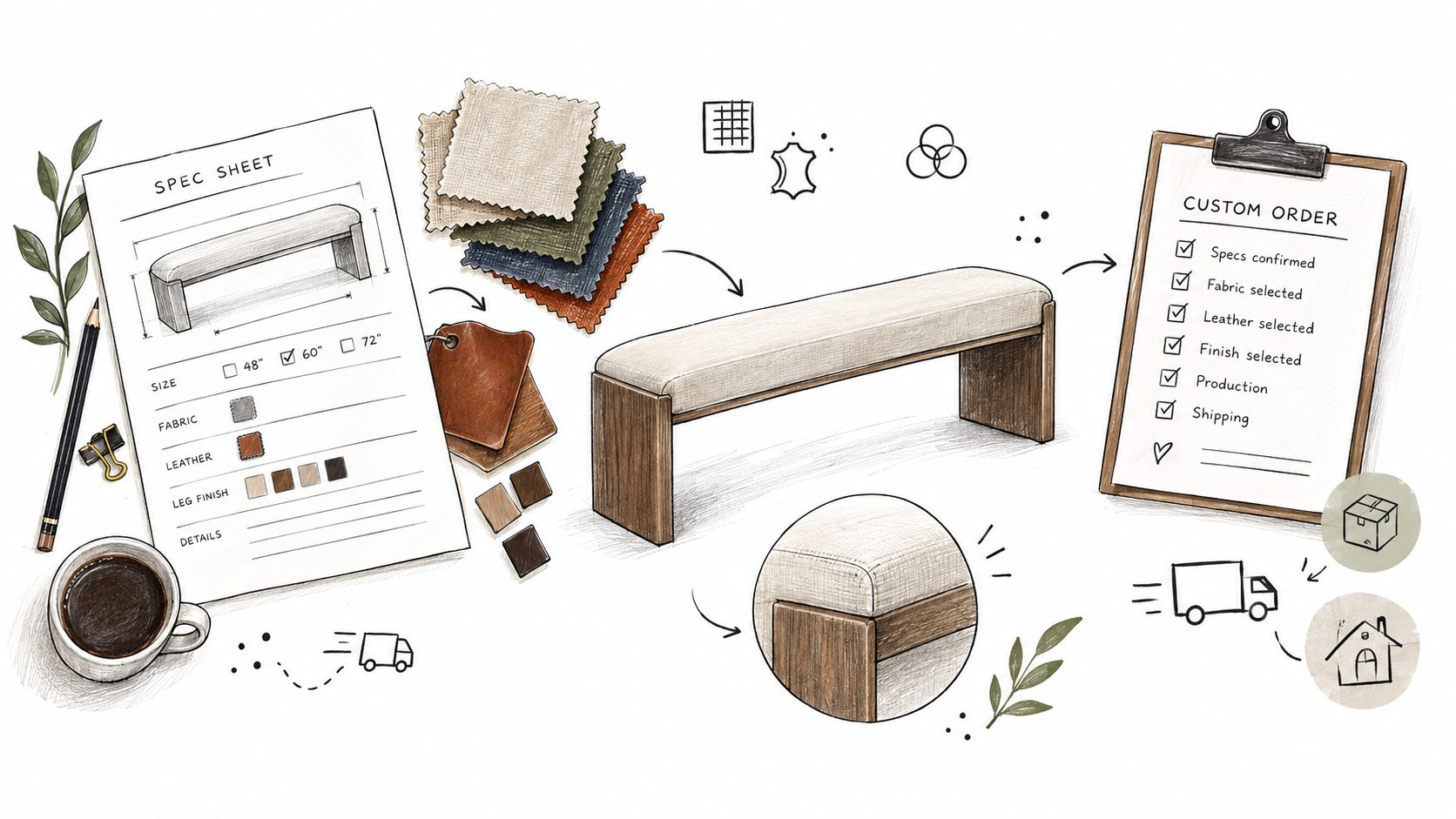
A bench can fit the room on paper and still differ from what you expected in person. We help turn your measurements and choices into a written order, then check that the finished piece matches it. Lott's Special Order Program connects your selected style with the customization options available for that frame.
Options vary by manufacturer and frame. You may be able to choose from fabric or leather, performance textiles, cushion firmness, and selected arm or back details. A high-performance fabric is not an automatic upgrade: we help weigh its care needs and feel against how the bench will be used.
Move From Digital Shortlist to Written Approval
Digital browsing and a showroom visit can support the same purchase. Furniture Today reports that shoppers often use both channels, researching online and assessing items in person, or the reverse, in its report on cross-channel shopping.
Start with the measured fit and a digital shortlist. Then visit the showroom to compare color and texture, and sit on a sample to assess comfort. Our associates can help confirm which options are available for your chosen frame.
Before production, approve the details in writing:
- Fabric approval: Record the exact selection and keep the approved memo.
- Upholstery layout: Confirm the pattern placement and decorative details.
- Comfort construction: Specify the agreed cushion build.
- Written order: Document finished dimensions, base finish, available modifications, and applicable terms.
Our guide to getting started with custom ordering can help organize these decisions. If you consider Shop Now, Pay Later, review the applicable terms before purchase.
Include Safety and Delivery in the Order
Covered indoor upholstered seating manufactured, imported, or reupholstered on or after June 25, 2021, must meet federal smolder-resistance requirements based on California Technical Bulletin 117-2013. Certification-label enforcement began June 25, 2022, according to the Consumer Product Safety Commission's upholstered-furniture safety announcement. The announcement also cites estimates associating upholstered furniture with approximately 390 deaths annually, or 17% of home-fire deaths.
The standard covers relevant components such as the cover fabric, filling, barrier material, and decking. Ask us to confirm the applicable compliance documentation for your selected bench.
Before delivery, we check the frame for visible damage, assess the cushion's fit and construction, and review the upholstery for issues such as marks or uneven seams. Lott's Delivery standard includes white-glove placement in the room of your choice, rather than leaving the carton at the door. We place the bench where you want it and leave the order information available for reference.
Care for Your Bench and Plan the Next Visit
After a spill on a kitchen bench or a stretch of weeks between visits to a vacation home, the care sheet helps everyone respond consistently. Keep it with the fabric identification and order details, where household members or caretakers can find it.
Start with the instructions for the selected textile and cushion construction. Our guide to cleaning upholstered furniture at home offers a starting point, while the bench's own cleaning code takes precedence.
Protect the Fabric Without Overcomplicating Care
- Blot spills: Follow the fabric's approved response instead of scrubbing or trying an unapproved cleaner.
- Follow the cleaning code: Choose compatible products and arrange professional cleaning when required.
- Rotate or flip appropriately: Redistribute use only if the cushion construction allows it.
- Manage sunlight: In a vacation home, position the bench away from harsh afternoon sun while the property is empty.
- Keep records: Store care instructions and photographs with the original order.
A fabric's rub count describes an abrasion test, not the full service life of a bench. ACT explains this limitation in its textile performance guidelines.
Long-term value depends in part on whether the bench can be maintained, repaired, or have parts replaced, as well as its condition at delivery.
Ask What Can Be Repaired Later
Before ordering, ask whether the cushion can be replaced and whether the frame can be reupholstered. These details help you compare fabrics and cushion options by what can be cared for over time, not only by appearance at delivery. The highest-performance fabric is a use-case decision, not an automatic upgrade: a busy kitchen bench and a lightly used bedroom bench may call for different choices.
Sustainability claims also merit specific questions. A 2025 survey found that 57% of furniture buyers were more likely to purchase furniture labeled sustainable, while 55% identified price as the leading barrier, 27% raised durability and quality concerns, and 15% cited insufficient information about sustainability claims, according to Furniture Today's sustainability survey report.
Compare expected service life, maintenance, repair options, and eventual disposal alongside the initial price. If low-emission adhesives or finishes are offered, ask which options are available. Request verification for recycled-content claims before treating them as a deciding advantage.
For a Waycross or Fernandina Beach visit, bring the bench's care sheet, fabric identification, and order details if you already have them. If you are still considering options, ask our associate to show how the care requirements differ between the fabrics you are weighing. That makes the conversation about upkeep specific to your intended use.
Lott's Furniture offers custom-order guidance, fabric and finish selection, and white-glove in-home placement. Visit Lott's Furniture to arrange time with an associate in Waycross or Fernandina Beach.


