Save 50% Off MRSP on Lexington | Shop the Catalog >

Custom Upholstered Armchair Guide from Fabric to Delivery


The chair looked right until the fabric sample went beside the rug. Then the cushion felt too soft, the wood finish fought the coffee table, and the arms seemed likely to crowd the walkway. That's the moment many homeowners across South Georgia and North Florida discover that a custom upholstered armchair isn't an extravagant complication. It's a practical way to make one important seat fit the room, the household, and the way people live.
Lott's Furniture connects shoppers with a Special Order Program through vendors that support personalized designs, including fabric, leather, finishes, comfort levels, trim, legs, and selected power features. The process also benefits from showroom guidance, online style tools, material samples, room measurements, realistic planning, and white-glove delivery. A custom chair takes patience, but the result can feel less like a purchase and more like a unique piece of the home.
Why a Custom Upholstered Armchair Is Worth the Wait
A ready-to-deliver armchair has one major advantage: it's available to see and test immediately. It may still miss the details that matter most, though. The silhouette might be perfect while the upholstery feels wrong, or the seat might look polished but lack the support needed for long reading sessions, conversations, or evenings near the television.
Custom ordering solves that mismatch by treating the chair as a group of coordinated decisions rather than a single finished object. Buyers can work through upholstery, comfort, proportions, finish, and decorative details in an intentional order. Most vendors in a well-developed special-order program support personalized choices, so the shopper isn't limited to whatever combination happened to arrive on the showroom floor.

The value lies in the decisions
A custom upholstered armchair can be shaped around:
- Daily comfort: Cushion feel, seat support, and back height influence whether the chair works for a quick visit or extended sitting.
- Room character: Upholstery, welt, legs, and finish can reinforce a coastal, traditional, transitional, or contemporary interior.
- Household demands: Fabric performance matters more in homes with children, pets, frequent entertaining, or heavy daily use.
- Practical access: Measurements and delivery planning help prevent a beautiful chair from becoming impossible to bring through a doorway.
The tradition behind upholstered seating is long and closely connected with the evolution of domestic comfort. Historical references place the development of the first fully upholstered chair, often called the “sleeping chayre,” in 1705, during a period when European upholstery, particularly in England, was moving seating away from hard wooden surfaces and toward fully padded forms. This history of upholstery helps explain why the upholstered armchair still carries both decorative and functional importance.
Lott's Furniture offers access to major collections from names such as La-Z-Boy, Bassett, and Lexington, while its associates help translate a homeowner's preferences into a workable order. The shopper can begin online, visit a showroom in Waycross, GA or Fernandina Beach, FL, and continue the same conversation with samples, measurements, and comfort testing.
Choosing Fabric and Leather That Survives Real Life
Texture catches the eye first, but performance specifications tell the more useful story. A strong fabric review should consider abrasion, pilling, and seam integrity as separate durability tests. A textile may resist surface friction yet still distort at a stressed seam, develop fuzzing, or lose its clean appearance where arms, corners, and seat edges receive repeated contact.
Abrasion testing, including Martindale testing, indicates how a fabric responds to rubbing. Pilling assessment evaluates the formation of small fiber balls at stated testing intervals. Seam-slippage resistance focuses on whether yarns shift away from a stitched seam under tension. Textile testing guidance from Labo-Tex describes the importance of testing the sewn and unsewn fabric under tension, rather than assuming surface abrasion performance tells the whole story.
The specification that deserves closer attention
For upholstery fabrics, a commonly used acceptance threshold is a maximum seam opening of 4 mm, while ACT-style performance guidance sets a minimum seam-slippage resistance of 25 lb in both warp and weft directions. These figures should be read from the fabric's actual specification sheet, not guessed from its hand, appearance, or price.
Related test documentation shows upholstery fabrics recording seam-slippage values around 2.0 to 3.0 mm at 180 N and abrasion results above 105,000 Martindale rubs, while still requiring separate seam verification. This upholstery performance report is a useful reminder that one excellent result doesn't automatically certify the entire chair.
For a busy home, the practical questions are straightforward:
- Abrasion: Will the face fabric tolerate repeated contact on the seat, front rail, and outside arms?
- Pilling: Does the fabric retain a clean surface after ongoing friction?
- Seam slippage: Will the weave stay stable where stitching is placed under load?
- Directionality: Does the pattern or nap need to be cut consistently across the chair?
- Maintenance: Can the household follow the recommended cleaning method without damaging the fibers?
Matching Fabric Performance to Your Household
| Fabric Category | Best For | Watch-Outs |
|---|---|---|
| Performance textile | Children, pets, frequent sitting, and active living rooms | Performance labels still require review of pilling and seam stability |
| Tightly woven upholstery | Regular daily use and clean tailored silhouettes | A firm hand doesn't prove that the seam will resist opening |
| Textured weave | Layered interiors and rooms needing visual depth | Loops and raised surfaces may need careful cleaning and snag awareness |
| Leather | Homes seeking a material that develops character over time | Finish, care requirements, and comfort feel vary by selection |
| Decorative textile | Accent chairs used in lighter-duty areas | Bold pattern placement and delicate yarn structures need special review |
The furniture specialists at Lott's can help compare the available fabric and leather libraries, including performance options associated with La-Z-Boy and Smith Brothers. The collection includes thousands of textures, patterns, and colors, but a large library makes professional filtering more important, not less. A helpful starting point is Lott's guide to performance fabrics for upholstery.
Even a well-selected chair benefits from proper care. For homeowners who need specialized maintenance advice, Birmingham upholstery cleaning experts offer a useful reference for understanding professional upholstery cleaning considerations, especially before choosing a delicate texture or light-colored fabric.
Tailoring Comfort, Style, and Details to Your Room
Fabric is only one part of a custom upholstered armchair. The best orders coordinate the chair's internal comfort with its visible proportions, so a beautiful exterior doesn't conceal a seat that feels wrong after a few minutes.
Comfort choices deserve the same attention as color
Cushion construction and firmness should be discussed before the upholstery is finalized. A softer seat can feel inviting for lounging, while a firmer cushion may make it easier to sit upright, stand, and maintain a more structured look. Neither is universally correct. The right choice depends on posture, body preference, and how the chair will be used.
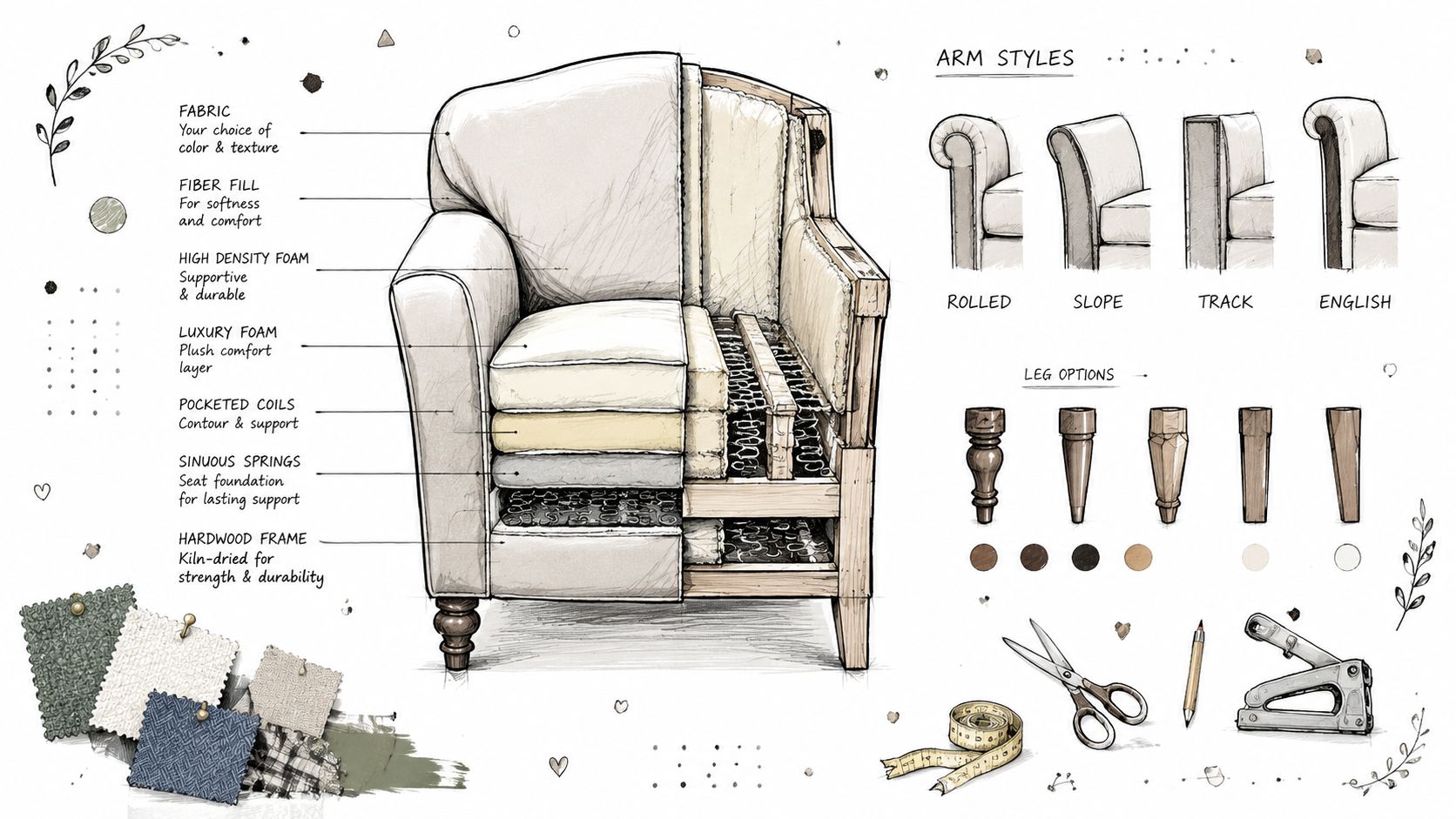
Arm and back styles create another meaningful contrast:
- Rolled arms: Bring traditional softness and visual weight.
- Track arms: Keep the profile cleaner and often suit fitted or transitional rooms.
- Higher backs: Support reading and conversation while creating a stronger vertical presence.
- Lower backs: Preserve open sightlines and a lighter appearance.
- Generous cushioning: Encourages relaxed lounging.
- Structured cushioning: Supports a more upright sitting posture.
The same basic chair concept can move in very different directions. A coastal room might use a lighter textile, a relaxed cushion, and a pale wood finish. A traditional room could use a patterned fabric, welt, turned legs, and a more supportive seat. A collection such as La-Z-Boy may emphasize comfort and motion options, Smith Brothers can support detailed upholstery personalization, and Stressless is known within showroom settings for comfort-focused seating choices. The important point is to assess the specific frame and available options rather than choosing by brand name alone.
Details that complete the design
A special-order conversation may include:
- Trim or welt color and placement
- Leg style and wood finish
- Base shape
- Accent pillows
- Cushion comfort level
- Leather or textile upholstery
- Power upgrades on eligible motion pieces
Digital guidance can reduce the number of choices before a showroom visit. Lott's Style Quizzes help shoppers identify directions such as Coastal Chic, Modern Farmhouse, or Timeless Traditional, while interactive style guides show how scale and layered materials work together. The Mattress Guide serves a different category, but it reflects the same service philosophy, helping shoppers understand comfort and support before visiting the floor.
An in-store associate then adds what a screen can't provide: a chance to touch the material, sit in comparable cushions, examine finishes, and see how the details interact. Homeowners preparing presentation boards or room concepts may also benefit from these client-winning design presentation tips, particularly when several decision-makers need to agree on the final look.
Measuring Your Space for the Perfect Fit
A chair can be correctly built and still be wrong for the room. The measurement process should begin before fabric selection, because a silhouette that works in a spacious great room may overpower a compact cottage sitting area.
Five measurements to bring to the showroom
- Entry clearance: Measure the front door opening, interior doors, hallways, turns, and any stair access. Record the narrowest point, not just the largest doorway.
- Available footprint: Mark the maximum width and depth the chair can occupy without crowding nearby tables or seating.
- Walking path: Preserve a comfortable route around the chair, especially between the sofa, kitchen, entry, and exterior doors.
- Seat proportions: Note the seat height and depth of existing furniture that feels comfortable. This helps the associate compare the new chair with the household's preferred sitting position.
- Sightlines: Check the view from the sofa, television, windows, and conversation areas. A tall chair may provide support but block visual openness.
A Fernandina Beach coastal cottage may have tight transitions between rooms, making doorway clearance and chair depth especially important. A Waycross great room may handle a broader silhouette, but scale still matters beside a large sectional. The same armchair shape can look balanced in one space and undersized or intrusive in another.
Practical rule: Measure the route into the room, not only the space where the chair will sit.
Take photographs of the room, include nearby furniture dimensions, and bring a simple floor plan. The Lott's furniture measuring guide can help organize the information before a showroom appointment. Associates can then assess whether the chair should sit beside an accent table, float near a sectional, or anchor a reading corner without interrupting movement.
Pricing, Financing, and Making It an Investment
Custom upholstery carries a wide price range because the finished chair reflects several decisions at once. Frame construction, fabric grade, leather selection, cushion design, trim, leg finish, and power mechanisms can all influence the final investment. The correct response isn't to chase the lowest figure. It's to decide which features affect daily satisfaction and which details are decorative preferences.
Spend first on what the body notices
A value-focused plan typically prioritizes:
- Frame and support: The chair needs a reliable foundation for its intended use.
- Cushion comfort: A beautiful fabric won't rescue a seat that feels wrong.
- Fabric suitability: Choose performance characteristics according to household demands.
- Proportion: Correct scale protects the room from looking crowded or unfinished.
- Decorative upgrades: Nailhead trim, special welt, premium finishes, and power features can follow when they serve the design.
This approach keeps the purchase investment-quality without turning every available option into a requirement. A homeowner may choose a simpler leg finish and place more emphasis on a performance textile, or select a refined leather while keeping the silhouette restrained.
Collections from Lexington, Wesley Hall, and Hooker Furniture give shoppers different design languages and construction approaches to consider. Lott's associates can review the available configurations and discuss how choices affect both appearance and comfort. Online Shop Now, Pay Later financing tools can also support planning, while the high-end living room furniture collection provides a broader context for coordinating the chair with sofas, tables, and other major pieces.
A custom upholstered armchair earns its place when it solves a real room problem and continues to feel right after the novelty fades. That's why comfort, fabric stability, and fit deserve priority over decorative extras that don't improve the chair's daily use.
Lead Times, Delivery, and White-Glove Service
Custom upholstery should be planned as a project, not treated like an immediate floor purchase. Current industry guidance commonly places custom upholstery at 8 to 16 weeks, while customer-owned-material orders, often called COM orders, can add 2 to 4 weeks before production begins. Industry guidance on custom furniture change orders also highlights how material approvals and mid-project specification changes can affect the schedule.
What happens during the waiting period
The timeline usually depends on several moving parts:
- Material sourcing: The selected textile or leather must be available and approved.
- Specification review: The order needs confirmed dimensions, finish, trim, cushion, and upholstery choices.
- Production scheduling: The workshop builds the chair according to the approved specification.
- Change-order control: Altering fabric, dimensions, finish, or comfort after approval may create additional delay.
- Delivery coordination: The completed chair must be inspected and scheduled for in-home placement.
A realistic planning conversation is more useful than a single promised date. Coastal renovations, seasonal move-ins, second homes, and room projects across South Georgia and North Florida can all be affected by the arrival sequence of other furnishings. Customers should finalize the chair's specifications before production starts, especially if the armchair needs to coordinate with a larger sectional, rug, or window treatment.
Faster made-to-order programs are emerging, with one industry example launching custom upholstery at 8 to 10 weeks, which shows that shorter schedules are becoming a competitive differentiator rather than a universal standard. The safer approach is still to plan around the stated range and ask what conditions could change it.

What white-glove delivery should include
White-glove service is more than moving a carton to the front door. A defined process can include a pre-loading check, inspection on arrival, unpacking, placement, and final sign-off. This explanation of white-glove damage handling describes multi-point checks before loading, on arrival, and after placement.
Lott's delivery standard emphasizes white-glove, in-home delivery and a rigorous multi-point inspection before the piece reaches the customer. The delivery team brings the chair into the chosen room, positions it appropriately, and confirms its condition after placement. Customers can review Lott's explanation of what white-glove delivery service includes before scheduling a special-order purchase.
Start Your Custom Armchair Journey With Lott's
The right custom upholstered armchair starts with four disciplined choices: read the performance specification, tailor the comfort, measure the room and delivery path, and plan for the full lead time. That process protects the design and reduces avoidable surprises.
Lott's Furniture supports the journey through its Special Order Program, online Style Quizzes, interactive style guidance, the Mattress Guide, and in-store associates who can help compare materials and comfort options. Shoppers can browse the digital catalog from home, then move naturally to the showrooms in Waycross, GA or Fernandina Beach, FL to touch fabrics, test seating, and review details. The custom order starting guide provides a practical first step for homeowners across South Georgia and North Florida.
After more than 78 years serving local communities, Lott's Furniture continues to pair big-brand selection with small-town service and convenient delivery.
Visit Lott's Furniture to browse custom upholstered armchair options, take an online style quiz, or schedule a showroom conversation. Bring room measurements and your preferred comfort goals to the Waycross or Fernandina Beach location, where the team can help turn a promising chair into one made for the home.