Save 50% Off MRSP on Lexington | Shop the Catalog >

Reclaimed Wood Furniture: A Complete Buyer’s Guide


A homeowner often knows the exact moment a room needs a stronger anchor. The sofa is comfortable, the lighting is right, and the walls are finished, yet the space still feels assembled rather than settled. A reclaimed wood dining table, console, coffee table, or sideboard can bring the missing sense of history, but only if the material is genuine and the construction is sound.
Reclaimed wood furniture deserves more than a rustic story and a handsome showroom finish. Buyers should ask where the wood came from, how it was dried, whether hidden fasteners were detected, what finish protects it, and how the piece will be inspected before delivery. For homes across South Georgia and North Florida, from Waycross to Fernandina Beach, those details matter as much as the grain.
Why Reclaimed Wood Furniture Belongs in Your Home
A reclaimed piece works best when it solves a design problem, not when it merely announces a theme. In a dining room, a weathered tabletop can soften crisp modern chairs. In a coastal home, a pale console can add warmth without making the room feel heavy. In a traditional interior, a reclaimed coffee table can introduce texture while the surrounding upholstery remains fitted and formal.
The material itself has a distinct identity. Industry guidance describes reclaimed wood as material salvaged from old buildings and structures, including barns, factories, warehouses, lake and river bottoms, urban trees, and similar sources. That origin affects the finished furniture. Old nail holes, saw marks, irregular grain, mineral staining, and natural patina aren't defects to hide. They're evidence that the surface has a history.

Provenance changes the value
A credible seller should be able to explain the material's source in practical terms. “Reclaimed look” can describe a new board that has been distressed, stained, and finished to imitate age. Authentic reclaimed stock carries a more varied surface because its character developed through prior use and exposure.
That distinction doesn't make new wood inferior. It makes the choices different. Reclaimed wood offers visual individuality and a circular-material story, while responsibly sourced new wood may offer more predictable dimensions and easier grading. Buyers should choose based on the room, the intended use, and the documentation available.
The category has also grown well beyond a niche farmhouse application. The broader reclaimed lumber market was estimated at USD 54.34 billion in 2022 and projected to reach USD 78.16 billion by 2030, with a 4.7% CAGR from 2023 to 2030, according to Grand View Research's reclaimed lumber market analysis. Furniture accounted for either 32.6% of global reclaimed lumber demand in 2024 in one report or 40.7% of market share in 2024 in another estimate presented on the same market page. The differing figures shouldn't be treated as interchangeable, but both point to the same conclusion, furniture is one of the category's dominant applications.
A material with a longer story
Reuse also has deeper roots than current farmhouse styling. One industry history source notes that wood from abandoned structures had been reused commonly in Germany since the 1940s, on the U.S. East Coast since the 1970s, and on the West Coast in the 1980s, before broader adoption in the 1990s as upcycling and recycling gained momentum. The Re-love Report from Feast Watson also records furniture audits identifying between 4,932 and 7,399 tonnes of reusable wooden furniture that could be recovered, while noting that national data remained insufficient to estimate total solid wooden furniture volumes precisely.
That history gives reclaimed wood furniture a legitimate place in a curated sanctuary. It isn't a finish applied for atmosphere. It's a material decision involving sourcing, structural preparation, maintenance, and design proportion. Homeowners comparing options for a living room furniture collection should judge the complete piece, not just the surface.
For shoppers also concerned about finishes, adhesives, and indoor air quality, a practical nontoxic furnishings advice resource can help organize the questions to ask before committing. The best reclaimed wood furniture combines a traceable story with construction that can withstand ordinary family life.
The Four Pillars of Quality Reclaimed Wood
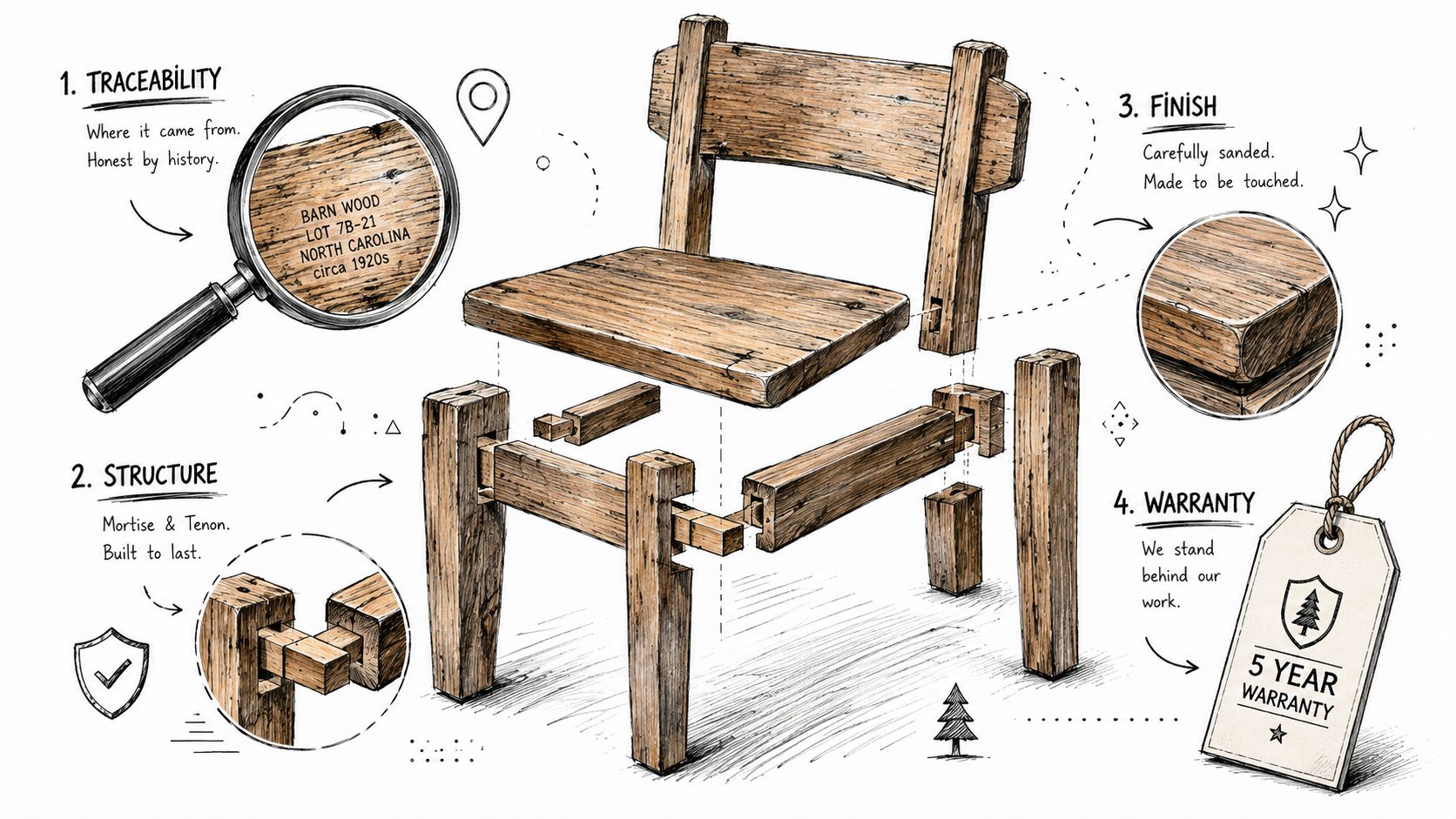
Not every weathered-looking table is heirloom-quality. A strong evaluation rests on four pillars: traceable sourcing, structural preparation, finish selection, and authenticity verification. If one pillar is missing, the romance of the piece can become an expensive distraction.
Sourcing should be more than a color description
Ask whether the wood is reclaimed, newly milled and distressed, or a combination. A seller should be able to identify the general source category and explain how the boards were selected. Industry guidance from the Sustainable Furnishings Council describes reclaimed wood as coming from sources such as old buildings, barns, factories, warehouses, waterways, and urban trees, which makes provenance a material question rather than a decorative slogan.
FSC provides another useful benchmark. Its definition includes pre-consumer and post-consumer reclaimed material. For FSC Recycled products made under the percentage system, at least 70% of timber or fibre inputs must be post-consumer reclaimed, as explained in the FSC furniture guidance. Certification isn't the only acceptable form of proof, but a buyer should be wary when a retailer can't explain either certification or chain of custody.
Construction begins before the first cut
Moisture control is where attractive wood becomes reliable furniture. A European recycled-wood standard sets delivery moisture content at normally no more than 20%, with a ±5% tolerance, while technical guidance for interior furniture commonly targets roughly 6–8% after kiln drying, according to the European Panels Federation recycled-wood standard.
Those figures describe different points in the preparation process, so they shouldn't be confused. The practical rule is simple, wood intended for indoor furniture must be dried and acclimated before milling and assembly. Excess moisture can lead to dimensional movement, warped boards, checking, and stressed joints as the piece settles into indoor humidity.
Buyers should look for:
- Drying records: The maker can explain whether the boards were kiln dried and tested.
- Defect screening: Rot, degradation, soil, concrete, plastic, and metal have been removed.
- Sound assembly: Load-bearing areas use properly fitted joinery rather than relying only on staples or surface fasteners.
For a more detailed explanation of why drying matters, review Lott's guidance on kiln-dried hardwood.
Finish chemistry affects daily ownership
A finish should protect the surface without burying the character that made the material desirable. Waxes and hardwax oils can preserve a tactile, natural appearance but may need periodic renewal. Water-based polyurethane generally creates a more resistant film and can simplify care, though the final appearance and repair process differ.
A dining table deserves special attention. The seller should identify the finish, explain how it responds to moisture and heat, and confirm whether it's appropriate for food-contact areas. “Natural” isn't a sufficient technical description.
Authenticity needs physical and written evidence
Authentic reclaimed wood often shows grain variation, old fastener holes, uneven color, and surface patina. Those clues support the story, but documentation from the maker strengthens it. A piece made from a thin decorative layer over a manufactured core may look convincing in photographs while offering a different ownership experience from solid reclaimed construction.
Practical rule: Ask for the material story, the moisture preparation, and the finish specification before discussing the price.
The Honest Pros and Cons of Reclaimed Wood
Reclaimed wood furniture brings character that new boards can't reproduce easily. The surface may preserve old-growth grain, marks from prior use, and color variation developed over time. It also gives a homeowner a way to use an existing material stream rather than treating every furnishing as a newly manufactured object.
That doesn't make reclaimed wood automatically superior. Its sustainability depends on more than the word “reclaimed.” Transport distance, processing energy, finish chemistry, and the service life of the finished piece all matter. A well-built piece that remains useful for decades can make a stronger environmental argument than a poorly prepared item that requires early replacement.
Strength varies with history
Salvaged timber has a past, and that past can affect performance. One structural study reported modulus of rupture about 26% lower in reclaimed lumber, with preliminary data indicating bending strength may be as much as 25% less than virgin wood members, particularly where defects or previous service damage are present. The findings are reported in this MIT study of salvaged timber.
Furniture makers should therefore grade each board rather than assume age equals strength. Tabletops, bed rails, stretchers, and other load-bearing components need careful defect mapping, moisture testing, and fastener detection. A visibly dramatic board may be ideal for a decorative panel but unsuitable for a structural member.
The practical trade-offs are real
Solid reclaimed pieces can be heavy. That weight can support a substantial, grounded presence, but it also affects stair access, room changes, and delivery planning. A narrow doorway or weak floor protection can turn an otherwise sound purchase into a logistical headache.
Cost also varies substantially. Salvage, cleaning, metal detection, drying, milling, grading, joinery, and finishing require labor. A value-focused buyer shouldn't compare a fully prepared, solid reclaimed table with a lightly distressed manufactured piece as though they were equivalent products.
| Advantage | Trade-off |
|---|---|
| Distinctive grain and patina | Color and texture may vary from board to board |
| Strong provenance when documented | Source history may be incomplete |
| Potential for a long service life | Quality depends on grading and preparation |
| Works across several design styles | Heavy construction can complicate placement |
| Reuses existing material | Transport and finishing still affect environmental impact |
A thoughtful antique wood refinishing guide can help a buyer understand how different finishes and restoration methods affect an older surface. The recommendation is straightforward: buy reclaimed wood furniture for its character, but approve it for its preparation and construction.
How to Evaluate a Reclaimed Wood Piece Before You Buy
The showroom inspection should be physical, specific, and unhurried. A buyer doesn't need to be a professional woodworker, but a few deliberate checks can expose problems that photographs conceal. The goal isn't to demand sterile perfection. The goal is to distinguish honest character from preventable failure.
Start with the boards. They should feel dry and stable rather than cool or damp, particularly along unfinished edges and underneath the piece. Examine end grain for excessive checking, look for broad splits that cross a structural area, and inspect whether adjoining boards sit flush. A few old marks can add charm. Movement at a joint or a widening structural crack is a different matter.
Test the structure, not just the finish
Run a hand along the underside of a tabletop and the back of a case piece. Quality construction should show deliberate support, clean transitions, and joints that fit without visible gaps. Mortise-and-tenon and dovetailed construction generally provide a more substantial basis than assemblies held primarily by staples, superficial dowels, or adhesive.
Tap panels lightly and listen for consistency. A hollow sound can suggest a veneer over a manufactured core, though sound alone isn't proof. Buyers comparing materials can also consult Lott's explanation of solid wood versus veneer before choosing between the two.
Fastener detection deserves special attention. Reclaimed boards may hide nails, screws, or other embedded metal from their former use. A responsible maker scans and removes those hazards before milling, because missed fasteners can damage equipment and create weak points in a finished joint.
Ask questions that produce useful answers
A confident retailer should answer these questions without reaching for vague language:
- Where did the wood originate? Look for a source category and a clear explanation.
- How was it dried? Ask whether moisture was tested after kiln drying and before assembly.
- How was it graded? The maker should explain how defects were mapped and where the boards were approved for use.
- What finish was applied? Confirm maintenance requirements and suitability for dining surfaces.
- Can the finish be refreshed? A repairable surface offers better long-term value than one with no documented maintenance path.
- What happens if damage is found? Clarify inspection, delivery, and resolution procedures before purchase.
| Check | What to Look For | Red Flag |
|---|---|---|
| Board condition | Stable surfaces, controlled checking, no active decay | Damp feel, soft spots, or spreading splits |
| Joinery | Fitted joints and purposeful support | Staples, loose seams, or excessive adhesive |
| Fasteners | Evidence of metal detection and removal | No answer about hidden nails or screws |
| Finish | Named product type and care instructions | “Sealed” without a maintenance explanation |
| Provenance | Source description or documentation | Reclaimed claim based only on distress marks |
A retailer's pre-delivery process matters as much as the in-store inspection. Lott's standard includes a rigorous multi-point inspection before every piece reaches the customer, followed by in-home placement rather than a curbside handoff. That process should include checking for visible damage and confirming that the furniture is ready for the room where it will live.
Homeowners researching wood choices for related built-ins can also review this guide to best kitchen cabinet wood types. The same principle applies, material selection should follow the use, not the sales label.
Caring for Reclaimed Wood So It Lasts for Generations
Reclaimed wood rewards consistent care, not complicated rituals. The first priority is acclimation. After delivery, the piece should settle into the home's interior conditions before it receives demanding use, particularly if it has traveled from a different climate or a conditioned warehouse.
Placement affects stability just as much. Direct sunlight can alter color and dry exposed areas unevenly. Heating vents can accelerate moisture changes, while unconditioned coastal spaces can expose joints and boards to repeated humidity swings. In coastal North Florida, good air circulation and sensible dehumidification help protect reclaimed furniture alongside the rest of the home.
Use gentle cleaning habits
Dust with a soft microfiber cloth. Feather dusters can catch on roughened grain and old patina grooves, pulling loose fibers instead of removing them. For ordinary marks, use a lightly damp cloth and mild soap, then dry the surface promptly.
All-purpose sprays are a poor default. They may leave residues, dull a wax finish, or strip protection from an oil-treated surface. The finish determines the maintenance routine, so the owner should follow the maker's instructions rather than apply the same product used on every surface in the house.
A useful care routine includes:
- Protective habits: Use coasters, trivets, and felt pads even when the tabletop appears exceptionally tough.
- Prompt cleanup: Remove standing water, alcohol, oily food, and acidic spills before they sit in the finish.
- Finish-specific renewal: Re-oil or re-wax when the surface shows dryness or loses its protective feel, following the maker's schedule.
- Gentle acceptance of wear: Small scratches and gradual patina changes can become part of the piece's visual history.
For product-specific recommendations, owners can use Lott's wood furniture care guide. The right approach depends on whether the furniture has wax, hardwax oil, water-based polyurethane, or another protective system.
Treat repairs as maintenance, not failure
A small mark doesn't automatically justify aggressive sanding. Over-restoration can erase the very evidence that gives reclaimed wood its identity. Clean the area gently, identify the finish, and ask a qualified furniture professional whether a local repair or maintenance coat is appropriate.
The sensible standard is appropriate care. A dining table used every day needs more protection than a decorative console in a quiet hallway. A bed frame needs stable placement and tight joints more than frequent polishing. Quality reclaimed wood furniture becomes heirloom-quality through sound construction and ordinary attention repeated over time.
Styling Reclaimed Wood in Coastal, Farmhouse, and Traditional Rooms
Reclaimed wood no longer belongs to one visual vocabulary. The same material can feel breezy, custom, rustic, or formal depending on its scale, finish, surrounding upholstery, and the amount of contrast in the room. The mistake is building an entire room around weathered wood and then wondering why the space feels themed.
Coastal rooms need lightness and restraint
In Fernandina Beach and St. Simons, a coastal room benefits from pale, quiet reclaimed surfaces. A whitewashed dining table or driftwood-toned console can bring organic texture without competing with daylight. Pairing that piece with La-Z-Boy performance fabrics in linen or sea-glass hues keeps the composition airy and comfortable.
The surrounding pieces should have clean profiles. A simple upholstered chair, woven accent, or lightly finished case piece gives the reclaimed table room to speak. Heavy black hardware and strongly distressed boards can shift the mood toward farmhouse, so they should be used deliberately rather than by default.

Modern farmhouse benefits from contrast
Modern farmhouse is where reclaimed wood feels most familiar, but the result improves when rustic texture meets disciplined silhouettes. A substantial dining table can anchor the room, while open shelving in barn-wood tones adds continuity. Hooker Furniture or Universal pieces can balance the irregularity with cleaner lines and controlled proportions.
Color should do some of the work. A restrained palette of warm wood, soft white, muted green, or charcoal creates atmosphere without covering every surface in distressed treatment. Homeowners planning a broader palette can use these farmhouse color schemes as a starting point, then adjust the intensity to suit the room's natural light.
Traditional rooms need one confident gesture
Traditional interiors rarely need several reclaimed pieces. One live-edge coffee table, a wooden bench at the foot of a Stressless recliner setup, or a heritage-inspired cabinet can provide the needed contrast. Upholstery from a curated collection, classic lighting, and measured accessories keep the room polished.
The latest direction also favors mixed materials. Reclaimed wood paired with recycled metal, terrazzo, or natural stone can look lighter and more refined than the old rustic formula. This approach suits smaller homes and vacation properties because modular and multi-functional pieces add texture without filling the room with visually heavy furniture.
Customization makes the difference when a ready-made size or finish isn't quite right. Through a Special Order Program, most vendors support personalized designs involving fabrics, finishes, and comfort levels. That flexibility lets a homeowner select the character of reclaimed wood while tailoring the upholstered companions around it.
Buying Reclaimed Wood Furniture Locally From Lott's
For homeowners in South Georgia and North Florida, local shopping changes the decision from image-based guessing to direct evaluation. A visit to the showrooms in Waycross or Fernandina Beach allows buyers to touch the surface, examine construction, test scale, and compare reclaimed wood with collections from La-Z-Boy, Stressless, Lexington, Smith Brothers, Wesley Hall, Theodore Alexander, Rowe, Hooker Furniture, Bassett, and Universal.
That comparison matters because reclaimed wood furniture shouldn't be judged in isolation. A homeowner may discover that a reclaimed elm sideboard works beside a more refined upholstered room, or that a lighter finish suits a coastal space better than a heavily distressed surface. Associates can help evaluate proportion, traffic patterns, seating relationships, and the difference between a statement piece and a room full of visual noise.
Guidance starts before the showroom visit
The digital catalog and physical showrooms are designed to work together. A shopper can browse online, save possible directions, then visit Fernandina Beach or Waycross to inspect materials in person. The transition is smooth rather than separate, which is useful when a household is furnishing a room from a distance or narrowing choices before a scheduled visit.
The available guidance includes:
- Style Quizzes: Help identify whether a room leans Coastal Chic, Modern Farmhouse, or Timeless Traditional.
- Interactive Style Guides: Show how scale, texture, and color can work together across room types.
- Mattress Guide: Helps shoppers compare comfort levels and support considerations before visiting the showroom.
- In-store associates: Offer practical help with design decisions, material coordination, and room planning.
The Special Order Program extends that advice into personalization. Most participating vendors support custom designs, including custom finishes, fabrics, cushion firmness, arm styles, and other comfort details. Performance fabrics can also help upholstered companions handle the demands of children and pets without forcing the room into a purely utilitarian look.
Delivery should protect the purchase
A sound inspection doesn't end at the warehouse door. White-glove, in-home delivery commonly includes pre-loading inspection, arrival inspection, unpacking, placement, and final sign-off, with damage documented at multiple stages, as described in this white-glove delivery and damage-handling guide.
Lott's Delivery standard follows that practical model. Every piece undergoes a rigorous multi-point inspection before it reaches the customer, and the professional delivery team places the furniture in the room of choice rather than leaving it at the curb. For a heavy reclaimed table or a substantial case piece, that service protects both the furniture and the home.
Lott's Furniture offers design guidance, Special Order customization, and white-glove in-home delivery for homeowners choosing reclaimed wood furniture across South Georgia and North Florida. Visit Lott's Furniture to browse the digital catalog, take an online Style Quiz, or arrange a showroom consultation in Waycross or Fernandina Beach.