Florida Console Table Guide: Choosing the Right Piece


A homeowner in Fernandina Beach can spot the problem before the first coffee is poured: a sticky August hallway, a console table left by the previous owner, and a top that has begun to warp near the joints. In a narrow condominium corridor, the replacement must also leave room for groceries, walkers, children, pets, and the steady movement of everyday life.
A Florida console table has to do more than look coastal. It must balance scale, humidity, salt air, maintenance, and the way a household uses its entryway or living room. The right piece can become a hardworking landing place for keys, mail, lamps, and family keepsakes, while the wrong one can obstruct circulation or deteriorate faster than expected.
The strongest approach is straightforward: measure first, choose construction second, decide placement third, and style last. Homeowners across South Georgia and North Florida can use the guidance below to select a table suited to narrow condos, wide foyers, open-plan rooms, and active multigenerational households. For help translating measurements into a complete room plan, a design consultation can add practical direction before a purchase is made.
Finding the Right Florida Console Table for Your Home
In a Fernandina Beach entryway, the right console table has to handle more than a first impression. Salt air, open doors, humid summers, and years of family use all affect whether a piece remains stable and useful. Choose it for the room's traffic and exposure before choosing its decorative details.
The console table developed from an architectural shelf supported by a wall bracket or corbel. Its early form was closely tied to the wall, and later designs became more decorative, including half-moon shapes, mirrors, and marble tops. Regent Antiques traces the console table's early history and architectural origin.
That background still guides good selection. A console works beside architecture, whether it stands against an entry wall, behind a sofa, or within a passage. Proportion therefore matters as much as ornament. A polished table that blocks a door or tightens a hallway has missed its purpose.
Start with how the household moves
A retired couple may need an unobstructed route for a walker. A family may need a durable surface for backpacks, beach bags, mail, and keys. A seasonal homeowner should favor finishes that clean easily and construction that tolerates the shift between air-conditioned rooms and open doors.
Inspect the room before shopping:
- The passage: Measure the narrowest walking route, including the space used when doors open.
- The climate exposure: Mark exterior doors, sunny windows, pool entrances, and walls exposed to damp outdoor air or salt.
- The daily load: Decide whether the table will carry a lamp and artwork or also baskets, leashes, and household drop-zone items.
- The visual scale: Compare the table with the wall, sofa, entry opening, and ceiling height.
Practical rule: Keep the route clear first. Decorative storage cannot compensate for a table that interrupts daily movement.
Historical examples show how widely the form can change while retaining that architectural role. A French console from about 1730–35 measures 35 1/2 by 51 1/4 by 25 inches, or 90.2 by 130.2 by 63.5 centimeters. Later Empire examples from 1800–1815 used straighter shapes, marble, sculptural supports, and mirrored backs. The Frick Collection documents this development through a dated French console table.
For a Florida home, select character after considering circulation, moisture exposure, and construction. A lighter profile suits a busy entry, especially where children, pets, or walkers pass through. A more substantial design can anchor a broad foyer or open living area, provided it does not crowd the route. If the room serves several generations, a practical design consultation for planning the space can turn those household needs into a workable choice.
Sizing and Placement That Works in Real Florida Rooms
A console that works in a Fernandina Beach foyer must fit the route, not merely the wall. Start with height, width, depth, and walking clearance. A dependable planning range is 28 to 32 inches high, 30 to 72 inches wide, and 10 to 18 inches deep. Use these dimensions as a starting point, then adjust for salt-air entry points, humid walls, and the people who move through the room every day.
Keep the height visually connected to nearby seating. A table measuring 28 to 32 inches high usually sits comfortably behind a sofa or against an entry wall. Behind a sofa, 48 to 72 inches wide gives the piece enough presence without pushing past the seating. A narrow condominium hall usually suits 36 to 48 inches, while a broad foyer with a transom can handle 60 to 84 inches if the passage remains open.
Depth creates the most placement problems. Many consoles fall within 12 to 16 inches, while a narrow model is safer at 8 to 12 inches. Before ordering, subtract approximately 30 inches from the available walking width. That check matters in Florida homes where children, pets, older adults, or walkers may share the same route.
Use the room type as the starting point
| Room Type | Height (in) | Width (in) | Depth (in) | Front Clearance (in) |
|---|---|---|---|---|
| Narrow condominium hallway | 28–32 | 36–48 | 10–14 | 30–36 |
| Behind a sofa | 28–32 | 48–72 | 12–16 | 30–36 |
| Florida foyer | 28–32 | 60–84 | 16–22 | 30–36 |
| Secondary passage | 28–32 | 30–48 | 10–12 | At least 30 |
Reserve 30 to 36 inches of walking clearance in front of the table. Leave at least 3 inches from wall switches or outlet trim, so controls remain usable. A wide entryway may accept 18 to 22 inches of depth when two people can pass comfortably. That depth belongs in an open foyer, not a tight corridor.
For the rest of the living room, follow this living room furniture placement guide. Test the footprint with painter's tape. Open nearby doors, walk through carrying a basket or bag, and check the route at different times of day. If the table catches a shoulder, blocks a walker, or crowds a damp exterior entrance, reduce its depth before choosing a finish or styling scheme.
Coastal-Friendly Materials and Finishes
In a Florida home, humidity and salt air should decide the console's construction before its color. A flat-sawn white oak top measuring 12 inches wide can move roughly 1/4 inch across the grain between winter and summer humidity conditions. Lott's craftsmanship expertise treats that movement as a design requirement, not a defect. Seasonal accommodation keeps rigid joints from being forced apart.
Look for slotted fastener points, figure-eight connectors, and other attachments that let the top expand and contract. Rigidly fixed panels are more likely to split, cup, or loosen as indoor conditions change. Ask how the top is secured before approving a stain or painted finish.
Choose construction before color
Kiln-dried solid hardwoods, including teak, white oak, and mahogany, suit a coastal console when the joinery and finish receive equal attention. Engineered wood can also perform well with balanced construction and a properly sealed surface. A driftwood-style veneer supplies a weathered look, but its appearance does not prove that the underlying board will stay stable.
Sealed finishes provide a stronger moisture barrier than wax-based treatments. Conversion varnishes, catalyzed lacquers, and marine-grade spar urethanes fit consoles exposed to humid entryways. Oil-and-wax systems require more frequent, careful maintenance. Choose hardware with the same coastal conditions in mind:
- Solid brass: Choose PVD or lacquered protection to slow surface change.
- Marine-grade stainless steel: Use it near salt air and frequently open doors.
- Zinc hardware: Avoid it where coastal corrosion could become visible.
A console that feels unusually light and smells like cardboard is a poor choice for an exposed Amelia Island entry. The showroom test cannot replace construction details, but it can reveal a piece whose decorative surface is carrying the entire design.
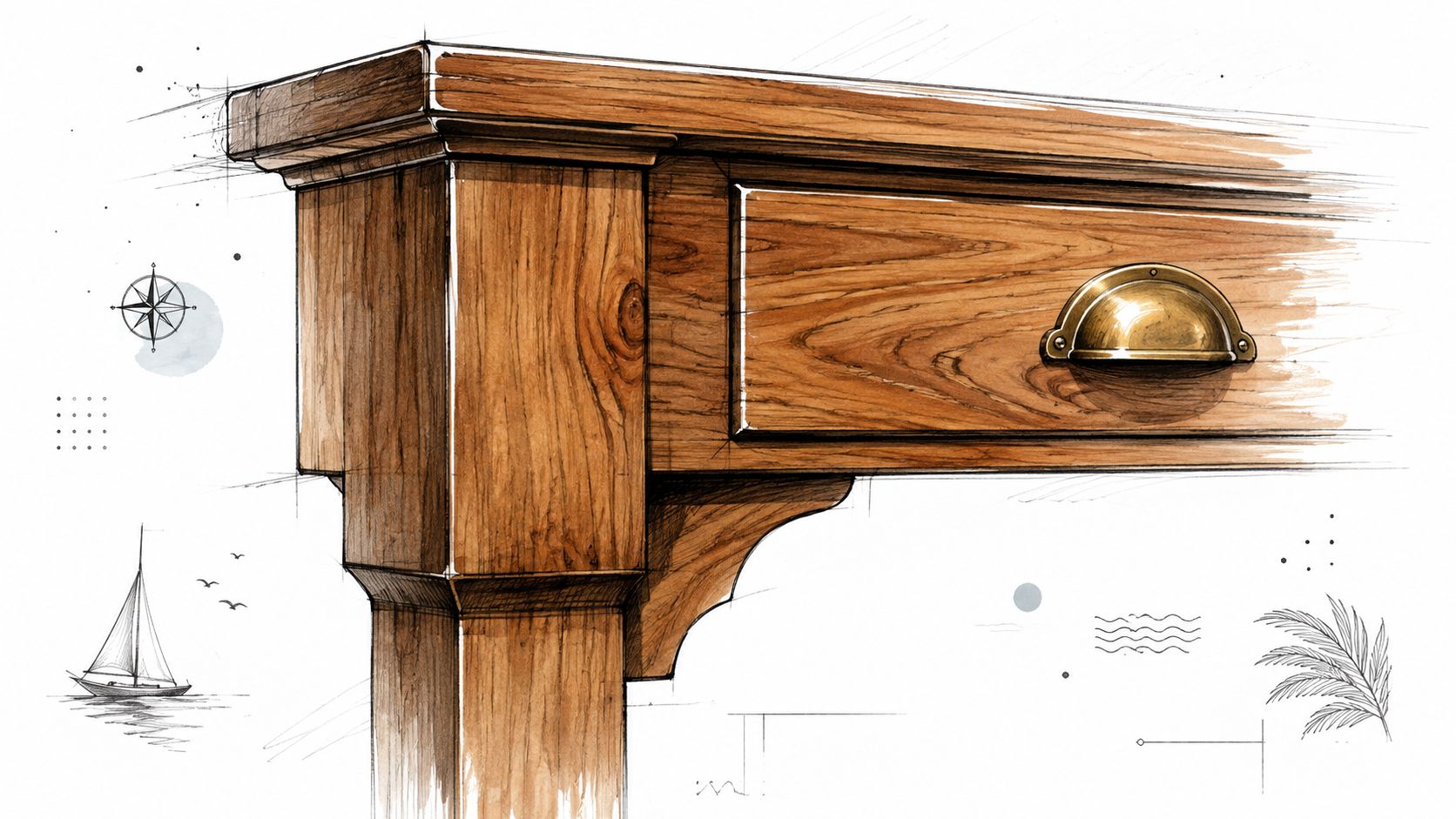
Use Lott's guide to understanding wood finishes to compare stain, lacquer, and protective topcoats. A curated Coastal candle collection can finish the display, but candles belong on a stable tray, away from drafts, damp surfaces, and flammable accessories. In multigenerational Florida homes, that stable setup matters as much as the finish.
Choosing the Best Spot in Your Home
A console table near a Florida entryway must handle wet sandals, salt-laden air, and busy household traffic. Choose the location before choosing the table. The right spot protects the finish, keeps circulation clear, and gives every generation in the home a place to set down keys, mail, or a bag.
Entryway, sofa, or hallway
For an entryway, start with 28 to 32 inches high, 12 to 16 inches deep, and a width around one-half to two-thirds of the wall. Keep 30 to 36 inches of walkway in a condominium corridor. Check the front-door swing, stairs, shoe storage, and coat area before approving the footprint.
An interior wall usually serves a Fernandina Beach entry better than a position directly opposite an exterior door. Rain, salt air, and strong sunlight can wear a finish faster when the table sits in the direct path of outdoor exposure. Inspect exterior-facing walls, HVAC vents, outlets, baseboards, and humid corners. A table pressed against a vent or damp corner will age poorly, regardless of its appearance in the showroom.
Behind a sofa, place the table approximately 1 to 3 inches above the back cushion. Let it extend 5 to 7 inches beyond each end for balanced proportions. A profile around 10 to 14 inches deep preserves the route behind the seating, which matters in homes shared by children, older adults, pets, and frequent guests.
A hallway demands a stricter measurement. Use the narrowest point as the deciding measurement, with at least 36 inches for a main path and 30 inches for a secondary passage. For a narrow hall, choose a shallow table or consider a wall-mounted design. Lott's showroom team can help check the proposed location against the household's actual traffic pattern.
| Location | Recommended Size | Key Clearance | Placement Priority |
|---|---|---|---|
| Entryway | 28–32 in high, 12–16 in deep | 30–36 in walkway | Door swing and drop-zone access |
| Behind sofa | 1–3 in above cushion, 10–14 in deep | 30–36 in behind seating | Traffic flow and balanced ends |
| Hallway | 28–32 in high, shallow profile | At least 36 in on main paths | Narrowest passage first |
| Wide foyer | 16–22 in deep when suitable | 30–36 in in front | Architecture and two-person movement |
Placement test: Tape the footprint, then walk the route carrying the objects the household actually carries.
This test exposes conflicts a floor plan misses, including a walker clipping a corner, a stroller narrowing the route, or a pet turning the table into an obstacle. In a compact condo or high-traffic family home, let circulation decide whether the console should stand on the floor or attach to the wall.
Styling a Console Table Like a Showroom
A humid Tuesday exposes a weak console arrangement quickly. Keys pile up, beach bags arrive damp, and children or older adults need clear access through the entry. Style the table around those routines first, then add the coastal details that make the room feel finished.
Start with one strong anchor, such as a framed coastal map, a large mirror, or substantial artwork. Choose a piece spanning about one-half to two-thirds of the table width, then center it by eye. A doorway, switch plate, or architectural feature may make the wall's exact midpoint look unbalanced.

Build the arrangement around daily use
Place a shallow tray where keys land. Use a lidded box for mail and a small basket for leashes, sandals, or flip-flops. These pieces keep the surface useful instead of turning it into a display no one wants to touch.
Build the composition with three layers:
- One tall element: Set a lamp, vase, or sculptural form slightly off center.
- One middle layer: Add framed art, a modest plant, or a ceramic object with contrasting texture.
- One low layer: Finish with a tray, box, or shallow bowl that remains easy to reach.
Woven fiber, pale ceramic, weathered wood, linen, and aged brass suit a Florida coastal room without creating a theme display. Keep visual weight low near the doorway. Open space there makes movement easier and the entry more welcoming.
A narrow hallway needs restraint. One substantial object and a low tray usually finish the surface. In a home with children, pets, or frequent multigenerational traffic, skip fragile shells and unsecured glass. Choose stable décor with rounded edges, and manage lamp cords so they cannot catch on bags or feet. Protect electrical components from moisture.
For room-by-room guidance, review these ideas for decorating a Florida home. Then stand about six feet away. If one object disappears behind another, remove it. The finished console should handle keys, mail, and damp-day traffic while still looking composed.
Caring for Your Console in Florida Humidity
Coastal console care works best as a regular household routine. In Fernandina Beach and nearby coastal South Georgia, the top should be wiped weekly with a soft, slightly damp cloth and dried immediately, especially around joints, drink rings, and flower vases.
Keep the finish clean and the joints observed
Hardware needs a dry microfiber cloth each month. At the same time, check screws, drawer runners, and door hinges for looseness or resistance. Twice a year, inspect the full piece for white salt residue, sticky areas, fading, swelling, cracking, and loose joints.
Pay special attention to surfaces facing open doors, pool doors, and sunny windows. Keeping the table several inches from an exterior wall where possible, while maintaining indoor humidity through air conditioning and dehumidification, reduces unnecessary exposure to changing conditions.
Care standard: Moisture should never remain on the furniture long enough to become part of the finish problem.
Wet umbrellas, beach bags, coolers, and damp décor belong on a protected surface, not directly on wood or wicker. Coasters and felt pads protect the top, while rotating accessories prevents one area from fading or collecting residue.
Avoid silicone-heavy polishes, which can soften or complicate modern finishes. Solid wood should only receive a compatible product from its original finish system. An incompatible oil or wax may interfere with later repairs. Metal tables need prompt attention to scratches because exposed steel can rust near salt air, while brass and aluminum should be cleaned according to their specific finish.
A wood furniture care guide can help establish a product-safe routine. If joints loosen or the top begins to cup, schedule a professional assessment before the damage spreads. Early attention is especially valuable in seasonal homes that may sit unattended between visits.
Ordering Custom and Bringing It Home
A console order should start with the room, not a guess. Bring measurements and photographs to an in-store or virtual showroom consultation. Review finish samples and hardware, confirm the dimensions, sign the build sheet, and establish the delivery lead time before production begins. For a coastal home, include the entry path, covered porch, stair turns, and any narrow doorway in that discussion.
The Special Order Program makes sense when a ready-made profile is close but misses on finish, fabric, comfort, or scale. Personalized options can include fabrics, leathers, frame choices, arm and leg styles, cushion cores, and leg finishes. Universal Furniture describes this type of special-order customization. Select special-order programs may provide extensive fabric, leather, and frame selections, but the right choice is the one that suits your household, including children, older adults, and frequent guests.
Match the table to the home already owned
Coordinate the console with the sofa, dining set, and flooring by comparing stain, wood tone, metal finish, and proportion. Bring a drawer front, finish sample, or clear photograph to the showroom. Screens distort color, especially with warm wood and metallic finishes.
Lott's Furniture connects its digital catalog with showrooms in Fernandina Beach, Florida, serving South Georgia and North Florida. Homeowners can browse online, use the Style Quizzes and room inspiration tools, and then work with an associate on finish, scale, and placement decisions.
White-glove delivery should include more than leaving the console at the threshold. Confirm that the service covers receiving, inspection, room placement, assembly when required, packaging removal, and installation support. Design Logistics Group explains the components of white-glove furniture delivery.
Before signing, verify the package count and inspect corners, edges, legs, seams, upholstery panels, armrests, surfaces, finishes, hardware, drawers, doors, and moving parts under direct light. A detailed furniture delivery inspection policy lists these verification points. Require the crew to place the table where agreed, document visible damage on the delivery record, and remove packing materials before leaving. This white-glove furniture delivery guide outlines the same receiving priorities.
Lott's Furniture provides custom-order guidance, online catalog access, showroom associates, and white-glove in-home delivery for homeowners selecting a Florida console table. Visit Lott's Furniture to schedule a Fernandina Beach showroom appointment or begin an online style consultation with measurements and room photos ready.