
Mattress Financing Bad Credit


A mattress problem rarely arrives at a convenient time. The old bed may be sagging, a guest room may need a dependable sleep surface, or a growing household may need a replacement before the next payday. For shoppers searching for mattress financing with bad credit, an approval can feel like the finish line. It isn't. The question is whether the payment plan will still feel manageable after rent, utilities, groceries, existing debt, and ordinary surprises have taken their share.
A strong mattress supports a healthier home routine, but financing is still a financial commitment. The safest decision weighs the total repayment, debit dates, late-fee rules, credit-reporting policy, and payment stacking risk before anyone signs. That approach protects the sleep the mattress is meant to provide.
What Mattress Financing Really Means When Your Credit Is Stretched
A shopper may stand in a Fernandina Beach showroom with a mattress selected and several payment paths in front of them, perhaps a same-as-cash promotion, an installment contract, or a lease-to-own arrangement. The tempting figure is usually the recurring payment. The important figure is the amount paid from the first charge through the final scheduled debit.
Bad credit doesn't make a shopper careless or irresponsible. The Federal Reserve Bank of St. Louis reported that 23.9% of adults with a credit record had a subprime score in the first quarter of 2025, while about 30% of U.S. adults had limited access to traditional credit. Those figures explain why alternative financing appears at so many essential-purchase counters, but approval still says nothing about whether the plan fits the household's cash flow. The St. Louis Fed's analysis of access to traditional credit provides the broader context.

Approval is only the first checkpoint
Before accepting an offer, the shopper should write down the down payment, finance charge, required fees, delivery charges, optional protection products, payment frequency, and final repayment amount. A plan that appears small each month may demand more frequent withdrawals or a larger final payment than expected. Anyone comparing categories can also review this overview of consumer financing options for mattress stores, then confirm every term in the actual financing disclosure.
| Score Range | Lender Label | Typical Treatment |
|---|---|---|
| Below 620 | Subprime | Approval may involve higher rates or fees, a smaller approved amount, or a down payment |
| 620–719 | Near-prime | Terms may vary according to the complete application and repayment risk |
| Above 719 | Prime | Lenders generally associate higher scores with lower borrowing costs |
These bands come from the Federal Reserve's commonly used credit-score framework, and the Federal Reserve's credit-scoring overview explains why scores influence approval decisions, rates, and fees. A shopper should also read the mattress return policy before financing, because returning a mattress may involve conditions that don't cancel a financing obligation automatically.
Practical rule: The right plan is the one that can be paid in full without a late payment, not the one that produces the easiest approval.
Lott's Furniture connects showroom assistance with online shopping for households across South Georgia and North Florida. Whether a customer starts with the digital catalog or visits a showroom, the purchase should end with a mattress that fits both the body and the cash flow. White-glove, in-home delivery adds another layer of care, and every piece undergoes a rigorous multi-point inspection before it reaches the customer.
The Main Paths to a Mattress Without Strong Credit
A shopper with a challenged credit history has several categories to consider, but each solves a different problem. The best choice depends on whether the priority is predictable monthly billing, short-term flexibility, credit reporting, or access without unsecured approval.
The need is widespread, not unusual. The St. Louis Fed's finding that nearly one in four adults with a recorded credit history falls into the subprime category puts bad-credit financing in a realistic context. It shouldn't be treated as a personal label or a reason to accept unclear terms.
Five paths with five different trade-offs
In-store installment contract: The customer applies through a financing provider connected to the retailer and repays according to a fixed schedule. The key questions are the annual percentage rate, finance charge, down payment, late fees, and whether the account reports payments.
Buy Now Pay Later: A short plan may split the purchase into four payments, commonly requiring 25% at checkout followed by three payments every two weeks, according to the Federal Reserve's household-borrowing summary. That frequency can create a heavier monthly cash burden than a monthly-payment advertisement suggests.
Lease-to-own: The customer makes scheduled payments for the right to use the mattress and may obtain ownership under the contract's conditions. The total cost can differ substantially from the cash price, so the written ownership terms matter more than the recurring payment.
Secured or credit-builder card: A deposit or other security supports the account. This may offer a route toward credit history when the issuer reports qualifying activity, but it can be a poor fit if the card balance and mattress purchase create another payment that the household can't sustain.
Co-signer: Another person accepts responsibility if the primary borrower doesn't pay. This can change approval terms, but it also places the co-signer's credit and finances at risk. A co-signer should never be added casually or used to disguise an unaffordable plan.
BNPL deserves particular scrutiny because its use expanded sharply. The five largest U.S. BNPL lenders increased originations from 16.8 million loans in 2019 to 180 million in 2021, while total loan value rose from $2 billion to $24.2 billion, according to the Consumer Financial Protection Bureau's BNPL report. The same report found that 17% of consumers used BNPL during the year before its 2023 study, and users were 11 percentage points more likely to have a delinquency of at least 30 days on another reported credit product. Those figures don't prove BNPL caused delinquency, but they show why approval isn't an affordability test.
A shopper who wants to compare mattress construction, support, and comfort before considering payment terms can use Lott's mattress buying guide. Lott's serves South Georgia and North Florida with brands such as Stressless, Lexington, and Smith Brothers, while associates help customers separate a genuine comfort need from an unnecessary feature upgrade.
Running the Affordability Test Before You Sign
The payment plan should pass a cash-flow test before it passes an approval screen. A useful worksheet asks four questions, and each answer should be specific enough to verify against the contract and the household bank account.
Four questions that expose the real cost
What is the complete repayment amount? Add the down payment, finance charges, mandatory fees, delivery charges, optional products, and any deferred-interest deadline. A promotional interest rate doesn't eliminate the need to inspect late-payment terms. Most BNPL lenders charge late fees, although the amounts and rules vary, and an automatic debit can also trigger a bank overdraft or nonsufficient-funds fee. The CFPB cites an average overdraft fee of about $35 in its consumer-finance research, so the household should account for the bank's consequence as well as the lender's.
When will every payment leave the account? Write the exact debit date, not only the advertised monthly amount. Pay-in-four plans use recurring two-week withdrawals, while conventional contracts may use one monthly date. A payment that arrives before a paycheck can be unaffordable even when the total monthly income appears adequate.
What happens after a missed payment? Check the grace period, returned-payment charge, late fee, collections language, and credit-reporting policy. The Federal Reserve reports that 4.1% of BNPL loans were assessed a late fee in 2023 and 1.83% were charged off, although those figures cover six large providers and don't specifically represent bad-credit mattress applicants. The Federal Reserve's household borrowing summary explains the limits of that comparison.
Can the payment survive a weaker month? Subtract the proposed installment and every existing debt payment from dependable monthly income. Don't count uncertain overtime, seasonal work, or another credit account as income. Associates in Fernandina Beach can help customers compare payment dates against paydays, but the household still has to test the plan against its own bank balance.
| Question | Why It Matters | Red Flag Answer |
|---|---|---|
| What is paid in total? | Reveals the actual cost beyond the recurring payment | The salesperson or disclosure shows only a monthly figure |
| Which dates trigger withdrawals? | Shows whether payments collide with rent or other bills | The dates are unclear or change without notice |
| What does a late payment cause? | Identifies fees, reporting, and collection risk | The provider won't explain the policy in writing |
| Can the household pay during a slow month? | Tests resilience instead of relying on an average month | The plan requires overtime, another loan, or skipped essentials |
For a broader replacement decision, households can review how long mattresses last. A payment plan shouldn't extend beyond the useful purpose of the mattress without a clear reason, and longer repayment can reduce the recurring amount while increasing the time the obligation remains active.
Why Stacking Small Plans Can Break a Budget
One mattress payment may look harmless beside rent and utilities. Several automatic withdrawals can become a different problem, especially when each plan uses a separate account, debit date, alert system, and late-fee policy.
Consumer Reports found that 11% of surveyed BNPL users missed at least one payment. Among people managing four or more simultaneous BNPL loans, nearly one in five missed a payment, approximately twice the rate among users with fewer plans. The same survey found that 30% didn't understand all possible late fees or interest charges at enrollment. These findings make payment stacking a practical household risk, not an abstract warning.
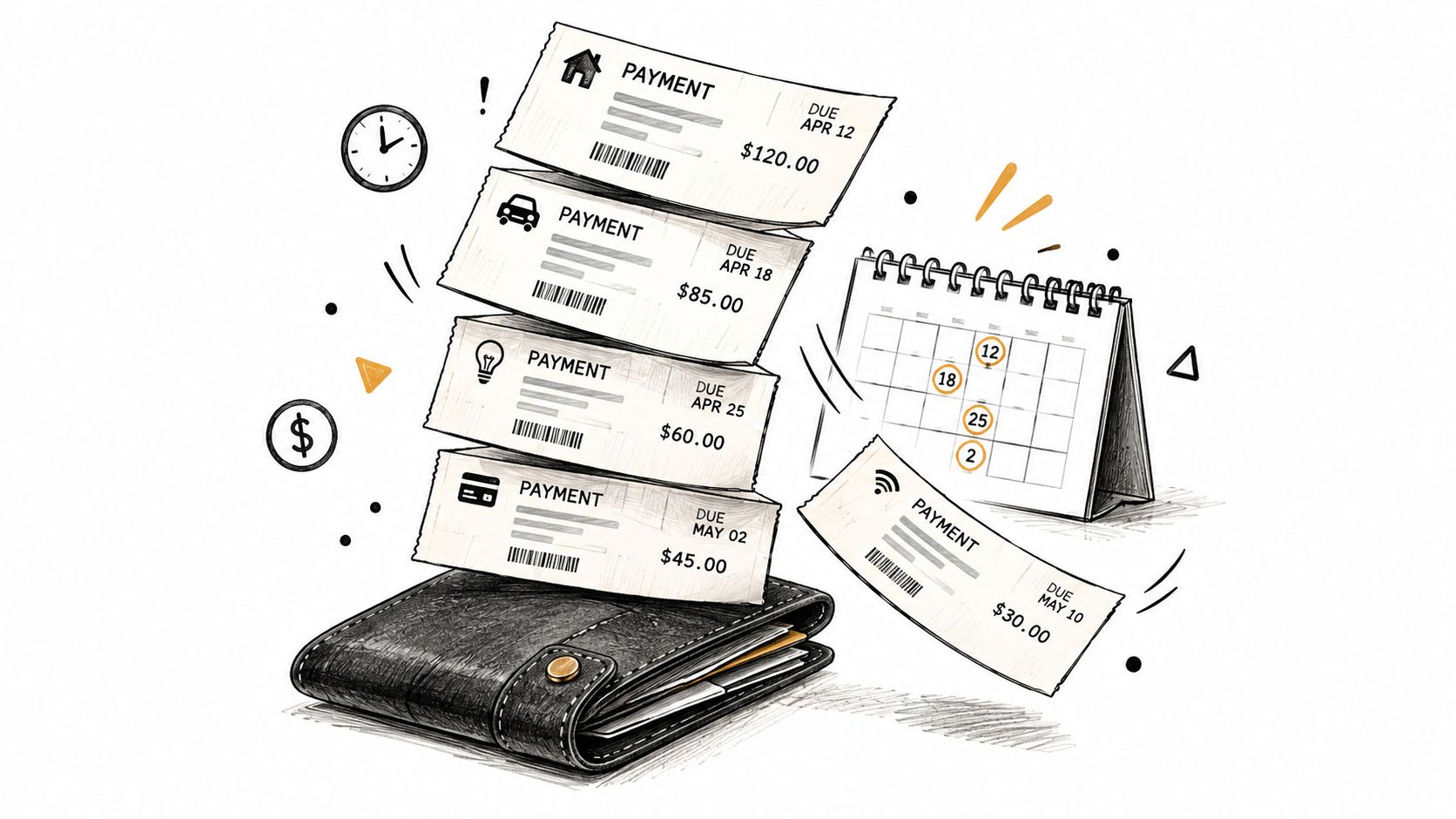
The five-step payment audit
Inventory every obligation. List store financing, BNPL plans, cards, auto payments, personal loans, and recurring subscriptions. The list should include the remaining balance and payment amount.
Map each debit date. Put every withdrawal on a calendar. Four individually modest payments can drain the account before the borrower notices the combined total.
Protect a cash buffer. Keep enough available to cover at least the largest two-week withdrawal. A buffer reduces the chance that timing alone creates a missed payment.
Turn on early alerts. Enable notices several days before each debit. Alerts give the customer time to transfer money, reschedule where permitted, or contact the provider.
Check reporting rules. Confirm whether positive or negative payment data goes to major credit bureaus. A lender's approval doesn't reveal the customer's full outstanding exposure, particularly when providers report inconsistently.
A household can also use a neutral planning resource to compare payment apps for debt while building its own calendar. The tool doesn't replace the financing disclosure or bank records, but a visible schedule can make overlapping obligations easier to catch.
Payment discipline matters more than payment size. A smaller installment still creates damage if it arrives when the account is empty.
Consumer Reports also found that 15% of respondents who had made a late payment said it appeared on their credit report, while 21% said the debt was sent to collections. A customer shouldn't assume that a pay-in-four plan is invisible because it isn't structured like a traditional credit card. The safest standard is zero missed payments through the full term, and financing should be declined if another credit account is needed to fund the scheduled debits.
Will Mattress Financing Actually Build Your Credit
The phrase credit-building can create false confidence. Financing improves a credit profile only when the specific provider reports qualifying on-time activity and the account is handled as agreed. Approval alone doesn't raise a score.
Many Pay-in-4 providers generally don't furnish origination or repayment data to all three major credit bureaus. The Federal Reserve also notes that pay-in-four products often don't fit existing credit-reporting infrastructure, which means timely payments may provide little or no score benefit while lenders may not see the borrower's complete BNPL exposure. The Congressional Research Service overview of BNPL explains why reporting practices remain inconsistent.
Questions to get answered before applying
Will the application use a soft or hard inquiry? A soft inquiry generally doesn't affect the score in the same way as a hard inquiry, but the applicant should confirm the method for the specific product.
Which bureaus receive data? The answer may be one, two, all three, or none of the major bureaus.
Are on-time payments reported? Don't assume positive reporting based on an offer using credit-building language.
When is a late payment reported? Ask whether the provider reports after a grace period, after a defined delinquency period, or when the account enters collections.
What happens after a collection assignment? Confirm whether a debt collector can report the account and how the provider handles disputes.
Credit reporting should be treated as a contract feature, not a marketing promise. The Federal Reserve explains that credit-building products can help establish or improve credit through reported payment activity, while the CFPB warns that reported late payments may harm credit history and scores. The Federal Reserve's overview of credit-building products supports checking the product's reporting terms before an application.
A shopper reviewing the dos and don'ts of furniture shopping should add one more rule: never trade a possible credit benefit for a payment that threatens housing, food, utilities, or existing obligations. A mattress can be an urgent household need, but a vague reporting promise isn't a reason to accept an unstable cash-flow commitment.
Choosing the Mattress First, Then the Payment Plan
The payment should serve the sleep solution, not dictate the sleep solution. A shopper who chooses a mattress only because its advertised payment is low may leave with the wrong firmness, inadequate support, or a repayment period that lasts longer than the comfort benefit.
Lott's Furniture gives households in South Georgia and North Florida several ways to make the decision calmly. A customer can start with the online Mattress Guide, use Style Quizzes to clarify preferences, and move from the digital catalog to a showroom in Fernandina Beach or Waycross. In-store associates can help test comfort levels and explain the practical differences between support systems without turning the conversation into an approval race.
Comfort deserves the same attention as cost
The mattress itself should be assessed for sleeping position, pressure relief, movement transfer, temperature preferences, room dimensions, and the needs of anyone sharing the bed. A shopper seeking more technical guidance can review this pressure relief mattress buying guide, then test suitable surfaces in person.
Lott's Special Order Program also matters when standard showroom options don't fit the room or the sleeper. Most vendors support personalized designs, including fabrics, finishes, and comfort levels, so customers can pursue custom comfort rather than settling for a one-size-fits-all purchase. The same philosophy appears across the home, whether a household is considering a La-Z-Boy chair, a Hooker Furniture office piece, or a mattress selected for a carefully curated sanctuary.
A useful order of operations is:
Define the sleep need: Identify the comfort and support characteristics that matter before looking at payment amounts.
Test the surface: Visit a showroom when possible, and allow enough time to compare options rather than choosing from a thumbnail and a monthly figure.
Price the complete purchase: Include the mattress, foundation if required, delivery, protection products, financing charges, and any required down payment.
Run the cash-flow worksheet: Match every debit to dependable income and existing obligations. Reject any structure that depends on uncertain overtime or another new loan.
Confirm the service details: Ask how delivery, inspection, setup, returns, and cancellations interact with the financing agreement.
The mattress firmness guide can help narrow the comfort conversation before a showroom visit. Once the selection is made, Lott's white-glove, in-home delivery places the purchase in the room of choice, and every piece undergoes a rigorous multi-point inspection before reaching the customer. That standard matters because a major sleep purchase deserves careful handling from selection through setup.
Shopping can remain convenient without becoming impulsive. Customers may browse the digital catalog online, complete a style consultation, and then visit a Fernandina Beach showroom to test a sleep surface. Or they can start in Waycross with an associate and continue reviewing options online. That smooth transition gives the household time to compare the mattress and the payment plan as separate decisions.
The strongest recommendation is straightforward: choose the mattress that meets the sleep need, then accept financing only if the total repayment, exact dates, fees, reporting rules, and cash-flow test all work. If the numbers don't hold, postpone, choose a different configuration, or pay through a safer route. Restful sleep shouldn't be purchased by creating a payment schedule that keeps the household awake.
Lott's Furniture offers mattress guidance, online and in-showroom consultations, Special Order options for personalized comfort and finishes, and white-glove in-home delivery across South Georgia and North Florida. Visit Lott's Furniture online or in Fernandina Beach or Waycross to test mattresses, review the payment terms clearly, and choose a plan that supports the household instead of stretching it.