Coastal Style Interior Design: A Complete Guide


A coastal home can look beautiful on move-in day and still become difficult to live with once sandy feet, damp towels, curious pets, and strong afternoon sun enter the picture. The right approach isn't a room covered in navy paint and rope accents. It's a comfortable, light-filled interior where upholstery, finishes, circulation, and maintenance habits are chosen for real life in South Georgia and North Florida.
Coastal style interior design works best when the home feels connected to its surroundings without becoming fragile. Natural textures, pale reflective surfaces, flexible seating, and carefully selected performance materials create an atmosphere that feels relaxed today and remains practical years from now.
What Coastal Style Interior Design Actually Feels Like
The French doors stand open toward a porch, and the room seems to breathe with them. Sunlight moves across a pale wood table, linen-look upholstery softens the seating, and a woven rug gives bare feet a comfortable landing without demanding attention. Nothing shouts “beach house,” yet the room feels unmistakably connected to the water, the garden, and the changing light outside.

That feeling comes from light, air, proportion, and environmental connection. Architectural Digest traces coastal design from lavish seaside homes, including residences in the Hamptons, where interiors responded to water views, outdoor leisure, and proximity to the surroundings. The style later expanded beyond literal beach houses into a broader design language that brings the surrounding environment indoors. Architectural Digest's history of coastal interior design makes the distinction clear: authentic coastal rooms defer to the scenery rather than compete with it.
A relaxed room still needs structure
A coastal living room usually offers generous seating, open sightlines, and enough space for people to move between the sofa, porch, kitchen, and dining area. Curtains filter light instead of blocking it completely. Upholstery feels touchable and inviting, while tables, lamps, and artwork provide quiet definition.
The result isn't empty or unfinished. It's visually open but physically comfortable, with textures doing the work that heavy pattern might do elsewhere. A pale wood finish, a softly nubby textile, and a woven accent chair can create more depth than a collection of literal nautical accessories.
Homeowners who aren't sure whether their preferences lean Coastal Chic, Modern Farmhouse, or Timeless Traditional can begin with Lott's home design style quiz. A clear style direction makes it easier to select pieces that belong together rather than purchasing isolated beach-inspired objects.
Practical rule: If the room would feel coastal only after adding anchors, shells, or ship imagery, the furniture, light, and proportions probably need more attention first.
The Foundational Principles Behind Every Coastal Room
Coastal interiors have a recognizable logic. The look begins with how a room receives light, connects to the outdoors, and supports movement. Accessories come later.
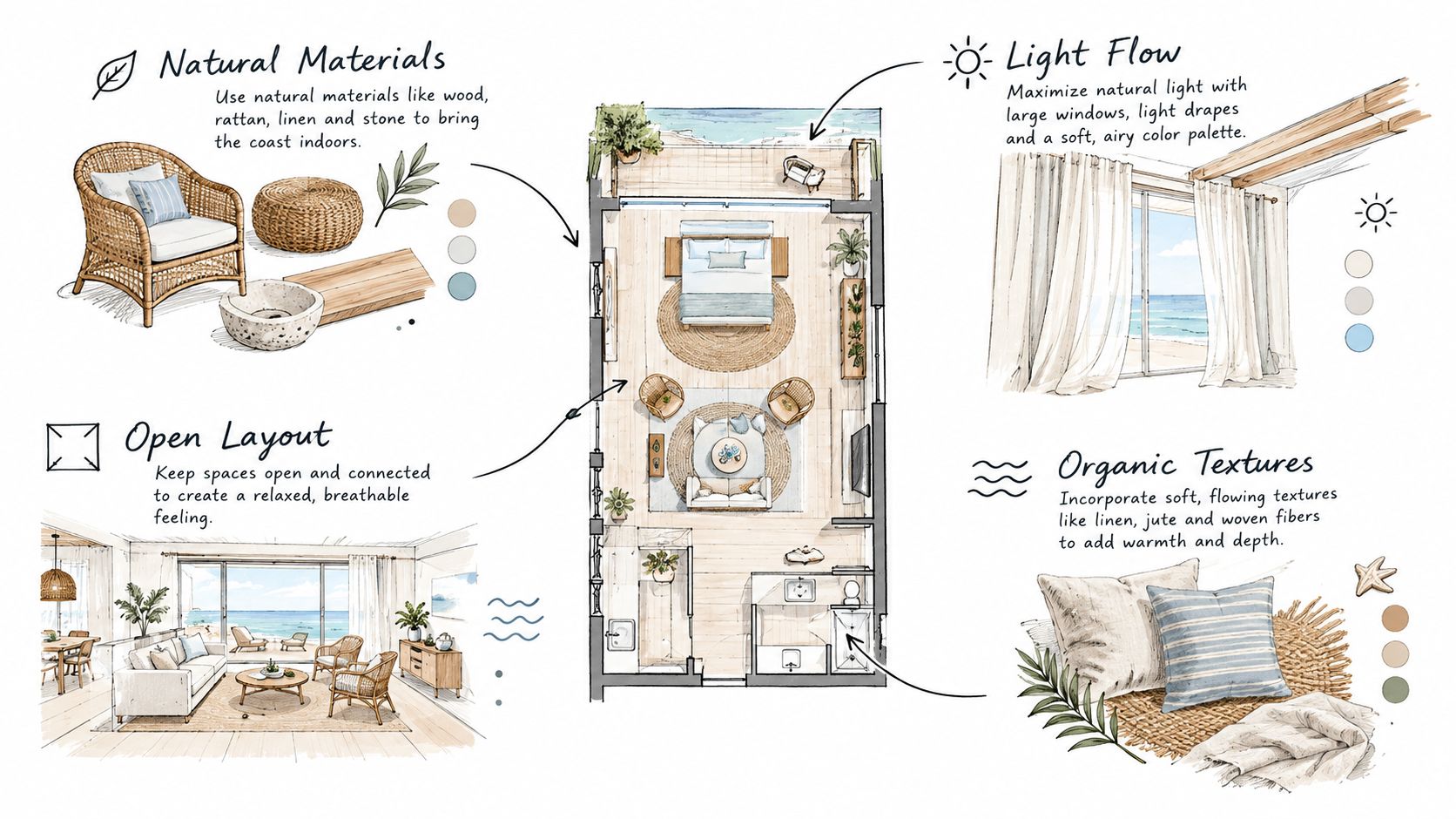
Start with light and outdoor connection
Large windows, glass doors, balconies, courtyards, breezeways, and overhangs all appear in the Sarasota School of Architecture because they connect interior life with the outdoors. A University of Florida-hosted study of Sarasota coastal architecture identifies the Revere Quality House, designed by Twitchell and Rudolph in 1948, as one of the movement's earliest examples. The same study notes that heating and cooling can account for as much as 45 percent of annual household energy use, which helps explain why passive cooling, shade, and ventilation matter in coastal planning. The University of Florida study of Sarasota coastal architecture also records approximately 52 inches of average annual rainfall at the study location, reinforcing the need to design for sun, humidity, and heavy precipitation.
Furniture should support those architectural conditions. A sofa that blocks a doorway or closes off a garden view works against the room, even if its fabric looks perfectly beachy. A lower-profile arrangement, an open-backed chair, or a console with visual breathing room can preserve the connection.
Let circulation shape the layout
A coastal plan should make it easy to carry a drink from the kitchen to the porch, guide children toward a screened room, or move around a conversational seating group without squeezing past every chair. Generous clearances help the interior feel cooler and calmer because the eye can travel through it.
Four questions help evaluate a room:
- Where does daylight enter? Keep bulky case goods from interrupting the brightest openings.
- What view deserves emphasis? Position seating toward a porch, garden, or waterfront.
- How does air move? Avoid arrangements that create unnecessary visual and physical barriers.
- Which materials belong to the setting? Favor wood, woven textures, stone-like surfaces, and finishes that support rather than imitate nature.
Coastal style isn't a catalog category with one fixed silhouette. Atlantic and New England rooms may draw from weathered materials and seaside architecture, while warm-climate interpretations often emphasize breezes, shaded outdoor rooms, and continuous indoor-outdoor transitions. The principles remain useful even when the home sits inland.
Building a Coastal Color Palette That Reflects Light
The most successful coastal palette isn't built from a blue-and-white paint chip. It's built from a reflectance hierarchy, with the ceiling, walls, and floor each performing a different job.

Give the ceiling the brightest role
Daylighting research commonly models ceilings at approximately 80 percent reflectance, walls at 70 percent, and floors at 30 percent. Research on surface reflectance and daylight distribution supports a practical sequence: a bright upper surface redirects light, lighter walls help distribute it, and a medium-value floor grounds the room without creating excessive glare.
For a coastal living room, that can mean:
- Ceiling: A matte or low-sheen high-reflectance white.
- Walls: A warm off-white with a high light-reflectance value.
- Flooring: Medium-value wood, tile, or natural fiber that adds visual weight.
- Furniture: Pale wood, sand, oat, soft gray, and restrained blue-green accents.
Gloss isn't automatically better at reflecting light. In rooms with large windows, highly polished surfaces can create distracting highlights. Matte paint, brushed metal, lightly textured textiles, and softly finished wood usually produce a more comfortable glow.
Use ocean colors as punctuation
Saturated ocean tones work best as a controlled accent, such as one wall, a textile group, a rug detail, or a piece of artwork. Changing one wall's color has relatively little effect on average room reflectivity across a broad range of light-reflectance values, so a stronger blue or green can add character without overwhelming the room. This guide to choosing a purposeful color palette can help homeowners connect paint, upholstery, flooring, and accent pieces before committing to a full-room treatment.
A useful test is to imagine removing the blue accessories. If the room still feels bright, airy, and connected to the coast, the foundation is working. If the identity disappears, the palette may be relying too heavily on a decorative idea rather than proportion and light.
Warm sand, shell, driftwood, muted sage, and weathered gray can keep the room from feeling cold. The aim is a palette with movement, not a showroom washed entirely in one white.
Choosing Textiles and Materials That Survive Coastal Living
A sofa can look perfect in a showroom and fail within a season beside an open porch. Salt air, humidity, strong sunlight, sand, children, and pets test every material choice. In homes from North Florida to South Georgia, durability starts with matching each finish and textile to its actual exposure, then confirming that the household will follow the care requirements.
Compare fabric by exposure and maintenance
Natural fibers bring softness and breathable texture, but some absorb moisture and need more careful placement. Performance weaves usually simplify cleaning and handle daily use well. Leather offers a smooth, wipeable surface that develops character, although it can feel warmer and needs protection from direct sunlight. Engineered materials can provide consistent color and better moisture tolerance, but their hand and visual depth vary considerably.
Texture and construction matter as much as color. Lewis and Sheron Textiles' designer fabric guide offers a useful reference for comparing patterns, weave, and application. Choose according to room traffic, sun exposure, pets, children, and the cleaning routine the household will maintain.
| Material | Best Room | Coastal Strength | Watch Out For |
|---|---|---|---|
| Performance weave | Family living room | Cleanability and everyday resilience | Confirm the care instructions and fabric hand |
| Removable washable cover | Sand-prone living room or vacation home | Easy rotation, cleaning, and refresh | Covers still need proper drying before reuse |
| Sealed wood | Dining area or sunroom | Helps limit moisture absorption and simplifies care | Direct sun can still affect color over time |
| Leather | Reading chair or primary seating | Wipeable surface and tailored appearance | Keep away from harsh direct sunlight and uncontrolled humidity |
| Corrosion-resistant metal | Porch, entryway, or sunroom | Better suited to moisture and salt-air exposure | Hardware still benefits from routine cleaning |
The EPA recommends keeping indoor relative humidity below 60 percent, ideally between 30 and 50 percent (EPA mold and moisture guidance). For a coastal home, aim for approximately 40 to 50 percent with air-conditioning, dehumidification, and a simple humidity monitor. Excess moisture raises the risk of mold and material degradation, particularly on porous upholstery, rugs, wood, and cool exterior walls.
Use labels as a starting point, not a guarantee. Lott's guide to what performance fabric is made of explains why performance textiles behave differently from traditional decorative fabrics. Check the cleaning method, drying requirements, light exposure, and fabric feel before ordering.
Specify the finish, not only the silhouette
Sealed wood suits rooms where sunlight and humidity are part of daily life. Powder-coated or corrosion-resistant metal is a better choice for entryways, porches, and sunrooms than finishes that can deteriorate quickly in salt air. Keep absorbent fabrics from pressing directly against cool exterior walls, where condensation may form.
Finish quality affects upkeep. A sealed surface limits absorption, but it does not make wood immune to fading or moisture. Metal still benefits from routine cleaning, and washable covers need to dry fully before returning to a cushion.
The most comfortable coastal room balances softness with practical cleanability. Upholstery should recover from real use, finishes should suit the setting, and furnishings should allow enough airflow to support the home's moisture-control strategy. That approach creates a room that feels relaxed without making every choice fragile.
Furniture Styles That Anchor a Coastal Room
Coastal furniture should make the room feel more open, not more decorated. Relaxed silhouettes, pale finishes, generous seating, and woven details support the style because they reinforce light, circulation, and comfort.
Choose profiles that preserve visual space
Slipcovered sofas and lounge chairs bring an easy, informal character to family rooms, especially when covers can be removed for cleaning or replacement. Low-profile case goods in pale or medium wood finishes provide storage without creating a dark visual block. Woven chairs, cane details, and textured ottomans add dimension when used selectively.
Brand collections can help shoppers explore different interpretations of the same principles:
- Lexington: Custom case goods and dining pieces can give a coastal room structure without making it formal.
- Hooker Furniture: Storage, occasional tables, and dining furniture can introduce grounded wood tones and useful proportion.
- La-Z-Boy and Smith Brothers: Upholstered seating can support family use when the selected textile and cushion configuration match the household.
- Wesley Hall: Relaxed upholstered silhouettes can soften a room while preserving a refined appearance.
A retailer's coastal accent chair selection can be useful when a room needs one lighter seat rather than another full-size sofa. An open frame, a textured cover, or a slightly smaller footprint can add seating while protecting the sense of air around the main arrangement.

Let scale follow the room
A large sectional may suit a broad vacation-home great room but overpower a narrow cottage living area. A small accent chair may look graceful in a bedroom and disappear in a spacious family room. The correct scale keeps walkways clear, supports conversation, and maintains sightlines toward doors and windows.
Before selecting a piece, measure the room, doorways, stair turns, and desired walking paths. Then consider how the furniture will be used. A deep sofa that looks inviting in a photograph may be less practical for an older family member who needs firmer support. Coastal style should feel relaxed, but relaxed doesn't mean unstructured.
Layering and Accessorizing Without Going Nautical
Accessories should strengthen the room's atmosphere, not announce a theme. A coastal interior becomes more refined when texture, scale, and restraint carry the design instead of anchors, ropes, signal flags, or collections of shells.
Build three quiet layers
Textiles establish softness. Use a lightly patterned rug, a woven throw, or cushions in sand, sea glass, muted blue, or warm gray. Keep the pattern open enough that it doesn't compete with the view.
Surfaces add tactile variation. A woven basket, lightly grained wood tray, matte ceramic lamp, or natural fiber shade can make a pale palette feel collected rather than bare.
Objects provide personality. One oversized piece of driftwood-inspired wall sculpture can have more impact than a shelf crowded with nautical souvenirs. Artwork showing water, marsh grass, weathered architecture, or abstract movement can reference the coast without reproducing it.
Coastal versus themed: Coastal design borrows the light, texture, and openness of waterfront living. Nautical decorating reproduces recognizable maritime symbols as the main subject.
Lighting deserves the same restraint. A linen shade, woven pendant, or softly aged metal fixture can reinforce the room's material language. Candles can also add evening warmth when their vessels and colors support the palette. Shivora Candles offers a helpful candles and home decor guide for coordinating candle styles with surrounding furnishings.
The final edit matters more than the initial purchase. Remove one object from a crowded console. Replace several small accessories with one substantial piece. Leave space around artwork and allow the furniture to remain the room's primary expression of comfort.
A Room by Room Decision Framework for Coastal Homes
A coastal home becomes easier to furnish when each room receives a clear job. The goal isn't to make every space identical. It's to repeat the same commitments to light, comfort, circulation, and materials.
Living room
Begin with the seating conversation. A La-Z-Boy or Smith Brothers sofa can anchor family use, while a lighter accent chair opens the arrangement toward a porch or garden. Choose a performance rug with enough texture to feel natural but sufficient durability for sandy feet and pets.
Keep side tables accessible, preserve the main walkway, and avoid placing tall furniture directly in front of the brightest opening. If the room serves as both family lounge and entertaining space, flexible chairs and an ottoman can work harder than a rigid collection of matching pieces.
Bedroom
A coastal bedroom should feel quiet rather than decorative. Use breathable bedding, a neatly upholstered headboard, and case goods in a finish that complements the home's existing wood tones. A Stressless chair can create a comfortable reading corner where space allows, while the Mattress Guide helps organize decisions around support and comfort technologies before a showroom visit.
The right mattress is personal. Digital research can narrow the options, but in-store testing remains valuable because body support and pressure comfort can't be judged by appearance alone.
Dining area
Select a table that leaves enough room for chairs to move without striking walls or nearby furniture. Finish matters near open windows, especially in homes where humidity and airborne moisture are regular considerations. Comfortable dining chairs encourage the room to function beyond formal meals, so upholstery should be selected for both sitting comfort and care requirements.
Sunroom, porch, and transitional spaces
These areas need furniture that respects airflow, shade, and changing exposure. Use moisture-conscious materials, corrosion-resistant hardware, and textiles suited to the amount of direct light. Wesley Hall pieces can support a relaxed upholstered direction indoors, while a carefully selected lounge chair or table can connect the sunroom visually to the main living area.
Lott's Style Quizzes and interactive style guides can help shoppers confirm a direction before ordering. The direct path from the digital catalog to the Fernandina Beach showroom or Waycross showroom lets customers research finishes at home, then assess scale, upholstery, and comfort with in-store associates.
Delivering and Maintaining a Coastal Home That Lasts
A durable coastal room isn't created when the order is placed. It depends on accurate specifications, careful handling, appropriate placement, and regular care after delivery.
Replace common durability myths
Myth: outdoor-rated means every indoor coastal piece is protected. Outdoor-rated and performance indoor furnishings are different categories. The correct textile depends on exposure, cleaning needs, hand, comfort, and whether the piece sits in an air-conditioned room, screened porch, or open area.
Myth: delivery is complete when the furniture reaches the driveway. A true white-glove process includes inspection before loading, protective wrapping and securement during transit, packaging inspection on arrival, careful unpacking, room-of-choice placement, and a final condition check with customer sign-off. Lott's Delivery Standard treats every item as an investment-quality piece that deserves a documented multi-point inspection before it reaches the customer.
Myth: maintenance can wait until a problem appears. Monitor indoor humidity, follow textile care instructions, rotate removable covers, clean salt and dust from exposed surfaces, and protect wood and leather according to the manufacturer's recommendations. Lott's wood furniture care guide provides a practical reference for preserving finished surfaces.
Windows and building envelope decisions also influence how furniture ages. Homeowners reviewing storm protection and solar exposure can consult this impact resistant window guide as part of a broader conversation about the home's openings, weather, and daylight. Furniture specifications still matter, but the surrounding environment determines how much stress those materials receive.
Customization makes the final result more personal and more usable. Most vendors support personalized designs through fabric, finish, dimension, cushion, and comfort selections, so the Special Order Program can adapt a coastal room to its actual occupants instead of forcing the household into a standard configuration. Lott's connects that process with Style Quizzes, the Mattress Guide, online browsing, and in-store associate support, giving customers a practical route from inspiration to custom comfort.
Lott's Furniture offers coastal furniture guidance, Special Order customization, and white-glove in-home delivery for homeowners across South Georgia and North Florida. Visit Lott's Furniture online for a style consultation, then bring the shortlist to the Fernandina Beach or Waycross showroom to test fabrics, finishes, scale, and comfort with an associate.