
Mattress Firmness Guide: Find Your Perfect Comfort Level


A couple settles onto a showroom mattress, and the conversation starts immediately. One says firm. The other wants soft. A few minutes later, both agree the bed feels “wrong,” but neither can explain whether the problem is the surface feel, the support underneath, or the way their own body sinks into it.
That confusion is why a mattress firmness guide matters. Firmness is often described on a 1-to-10 scale, with 1 as the softest and 10 as the firmest, but the words shoppers use in the store rarely mean the same thing from one brand to another. We help families across South Georgia and North Florida sort through that language every day, because comfort gets clearer once the guesswork turns into a shared system.
Why Mattress Firmness Confuses Most Shoppers
A mattress can feel like a cloud in the first minute and still leave someone achy by morning. That gap between first impression and all-night comfort is where most shoppers get tripped up, because firmness is the initial surface feel, while support is the structure that helps the spine stay aligned.
Practical rule: a mattress that feels “right” in the first 30 seconds can still fail if it lets the hips sink too far or keeps the shoulders too high.
Marketing language makes the confusion worse. Words like plush, supportive, and firm sound precise, but they're often used loosely, so the same label can feel different from one mattress to another. That's why families often end up repeating the same cycle, test a bed briefly, trust the description, and discover later that the fit isn't right for their body.
A shared scale solves that problem. In retail education, the most widely used benchmark is the 1-to-10 firmness scale, and the reason it stuck is simple, there's no official universal measurement for firmness, so shoppers need a common language to compare models across brands and construction types. That shared language becomes especially useful in our showrooms in Waycross and Fernandina Beach, where one person might prefer more contouring and another wants a more lifted feel.
Our Special Order Program also matters here, because many vendors support personalized designs, including comfort levels, fabrics, and finishes. That means the question is not just “soft or firm,” but “what feel matches the sleeper, the room, and the long-term plan?”
Decoding the 1-to-10 Mattress Firmness Scale
The easiest way to read mattress firmness is to treat the scale like a map, not a label. 1 means the softest surface feel, while 10 means the firmest, and many consumer guides group that range into five practical bands: extra soft (1–2), soft (3–4), medium (5–6), firm (7–8), and extra firm (9–10), with medium firmness often centered around 6.5/10 as the industry standard (Sleepopolis mattress firmness guide, NCOA mattress firmness scale).
A useful way to picture the scale is this, soft feels more like sinking into a cushioned seat, while firm feels more like resting on top of the surface with less contouring. That doesn't mean one is automatically better. It means the bed is delivering a different first impression before the sleeper's weight and position settle in.
The reason this scale became the practical standard is that it turns vague showroom language into something shoppers can compare. A mattress described as plush on one floor and supportive on another can still land in the same band, which is why the number matters more than the adjective. For online browsing, that number gives shoppers a cleaner starting point before they narrow choices in person.
A mattress can be soft on top and supportive underneath. That's why a quick sit test can mislead, but a full-body test tells the better story.
The same framework helps customers move between digital browsing and in-store testing without losing context. Our online catalog, style tools, and mattress education pages make it easier to shortlist options before anyone steps into the showroom. For a deeper look at how mattress types influence feel, see our innerspring mattress vs hybrid guide.
How Mattress Construction Shifts Perceived Firmness
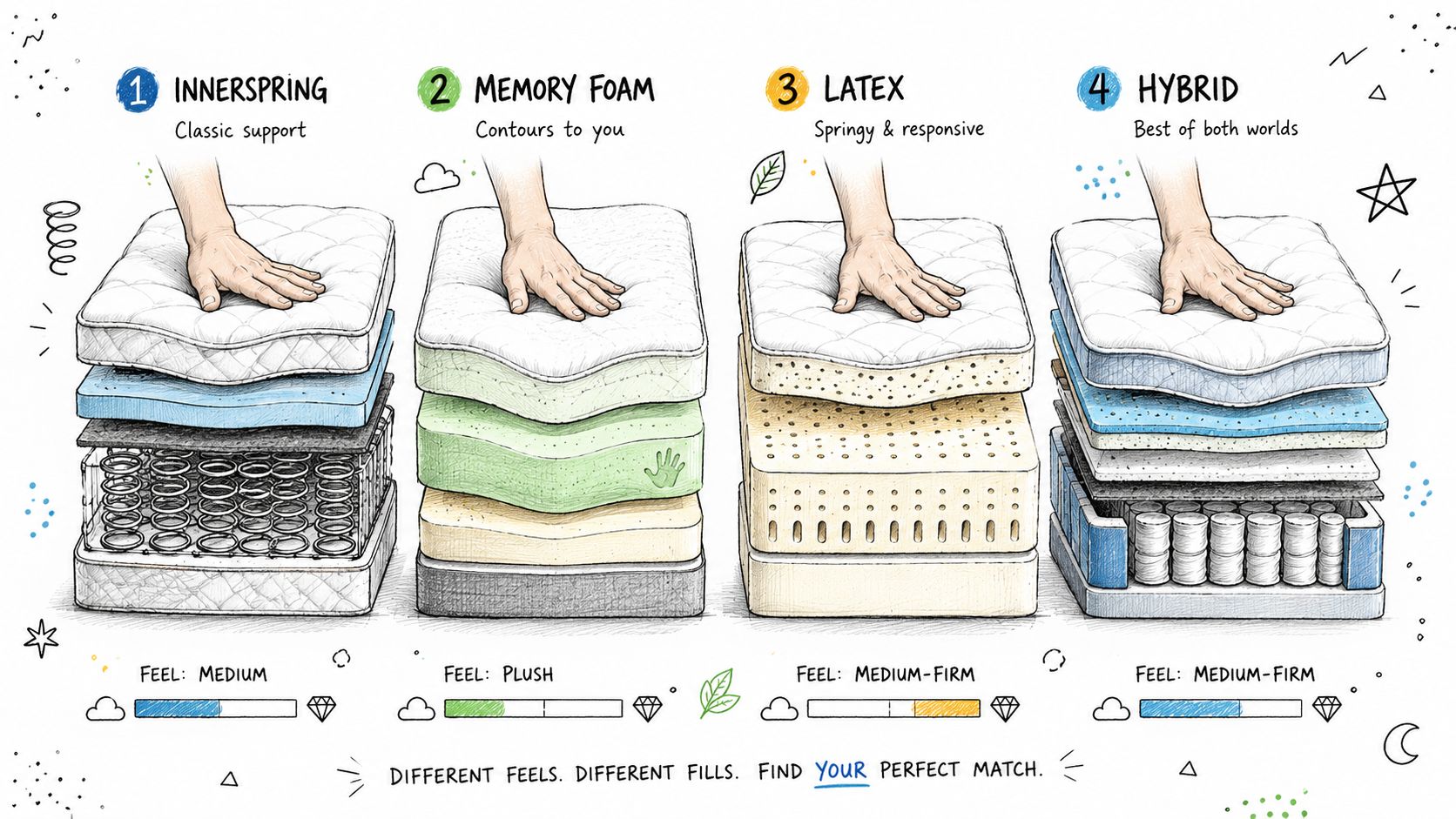
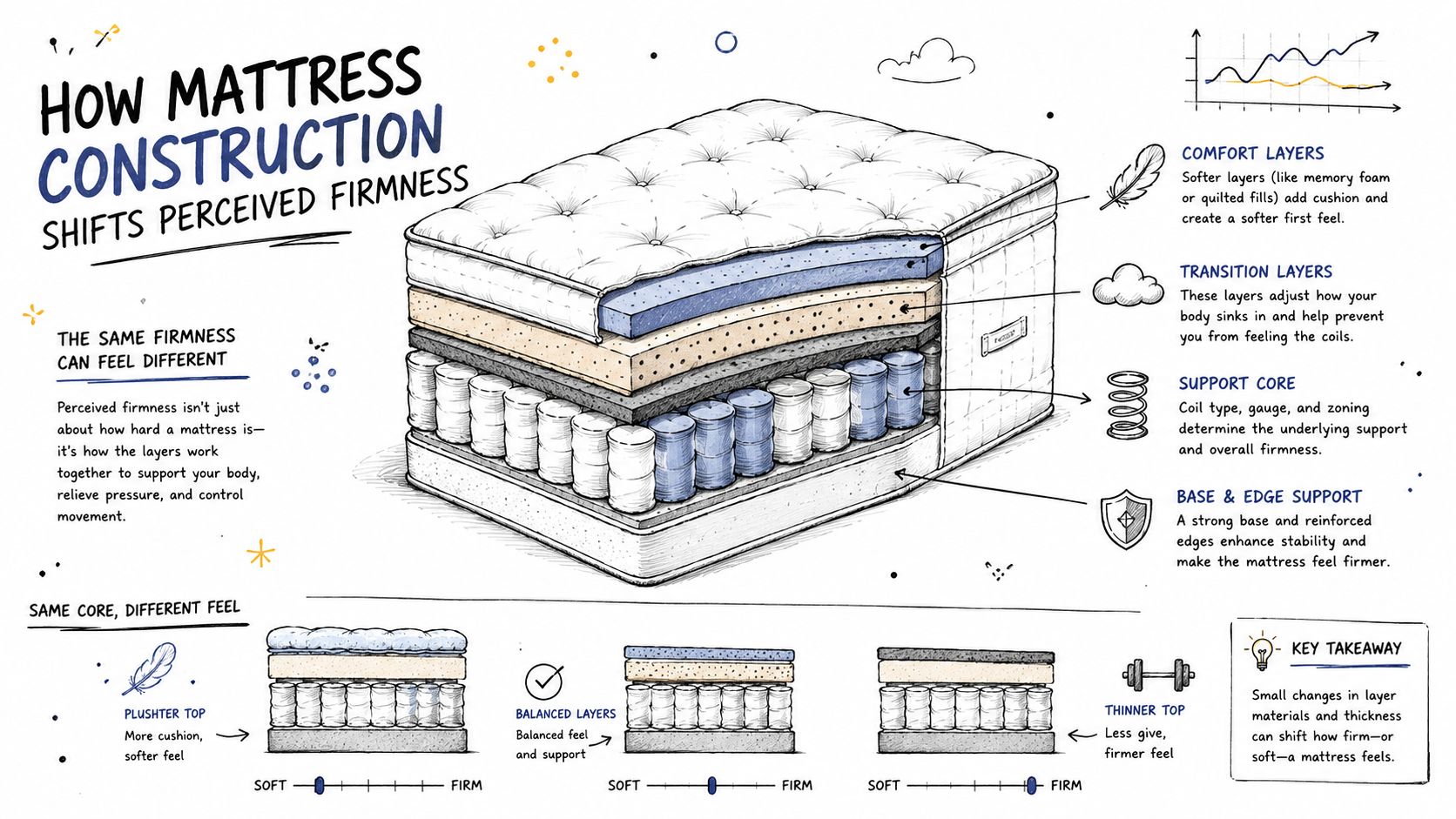
Two mattresses can both be called medium-firm and still feel completely different once someone lies down. Construction changes the story, because the comfort layers, support core, and materials above and below the surface all shape how firmness is felt in the body. Foam is a good example, because ILD/IFD, or Indentation Load/Force Deflection, measures how much force it takes to compress foam to 25% of its thickness, with 20–30 ILD commonly read as medium and 30–40+ ILD as firm.
That layered design matters. A mattress can have a softer top feel and still provide firmer underlying support, which is why shoppers sometimes describe a bed as plush-on-top, supportive-beneath. The top layer cushions pressure points, while the support layer keeps the sleeper from sinking too far into the middle. That balance is useful for people who want comfort without the feeling of being swallowed by the mattress.
Construction also explains why body weight changes the result. The same foam compresses differently under different loads, so a lighter sleeper may feel more contouring while a heavier sleeper feels more resistance. That's why spec sheets matter, because the numbers help separate what a mattress is designed to do from what it feels like to one particular person on a showroom floor.
For shoppers who like to compare details carefully, the memory foam note in our what is a memory foam mattress guide can help frame those tradeoffs before a visit. It's also where our Special Order Program becomes especially useful, since many vendors allow comfort levels that suit different sleep styles and room goals.
Matching Firmness to Sleep Position and Body Weight
The best starting point usually comes from two questions, how does the sleeper lie down, and how much pressure does the mattress need to support. Contemporary guidance says about 80% of sleepers prefer firmness levels between 5 and 7, and medium-firm is the most popular single category, which is why so many shoppers land near the middle before fine-tuning from there. For a broader sleeper-behavior overview, a sleep posture guide for executives can be useful when comparing posture patterns.
A practical way to think about it is this. Side sleepers usually need more cushioning at the shoulders and hips, back sleepers need enough lift to keep the lower back from dropping, and stomach sleepers usually do better when the midsection stays from collapsing into the bed. Weight changes the feel within each position, which is why a single firmness number doesn't solve the whole problem.
| Sleep Position | Under 130 lb | 130–200 lb | Over 230 lb |
|---|---|---|---|
| Back | Soft to medium, around 3–5 | Medium-firm, around 5–7 | Firm, around 7–8 |
| Side | Softer feel, around 2–4 | Medium, around 4–6 | Medium-firm to firm, around 5–7 |
| Stomach | Medium, around 4–5 | Firm, around 6–7 | Firm, around 7–8 |
| Combination | Soft to medium, around 4–5 | Medium-firm, around 5–7 | Firm, around 6–8 |
That table is a starting point, not a verdict. RTINGS describes firmness in normalized stiffness terms, where Plush (<37 Pa/mm)** is generally for lighter side sleepers, **Medium (43–49 Pa/mm)** fits average to heavier sleepers, and **Firm (>60 Pa/mm) suits average to heavier back and stomach sleepers who need less sinkage and more midsection control. In plain showroom language, that means the mattress should hold the body where it needs to be held, not just feel nice during a brief sit.
For another helpful internal reference while narrowing choices, the right mattress for your sleeping style guide can help translate sleep position into a better first shortlist.
Testing Mattresses In-Store and Navigating Trial Periods
A mattress test needs more time than a quick press with the hand or a short seat at the edge. The most useful showroom habit is simple, lie down in the primary sleep position for at least 15 minutes, and bring the pillow used at home so the neck and shoulders are supported in a familiar way. Couples should test together, because motion transfer and shared comfort matter more than many shoppers expect.
Showroom check: side sleepers should notice shoulder and hip pressure, back sleepers should feel whether the lower back is supported, and stomach sleepers should watch for midsection sinkage.
The test itself should be calm and specific. If the sleeper feels a gap under the lumbar area, the bed may be too soft for that body position. If the shoulders or hips start to ache, the surface may be too firm or too flat for pressure relief. The goal is not to find a mattress that feels perfect for ten seconds, but one that stays comfortable when the body settles.
Our digital catalog and mattress education tools make the first part of shopping easier, then the showroom experience finishes the job. Lott's associates can help shoppers compare options in person in Waycross or Fernandina Beach, and our delivery process adds another layer of confidence. Every piece goes through a rigorous multi-point inspection before it reaches the customer, and our white-glove, in-home delivery places it where it belongs instead of leaving the family to deal with the heavy lifting.
For shoppers who are still comparing policies and ownership questions, our tips for buying a new mattress guide is a useful next stop. Trial periods and return rules vary by retailer, so it helps to confirm them before the final choice, especially when a mattress will be used every night for years.
When Your Mattress Firmness Changes Over Time
A mattress does not stay exactly the same forever. Foam compresses, body impressions form, and the surface can begin to feel softer even when the internal support is still doing its job. That's why it helps to separate surface feel from structural support, because a bed may feel different without being fully worn out.
Small adjustments can restore comfort without replacing the entire mattress. A topper can make a bed feel softer or firmer depending on the material, rotation can spread wear more evenly, and changing the foundation can alter how the surface responds. A slatted base, a solid base, and an adjustable base all change how the mattress behaves, which is why the frame underneath matters almost as much as the mattress itself.
If a mattress starts causing new aches, the first move is usually to check the foundation and the sleep position again. If the bed is still structurally sound, a topper or base change may be enough. If the surface has visible body impressions, the sleeper feels unsupported even after adjustments, or the comfort no longer matches current needs, replacement becomes the more sensible option.
For maintenance habits that can slow that decline, the mattress maintenance and cleaning tips guide offers a practical reference point. When a mattress reaches the end of its useful life, proper disposal matters too, and the Renue Systems Four Points mattress service is one resource shoppers sometimes check when planning removal.
Your Next Step to Personalized Sleep Comfort
A good mattress choice gets clearer once the shopper has a real framework, not a vague hunch. Start with the firmness scale, then connect what the construction is doing inside the bed to how it feels under your body. Match that feel to your sleep position and weight, test the mattress in person, and check the setup again if comfort changes over time. That is the kind of guidance families expect from a hometown team that also understands big-brand options.
Our approach at Lott's brings that together with small-town service and big-brand expertise. Shoppers can use our Style Quiz, browse the digital catalog from home, then visit our showrooms in Waycross, GA or Fernandina Beach, FL to compare comfort in person. Brands like La-Z-Boy, Stressless, and Lexington give our customers a strong starting point, while our associates help narrow the options without pressure.
A firmness number on a screen can be useful, but the showroom tells the fuller story. A mattress may read one way online and feel different once you lie on it for a few minutes, especially when ILD and normalized stiffness are translated into pressure on the shoulder, lower back, and hips. That is why in-store testing matters so much for shoppers in South Georgia and North Florida, where humidity, sleep habits, and room setup can all shape how a bed feels at home.
We also stand behind the details after the sale. Every piece goes through a careful inspection, and our white-glove, in-home delivery helps the mattress arrive ready for the room, not as one more chore on the weekend list. For families in South Georgia and North Florida, that kind of service keeps the process comfortable from the first question to the final setup.
Visit Lott's Furniture to browse mattresses online, use the Style Quiz, or schedule a showroom visit in Waycross or Fernandina Beach. Our associates can help match firmness, construction, and comfort level to the way you sleep, then guide you toward a choice that feels right in your home.

