Save 50% Off MRSP on Lexington | Shop the Catalog >

What Is a Memory Foam Mattress: Expert Guide 2026

A memory foam mattress is made from viscoelastic foam, a temperature- and pressure-sensitive material that contours to the body for personalized support and pressure relief. Quality memory foam typically takes 5 to 10 seconds to recover after pressure is removed, which is part of why it feels so different from a traditional spring bed.
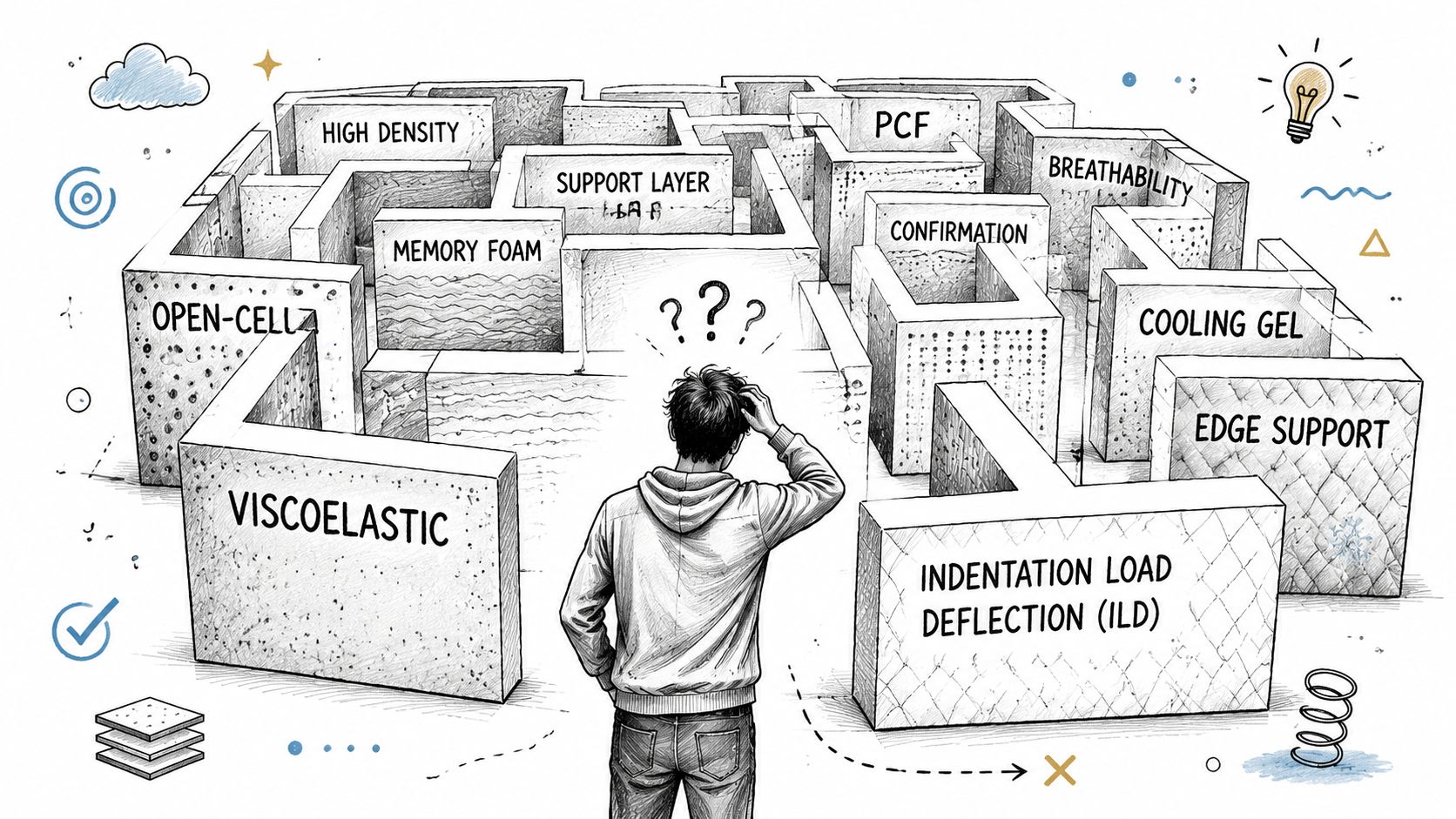
A lot of folks start looking for a new mattress while standing in a bedroom at the end of a long day, rubbing a sore shoulder, wondering why sleep still feels like work. Then the search begins, and suddenly there are terms like viscoelastic, open-cell, density, ILD, cooling gel, transition layers, and hybrid support systems. That's enough to make any sensible homeowner in South Georgia and North Florida want to close the laptop and keep the old mattress another year.
Memory foam doesn't have to be mysterious. It's a mattress material designed to respond to body heat and pressure, easing around the curves of the sleeper instead of pushing back the same way everywhere. That contouring feel is what makes many people describe it as more personal, more customized, and more restful.
At Lott's Furniture, the goal is to translate mattress science into plain language people can use in real homes. The digital catalog, in-store guidance in Fernandina Beach, FL, style quizzes, and mattress guide all make it easier to move from browsing to testing without losing confidence along the way. For homeowners furnishing a primary suite, a guest room, or a coastal retreat, understanding memory foam is the first step toward creating a bedroom that feels like a curated sanctuary.
Your Guide to Understanding Memory Foam
Mattress shopping gets confusing fast because many terms describe how a material behaves, not how it feels at midnight. A memory foam mattress is built from foam that reacts to warmth and pressure, then shapes itself around the sleeper in a slower, gentler way than a spring mattress.
That material has a remarkable backstory. Memory foam was first invented in 1966 under a NASA contract to absorb shock and improve the safety of aircraft seats. This “temper foam” softened with heat and pressure, a quality that now allows it to evenly distribute weight and reduce pressure points in modern mattresses, as outlined in this history of memory foam's NASA origins.
Why shoppers often get turned around
People often confuse three separate ideas:
- Softness versus support. A mattress can feel plush on top and still support the body well underneath.
- Foam type versus mattress build. Memory foam is one material, but the full mattress may include several layers with different jobs.
- Feel versus durability. A bed that feels pleasant for five minutes in a showroom isn't always built for long-term use.
For readers who want a broader look at the types and history of memory foam, that overview helps connect the material's early development to the versions sold today.
A practical starting point: memory foam is less about “sinking” and more about contouring. Good construction should relieve pressure without making the sleeper feel stuck.
A helpful way to think about it is this. Traditional innersprings tend to push back. Memory foam tends to receive weight, spread it out, and cushion the body's sharper pressure points. That's why it often appeals to side sleepers, couples, and anyone trying to make a bedroom feel more restorative.
Readers curious about the longer sleep-story arc can also explore this look at the history of mattresses from straw mats to memory foam.
How Memory Foam Works Its Magic
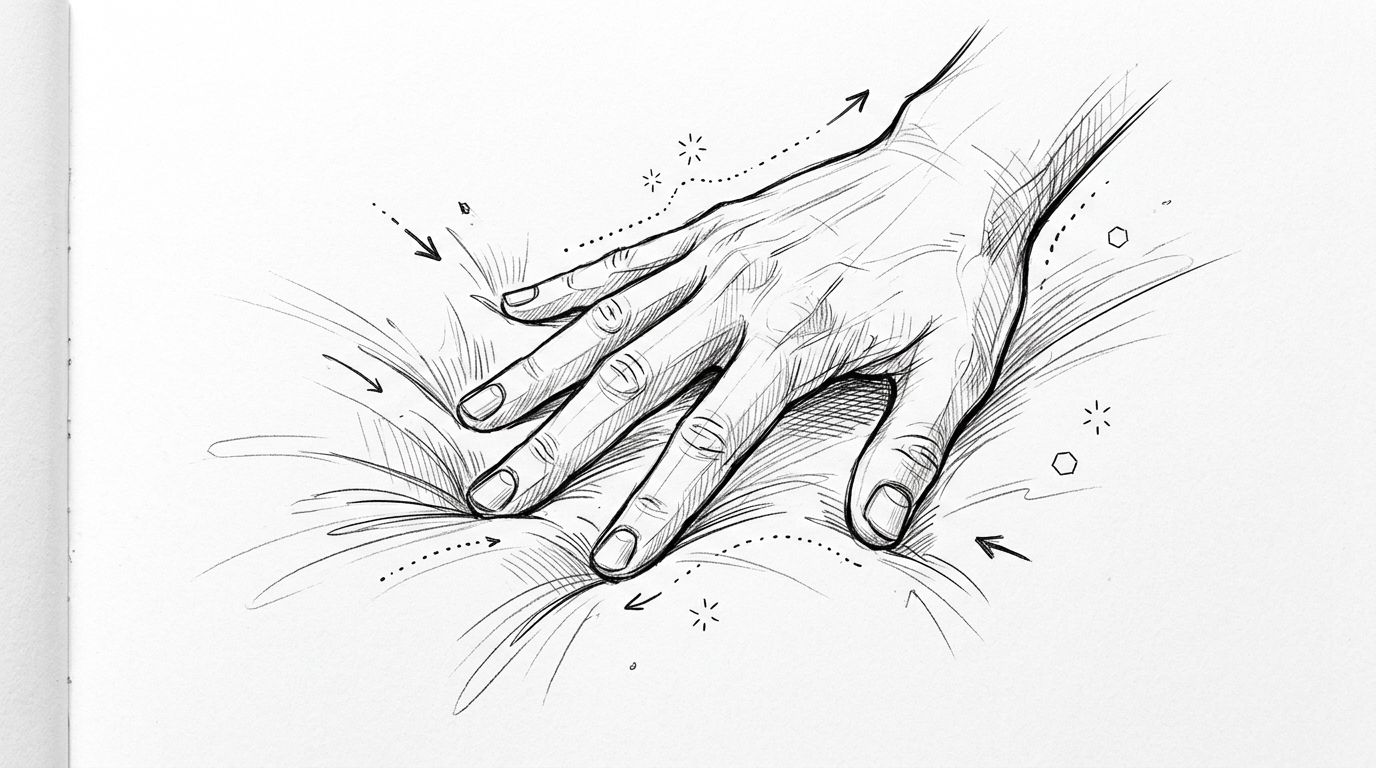
Press a hand into bread dough and watch the shape linger for a moment before it smooths out. That's a simple way to picture viscoelasticity, which is the quality that gives memory foam its “memory.”
What happens when the body lies down
Memory foam contains tiny open cells. When body weight settles onto the mattress, those cells compress. When body warmth enters the picture, the foam softens further and conforms more closely to the sleeper's shape.
That combination creates the classic memory foam cradle. The shoulders, hips, and knees can settle in more evenly, which helps reduce the “hot spot” feeling many people notice on firmer, flatter surfaces.
Why motion transfer feels lower
A spring bed tends to return energy quickly. Memory foam absorbs more of it. That means when one partner rolls over, the movement is less likely to travel across the mattress.
According to this Sleep Foundation explanation of memory foam behavior, quality memory foam has a recovery time of 5 to 10 seconds after pressure is removed. That slow response allows it to absorb impact energy, resulting in minimal motion transfer, often less than 10% between partners, while also providing strong joint support.
The slow rebound is the point. A mattress that responds more gradually can feel calmer and quieter through the night.
What ILD means in plain language
Shoppers often run into the term ILD, short for Indentation Load Deflection. That's a measurement of how much pressure it takes to compress foam. Lower ILD feels softer. Higher ILD feels firmer.
Here's the practical version:
- Lower ILD usually feels gentler at the surface and suits sleepers who want more cushioning.
- Mid-range ILD often balances contouring with steadier support.
- Higher ILD generally feels firmer and can help sleepers who want less sink and more pushback.
The feel of a mattress also depends on layering, not just one number. A well-built memory foam mattress usually combines a comfort layer near the top, a transition layer below it, and a more supportive core underneath. Those layers work together so the sleeper gets pressure relief without losing alignment.
That layered design is one reason memory foam can feel both plush and supportive at the same time. It isn't magic. It's engineering shaped around comfort.
The Different Types of Memory Foam Mattresses
Not every memory foam mattress feels the same, and that's where many shoppers get tripped up. Two beds may both carry the memory foam label, yet one feels contouring while another feels cooler, firmer, or more responsive.
The four most common styles
Most showroom conversations around memory foam land in four broad categories.
| Memory Foam Mattress Type Comparison | |||
|---|---|---|---|
| Foam Type | Primary Benefit | Best For | Consideration |
| Traditional memory foam | Deep contouring and pressure relief | Sleepers who enjoy a classic body-hug feel | Can feel warmer and slower to respond |
| Gel memory foam | Added cooling-oriented design | Hot sleepers seeking a gentler foam feel | Cooling feel varies by construction |
| Open-cell or breathable memory foam | Better airflow through the foam structure | People who want contouring with a less closed-in feel | Performance depends on the whole mattress build |
| Memory foam hybrid | Foam comfort with a coil support core | Shoppers who want contouring plus stronger lift and easier movement | Usually feels less “hugging” than all-foam |
What each type solves
Traditional memory foam is closest to what many people imagine first. It contours more noticeably and often gives that slow-response sensation people either love or need a little time to get used to.
Gel memory foam was developed to address heat concerns. Some sleepers find it offers a fresher surface feel, especially in the top comfort layer.
Open-cell memory foam focuses on airflow. Because the foam structure is designed to be more breathable, it can reduce that dense, closed-in sensation some earlier foam beds were known for.
Memory foam hybrids combine foam layers on top with coils below. That gives a sleeper contouring at the surface and a more traditional support system under the body.
Shopping rule: don't choose by label alone. Choose by how the full mattress is built and how the whole bed feels in the position used most often at home.
Where customization matters
A Special Order Program is especially useful. Many vendors support personalized comfort choices, fabrics, finishes, and design details across the broader home, and mattress selections often benefit from that same personalized approach. Some households want a guest room mattress with a more universal medium feel. Others want a primary-suite mattress tuned more closely to side sleeping, back support, or temperature concerns.
The same homeowners comparing mattresses may also be furnishing the rest of the room with trusted brands such as:
- La-Z-Boy for comfort-focused seating
- Stressless for ergonomic lounge options
- Hooker Furniture for bedroom pieces that complete the sanctuary
For readers weighing foam against more traditional support systems, this guide on memory foam vs innerspring helps frame the decision in practical terms.
Digital tools also make this process smoother. Style quizzes can clarify the room's look, the mattress guide can narrow down sleep preferences, and in-store associates can translate all that information into a mattress that suits the space and the sleeper, whether shopping online first or visiting Fernandina Beach, FL.
A Realistic Look at Benefits and Drawbacks
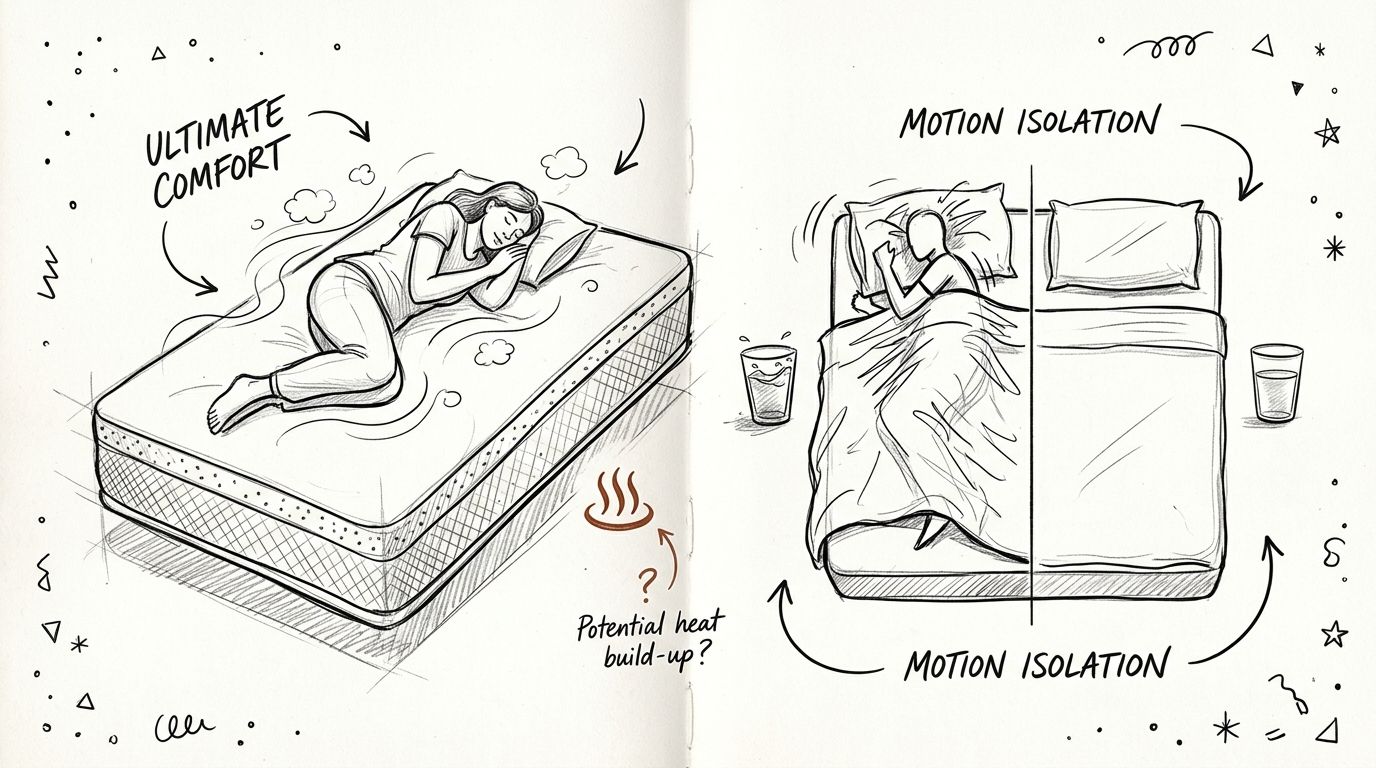
Memory foam justifiably earns its reputation for comfort. It can cushion pressure points, reduce motion transfer, and create a more settled sleep surface. But it's also one of the most over-marketed mattress materials in the business, so a realistic look matters.
The real benefits people notice
Some advantages show up quickly after a person lies down.
- Pressure relief helps the mattress accommodate shoulders and hips more gently.
- Motion isolation can make a shared bed feel less disruptive through the night.
- Adaptive contouring often appeals to sleepers who want a more cradled sensation instead of a springy surface.
For side sleepers, in particular, that contouring can feel like the mattress is filling in the gaps beneath the body rather than resisting them.
The heat myth that needs cleaning up
A common worry is that heat automatically causes memory foam to deform and lose support. That's not the full story. Heat can soften foam, yes, but meaningful support loss is more closely tied to low-density foam, not to memory foam as a category.
Foam density is measured in pounds per cubic foot. The density ranges commonly used in memory foam mattresses run from 1.5 lb/ft³ to 8 lb/ft³, with many standard products falling between 1.5 lb/ft³ and 5 lb/ft³, according to this overview of memory foam construction and density ranges. In practical terms, denser foams generally hold up better and resist body impressions more effectively than lighter foams.
That's why “hot sleeper” and “support loss” shouldn't automatically be treated as the same issue. A warmer feel can be one comfort concern. Premature breakdown is a construction concern.
Readers trying to sort out temperature questions may find this look at the best mattress options for hot sleepers useful alongside in-store testing.
A warm mattress isn't always a weak mattress. The more telling question is whether the foam is built with enough density to keep its shape over time.
The durability truth about all-foam models
This is the part many sales pages glide past. While memory foam is often marketed as highly durable, all-foam memory mattresses don't always last as long as shoppers assume.
According to this Leesa article on what memory foam is, consumer tests show that all-foam models without hybrid coils often have a realistic lifespan of 6 to 7 years before showing signs of degradation. That doesn't make them poor choices. It means buyers should match expectations to construction.
Hybrid models often appeal to shoppers who want the pressure relief of foam with a support core that may feel sturdier over time. Readers comparing those categories can review memory foam versus hybrid mattresses for a broader framing of that decision.
For investment-quality buying, honesty beats hype. The right memory foam mattress can be wonderful. It just needs the right density, the right build, and the right expectations.
Finding Your Perfect Match For Sleeper Types and Firmness
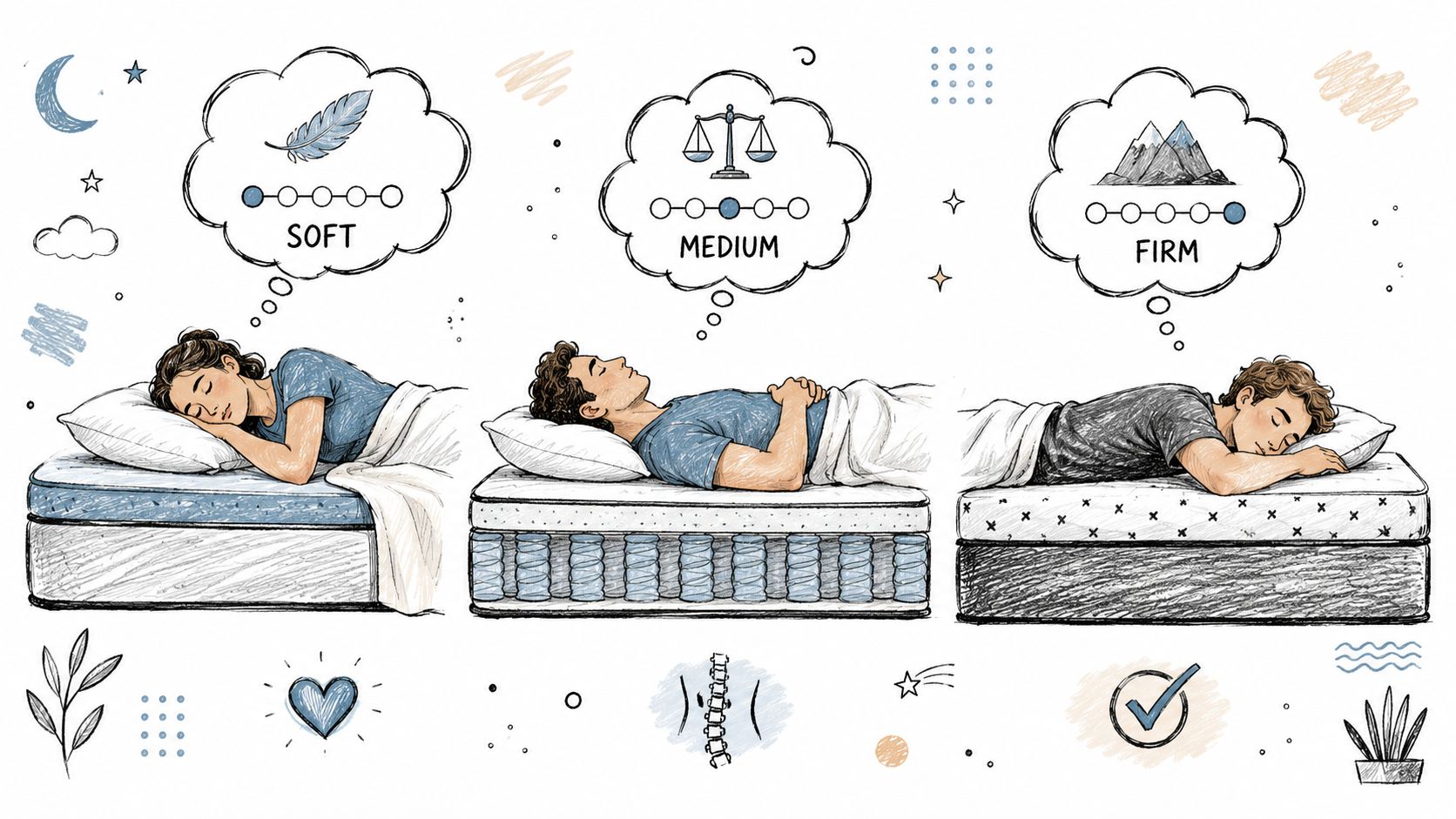
The right mattress for one sleeper can feel completely wrong to another. Body shape, sleeping position, and firmness preference all influence whether memory foam feels supportive or suffocating.
Firmness starts with sleeping position
A side sleeper usually needs more cushioning at the shoulders and hips. A back sleeper often does better with a feel that keeps the midsection from sinking too far. A stomach sleeper usually needs firmer support to help keep the lower back from bowing.
That's where firmness guidance becomes more useful than broad labels like plush or supportive.
- Side sleepers often prefer softer to medium feels that cushion sharper pressure points.
- Back sleepers usually land well in the medium to firm range because alignment matters more than deep contouring.
- Stomach sleepers often need the firmest feel of the three so the torso doesn't dip out of line.
What ILD tells the shopper
Firmness in memory foam is measured by Indentation Load Deflection, or ILD. According to this Saatva guide to memory foam mattress firmness, memory foam ILD typically ranges from 10 for very soft to 50 for very firm. In plain language, that number reflects how much pressure it takes to compress the foam.
That matters because shoppers can finally connect showroom feel to sleep style.
Softer isn't always better. Firmer isn't always healthier. Proper support means the mattress fits the sleeper's position and body shape.
How to narrow the choice without overthinking it
A useful testing approach is to lie in the usual sleep position long enough for the body to settle. If the shoulder feels pinched, the mattress may be too firm for side sleeping. If the lower back feels unsupported, the surface may be too soft for that sleeper's build.
This is also where digital tools and in-person guidance work well together. The mattress guide can help sort preferences before a showroom visit. Style quizzes can help align the bedroom's aesthetic with the rest of the home. In-store associates can then help interpret feel, support, and overall room design for shoppers in South Georgia and North Florida who prefer to test before deciding.
The article mentions Lott's Furniture here because it fits naturally. The retailer offers a mattress guide, digital catalog browsing, and showroom testing in Fernandina Beach, FL, which lets shoppers move between online research and in-person comparison without starting over.
For bedroom shoppers also curating a complete retreat, brands like Lexington, Smith Brothers, and La-Z-Boy often come into the conversation as part of a cohesive home plan, not just a single mattress purchase.
How to Choose and Care For Your Investment
A mattress is one of those purchases that feels simple until the wrong one shows up in daily life. The smartest buyers slow down, test thoughtfully, and pay attention to construction details that predict how the mattress will age.
What to look for before buying
Density is one of the clearest quality signals in memory foam. According to this foam density guide, 3.0 PCF is the budget threshold, 3.5 to 4.0 PCF indicates standard quality, and 4.0 to 5.0+ PCF defines premium foam. The same source notes that mattresses below 3.0 PCF often develop significant body impressions within 3 to 5 years.
That doesn't mean every shopper needs the densest foam available. It does mean density should be part of the conversation, especially for a primary bedroom where nightly use is heavy.
A sound in-store routine includes:
- Lie down long enough to let the foam respond in the position used most often.
- Ask about density instead of relying only on marketing terms like ultra-plush or luxury comfort.
- Check the support system under the mattress, since a poor foundation can affect feel and wear.
For shoppers curious about support beneath the mattress, this explanation of essential bunkie board benefits can help clarify when a flatter base may be useful.
How to protect the mattress after delivery
Care is simple, but it matters.
- Use a protector to guard against moisture and everyday soil.
- Rotate head to foot on a regular schedule if the mattress design allows it.
- Keep the foundation appropriate so the mattress stays evenly supported.
For more detailed upkeep advice, this guide on mattress maintenance and cleaning tips to extend its lifespan is worth bookmarking.
The delivery experience matters too. White-glove, in-home delivery protects an investment from rough handling, and a rigorous multi-point inspection before arrival helps ensure the mattress reaches the home in proper condition. That kind of care is especially important when a bedroom is being designed as a polished, restful retreat, not just furnished in pieces.
Common Questions About Memory Foam Mattresses
A few practical questions tend to come up right before a purchase.
What warranty and trial terms make sense
Shoppers should look carefully at what a warranty covers, especially visible sagging or body impressions. Trial periods also matter because memory foam can feel unfamiliar at first, and the body often needs some time to adjust.
How long does the new mattress smell last
That temporary scent is commonly called off-gassing. In a well-ventilated room, it usually fades with time. Opening bedding, allowing airflow, and giving the mattress a little breathing room can help the room feel normal more quickly.
Can memory foam work on an adjustable base
In many cases, yes. Modern memory foam is often flexible enough for adjustable base use, which can be appealing for reading, relaxing, or elevating the upper body or legs. Bedroom shoppers considering a full comfort setup may also look at related furnishings from Stressless, Hooker Furniture, or Lexington to complete the space.
How does a shopper know it's time to replace one
Visible impressions, reduced comfort, and waking up less rested are common signs. This guide to 7 signs it's time to replace your mattress can help confirm whether the issue is temporary discomfort or a mattress that has reached the end of its useful life.
For homeowners and renters across South Georgia and North Florida, the most reassuring path is usually the same. Start with online research, narrow the choices with style quizzes and a mattress guide, then visit a showroom in Fernandina Beach, FL, to feel the difference in person and speak with an associate who can translate specs into comfort.
A new mattress should feel like a thoughtful investment in rest, not a guessing game. Browse the digital catalog, explore the online style consultation tools, or plan a showroom visit with Lott's Furniture in Fernandina Beach, FL, to compare comfort levels, talk through Special Order options, and arrange white-glove, in-home delivery backed by a rigorous multi-point inspection.