
Coastal Dining Tables: The Complete Buyer’s Guide


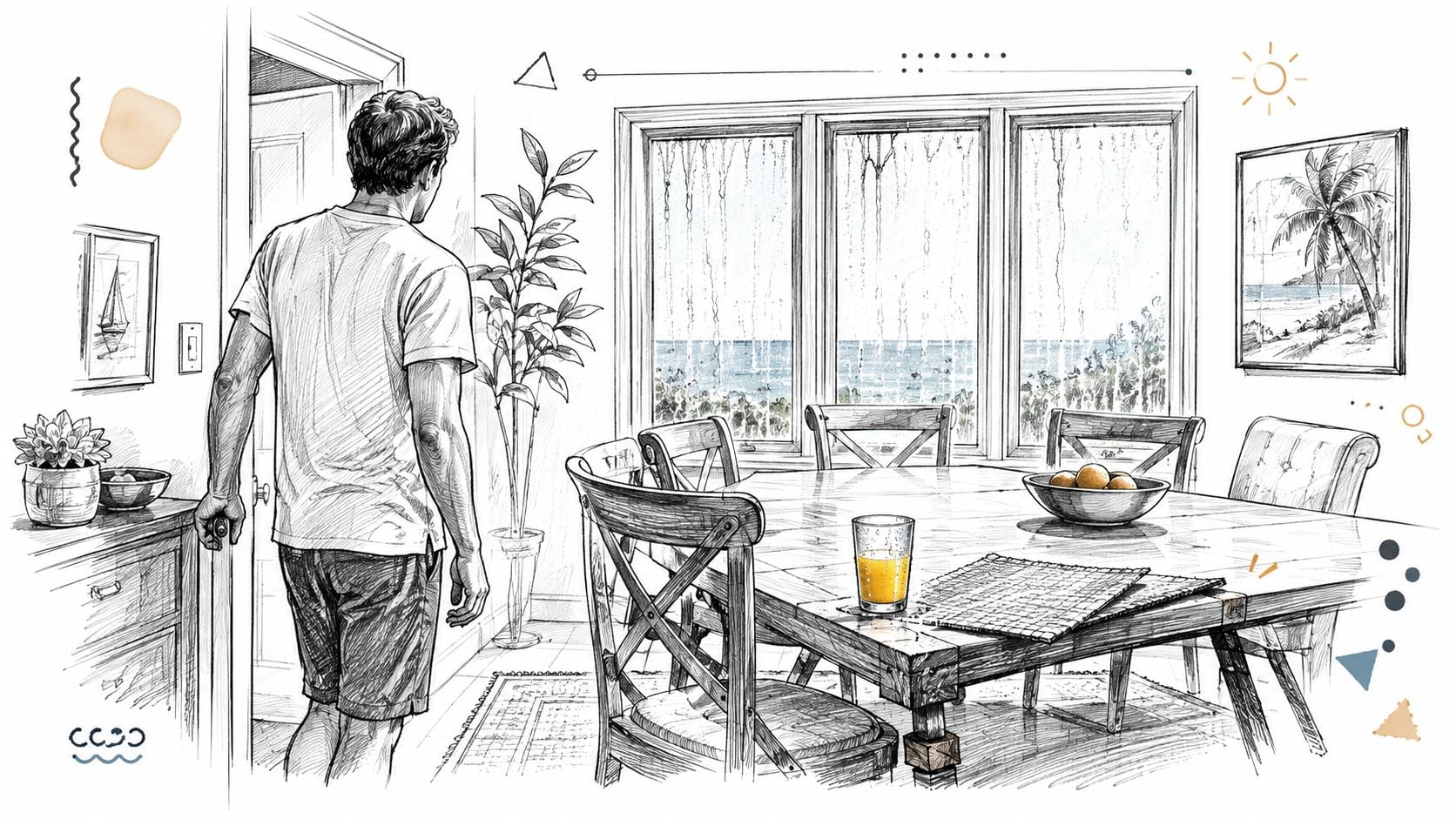
A coastal dining room can look beautiful at breakfast and still reveal its weaknesses by dinner. Salt film streaks the windows, humidity beads on a cold glass of orange juice, and one unstable leg threatens the placemat beneath it. That scene captures why a coastal dining table deserves more than a style-first purchase.
A well-chosen table must handle salt air, summer humidity, seasonal movement, sandy feet, and frequent family meals while still looking intentional beside the rest of the home. For homeowners across South Georgia and North Florida, the right decision combines climate-aware construction with design that fits their space, comfortable proportions, and dependable service.
This guide focuses on modern coastal character, material stress, species and finishes, room sizing, relaxed styling, custom ordering, and long-term care. The aim is simple: provide the engineering answers and design confidence needed before committing to an investment-quality table.
Finding the Right Coastal Dining Table for Your Home
The first question isn't whether a table looks coastal. It's whether the table's construction matches the room where it will live. A bright beach house with ocean-facing glass, a shaded inland cottage, and a screened porch each expose furniture to different combinations of humidity, sunlight, and airborne salt.
Start by identifying the table's daily environment:
- Measure the exposure: Note nearby windows, sliding doors, vents, and exterior walls.
- Assess the traffic: Account for children, pets, sandy clothing, frequent entertaining, and everyday dining.
- Study the room's visual language: The table should connect with flooring, cabinetry, lighting, and adjacent seating.
- Inspect the construction: Look beneath the top, examine joints, and check how the base meets the floor.
The commercial category is broader than a decorative trend. One market report estimates the global wood dining table market at USD 4.75 billion in 2024, with a projection of USD 10.13 billion by 2035 and an implied 7.13% CAGR from 2025 to 2035. The same source places coastal tables within a larger, established furniture market rather than an isolated niche, particularly because many coastal designs use wood construction, pale finishes, or relaxed silhouettes. Read the wood dining table market analysis
A buyer should therefore judge a coastal dining table on two levels. The first is emotional, the way its grain, shape, and finish make a room feel like a curated sanctuary. The second is practical, the way its substrate, joinery, hardware, and finish respond to the home's climate.
A showroom associate can help connect those decisions. Lott's style quizzes and digital catalog support early research, while in-store associates in Fernandina Beach can help homeowners compare proportions, finishes, and brand collections before a special order is placed.
What Defines a Coastal Dining Table Today
Modern coastal design has moved beyond literal nautical decoration. Anchors, rope trim, striped upholstery, and shell motifs can work in carefully edited spaces, but they shouldn't carry the entire room. Current coastal interiors favor a quieter modern heritage language built from natural materials, pale woods, woven texture, and softened silhouettes. Explore coastal design style

Start with the silhouette
The strongest coastal dining tables usually offer visual breathing room. Clean lines, tapered or gently turned legs, generous pedestals, and trestle bases can make a substantial table feel less formal. Round and oval tops soften circulation, while a restrained rectangular design suits longer rooms and shared meals.
Look for:
- Airy proportions: Open space beneath the top helps the room feel lighter.
- Soft curves: Rounded corners reduce visual severity and suit relaxed entertaining.
- Useful bases: Pedestals and trestles can offer legroom without filling the room with multiple corner posts.
- Visible craftsmanship: Slightly varied grain and hand-finished character create depth without artificial distressing.
Choose materials that support the mood
White oak, teak, walnut, washed maple, rattan, cane, powder-coated metal, concrete, and travertine each create a different coastal expression. White oak and washed maple reflect light and feel calm. Teak brings warmth and a naturally relaxed presence. Cane and rattan add ventilation and texture around heavier timber.
Finish language matters just as much. Sun-bleached, lime-washed, cerused, pickled, and matte finishes create a chalky, low-glare surface that works well near bright windows. They also make everyday texture part of the design, rather than forcing a room to rely on decorative beach symbols.
The most successful rooms borrow from Belgian, Scandinavian, and California coastal interiors. They layer neutrals, organic surfaces, and comfortable forms so the table feels connected to the shore without making the dining room look themed.
How Coastal Climates Stress Wood and Metal
Coastal homes challenge furniture through several forces at once. Relative humidity rises and falls, salt-laden air reaches exposed hardware, and direct sunlight can heat and fade surfaces near large windows or sliding doors.
Wood responds to moisture. The USDA Forest Products Laboratory guide to wood movement explains that wood expands and shrinks as it gains and loses moisture below the fiber saturation point. A tabletop may move across its grain, placing stress on glue lines, aprons, breadboard ends, and fasteners. Properly dried stock, acclimation before assembly, engineered construction where appropriate, and stable joinery can reduce problems, but they can't make wood completely immobile.
A useful showroom inspection should include the underside, not only the styled top. Check whether the tabletop has room to move, whether joints look clean and intentional, and whether the base feels solid when pressure is applied from different angles. More information about the role of dried hardwood appears in Lott's kiln-dried hardwood guide.
Salt air creates a different problem. Corrosion can begin at fasteners, welds, hinges, and areas where dissimilar metals meet. Corroding hardware may stain nearby wood and gradually reduce assembly strength, particularly when moisture remains trapped in a joint.
Coastal climate stressors and their effects
| Stressor | Effect on Wood | Effect on Metal | Mitigation |
|---|---|---|---|
| Humidity swings | Expansion, contraction, loose joints, changes in tabletop flatness | Moisture supports corrosion at exposed connections | Acclimated timber, movement-friendly joinery, stable substrates |
| Salt-laden air | Surface staining when corroded hardware contacts wood | Oxidation, pitting, and weakening at vulnerable fasteners or welds | Corrosion-resistant metal, protected joinery, prompt cleaning |
| Ultraviolet exposure | Bleached finishes, dried surface fibers, fading | Finish degradation and heat-related surface stress | Shading, UV-filtering window film, suitable protective finishes |
Direct sun deserves separate attention. A table beside an ocean-facing window can fade unevenly, while heat dries the exposed surface faster than the shaded side. Film-forming finishes may weaken faster under repeated sunlight and heat, so furniture placement and window protection matter as much as finish selection.
Practical rule: A coastal table should be designed to accommodate controlled movement, not forced into resisting movement completely.
Materials and Finishes That Hold Up by the Shore
Material selection should follow exposure, not fashion. A shaded dining room in a North Florida home can support a broader range of finishes than a table positioned beside open doors, ocean-facing glass, or a covered outdoor area.
| Material | Durability | Look | Care Demand | Best Coastal Fit |
|---|---|---|---|---|
| Whitewashed solid white oak | Strong when properly dried and joined | Pale, grain-forward, relaxed | Moderate, with attention to spills and sunlight | Indoor dining rooms with controlled exposure |
| Kiln-dried teak | Naturally suited to demanding moisture conditions | Warm, textured, quietly tropical | Moderate, depending on finish | Humid homes and relaxed coastal interiors |
| Powder-coated aluminum | Resistant to moisture when the coating remains intact | Light, contemporary, adaptable | Low to moderate | Bright, humid spaces and covered dining areas |
| Marine-grade stainless steel | Strong corrosion resistance when correctly specified | Clean, modern, architectural | Moderate, with regular salt removal | Highly exposed coastal settings |
| Driftwood-finished mango or acacia | Characterful and approachable | Weathered, organic, casual | Moderate to high, depending on sealing | Protected interiors where texture is the priority |
Teak, powder-coated aluminum, and marine-grade stainless steel deserve special attention in salt-air settings. Recent coastal guidance recommends these materials, along with HDPE or recycled plastic, over untreated wood and low-grade metals. It also notes that salty air can pit 304 stainless faster than 316, while breathable covers are preferable to sealed covers because trapped moisture may worsen damage. Review this salt-air corrosion guide
White oak remains an excellent indoor choice when it has been properly dried and the construction allows movement. Teak offers stronger moisture tolerance, but its warm tone may need balancing with pale upholstery or light walls. Mango and acacia provide appealing grain variation, although their success depends heavily on drying, substrate design, and finish quality.
Engineered hardwood cores and sealed MDF can perform poorly in persistently humid homes when edge protection or construction quality is weak. A stable core isn't automatically a durable core. The edge, joint, veneer, and fastener details determine whether the table continues to look composed after repeated seasonal changes.
For shoppers comparing surfaces and formats, a carefully organized selection of table tops can help clarify how thickness, edge profiles, and material choices affect the final design.
Finish selection also requires restraint. Matte ceramic conversion coatings, low-sheen catalyzed conversion varnish, and oil-and-wax hybrids each create different tactile and visual results. No finish forms a perfect vapor barrier, so the finish should reduce vapor exchange while the construction accommodates natural movement. Lott's guide to understanding wood finishes can help homeowners compare sheen, maintenance, and surface character before ordering.
Sizing and Layout for Coastal Dining Spaces
A coastal dining room should feel open, but open doesn't mean undersized. The table needs enough room for plates, serving pieces, elbows, and movement around the chairs without interrupting views or blocking access to a deck.
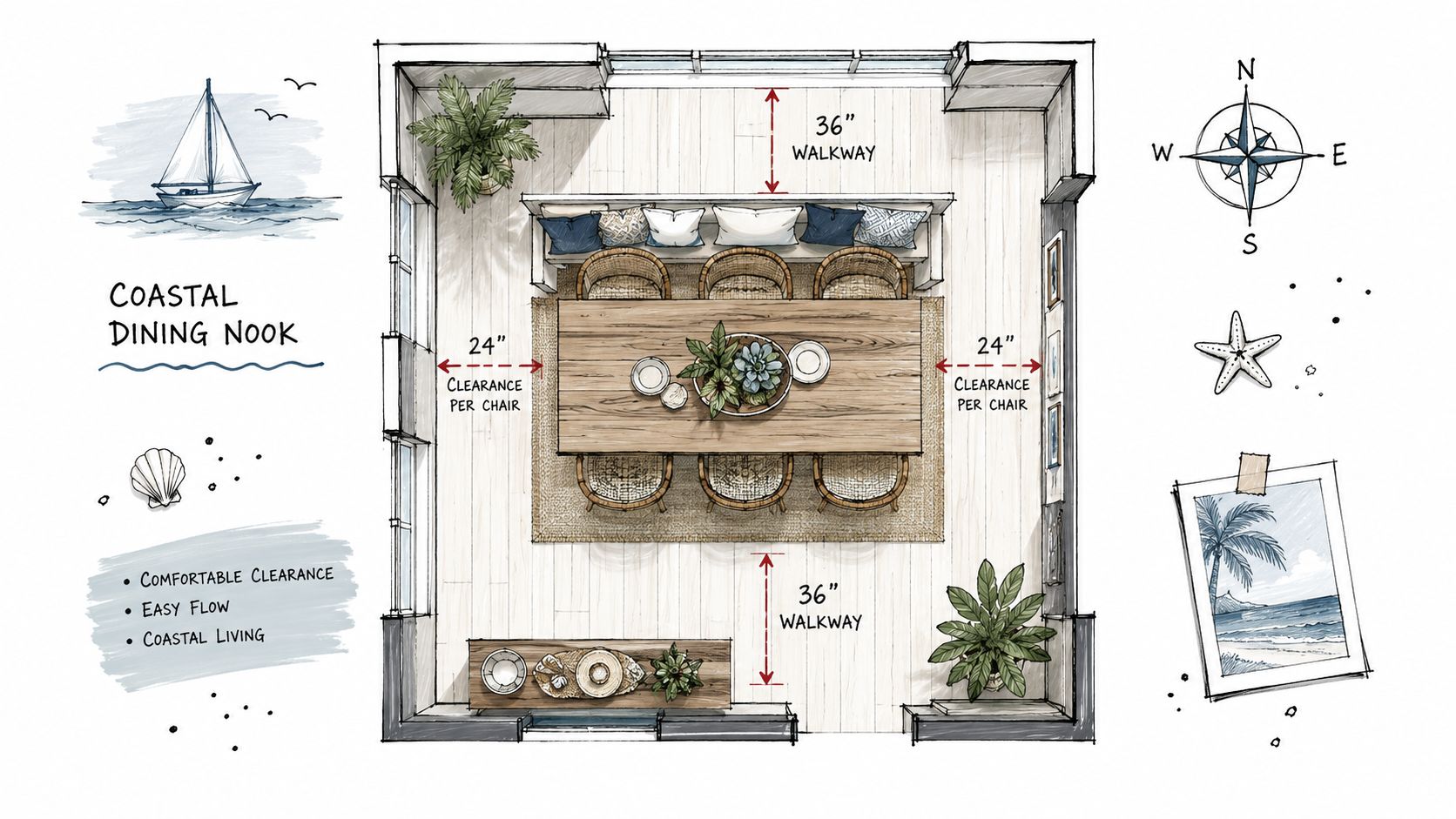
Use 24 inches of table edge per chair as a practical planning rule. Behind occupied chairs, allow 36 inches for a comfortable walkway so people can pass without asking diners to move. These measurements should be treated as working guidelines for furniture planning, not as substitutes for measuring the actual room.
Match shape to circulation
Rectangular tables suit long dining rooms and can align with a wall of windows. Round tables support conversation and eliminate sharp corners in compact breakfast areas. Oval tables provide some of the circulation benefits of a round top while offering a longer visual axis.
A pedestal base often works better than four corner legs in a tight nook because diners can shift their chairs without colliding with table supports. In an open-concept beach house, a round or oval top can also create a softer transition between kitchen, dining, and living areas.
Sliding doors require special care. The table shouldn't occupy the natural path between the dining room and deck, and chairs shouldn't collide with door panels when pulled out. Ocean-facing windows deserve a clear sightline, so a lower-profile table or a placement slightly away from the glass may preserve the view while reducing direct sun exposure.
Plan for daily use and guests
For four guests, prioritize comfortable circulation over a table that dominates the room. For six, a standard rectangular or oval layout usually offers a balanced everyday footprint. For eight, a longer top, extension leaves, or a generous pedestal may be appropriate, provided the room can absorb the added chair depth.
A leaf extension is valuable when entertaining is occasional, but it must have a stable storage and locking system. Homeowners planning an outdoor or covered dining arrangement can consult this guide to outdoor dining dimensions for additional planning context. Lott's dining table size guide offers another useful starting point before a showroom visit.
Styling Coastal Dining Tables with Relaxed Texture
A coastal dining room feels current when texture does the decorative work. The table should anchor the room, while chairs, lighting, linens, and tabletop objects introduce softness without turning the space into a nautical set.
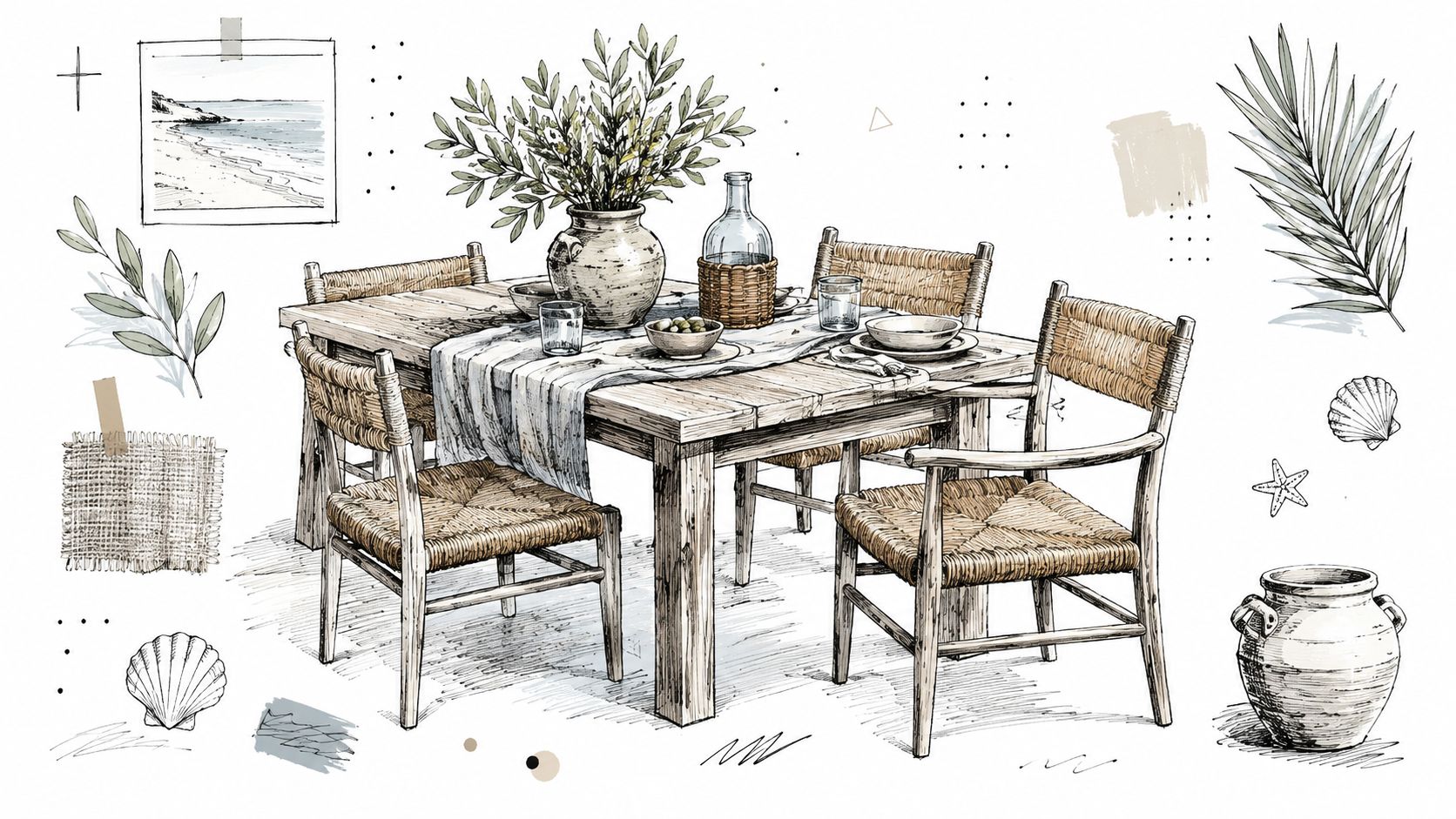
Pair a weathered-wood table with woven seagrass-seat chairs for an earthy, informal effect. Slipcovered linen side chairs make a room feel collected and comfortable, while cane-back frames keep a darker or heavier table from looking visually dense. A pale table can take on more warmth through leather seating, natural rush, or softly patterned upholstery.
Lighting should echo the table's material language. Rattan, woven rope, and white ceramic pendants cast a gentle presence above the dining surface. A fixture with an open weave can preserve the room's airiness, while a matte ceramic shade provides a cleaner interpretation of coastal simplicity.
Build the tablescape in layers
Start with a runner in stonewashed linen, raw silk, or a vintage textile. Add matte stoneware, hand-thrown pottery, and simple glassware. Keep arrangements low, using dune grasses, eucalyptus, or olive branches so diners can see across the table.
A thoughtful linen collection can make everyday meals feel more finished without adding visual clutter. This resource on table linen investment for hosts provides useful context for selecting durable, tactile pieces.
Avoid repeating rope, anchor, shell, and stripe motifs throughout the room. One restrained reference can feel intentional. Several create a theme that ages quickly. The more durable approach uses natural grain, woven texture, chalky color, and comfortable proportions as the coastal vocabulary.
Lott's associates can help coordinate a dining table with brands such as Lexington, Hooker Furniture, or Stressless seating when the room needs a broader furniture plan. The same team can use style quizzes and curated guides to help homeowners define whether their version of coastal design leans modern, traditional, or relaxed farmhouse.
Custom Orders, White-Glove Delivery, and Brand Choices at Lott's
Amelia, a Fernandina Beach homeowner, begins with a familiar problem. Her sunlit dining nook is narrow near the sliding doors, but it opens toward the living room, so the table must feel substantial without interrupting circulation. She brings measurements to a Lott's associate, who helps translate the room's climate and layout into a practical order.
The consultation begins with a whitewashed solid-oak top and pedestal base. Amelia compares finish swatches in the showroom, selects a Seaside Performance Fabric for the chairs, and asks the design team to confirm corrosion-resistant hardware. The order includes a stated 10-week lead time, so the household can plan around delivery rather than guessing when the room will be ready.
The Special Order Program supports personalization beyond color. Depending on the vendor, homeowners may select fabrics, finishes, comfort levels, arm styles, leg styles, cushion cores, welt or no welt, and other construction details. One custom upholstery program describes five arm options and four leg styles, illustrating how furniture can extend well beyond a basic fabric choice. Review this custom furniture program example
Design decision: A custom order should specify the room's exposure, not simply its preferred color. The finish, hardware, joinery, and upholstery all need to suit the home.
Lott's Furniture connects the online catalog with showrooms in Fernandina Beach and Waycross. A homeowner can research digitally, then visit the Fernandina Beach showroom to touch finish samples, test chairs, and discuss dimensions with an in-store associate. Style quizzes and the Mattress Guide are also available as part of the broader design-help system, even though the table decision itself should remain focused on room fit and construction.
Brand selection can support different lifestyles:
- Lexington: Appropriate for homeowners seeking polished coastal collections with a composed, refined presence.
- Tommy Bahama: Suits relaxed rooms that favor warm island character and approachable entertaining.
- Hooker Furniture: Useful for shoppers looking for considered construction and adaptable dining silhouettes.
- Coast to Coast: Fits casual spaces where a lighter, easygoing look is central to the design.
Every piece receives a rigorous multi-point inspection before reaching the customer. Lott's white-glove service includes in-home placement, room-of-choice positioning, basic assembly, packaging removal, and debris haul-away. The white-glove delivery service guide explains the process in greater detail for homeowners planning a custom installation across South Georgia and North Florida.
Care, Guarantees, and Your Next Step
A durable table still needs a sensible care routine. Coastal maintenance isn't complicated, but it must be consistent. Salt residue, standing moisture, direct sun, and unstable indoor humidity can undermine an otherwise well-built piece.
Keep the room and surface stable
A practical checklist includes:
- Dust weekly: Use a clean microfiber cloth that won't drag grit across the finish.
- Remove salt residue promptly: Wipe exposed surfaces with an appropriate slightly damp cloth, then dry them completely.
- Refresh hardwood carefully: Apply paste wax quarterly when the finish and manufacturer guidance permit it.
- Control indoor humidity: One coastal furniture source recommends keeping indoor relative humidity between 40% and 60% to help preserve wooden furniture. Review the coastal wood-furniture storage guidance
- Reduce direct exposure: Felt pads, coasters, and UV-filtering window film help limit scratches, rings, and uneven fading.
The exact care method depends on the finish. Oil-and-wax surfaces may need different attention from catalyzed varnish or matte conversion coatings, so homeowners should follow the manufacturer's instructions rather than applying a universal cleaner.
Confirm service before ordering
A consultation should cover manufacturer warranties, the in-home delivery guarantee, inspection procedures, and available financing. Lott's financing options through Synchrony and Wells Fargo can help qualified buyers reserve a custom order without paying the full amount upfront. Terms and eligibility should be reviewed before signing.
The Style Quizzes can help clarify the room's visual direction, while the Mattress Guide demonstrates the broader level of comfort guidance available through Lott's digital tools. For the table itself, an associate can review finish samples, chair comfort, table dimensions, and the practical implications of a high-humidity or salt-air setting.
A coastal dining table should support everyday life, not require the household to protect it from everyday life. The strongest purchase combines stable construction, a finish suited to exposure, enough room for movement, and service that carries the piece safely into the home.
Lott's Furniture offers custom dining-table planning, upholstery and finishes, brand selection, and white-glove in-home delivery for homeowners across South Georgia and North Florida. Visit Lott's Furniture to book a complimentary consultation at the Amelia Island showroom in Fernandina Beach or schedule an online style session for a coastal dining table plan built around the home's climate and layout.


