
What Size Mattress Fits Your Bedroom: A Complete Guide

Choosing what size mattress fits can feel straightforward until the room is measured and the bed frame, bedside tables, and doorways enter the picture. A mattress that looks right on a showroom floor may leave too little room to walk around at home, while a smaller size may not give its sleepers enough space to rest comfortably.
A good choice balances body size, sleeper count, mattress dimensions, and usable floor area. The numbers are a useful starting point, but the room's layout and the exact model specifications determine whether a mattress will work in everyday life.
Mattress Sizes at a Glance From Twin to California King
A shopper measures the bedroom, checks the bed frame, then discovers that mattress names don't tell the whole story. A Queen label says nothing about how many inches separate it from a King, and a Twin XL sounds like a wider bed when it is in fact a longer one. The names are labels. The numbers underneath them decide whether a bed fits the sleeper and the room.
Six standard U.S. mattress sizes cover nearly every bed on the market, and each is defined by width first and length second, in inches. These are nominal measurements, so the exact product specification should guide final planning.
| Size | Dimensions (W × L, inches) | Typical sleeper | Best room fit |
|---|---|---|---|
| Twin | 38 × 75 | One child or small-framed adult | Kids' rooms, nurseries, compact guest rooms |
| Twin XL | 38 × 80 | Taller teens and college students | Dorm-length beds, teen bedrooms, narrow rooms |
| Full | 54 × 75 | One adult who wants more width than a Twin | Smaller bedrooms and single-adult guest rooms |
| Queen | 60 × 80 | Couples, or one adult who wants room to move | Most standard bedrooms |
| King | 76 × 80 | Couples who want personal space | Primary bedrooms with clear walkways on three sides |
| California King | 72 × 84 | Tall couples and sleepers over 6 feet | Long-frame bedrooms with space for an 84-inch length |
Read the dimensions, not just the size name
The first figure is width, the distance across the bed from side to side. The second is length, measured head to foot. Reading the pair this way clears up the most common confusion in the chart: a Twin XL shares the same 38-inch width as a Twin and adds five inches of length, which is why it shows up in dorm rooms built for taller sleepers.
Queen and California King trip people up for a different reason. The California King sounds like the largest option, and at 84 inches it is the longest, yet its 72-inch width leaves it four inches narrower than a standard King. Each of the two sizes trades inches in a different direction.
Dimensions can also shift by roughly 1 to 2 inches from one manufacturer to the next, so the standard label works as a starting point rather than a guarantee. Queen, King, and California King account for a large share of what shoppers compare on a showroom floor, which makes those three rows the ones worth checking against the room first.
A practical order for using the chart: pick the row that matches the number of sleepers, then check its dimensions against the available floor area. A solo sleeper usually starts by comparing Twin, Twin XL, and Full. Couples typically begin at Queen or King and weigh the added width against the walkways left around the bed. Associates at Lott's Furniture's Waycross and Fernandina Beach showrooms can pull the exact specifications for models under consideration.
Choosing a Mattress Size by Height, Age and Sleeper Count
Six foot two and shopping for a Twin? The sleeper finds out the math doesn't work by the second night. Mattress size comes down to two variables: how long the sleeper is, and how many people share the surface. Length gets settled first, because a mattress that's too short can't be corrected later.
A sleeper taller than about 6 feet fits better on a mattress at least 80 inches long. On a 75-inch surface, that sleeper has roughly three inches of clearance once the pillow claims its share, and the margin disappears quickly. Lott's Mattress Guide walks through this same length check across every standard size.
A tape measure answers the question faster than guessing from a height chart:
- Lie flat on a firm floor and measure from the top of the head to the heel.
- Add 6 to 12 inches for clearance at the head and feet.
- Match that total against the mattress lengths in the size chart.
The figure that comes out of this measurement is the minimum length the sleeper needs. Any mattress shorter than that number comes off the list before the showroom visit even starts.
Solo adults
A Full measures 54 × 75 inches, giving a solo sleeper more width than a Twin. A Queen measures 60 × 80 inches, adding six inches of width and five inches of length over a Full. That extra room suits a sleeper who changes position through the night or likes space to stretch, as long as the larger footprint still leaves clear paths around the bed.
The choice between Full and Queen comes down to two questions asked in order: does the room leave workable walkways around a Queen, and does the extra length matter to the sleeper? A compact guest room often answers Full. A restless sleeper with the floor space usually answers Queen.
Kids and teens
A Twin bought for a six-year-old can still work at sixteen for some kids and feel cramped by twelve for others. Buying one stage up, when the room and budget allow, stretches how long the mattress stays useful. A Full in a child's bedroom gives a growing teenager more width to move and leaves space beside the bed for a parent reading at night.
The right size gives the sleeper room to grow while the bedroom keeps its walkways, dresser space, and desk area.
How Mattress Depth Changes Your Bed Height
Think of the mattress as a stage and the frame as the platform beneath it. Both affect the finished bed height, and a change in mattress depth can alter how easy it feels to sit down, stand up, and reach the bedside table.
Mattress construction influences depth. A hybrid combines a coil support system with foam or latex comfort layers, while pillow-top designs add cushioning above the mattress surface. Those layers can make a mattress deeper than a simpler model, so shoppers should compare the listed height of the mattress with the frame's design rather than assuming all mattresses sit the same way.
Check the finished height in person
A bed that's too low may be awkward to get out of, while a bed that's too high can make sitting on the edge feel unstable. The best test is practical: sit on the mattress edge and check that the feet rest flat on the floor, with the knees at or slightly below hip level. The ideal result depends on the sleeper's body and mobility, so a showroom visit can help clarify the feel.
Nightstand height matters, too. A bedside surface near the mattress top is easier to reach than one that sits noticeably lower or higher, especially for a lamp, phone, or glass of water. A deep mattress can change that relationship, even if the frame and nightstand remain the same.
Before ordering, record these details:
- Total mattress depth: Use the exact specification for the model being considered.
- Frame rail height: Check how high the mattress will sit above the floor.
- Nightstand height: Compare the top of the table with the expected mattress surface.
- Sheet pocket depth: Make sure the fitted bedding can cover the mattress and any added topper.
A deeper mattress may also be incompatible with some platform beds or storage frames, whose rails are designed for particular mattress depths. Lott's showroom associates can check frame compatibility while helping match the mattress, base, and bedding.
Fitting Your Mattress Into the Bedroom and Bed Frame
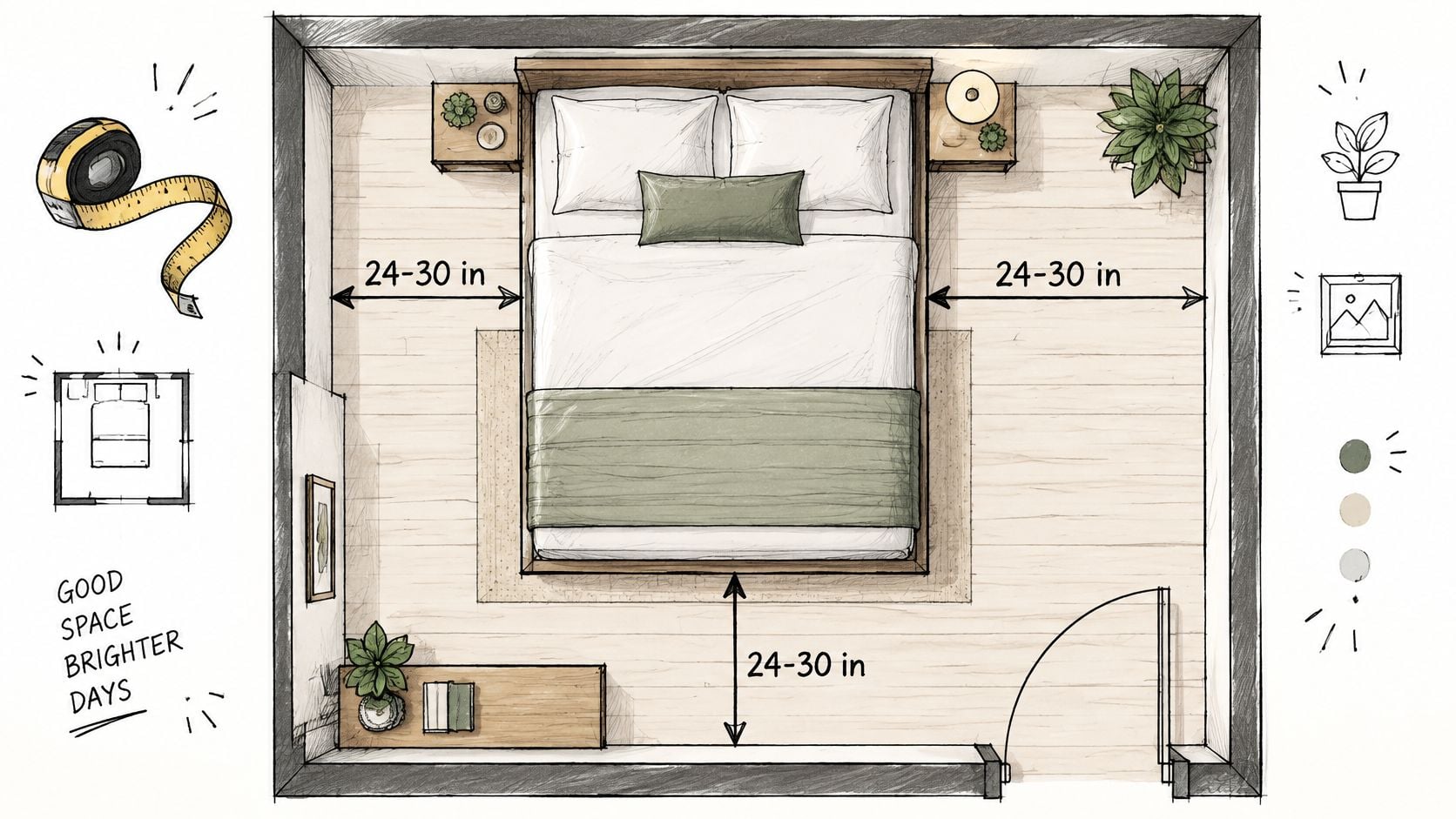
A Queen mattress measures 60 inches wide, but the bed it sits on rarely does. The frame rails, headboard, and footboard all add inches to the footprint, and the room still needs open floor for walking, making the bed, and pulling drawers fully open. A practical planning benchmark used when laying out a bedroom is about 24 inches of clear space on each side you walk along, with more room where doors or drawers swing into the path.
For a quick width estimate, add 24 inches for each open side to the mattress size. One side against a wall means you add once; a freestanding bed means you add twice. The headboard wall never counts, since nobody walks through drywall.
| Size | Room width, one side against wall (in) | Room width, both sides open (in) |
|---|---|---|
| Twin / Twin XL | 62 | 86 |
| Full | 78 | 102 |
| Queen | 84 | 108 |
| King | 100 | 124 |
| California King | 96 | 120 |
A King with both sides open asks for roughly 124 inches, or about 10 feet 4 inches, of room width before dressers, closet doors, and entry swings enter the picture. Even that figure is only a floor-plan estimate. Bed frames often extend past the mattress edges, and vents, radiators, or sloped ceilings can shrink the usable area. For a complete room check that covers door swings and walkway depth, use Lott's furniture measuring guide.
Make the walking path part of the decision
Clearance needs change with the sleeper. A bedroom that must work with a walker or wheelchair needs wider paths on the side used for transfers, plus open floor at the foot of the bed for turning. In that situation, a Queen surrounded by generous space often serves the sleeper better than a King hemmed in by furniture.
The route into the room matters as much as the space around the bed. Doorways, hallways, stairs, and elevators all have to accommodate the mattress and frame on the way in. Lott's white-glove, in-home delivery team places the set in the room of choice, and confirming access measurements before ordering helps the delivery go smoothly.
Before committing, mark the proposed bed footprint on the floor with painter's tape, then walk the outline and open every closet and dresser door nearby. If the taped rectangle leaves a comfortable path for everyone who will use the room, the size works on paper. If not, step down a size and reclaim the walking room.
Best Mattress Size for Couples and Shared Sleep
Stand a couple on opposite sides of a showroom Queen and the bed looks generous. Have them lie down with pillows, elbows, and a dog, and the roughly 30 inches of width per sleeper can start to feel narrow.
The math behind that feeling is simple. A Queen measures 60 inches across, so an even split gives each partner 30 inches. A standard King stretches that personal strip to 38 inches, the same width as a Twin XL mattress. A California King trims it back to 36 inches and adds length instead, a reasonable trade for taller couples who need foot room more than elbow room.
| Setup | Total width (in) | Width per sleeper (in) | Best for |
|---|---|---|---|
| Queen | 60 | 30 | Smaller rooms and couples who sleep close |
| California King | 72 | 36 | Taller couples in narrower rooms |
| King | 76 | 38 | Partners who move or share with pets |
| Split King (two 38-inch halves) | 76 | 38 each side | Different firmness preferences on one footprint |
| Two Twin XL beds | 76 combined, plus gap | 38 each | Independent schedules and separate adjustable bases |

Extra width earns its floor space when one partner shifts position often, when children or pets climb in, or when the two sleepers differ noticeably in body size. Surveys of married couples regularly surface complaints about one partner claiming more than half the bed, so a Queen does not feel equally roomy to every pair.
Match the setup to the source of discomfort
If the nightly complaint is crowding, added width addresses the source directly. If the complaint is pressure points or morning stiffness, a wider mattress changes little, and a different comfort feel is the more useful tool. Either upgrade only pays off while the room keeps a usable path around the bed. A King that blocks the route to the closet or crowds the dresser can make a Queen the better everyday choice.
A split King approaches the problem from the other direction: each partner picks a different comfort feel inside the same 76-inch footprint. Two separate mattresses suit couples who use adjustable bases or keep independent sleep schedules, since each side can move on its own. Lott's guide to shopping for a mattress as a couple walks through movement, pets, height, firmness preferences, and room width for partners weighing those options.
Lott's Mattress Guide and Style Quizzes sort choices by sleep preferences, including movement, height, and firmness needs. The Special Order Program gives access to personalized designs, and vendors typically offer choices such as fabrics, finishes, and comfort levels. Couples can ask whether each sleeper can specify a preferred cushion firmness.
Practical rule: Choose more width only after confirming that the room still leaves a clear, comfortable path around the bed.
Mattress Size Picks for Coastal and Vacation Homes
A Queen is a practical starting point for a guest room when visitors' preferences are unknown. It works like the default setting on a hotel booking: the size most adult guests already sleep on at home, so nobody has to adjust to something narrower or shorter. That familiarity matters in a rental, where a guest's first night should feel settled rather than surprising.
For coastal and vacation homes, the best size depends on the room and the likely guests:
- Primary guest room: A Queen gives most visitors a shared sleep surface without taking up as much width as a King.
- Small cottage or studio: A Full can preserve floor space when the room needs to serve more than one purpose.
- Children's beach-house room: Twin XL bunk-style beds or a pair of Twins can accommodate different sleeping arrangements.
- Luxury primary suite: A King or California King may suit guests staying for extended periods if the room can preserve clear paths.
Salt air reaches a mattress faster than most owners expect. Take a Twin XL bunk bed in a rental home near the beach: between guest turnovers, humidity sits in a closed room and works into the fabric. A removable, washable cover and a mattress protector keep routine care manageable between bookings, and airing the bedding on turnover day limits what a sealed, humid space can do.
Plan for comfort and flexible sleeping space
A sleeper sofa can provide another sleeping option when a room needs to serve as a living area, too. Lott's Special Order Program includes furniture options and performance-fabric selections suited to rooms that see sand, sunscreen, and damp swimwear. Shoppers looking at coastal properties for inspiration can explore Puntas Las Marias homes to see how beachside homes make room for guest comfort and relaxed living.
For ideas on carrying coastal character through furnishings and finishes, Lott's coastal-style interior design guide can help shape the room around its location. Lott's Furniture serves South Georgia and North Florida, including Fernandina Beach, where associates can help match mattress sizes to the proportions of a beach house floor plan.
Confirm Your Mattress Size Before You Order
The last check works like a final fitting: label sizes are the starting point, the order sheet is the measurement that counts.
- Match the model over the category. Pull the exact specification for the chosen mattress and foundation, as noted in the size chart above, then write down width, length, and depth in inches.
- Translate comfort terms into numbers. Keep the mattress buying guide open while comparing spec sheets so profile, support, and feel mean the same thing across models.
- Check the base before the mattress. If different positions or easier reading in bed matter, an adjustable bed frame changes the overall setup, so confirm compatibility together.
- Measure the delivery route like a carton. Record the narrowest door or turn from curb to bedroom and compare it with the largest boxed piece; ask whether the mattress ships flat or compressed.
- Choose the shopping path. Shortlist in the digital catalog, then confirm details with an associate in Waycross or Fernandina Beach or through an online consultation.
Bring the measurements and the shortlist to Lott's Furniture; an associate can check the set against the room before anything is scheduled.