
10 Foot Sofa: The Complete Guide to Scale, Fit, and Styling


A 10 foot sofa can look perfect on a product page, then become a delivery problem the moment it meets a narrow doorway or a tight hallway. Homeowners across South Georgia and North Florida often focus first on the wall where the sofa will sit. That's only half the decision. The other half is whether the piece can travel from the front entry to the living room without damaging walls, blocking circulation, or forcing the household to redesign its daily routines.
A well-planned 10 foot sofa can become the architectural anchor of an open-plan home, a generous gathering place, and an investment-quality foundation for a curated sanctuary. The right choice depends on scale, traffic flow, configuration, upholstery, and delivery access. Lott's Furniture approaches each of those questions with the practical attention expected from a family-owned store, supported by established brands, custom ordering, digital guidance, and in-home service.
Understanding the 10 Foot Sofa Dimension
A 10 foot sofa is typically 120 inches wide, which places it far beyond the common three-seat sofa range of 78 to 90 inches and above the frequently cited 84-inch standard benchmark. Mainstream sofa guides commonly pair those standard widths with depths of 36 to 40 inches and heights of 32 to 36 inches, so a 120-inch piece belongs to large-format or statement seating rather than the conventional three-seater category. Sofa size guidance provides useful context for comparing these proportions.
That distinction matters because sofa sizing has never followed one universal rule. Furniture research has found that some categories, including chairs and tables, became standardized over long periods, while sofas remained much more variable. Retail guides still publish broad ranges by sofa type, which explains why a 10 foot sofa should be judged by its complete footprint and purpose, not by the label alone.
Why 120 inches changes the room
At this scale, the sofa becomes a defining architectural line. It can establish a strong seating zone in an open-plan living room, give a large family space a sense of proportion, and accommodate shared conversation without requiring a full sectional. It also carries substantial visual weight, so the surrounding rug, tables, lighting, and circulation paths need to be planned as a composition.
The size sits near the upper range of many sectional layouts. Published buying guides place the long side of an L-shaped sectional around 108 to 120 inches, while U-shaped designs can span 96 to 144 inches across the center. A 120-inch sofa therefore marks the point where shoppers often begin comparing one straight sofa with sectional footprints. Standard sofa dimensions help clarify why this comparison is useful.
Practical rule: Treat a 10 foot sofa as a major room-planning decision, not simply a longer version of a standard couch.
The measurement itself is straightforward. The planning is not. Before committing, homeowners should record the sofa's full width, depth, arm thickness, back height, and any removable components. Lott's furniture measuring guide offers a useful starting point for documenting those details. A medical resource such as the SOFA scoring calculator for medical use belongs to an entirely different field, but it can prevent confusion when shoppers encounter the acronym during unrelated online research.
For a large home in the region, the payoff is presence. A carefully selected 120-inch sofa can feel custom-fitted, settled, and heirloom-quality rather than oversized for its own sake.
Room Layout and Traffic Flow Essentials
A 120-inch sofa needs more than a long wall. It needs a room that can preserve movement around the seating zone, accommodate adjacent furniture, and support the way residents use the space. A wall may measure ten feet, but the usable span becomes shorter once doors, windows, vents, trim, and access points are considered.
Measure the usable wall
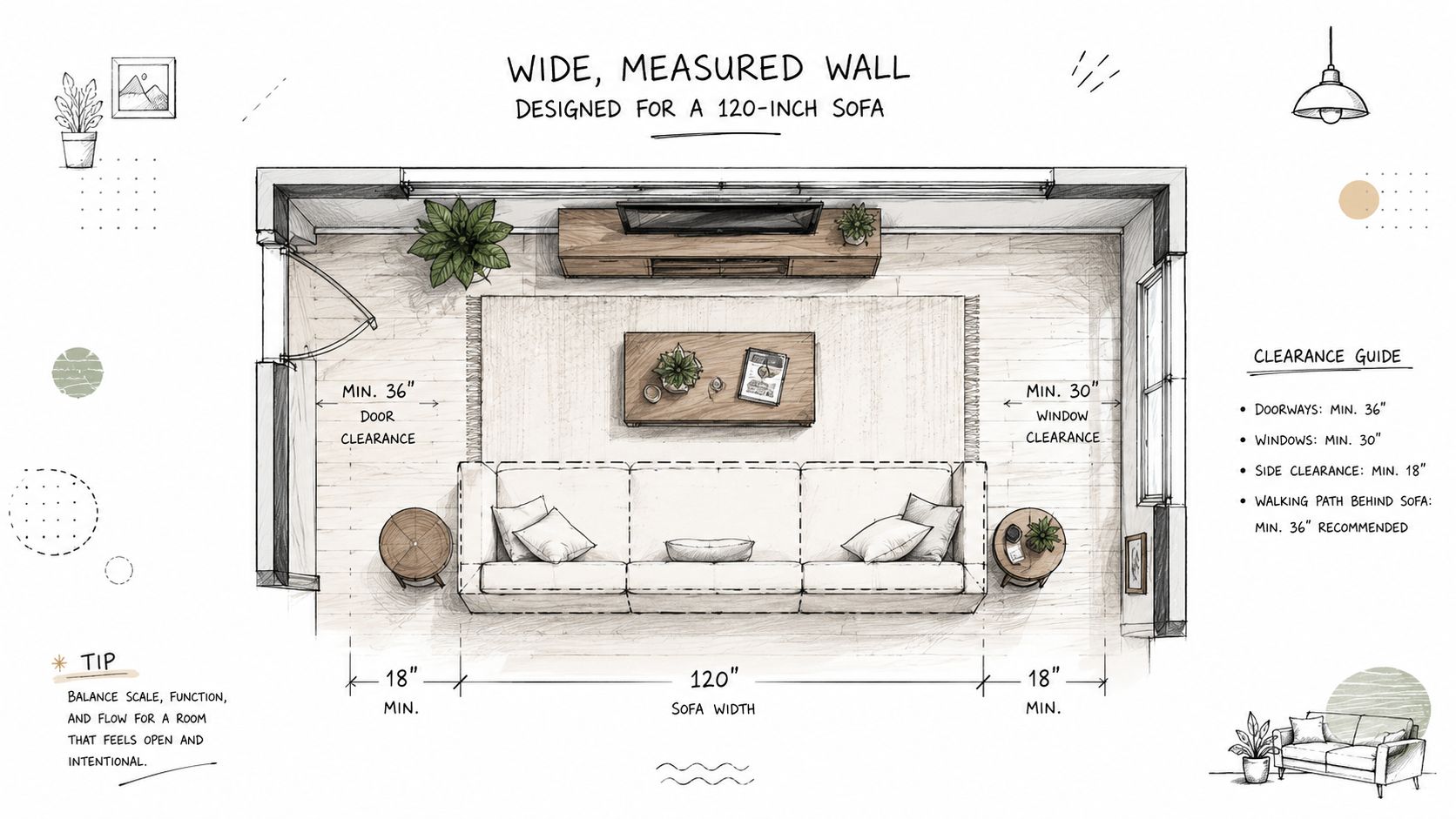
Start with the wall, then subtract every obstruction. Record the distance between fixed features rather than relying on the room's nominal dimensions. A 120-inch sofa can consume nearly the full width of a ten-foot wall before accounting for arms, end tables, wall treatments, or passage space. Room-fit guidance recommends measuring usable wall length and removing doors, windows, and other obstructions from the calculation.
Use painter's tape to mark the sofa's actual width and depth on the floor. This reveals visual mass more clearly than a photograph. Leave the existing coffee table, media console, baskets, and chairs in place during the test, because the sofa must work with the complete room rather than an empty rectangle.
A compact oversized seating arrangement commonly needs a practical envelope in the 10-by-12 to 12-by-12-foot range, depending on the furniture arrangement and circulation requirements. Standard sofas may work in a 10-by-12 or 10-by-13-foot room when paired with a coffee table and adequate passage space, but the larger sofa leaves less margin for error. These planning ranges come from the linked room-fit guidance above.
Protect the circulation paths
Design guidance commonly recommends 30 to 36 inches of walkway clearance around large seating layouts, while a main walkway should have at least 36 inches. Between the sofa and coffee table, 18 inches is workable, with 20 to 24 inches preferred for easier movement and comfort. Furniture layout guidance reinforces the need for wider clearances around oversized seating, while sectional sizing guidance addresses the relationship between seating and adjacent furniture.
A simple room test helps:
- Mark the full footprint. Tape the sofa width and the manufacturer's listed depth.
- Map the traffic. Trace the route from kitchen to patio, entry to hallway, and sofa to media console.
- Place the coffee table. Preserve the preferred spacing rather than pushing the table against the sofa.
- Test daily movement. Carry a laundry basket, walk beside another person, and open nearby doors.
- Remove the obstacles. Subtract every feature that interrupts the usable wall or walkway.
The right sofa leaves the room feeling generous after placement. If residents must turn sideways to pass, or if a kitchen-to-patio route becomes awkward, the configuration is wrong even if the sofa technically fits.
For homeowners considering a related arrangement, Lott's living room furniture layout guidance can help translate measurements into a workable plan.
Standard Sofa vs Sectional Configurations
A 120-inch straight sofa offers a clean, continuous line. A sectional uses comparable length to create an angle, define a corner, or extend seating into the room. The choice should follow the household's habits, not just the largest footprint the room can accept.
A straight sofa is usually the more composed option for formal entertaining, traditional interiors, and rooms where preserving a clear sightline matters. Its uninterrupted profile can look crisp beneath artwork or along a substantial wall. It also leaves more freedom to place accent chairs independently, which helps a room serve conversation, reading, and overflow seating.
A sectional makes a stronger spatial statement. L-shaped sectionals often span 108 to 120 inches on the long side, while U-shaped layouts can reach 96 to 144 inches across the center. Sofa-with-chaise arrangements commonly include a sofa side of 72 to 96 inches and a chaise of 60 to 72 inches. These figures come from the verified sectional sizing guidance and show why a 120-inch straight sofa frequently enters the same planning conversation as a sectional.
Compare the practical tradeoffs
| Configuration | Strongest advantage | Main planning concern |
|---|---|---|
| Straight 10 foot sofa | Unified, tailored appearance | It offers less flexibility after placement |
| L-shaped sectional | Defines a conversation or lounging zone | The projecting side can interrupt circulation |
| U-shaped sectional | Creates a highly enclosed gathering area | It demands substantial open space around the center |
| Sofa with chaise | Adds relaxed leg support without a full sectional | The chaise can dominate the room's traffic side |
Brands such as Smith Brothers and La-Z-Boy can suit different priorities, from custom upholstery and custom details to relaxed family comfort. Lexington can support a more coordinated room composition when the sofa needs to sit within a broader furniture collection.
A straight sofa is the better choice when the room needs visual calm. A sectional is the better choice when the seating arrangement itself should define the room.
Configuration orientation also matters. A chaise placed on the wrong side can narrow the route from the kitchen, patio, or entry, even when the dimensions are correct. Before ordering a sectional, the household should sketch the room from the standing viewpoint and identify which side has the least traffic.
Lott's sectional buying guidance provides additional planning direction. The key recommendation is simple: choose a single sofa for flexibility around the perimeter, and choose a sectional when the room benefits from a deliberately shaped seating zone.
The Delivery Route Clearance Checklist
A 120-inch sofa can fit the planned wall and still fail at the front door, a hallway turn, a staircase landing, or the final room entrance. Measure the delivery route before placing the order, especially for homes in South Georgia and North Florida where porches, steps, narrow entries, and older floor plans can limit carrying angles.
Standard interior doors are often 32 inches wide nominally, but the usable opening may be smaller because of the door, hinges, trim, and frame. The sofa's diagonal depth determines whether the crew can carry it straight, angle it, or turn it upright. Sofa doorway measuring guidance recommends measuring the complete route, not only the front entry.
Follow the route from outside to inside
At the porch and entry, measure the clear opening with the door fully open. Record railings, columns, low overhangs, steps, and narrow approaches that could restrict the carrying angle.
At every interior doorway, record both width and height. Measure the unobstructed opening rather than the nominal door size. Check whether the door can be removed for added clearance, and confirm whether the sofa has removable legs or other components.
Along hallways, measure the narrowest point and inspect each turning area. A long sofa needs room to pivot. Trim, wall sconces, consoles, radiators, and low ceilings can obstruct the route even when the hallway appears open.
At stairs and landings, measure stair width, ceiling height, landing depth, and every change in direction. The landing must provide enough room to rotate the sofa before the next flight or doorway.
At the final room entrance, repeat the doorway check. Nearby walls and existing furniture often make the last turn harder than the front entry.
Prepare the home before delivery
Clear lamps, artwork, tables, rugs, baskets, and other objects from the route. Protect vulnerable surfaces according to the delivery team's instructions. For general moving preparation, how to wrap furniture with moving blankets explains useful protection methods, while oversized upholstery should remain in trained delivery professionals' hands.
Give the retailer the route measurements before finalizing the order. Lott's furniture delivery and assembly service focuses on in-home placement rather than a doorstep handoff, so accurate information helps the team plan delivery and installation responsibly.
A successful move-in depends on turning clearance, not doorway width alone. If the sofa cannot pivot through the route, revise the delivery plan before it arrives.
Customizing Comfort and Durability
A 10 foot sofa receives more daily use than its size alone suggests. Several people may sit, stretch out, read, entertain, or gather on it at once. That makes customization more than a decorative exercise. It's the way a large piece becomes well-suited to the household.
Choose upholstery for real routines
Performance upholstery deserves serious consideration in homes with children, pets, entertaining, or frequent indoor-outdoor traffic. The most attractive fabric sample isn't automatically the most practical choice. The better question is whether the fabric's texture, color, cleanability, and wear characteristics match the household's routines.
Lott's performance upholstery guidance can help shoppers evaluate fabric choices before committing to a large upholstered piece. A neutral, textured weave, or carefully selected pattern can provide visual refinement without making the sofa feel precious.
The Special Order Program expands the decision beyond stock configurations. Most furniture vendors support personalized attributes such as:
- Fabrics and leathers, selected for color, texture, and household demands.
- Finishes, chosen to coordinate with flooring, case goods, and architectural details.
- Cushion firmness, adjusted for upright conversation, relaxed lounging, or a balance of both.
- Arm styles and proportions, selected to influence both comfort and the sofa's visual weight.
Build comfort around the household
Cushion firmness should reflect how the sofa will be used. A household that hosts conversation and reads regularly may prefer more supportive seating, while a family room dedicated to relaxed movie nights may favor a softer feel. Arm height and shape also influence how easily residents sit upright, recline, or rest against the side.
Wesley Hall and Rowe offer useful reference points for shoppers exploring upholstered silhouettes and custom details. Other collections, including Smith Brothers, can support a more personalized approach when fabric, finish, and comfort need to work together.
Investment-quality upholstery earns its place by serving the household for years. Custom ordering lets the sofa feel intentional from the first day, rather than requiring compromises that become more noticeable as the room settles into daily use.
The Lott's Furniture White-Glove Standard
Large furniture deserves a delivery process built around care, not a rushed drop-off. White-glove service typically includes in-home placement and setup, and Lott's standard adds a rigorous multi-point inspection before the piece reaches the customer.
The process begins before the sofa leaves the warehouse. The team checks the piece for visible condition, upholstery presentation, structural details, and order accuracy. That inspection protects the customer from discovering a concern only after the sofa has been carried through the home and positioned in the room.
Placement matters as much as arrival
After the route has been cleared and the destination confirmed, the delivery team brings the sofa into the home, places it in the room of choice, and completes the setup. The objective isn't just to get the furniture indoors. It's to position the piece correctly within the measured layout, preserve the intended traffic path, and leave the room ready for use.
For homes across South Georgia and North Florida, this local approach is especially valuable in houses with older construction, narrow corridors, porches, stair turns, or mixed indoor-outdoor circulation. Service from Waycross to Fernandina Beach reflects the small-town expectation that the store remains accountable after the purchase.
Lott's Furniture offers white-glove, in-home delivery with multi-point inspection as part of its furniture service approach. That combination gives a large sofa the handling appropriate to an heirloom-quality investment, from warehouse preparation through final placement.
Styling Your Statement Piece
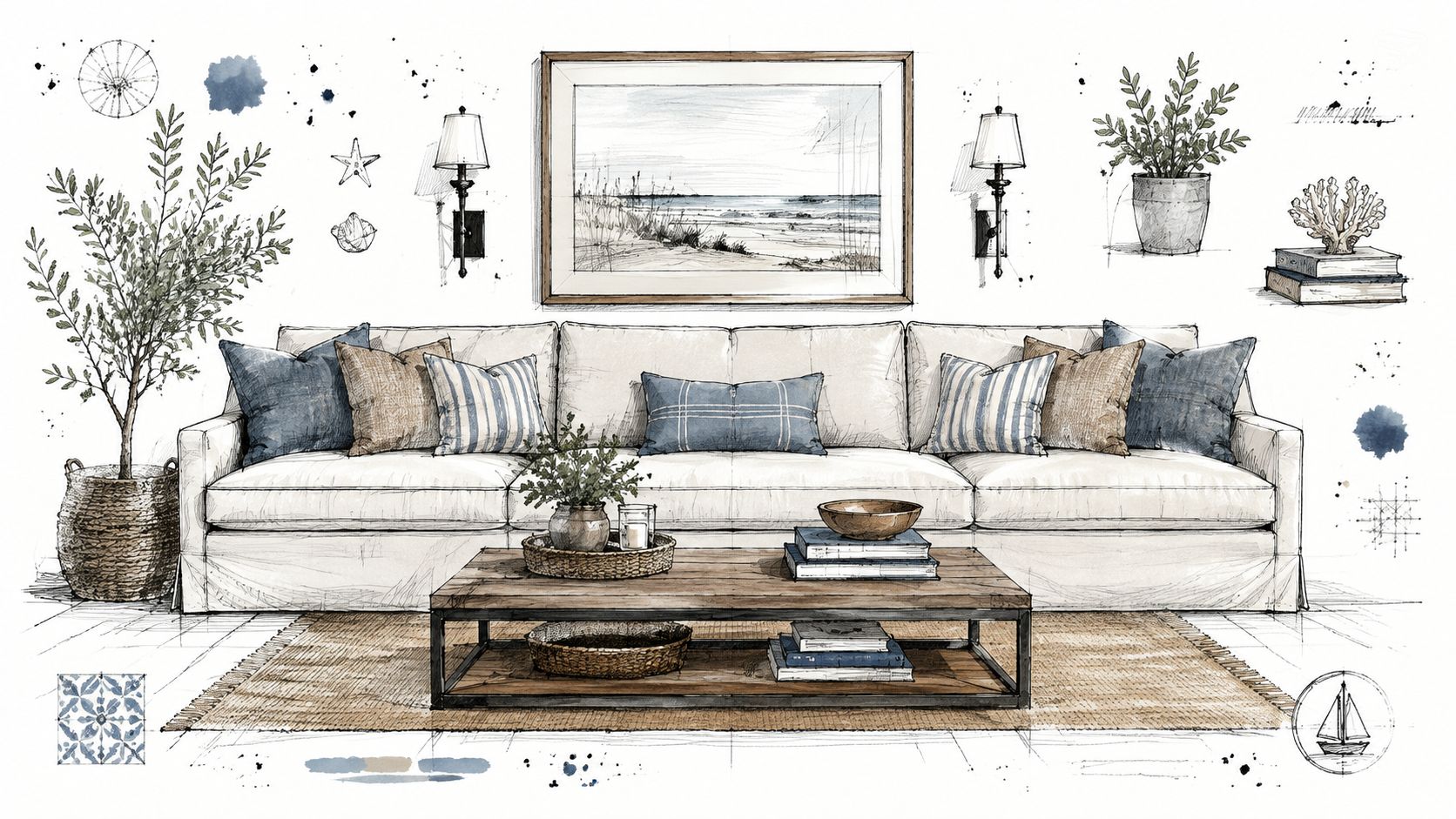
A 10 foot sofa needs visual partners that respect its scale without competing with it. In a Coastal Chic home, a light textured upholstery can sit comfortably with a substantial area rug, layered natural materials, and lighting that softens the room after sunset. In a Modern Farmhouse interior, the sofa can balance stronger wood tones, well-fitted textiles, and restrained architectural accents.
Balance width with visual breathing room
An area rug should connect the sofa to the coffee table and nearby seating rather than leaving the long piece visually isolated. Accent chairs can counterbalance the sofa's horizontal mass, especially when placed perpendicular to the sofa rather than lined up beside it. Lamps, artwork, and tall greenery help distribute the eye upward so the room doesn't feel dominated by one low, continuous form.
Support also matters beneath a large sofa. A practical guide to sofa support can help shoppers understand how the foundation and frame contribute to long-term comfort. The sofa should look substantial, but the room should still feel breathable.
Our online Style Quizzes help identify whether a room leans Coastal Chic, Modern Farmhouse, or Timeless Traditional. The interactive style guides then help coordinate scale, texture, and accent pieces. Shoppers can move between the digital catalog and the showrooms in Fernandina Beach, FL, while in-store associates remain available to help with fabric, configuration, and comfort decisions.
The same guided approach applies to sleep furnishings. Lott's Mattress Guide gives shoppers a framework for comfort levels and support choices, while associates can help customers test options in person. A 10 foot sofa and a mattress require different decisions, but both reward informed comfort testing rather than guesswork.
Lott's Furniture helps homeowners across South Georgia and North Florida plan, customize, and receive large sofas through its Special Order Program, Style Quizzes, digital catalog, and in-store guidance. Visit a Lott's Furniture showroom in Waycross or Fernandina Beach, or begin an online style consultation through Lott's Furniture to confirm the right configuration, upholstery, route clearance, and white-glove delivery plan for a 10 foot sofa.


