Perfect Living Room Furniture Layout Guide

A living room rarely feels wrong because of one bad piece. It usually feels wrong because the layout asks the room to do too much without a plan. The sofa is too deep for the walkway. The chairs are too far apart to invite conversation. The coffee table looks right in the showroom and oversized at home.
A strong living room furniture layout solves those problems before furniture ever arrives. For homeowners across South Georgia and North Florida, that matters even more because many homes have open plans, bright windows, frequent foot traffic, and a coastal rhythm that asks a room to feel relaxed without becoming shapeless.
Begin with a Flawless Foundation
Most layout mistakes start before a single chair is placed. A room gets arranged by eye, not by measurement. Then the walkway pinches, a window gets crowded, or a media wall works on paper but blocks access to an outlet.
Design guidance is consistent on the starting point. A measured floor plan should include room length, width, ceiling height, doors, windows, fireplaces, outlets, and fixed built-ins. It also recommends keeping about 30 to 36 inches for primary walkways and about 14 to 18 inches between a sofa and coffee table according to living room layout guidance from Willis Furniture.
Measure the room before shopping the room
A practical measurement pass should include more than wall dimensions. The details that usually derail a layout are the ones people skip.
- Record the shell first. Measure the full room, then note ceiling height and any alcoves or returns.
- Mark every opening. Include door swings, window widths, and how low the window trim sits.
- Add fixed elements. Fireplaces, built-ins, floor vents, and outlets all affect where larger pieces can live.
- Sketch to scale. Even a simple hand drawing helps test placement before a sofa, sectional, or pair of chairs is selected.
For homeowners who want a cleaner process, this furniture measuring guide helps translate room dimensions into furniture decisions that are easier to trust.
Practical rule: A room should support both seating and movement. If one function wins and the other loses, the layout still isn't finished.
Use the benchmarks that prevent costly mistakes
Rooms feel comfortable because clearances are handled well, not because every piece is expensive. The dimensions above are the quiet framework behind a room that feels easy to live in.
A second layer of planning comes from room size itself. One published benchmark places an average U.S. living room at about 18 × 12 feet, or 216 square feet, and classifies small living rooms as 130 to 160 square feet, medium rooms as 215 to 270 square feet, and large rooms as 320+ square feet in this living room size guide. The same source recommends 80 to 100 cm of circulation space for walkways. That matters because a layout that works in a larger family room can overwhelm a compact coastal cottage or townhome.
Art placement is often the final layer, but it should still support the layout, not fight it. Homeowners refining a finished room often find helpful visual cues in the art of perfect placement, especially when furniture grouping and wall composition need to work together.
Identify and Honor Your Focal Point
Some rooms make this easy. The fireplace is centered, the wall is clean, and the seating arrangement practically announces itself. Other rooms in North Florida and South Georgia aren't so neat. A television sits on one wall, a fireplace anchors another, and a bank of windows pulls attention in a third direction.
That tension doesn't mean the room is flawed. It means the layout has to choose priorities with intention.
Pick the anchor that matches real use
The focal point should reflect how the room is used. If evening television drives the room, pretending the fireplace is the only anchor won't help. If the room is for conversation and occasional viewing, the seating should support people first.
A practical way to sort it out is to ask which one of these functions would make the room fail if it weren't handled well:
- Daily viewing
- Conversation
- A coastal view or natural light
- A fireplace presence
- Flexible entertaining
That answer should shape the layout before decorative decisions enter the picture. Homeowners working through screen placement can also use this TV positioning guide to think through sightlines within the overall room plan.
Handle competing focal points with a hybrid layout
Design advice has shifted away from forcing every room to bow to one dominant wall. When a living room has multiple focal points, current guidance recommends a diagonal or hybrid approach, such as angling the sofa or using swivel chairs, rather than forcing one anchor to win, as outlined in this awkward living room layout resource from Castlery.
That approach works well in real homes because it respects how people live. A sofa can face between a fireplace and television. Swivel chairs can turn toward conversation or a view. A rug can square the seating group even when the architecture doesn't.
Some of the most successful rooms don't point at one thing. They create a balanced zone that lets several functions coexist without strain.
Rugs play a large role here because they visually settle a hybrid arrangement. Homeowners with heirloom or hand-knotted pieces often benefit from learning how ongoing care affects placement and longevity, especially with expert oriental rug cleaning as part of long-term maintenance planning.
Master Traffic Flow and Conversation Zones
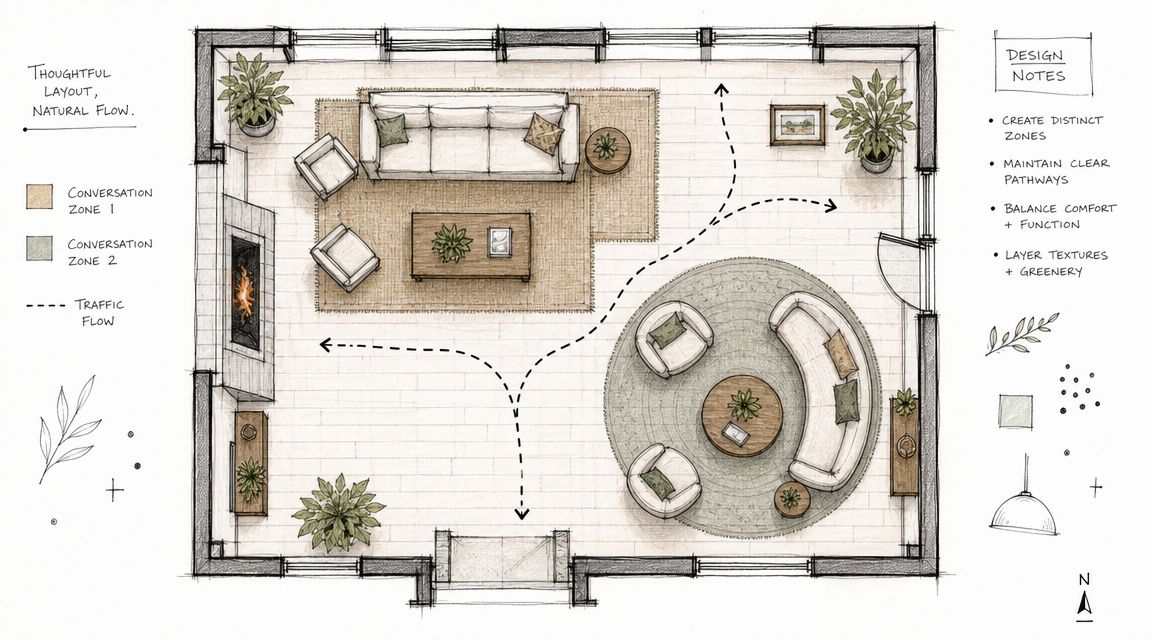
A living room should guide movement the way a garden path does. It should be obvious where to walk, easy to pass through, and pleasant to pause in. If guests have to sidestep a coffee table or squeeze behind a chair, the room is asking furniture to dominate the space instead of serve it.
That problem shows up often in homes where the living room is also a corridor between entry, kitchen, porch, or bedroom hall.
Create paths first and seating second
In living rooms that also serve as circulation corridors, current design guidance says it's important to float furniture to define zones while keeping traffic flow open and predictable. It may even mean placing a sofa with its back to a window when that's the best way to preserve usable flow, according to this design experts feature from Boston 25 News.
That advice matters because wall-hugging isn't always the answer. Pulling everything to the perimeter can turn the center of the room into dead space and force people to walk through the conversation area anyway.
A better sequence looks like this:
- Trace the natural route. Mark where people already move between doors, halls, and adjoining spaces.
- Keep the main lane clear. Let the most traveled path remain visually open.
- Float key pieces. A sofa or pair of chairs can define a seating zone without choking movement.
- Accept smart compromises. Sometimes the ideal view gives way to the better path.
For open plans, these strategies for arranging furniture in an open concept living space help connect circulation with room zoning in a more usable way.
Build a conversation group that feels natural
Once traffic is solved, seating can become inviting instead of defensive. A widely cited benchmark is the 2:1 principle, pairing two chairs with one sofa to create a balanced social grouping. The recommended spacing between seating pieces is 3.5 to 10 feet in this House Beautiful layout guide.
That range gives a room flexibility. In a narrower room, the grouping stays intimate. In a larger room, the seating can open up without losing connection.
A useful check is whether people can speak comfortably without leaning forward or raising their voices. If the room feels like a waiting area, the chairs are usually too far away or the seating isn't angled toward one another enough.
Room check: If a guest has to cross the main walkway to join the conversation, the zone is in the wrong place.
Rugs often reinforce those zones. In homes with wood floors, rug choice affects both visual weight and floor protection, so choosing rugs for hardwood can be a worthwhile reference while refining a layout.
Achieve Perfect Scale and Proportion
A room doesn't feel refined because it contains large furniture. It feels refined because the furniture is proportionate to the room and to each other. That's the difference between a living room that feels curated and one that feels patched together.
Scale matters more than sheer size. A large room can still feel skimpy with undersized pieces, and a modest room can feel calm and polished with furniture that fits correctly.

Follow proportion before style
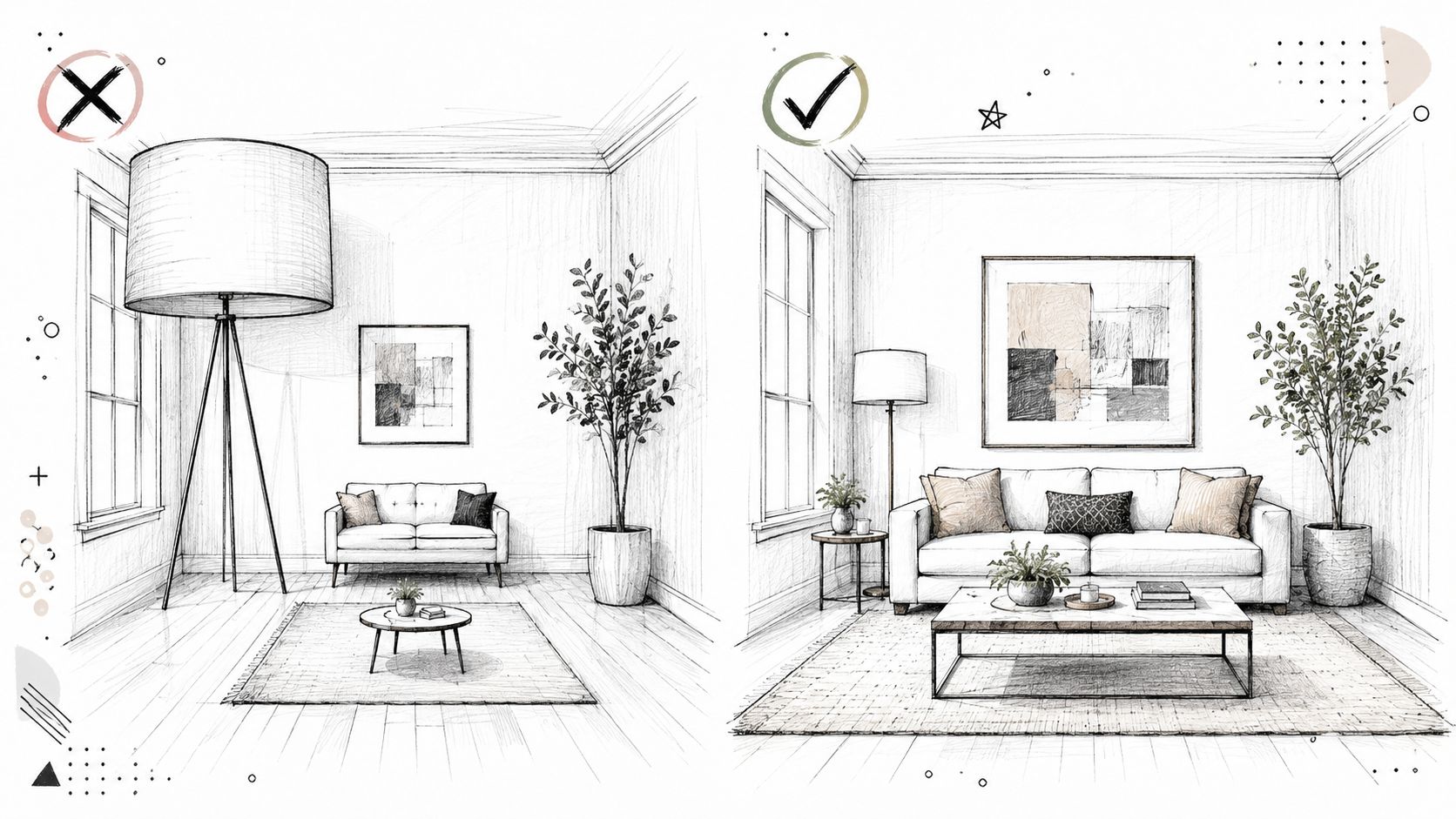
One widely used rule of thumb is that a sofa should occupy about two-thirds of the wall it's against, and a coffee table should be about two-thirds the sofa's length. The same guidance recommends an area rug large enough to anchor the front legs of all seating so the grouping reads as one zone, according to Emily Henderson's living room rules.
Those proportions solve several common problems at once:
| Layout element | What works | What usually fails |
|---|---|---|
| Sofa on main wall | Visually substantial without overpowering | Too short and adrift, or too long and cramped |
| Coffee table | Easy reach and balanced mass | Tiny table in a large seating group |
| Rug under seating | Connects pieces into one arrangement | Rug that floats under only the table |
A room can carry a deep sofa, well-proportioned chairs, and a substantial table if the proportions are aligned. A room can't hide a rug that's too small.
Choose pieces that work together, not just pieces that fit
Scale also depends on the relationships inside the seating group. A sofa with low, clean lines can look awkward beside chairs with dramatically different visual presence. A sectional can solve seating needs beautifully, but only if it doesn't consume every route through the room.
For households comparing sofas, chairs, and sectionals, this sectional buying guide is useful because the right sectional can anchor a room or overwhelm it depending on the plan.
A few categories deserve close attention in living room furniture layout:
- Sofas with clean profiles from brands such as Smith Brothers or La-Z-Boy often suit rooms that need comfort without visual bulk.
- Case goods and media pieces from Hooker Furniture can establish a focal wall, but they need enough breathing room around them.
- Rugs and tables should support reach, circulation, and visual cohesion at the same time.
A room looks expensive when the proportions are calm. It looks unsettled when every piece asks for attention at once.
Tailor Your Layout for Coastal Florida Living
A living room in this region has its own habits. The light is brighter. The entry pattern often includes sandy shoes, damp towels, or a straight path from porch to kitchen. The room may need to host quiet evenings one day and a house full of visitors the next.
That changes how a layout should behave.
Keep the room open to light and daily use
A typical coastal homeowner may start with a pleasant room and still feel stuck. The windows are beautiful, but the seating blocks the breeze. The room needs softness, but not heaviness. The family wants comfort, but the fabric also has to stand up to sun and humidity.
The most successful answer is usually an airy arrangement with clear visual lanes, fewer sharp interruptions, and materials chosen as carefully as the footprint. A sectional in a soft sand tone, a pair of chairs that can pivot toward guests, and lighter tables often keep the room from feeling congested.
Match material choices to the way the room lives
Customization matters. Through a Special Order Program, many vendors support personalized choices in fabrics, finishes, and comfort levels, which is especially helpful for coastal homes that need performance as much as style. Brands such as Lexington, Bassett, and Stressless offer a range of looks that can suit relaxed coastal interiors without leaning casual to the point of looking unfinished.
Homeowners who use digital planning tools before visiting a showroom often make faster decisions once they see pieces in person. Style Quizzes help narrow the look, and the Mattress Guide is useful for comfort shopping in other parts of the home, but the same principle applies in the living room. Better guidance leads to better fit. For homes that blend indoor and sunroom living, this Florida room decorating guide is a natural companion to the main living area.
From Our Showroom to Your Sanctuary
A thoughtful layout only works if the buying process supports it. The room has to be measured correctly, the proportions have to make sense, and the final placement has to match the plan that looked so good on paper.
That is where a full-service furniture experience changes the outcome.
Connect planning, customization, and real-world placement
Digital shopping is convenient, but layout decisions often become clearer once seating depth, arm height, and finish color can be tested in person. That is why many homeowners across South Georgia and North Florida move back and forth between online browsing and showroom visits. The digital catalog narrows the field. In-store associates help translate inspiration into dimensions, scale, and material choices that suit the home.
This is also where customization earns its place. Most vendors in a strong Special Order Program support choices such as:
- Fabric direction for homes that need lighter performance textiles
- Finish selection to better match flooring and existing case goods
- Comfort options that change how formal or relaxed a room feels
The article's layout principles also become easier to apply with real product categories in front of the homeowner. A balanced social grouping may call for one sofa and two chairs. A media-focused room may need a different anchor. The 2:1 benchmark remains useful because it creates visual balance and supports conversation without forcing the room into stiff symmetry.
Finish with delivery that respects the layout
A room plan isn't complete when the order is placed. It is complete when the furniture arrives, fits the space, and lands in the right position the first time.
Lott's Furniture provides a showroom and digital catalog experience, along with in-store associates, style quizzes, a mattress guide, special ordering through many vendors, and white-glove in-home delivery from its locations serving Fernandina Beach, Florida, and Waycross, Georgia. Every piece goes through a rigorous multi-point inspection before delivery, and that matters because the condition of the furniture is only part of the result. Placement is the other part.
A well-planned living room furniture layout deserves a final step that is just as careful as the first measurement.
A strong layout makes a living room feel settled, useful, and welcoming from the moment someone walks in. To refine a room in South Georgia or North Florida, browse the digital catalog, take an online style consultation, or visit Lott's Furniture to work through scale, customization, and placement with a design associate in person.