Save 50% Off MRSP on Lexington | Shop the Catalog >

Custom Cabinet Finishes: A Guide to Style and Durability

A lot of homeowners reach the same point at once. The cabinet color on the sample door looks beautiful under showroom lighting, but the question is what happens after steam from dinner, damp summer air, salty coastal conditions, and constant wipe-downs start working on that surface every day.
That's where many finish decisions go wrong. People shop for color first and protection second, when the smarter order is the reverse. In South Georgia and North Florida, custom cabinet finishes need to carry visual weight and defensive weight at the same time. The finish has to look refined, but it also has to resist moisture, grease, heat, and repetitive cleaning without turning cloudy, sticky, or tired.
The Foundation of Heirloom-Quality Cabinetry
A cabinet finish isn't a decorative afterthought. It's a protective system built over wood, and that distinction matters in a humid household.
The global cabinetry market reflects how important this decision has become. A Grand View Research cabinetry market projection estimated the market at USD 190.54 billion in 2025, with wood at 67.36% of revenue, the residential segment at 73.29% of demand, and retrofit and remodeling at 56.56% share. Those numbers support what design consultants see every day. Most finish choices happen during updates, where homeowners want a visible transformation without replacing every cabinet box.
A finish has a job beyond color
A busy kitchen near the coast asks a lot from cabinetry. Morning coffee cups leave rings. Hands reach for doors before they're fully dry. Cleaning products get used too aggressively on island panels. Humidity rises and falls with weather and air conditioning cycles.
That's why the finish should be judged like a layered shield, not a paint chip. The wood species, sealer, stain or paint layer, topcoat, and sheen all work together. If one layer is weak, the room eventually tells on it.
Practical rule: The prettiest finish in the room is a bad finish if it can't handle daily contact.
Natural materials also deserve a strong foundation. Homeowners exploring wood cabinetry often benefit from understanding how substrate quality affects the final surface, especially with kiln-dried hardwood construction, where stability and moisture control start before the finish is ever applied.
Grain is returning, but climate still decides the winner
Finish preferences are shifting. A Houzz survey summary of 1,780 homeowners and design preferences reports painted cabinets at 52%, stained cabinets at 18%, and natural finishes at 7%. The same summary says 59% of designers expect wood grain to overtake painted cabinets in popularity, and 51% named white oak as the most-requested wood.
That trend makes sense. Visible grain adds warmth, movement, and a quieter sense of luxury than flat color alone. It also aligns beautifully with the relaxed but polished homes common across South Georgia and North Florida.
For homeowners planning indoor-outdoor living spaces or aiming for continuity between the kitchen and covered entertaining areas, there's useful inspiration in designing with Blanc Haute Luxury Kitchens. The smart takeaway isn't to chase an outdoor look indoors. It's to think about finish durability and visual cohesion as part of one larger design language.
Understanding Stains Paints and Glazes
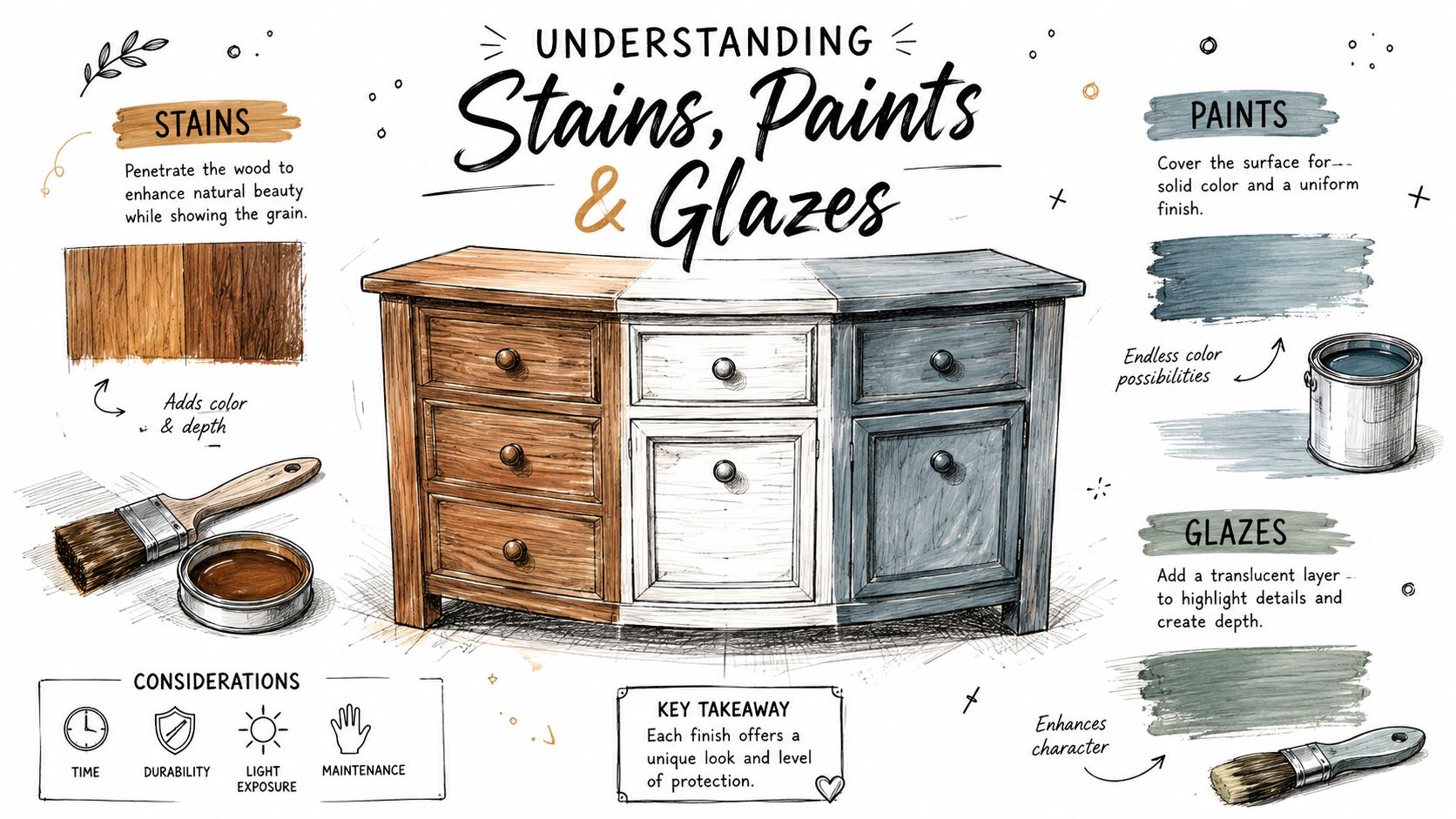
Each of the main custom cabinet finishes changes wood in a different way. They don't just look different. They age differently, reveal wear differently, and suit different room personalities.
Stain shows the material
Stain sinks into the wood and highlights grain, variation, and figure. It's the finish for homeowners who want to see the wood, not hide it.
A good stain turns the cabinet into part finish, part material story. White oak, for example, can read airy and refined with the right stain. Darker species can feel more formal and furniture-like. The appeal is depth. Minor dings also tend to read less harshly because the surface already has visual movement.
Stain is the right call when the room needs:
- Visible character: Grain becomes part of the design instead of background.
- Soft luxury: The space feels layered rather than stark.
- Aging grace: Small wear marks often blend better than they do on flat painted surfaces.
Paint creates a clean architectural surface
Paint sits more opaquely over the substrate. It doesn't celebrate grain. It controls it.
That makes paint the most effective option for a crisp, edited look. It works beautifully in homes that lean coastal, traditional, or transitional, especially where cabinetry needs to act as a clean frame for stone, lighting, and hardware. Paint can also be a practical visual shield on woods whose grain pattern isn't the star of the show.
There's a difference, though, between any painted look and a well-built painted system. On furniture and cabinetry, the most satisfying painted finishes have enough body to feel smooth and refined, not plastic or chalky. Homeowners drawn to artisanal surfaces often appreciate examples of hand-painted furniture finishes because they show how much nuance exists within “painted” as a category.
For readers comparing regional finish aesthetics, opaque finishes in Fort Collins offers a useful visual point of reference for the sleek, solid-color effect that opaque systems can create.
Painted cabinets are still popular for a reason. They simplify a room. The mistake is assuming simple means low maintenance.
Glaze adds depth, shadow, and age
Glaze isn't usually the main finish. It's the atmospheric layer that sits over stain or paint to create depth in corners, profiles, and recesses.
Think of glaze as the cabinet equivalent of low lighting in a well-designed room. It softens, enriches, and brings out detail. On the right door style, glaze makes molding and panel edges more legible. In a farmhouse or old-world setting, that can be exactly what gives cabinetry a lived-in, collected feel.
Use glaze carefully. It works best when the room already supports that language.
A strong selection process looks like this:
- Start with the wood or substrate. Grain-heavy wood and smooth paint-grade material don't ask for the same finish.
- Choose the visual role. Should the cabinetry feel quiet, expressive, or time-worn?
- Match the finish to the household. A high-traffic kitchen island may need a different strategy than a decorative bath vanity.
- Review edges and profiles. Glaze loves detail. Paint likes clean geometry. Stain depends on grain consistency.
Evaluating Durability for Coastal Climates
South Georgia and North Florida homes need cabinet finishes that can tolerate moisture swings, frequent cleaning, and heat exposure without losing clarity or adhesion. A beautiful surface that fails under routine use isn't luxurious. It's a future repair project.
Factory finish systems usually outperform field-applied options
One cabinet specification set describes a common high-performance approach: exterior surfaces receive a stain with a clear satin lacquer top coat or a color-tinted lacquer, while interiors and shelves receive a clear satin UV-cured scratch-resistant finish according to this cabinet finish specification reference. That separation matters because interior shelves and exterior doors deal with different kinds of wear.
Factory-applied systems generally cure harder and more consistently than site-applied finishes. In practical terms, that can mean less blocking, fewer early surface marks, and better abrasion resistance in high-use rooms. Homeowners shouldn't evaluate custom cabinet finishes as color alone. They should ask what coating system protects the outside, what protects the inside, and how those layers are expected to behave in daily use.
For households shaping a regional design plan, decorating a Florida home is useful because it frames finish choice as part of the broader conversation around light, moisture, and lived-in comfort.
Durability should be tested, not guessed
Independent finish testing standards give buyers a much better framework than appearance alone. SATRA's guidance on furniture finish testing references EN 12720 for resistance to cold liquids, EN 12721 for wet heat, EN 12722 for dry heat, and BS 3962-6 for resistance to mechanical damage. The same guidance notes wet-heat checks at 55°C, 70°C, and 85°C and dry-heat checks at 85°C, 100°C, 120°C, 140°C, and 160°C.
That tells homeowners what to ask for. Not chemistry lectures. Performance evidence.
Ask whether the finish was designed to resist cold liquids, wet heat, dry heat, and mechanical damage. If no one can answer, the finish hasn't been evaluated seriously enough.
Finish Performance Comparison
| Finish Type | Moisture Resistance | Repairability |
|---|---|---|
| Stained wood with protective topcoat | Strong if the topcoat is well-applied and edges are sealed | Usually easier to blend for small wear and touch-ups |
| Painted finish system | Good when factory-applied and properly cured | Chips and edge wear can be harder to disguise perfectly |
| Glazed finish over paint or stain | Depends heavily on the strength of the underlying coating system | Spot repair can be more complex because color depth is layered |
What coastal homeowners should prioritize
The most useful way to rank a finish is by failure risk.
- Look at edges first: Doors, drawer fronts, and exposed end panels show weakness early.
- Ask about cleaning tolerance: Kitchens need finishes that can handle regular wipe-downs without softening or dulling.
- Consider repair strategy: Some finishes are easier to touch up gracefully after years of use.
- Be realistic about site conditions: Near-coastal homes deal with damp air, tracked-in moisture, and heavier use of HVAC.
One under-discussed issue is that homeowners often focus on face frames and door color while ignoring fillers, side panels, and trimmed end pieces. Those modified surfaces can age differently if they're finished in the field instead of the factory. In a premium room, that mismatch shows up fast.
Pairing Finishes with Popular Design Styles
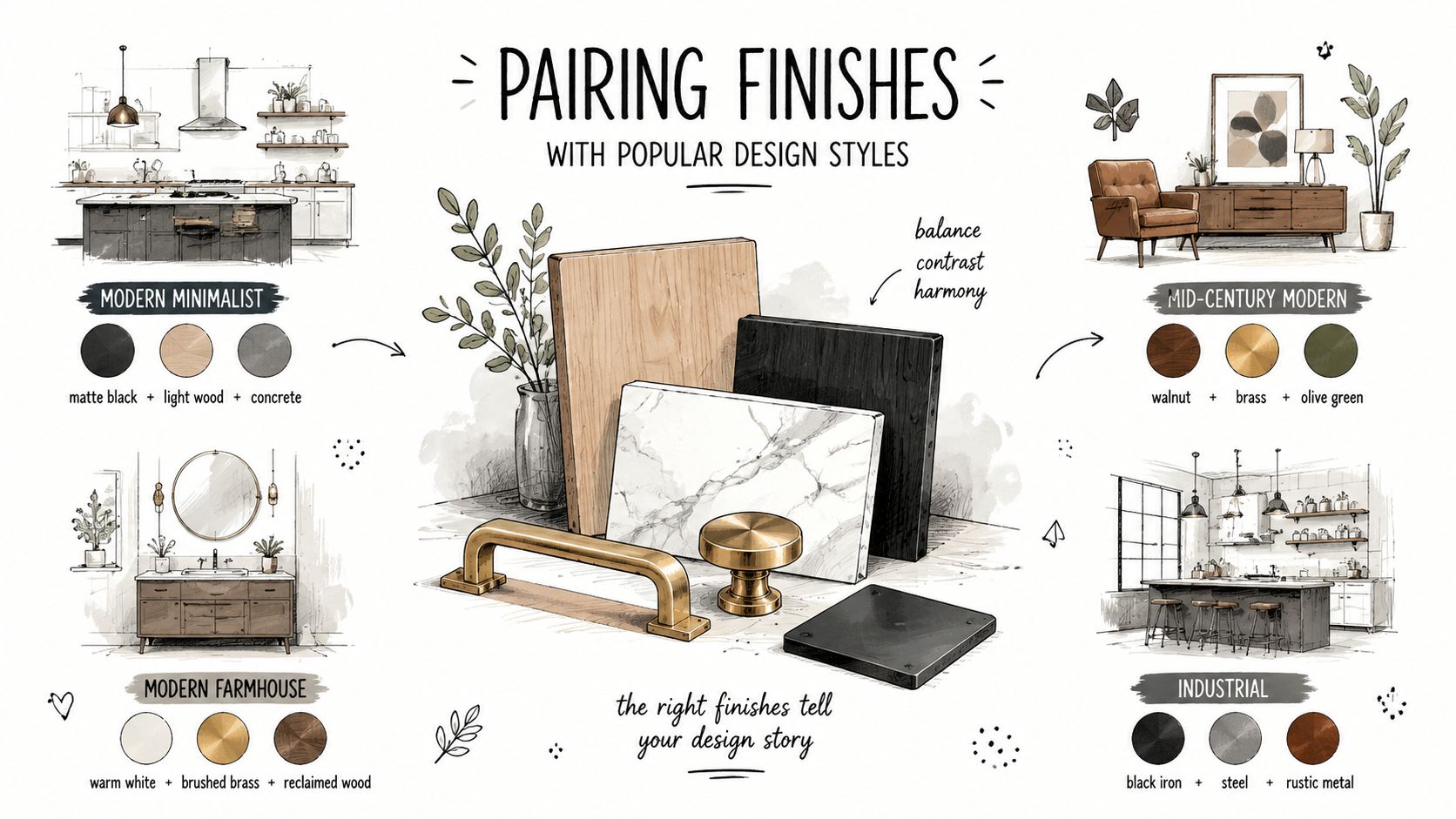
The right finish should support the architecture and mood of the room. It shouldn't fight it. In South Georgia and North Florida, the most successful cabinet palettes usually feel relaxed, grounded, and refined enough to hold up beside natural light, textured fabrics, and layered finishes elsewhere in the home.
Coastal Chic needs restraint
Coastal style works best when it avoids clichés. The finish should feel sun-washed and refined, not themed.
A white oak stain or soft natural finish often carries this look beautifully because it lets grain add texture without making the room heavy. Lighter stained cabinetry pairs well with woven accents, pale stone, and upholstery pieces from collections often associated with brands such as Lexington and Stressless, where comfort and polish can coexist.
Best matches for Coastal Chic:
- White oak stain: Light, airy, textured
- Natural matte wood tone: Relaxed and architectural
- Soft painted neutral: Clean backdrop for layered materials
Modern Farmhouse needs warmth and structure
Modern farmhouse cabinetry should feel anchored, not sugary. That usually means painted finishes with enough depth to avoid a flat, builder-grade impression, or stained wood that introduces texture where the room might otherwise feel too stark.
Glazes can work here, but only when the door profile supports them. A subtle glaze on a paneled cabinet can add age and shadow without tipping into fussiness. This is also where furniture influences matter. Collections associated with Hooker Furniture often show how wood tone, distressing, and clean silhouettes can share the same room without conflict.
The strongest farmhouse finish is rarely the most distressed one. It's the one that gives the room warmth while keeping the lines disciplined.
Timeless traditional and tailored transitional finishes
Traditional and transitional spaces invite more finish depth. Rich stains, layered glazes, and refined painted surfaces all make sense here, especially when the goal is a curated sanctuary rather than a stark minimalist shell.
A few reliable pairings:
- Medium stained wood: Works well where architectural trim and classic hardware are already present.
- Paint with glaze: Adds dimension to detailed door styles.
- Deep stain with satin sheen: Creates a furniture-like quality in libraries, bars, and formal dining spaces.
For homeowners considering what makes upscale Florida interiors feel cohesive, Ofir Engineering on luxury homes is a useful read because it places finishes within the larger context of luxury residential detailing.
Maintenance and Long-Term Care
A finish can only perform as well as the home allows it to. Daily care matters, but so do interior conditions.
Boston Building Resources gives a clear operating range for finished wood cabinetry. To avoid dimensional change or damage, cabinets should be maintained between 25% and 50% relative humidity and between 40°F and 100°F according to this cabinet finish overview and care guidance. The same range applies to storage before installation.
Control the room before blaming the finish
Many homeowners think a finish failed when the issue was environmental stress. Wood moves. Coatings expand and contract at different rates. Repeated swings in humidity can stress seams, joints, and edges.
In coastal areas, the goal isn't perfection. It's consistency.
- Run climate control steadily: Avoid dramatic indoor swings.
- Use ventilation while cooking and bathing: Steam doesn't belong on cabinet surfaces longer than necessary.
- Dry spills promptly: Standing moisture is still the enemy, even with a protective topcoat.
Clean gently and consistently
Harsh cleaners do slow damage. They can dull sheen, soften protective layers, or leave residues that attract more grime.
A safer routine usually includes:
- Use a soft cloth first. Dry dust is less abrasive than scrubbing after buildup hardens.
- Choose mild cleaning solutions. If a product feels aggressive on skin or stone, it's usually too aggressive for a furniture-grade finish.
- Dry after wiping. Don't leave moisture to evaporate on its own around profiles and seams.
For finish-specific upkeep on wood pieces throughout the home, this guide to wood furniture care helps reinforce the same habits that protect cabinetry.
Small habits preserve custom cabinet finishes better than occasional deep cleaning ever will.
Handle wear before it spreads
Minor scratches, rubbed edges, and finish dulling around pulls should be addressed early. Once exposed areas collect grease or moisture, touch-ups become more visible and more difficult.
The most practical approach is simple:
- Keep extra finish information from the original order.
- Ask for touch-up materials if they're available.
- Don't experiment with random patch products from a hardware aisle.
That last point saves a lot of regret. An incorrect sheen or undertone can make a tiny repair stand out more than the scratch itself.
Your Custom Finish Journey at Lott's Furniture
A custom finish decision goes better when the homeowner can compare materials in person, study sheen under real lighting, and get direct guidance on how a piece will live in the home. Digital browsing is useful, but touch matters with wood, paint, and layered finishes.
That's where a well-run Special Order Program earns its place. Many vendors support personalized designs, including finish selections, wood tones, upholstery choices, and comfort options. For homeowners furnishing connected spaces instead of isolated rooms, that flexibility helps cabinetry-adjacent pieces feel coordinated rather than close enough.
Better decisions come from guided selection
Lott's Furniture offers one path for homeowners who want to move from inspiration to specification. Through custom order planning support, shoppers can review options before committing to a finish direction for the room as a whole.
That process becomes more useful when paired with the brand's broader guidance tools:
- Style Quizzes: Helpful for narrowing the room's design language before selecting a wood tone or painted surface.
- Mattress Guide: A reminder that comfort guidance across the home matters, not only aesthetics.
- In-store associates: Available to help connect digital research with what materials look and feel like in person.
The omnichannel piece matters, too. Homeowners can move from the digital catalog to the showroom in Fernandina Beach, FL, where finish decisions become easier once samples, neighboring materials, and room scale can be evaluated together. For South Georgia and North Florida households, that bridge between online browsing and in-person review saves mistakes.
Delivery standards matter for finished pieces
High-end finishes can be damaged long before a homeowner ever uses them. That's why handling standards count.
Every finished piece should be checked before placement. Lott's Delivery emphasizes white-glove, in-home delivery, and each piece undergoes a rigorous multi-point inspection before it reaches the customer. That's the right standard for investment-quality furniture and finish-sensitive surfaces.
A few brands often relevant to coordinated interiors include:
- La-Z-Boy
- Smith Brothers
- Lexington
Those names matter less for status than for compatibility with a home that's being furnished thoughtfully, with finish, comfort, and longevity considered together.
A well-chosen finish doesn't just match a room. It protects the atmosphere the homeowner is trying to build.
For homeowners across South Georgia and North Florida, Lott's Furniture offers a practical way to compare custom finishes, explore Special Order options, and connect online inspiration with in-person guidance in Fernandina Beach. Visit the showroom or schedule an online style consultation to evaluate finish samples, ask the right durability questions, and choose a look that will hold up beautifully in real life.