
Custom Upholstered Ottoman: A Complete Guide for 2026


A stock ottoman can look fine in a showroom and still miss the mark at home. The height feels off next to the sofa, the fabric fights the room, and the footprint steals traffic space that was already tight. A custom upholstered ottoman solves that mismatch by fitting the room, the seating, and the way the household lives.
That matters in real homes across South Georgia and North Florida, where clients want furniture that feels custom without becoming fussy. It also fits the way our shoppers move between the digital catalog online and the showrooms in Waycross and Fernandina Beach, then ask an associate to help turn a vague idea into a finished piece. Lott's Furniture supports that process with Special Order Program options, style quizzes, and in-store guidance, plus the kind of white-glove, in-home delivery that makes investment pieces feel easy to live with.
Why a Custom Upholstered Ottoman Changes a Room
A family can love a sofa and still resent the ottoman in front of it. The piece may sit too low, forcing the knees up awkwardly, or it may be so large that people have to sidestep it every time they move through the room. A custom upholstered ottoman fixes those friction points because it is built for the sofa, the circulation path, and the way the household uses the space, not for a generic floor plan.
The strongest custom pieces do more than match color. They anchor a seating area, soften hard edges, and make the room feel finished without adding visual clutter. That is why the upholstered-furniture category keeps expanding, with the U.S. market estimated at USD 22.25 billion in 2026 and projected to reach USD 28.63 billion by 2031 at a 5.18% CAGR. For a buyer, that points to a simple truth, personalized comfort still has a real place in the home.
Practical rule: if the ottoman feels like an afterthought, the room will always feel slightly unresolved.
Placement decides whether the piece earns its keep. A well-sized ottoman can open a walkway, create a softer landing in front of a sectional, or serve as a casual surface when guests come over. It can also improve the way the room is styled, especially when the ottoman sits in a balanced arrangement with lamps, tables, and greenery. If you are trying to decide what belongs where, start with the room layout first, using the internal guide on how to place living room furniture, then add finishing touches that make the space feel intentional. For that last layer, it helps to choose plants for home decor, because the right plant can soften the ottoman's footprint without crowding the room.
The room improves when the ottoman matches the sofa's scale and the household's habits. That is the true value of custom work. It removes guesswork and replaces it with fit.
Anatomy of a Custom Upholstered Ottoman
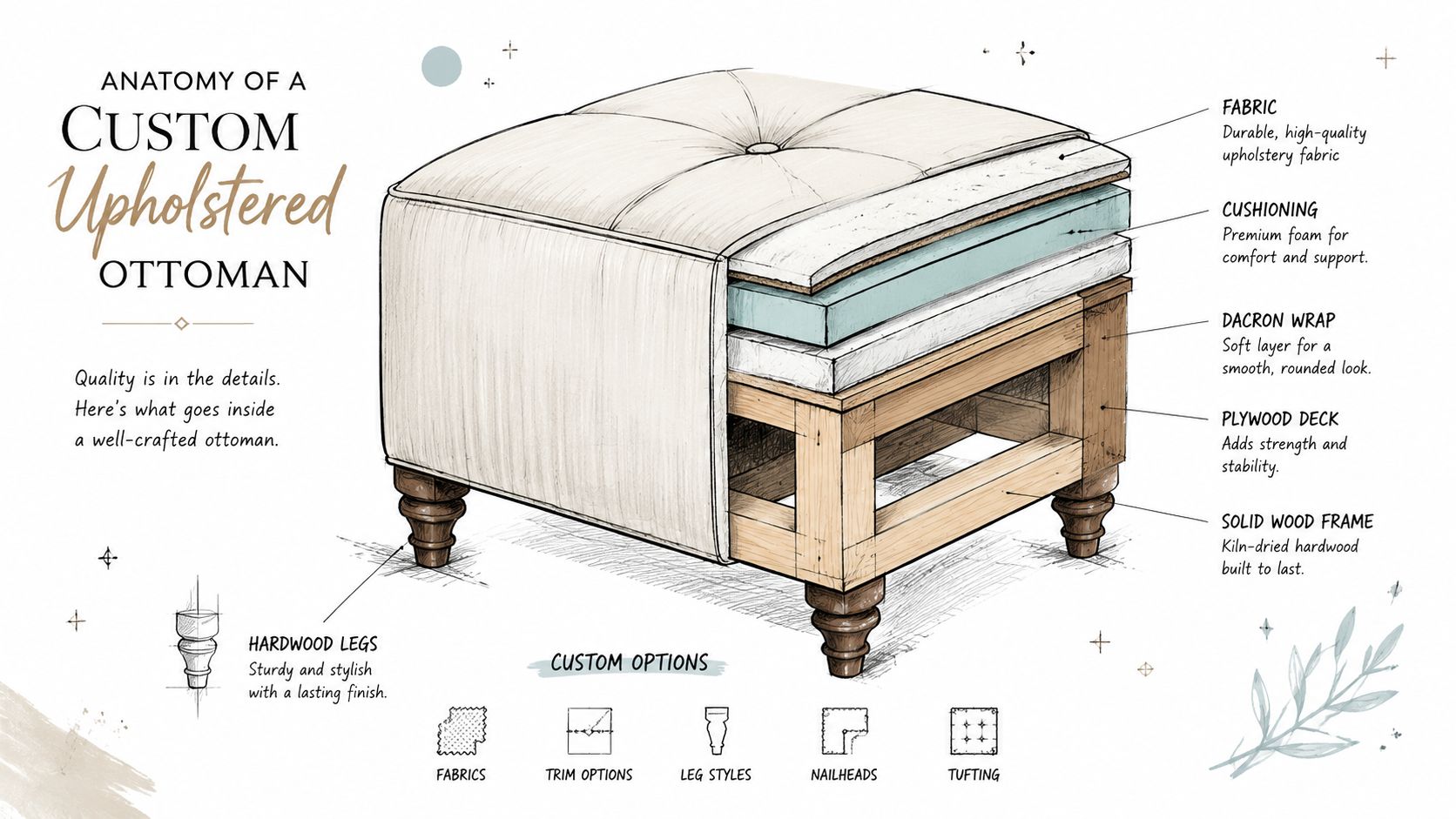
A buyer who understands the parts makes better decisions. The frame is the bones, the fill is the part you feel every day, the legs and base set the stance, and the upholstery is the visible finish. If one layer is weak, the whole piece disappoints no matter how good the fabric looks.
The frame is where longevity starts. A solid frame handles daily use and keeps the ottoman from racking or sagging too early, while the fill decides whether the surface feels firm, relaxed, or too soft. The wrap and outer layers matter too, because they affect how the piece holds shape, how it wears, and how it fits with the rest of the room. If you are comparing what sits beneath the fabric in a wider home setting, the Richmond homeowners rug placement guide is a useful reminder that flooring and soft furnishings need to work together, not fight each other. For a detailed breakdown of upholstery materials and how they affect the final look and feel, the internal guide on upholstery materials gives a solid baseline.
What matters most in the build
- Frame construction: this carries the load, so it affects durability first.
- Cushion fill: this changes comfort most, especially if the ottoman doubles as a footrest or seat.
- Leg style or skirting: this changes airflow, cleaning access, and the visual weight in the room.
- Fabric or leather: this affects feel, stain resistance, pattern alignment, and how refined the final piece looks.
- Finish details: piping, seams, and edge treatment decide whether the ottoman reads casual or custom-upholstered.
The upholstery layer matters more than many shoppers expect. One upholstery supplier notes that a basic ottoman cube can use about 2 yards of solid or small-scale fabric, while larger-scale patterns can require about 2.5 yards because of repeat matching, and leather needs different seam placement and stitching than fabric (1502 Fabrics). That affects labor, waste, and finish quality. It also changes how clearly the piece reads once it is in the room, because a poorly matched pattern or awkward seam line draws attention fast.
A premium fabric on a weak frame is a bad investment. The inside has to earn the outside.
The smartest buyers focus first on construction and fill, then choose the upholstery that fits the room.
Shapes, Sizes, and Where Each One Belongs
Shape should follow use, not trend photos. A round ottoman softens a sectional with hard lines. A square one reads more structured and works well when the seating is compact. A rectangular cocktail ottoman is the right move when the family wants one piece to function as a footrest, coffee-table substitute, and occasional seat.
Choosing the right silhouette
- Round: best for breaking up angular seating groups and easing circulation around corners.
- Square: best for balanced layouts where the ottoman sits directly in front of a sofa.
- Rectangular cocktail: best for longer sofas and sectionals that need more usable surface.
- Bench style: best for entry areas, narrow rooms, and spaces where the piece must move easily.
- Storage trunk: best only when the interior will be used often enough to justify the extra weight and mechanism.
The sizing rule matters just as much as the silhouette. A good ottoman usually sits close to the height of the adjacent seat, because that keeps it comfortable as a footrest and useful as extra seating. Commercial offerings commonly cluster around 430 to 450 mm, or about 17 to 18 in, for cube, round, and pill shapes, while larger cocktail formats reach roughly 50 in x 50 in x 19 in (Furniture by Design). That range is useful because it shows how much the footprint can change while still serving the same basic role.
For buyers using a sectional, the ottoman shouldn't crowd the front edge of the sofa or force people to squeeze past it. Leave enough space for knees, trays, and real foot traffic, not just a magazine spread. The ottoman should look intentional from every angle, not jammed into the room because it “fit.”
The internal cocktail storage ottoman page is a good reminder that storage is a feature, not a default. If the hidden compartment won't be used for blankets, games, or seasonal throw pillows, it usually isn't worth the extra bulk.
The right shape makes the room easier to live in. The wrong one just becomes another obstacle.
Fabrics, Performance Finishes, and Cushion Fill
Fabric choices should be judged by how they live, not just how they photograph. Natural fibers bring a softer, more relaxed look. Performance weaves are the better choice for households with kids, pets, or sandy shoes. Leather gives a sharper, more refined finish, but the seams, panel direction, and edge treatment have to be handled carefully or the piece can look awkward instead of well-finished.
The custom route makes this easier because the buyer can match the fabric to the room and the workload. That's why a special-order ottoman with a performance finish is usually the smartest recommendation for daily-use living rooms, while more delicate upholstery belongs in lower-traffic spaces. Lott's special-order approach supports that kind of choice, and the internal performance fabrics for upholstery guide is a practical place to compare options before deciding.
Ottoman fill options at a glance
| Fill Type | Feel | Best For | Trade-Off |
|---|---|---|---|
| Foam | Firm and structured | Daily footrest use | Less sink-in softness |
| Down-wrapped | Soft and relaxed | Occasional seating | Needs more upkeep |
| High-resilience core | Supportive with better shape retention | Heavier daily use | Usually a firmer hand |
The fill should match how the ottoman will be used. A firm foam core is the safest choice for a footrest that gets used every night. A down-wrapped option feels more luxurious if the ottoman is mostly for casual seating and the family doesn't mind fluffing it. A high-resilience core is the strongest all-around choice when the piece has to stand up to repeated use and still look composed.
Commercial offerings also show that many custom ottomans are built around modular size standards rather than one fixed dimension, which is another reason fill matters. Taller or wider pieces need better structure, or they start to look tired faster. That is the trade-off buyers should care about, not just the color under showroom lights.
The rule is simple, match the fabric to the climate and the fill to the workload. Anything else is a compromise.
Pricing, Lead Times, and Where the Custom Dollar Is Spent
Custom pricing makes sense only when the buyer knows what drives it. The quote usually moves because of frame construction, fabric grade, trim, size, and labor, not because the process needs to feel opaque. A larger ottoman uses more materials, a pattern needs more careful matching, and a detailed edge finish takes more time than a plain one.
Value question: which upgrade changes comfort or durability enough to justify paying for it, and which upgrade is mostly visual?
That question matters more than chasing a fancy spec sheet. The true test shows up in daily use, whether the ottoman keeps its shape, cleans easily, and still looks intentional after years in the room. Buyers who want a cleaner starting point on special orders should use the internal getting started with custom order page before they commit to a quote.
Lead time belongs in the price conversation too. Some made-to-order ottomans run 6 to 8+ weeks depending on complexity and fabric availability (L.S. Fabrics). That timing is normal for a piece built around specific dimensions, finishing details, and upholstery selection.
The smartest way to read the quote is to separate the durable upgrades from the decorative ones. A stronger frame, better fill, and a fabric that fits the household's life are worth paying for. Decorative trim that does not change comfort or cleaning is a judgment call, not a requirement.
The EU small ottoman market also points in the same direction. Market analysis from IndexBox describes a segment that is moving toward more value-added pieces, which makes sense because buyers are paying for more than a basic cushion on legs.
The bottom line is blunt. Pay for structure, comfort, and durability first. Pay for decoration only after those boxes are checked.
Ordering at Lott's Furniture, Step by Step
The cleanest ordering experience starts online and finishes in person. Buyers can begin with the digital catalog, use the Style Quizzes to narrow the look, and then visit the showrooms in Waycross, GA or Fernandina Beach, FL to feel the fabrics and confirm the proportions with an associate. That sequence saves time and keeps the design choices grounded in actual samples, not tiny screen swatches.
A good custom order should feel guided, not improvised. The process usually looks like this:
- Start online. Browse the catalog and narrow the style direction before leaving home.
- Use the style tools. The quizzes and guides help identify the right direction for comfort and finish.
- Visit the showroom. Handle fabric and leather options in person, then compare them under real light.
- Confirm measurements. Make sure the ottoman lines up with the sofa height, room flow, and intended use.
- Finalize the order. Review finishes, details, and delivery timing before committing.
The best part of buying locally is the human part. An in-store associate can help interpret the fabric library, talk through comfort choices, and keep the order from drifting into expensive overkill. Lott's also offers Shop Now, Pay Later financing, which can make an investment-quality piece easier to place in the budget without lowering the standard.
This is also where the brand mix matters. A custom ottoman can sit naturally beside pieces from La-Z-Boy, Smith Brothers, or Lexington, especially when the buyer wants the room to feel coordinated without looking overdesigned. Those categories work well because the same store can help match a performance fabric, a wood finish, and a broader seating plan in one visit.
The final step is the one many retailers skip. Every piece goes through a rigorous multi-point inspection before the white-glove, in-home delivery team places it in the room of choice. That standard matters because a custom ottoman should arrive ready to live with, not ready for the customer to solve.
Built for Coastal and Small-Space Living
Beach houses, condos, and rental properties put ottomans under pressure fast. Sand gets tracked in, humidity changes how fabrics feel, and a room that looks generous on a floor plan can still have tight clearances around a sectional. In those settings, a custom upholstered ottoman has to be chosen like working furniture, not decor.
For coastal homes, the safest move is usually a stain-resistant performance fabric. It handles guest traffic, wet towels, shoes, and quick turnovers better than a delicate weave. Lighter frames are easier to move for cleaning, and legs usually make more sense than full skirts because they improve airflow and make vacuuming easier. Storage ottomans sound appealing, but the extra weight and hardware only pay off when the storage gets used often enough to justify the tradeoff.
Coastal buying rules that hold up
- Keep access easy. The ottoman should move without dragging or pinching the walkway.
- Choose washable thinking. Even when the cover isn't removable, the fabric should handle real life well.
- Avoid visual bulk. Heavy skirting can make a small room feel tighter than it is.
- Be honest about storage. Hidden compartments help only when they solve a real problem.
- Prioritize clean lines. A simple shape usually ages better in a rental or vacation home.
That practical standard matters more than supply-chain chatter. The key question is simple: whether the ottoman can stand up to sand, humidity, and constant rearranging without becoming a nuisance. Global sourcing may shape what reaches the market, but it does not change the basics of good buying: choose a build that fits the room, cleans easily, and does not fight the way the space is used.
For South Georgia and North Florida households, the winning formula is plain. Keep it light, keep it cleanable, and keep it easy to move.
Care, Maintenance, and Your Next Step
A custom ottoman lasts longer when it's treated like a daily-use piece, not a decorative prop. Rotate it occasionally to even out wear, vacuum it with the right attachment, and blot spills instead of rubbing them deeper into the fibers. Performance fabrics need the cleaner that matches their code, and leather needs conditioning on a sensible schedule so it doesn't dry out.
Three questions come up again and again. Warranty coverage depends on the specific order and vendor. Re-ordering fabric is easier when the original selection is documented carefully. If a cushion softens unevenly, a store associate can usually help assess whether it needs a simple adjustment or a deeper service check.
Keep the ottoman working, and it keeps the room working.
The best next step is simple. Start with the online Style Quiz, then sit with the fabric choices in the Fernandina Beach or Waycross showroom and let an associate help narrow the build. That's the fastest way to turn a good idea into a piece that fits the room for years.
Lott's Furniture helps buyers choose a custom upholstered ottoman with real confidence, from the first online browse to the final in-home placement. Visit Lott's Furniture to start with a style quiz, explore special-order options, and plan a showroom visit that makes the right size, fabric, and finish obvious.