Mixing Leather and Cloth Furniture: Styling Tips

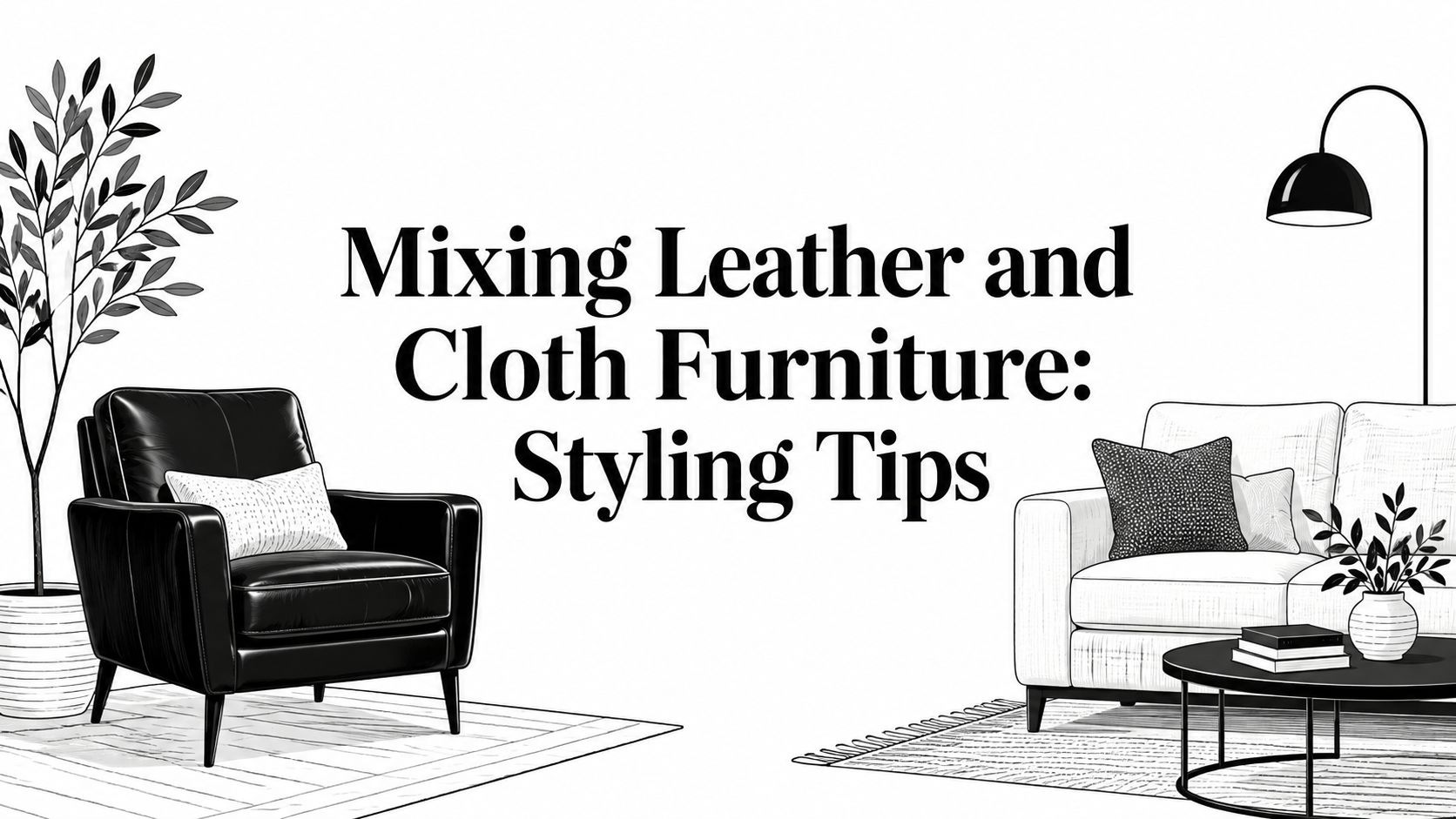
A living room usually gets stuck here. A leather sofa already owns the room, the new fabric chairs feel too delicate next to it, and the whole arrangement starts reading like two different shopping trips instead of one plan. Mixing leather and cloth furniture works when the room has hierarchy, not sameness, and that's the standard we use across South Georgia and North Florida.
Leather still carries serious weight in the upholstery market, with 38% of total upholstery sales and 4.3 million U.S. households buying leather upholstery in the prior year, spending an estimated $11.1 billion at retail (Furniture/Today). That scale matters because leather is rarely a side note, it's usually the anchor. Cloth then steps in to soften, balance, and keep the room livable.
The smartest mixed rooms follow four decisions, anchor, proportion, undertone, and connectors. Get those right and the room feels edited. Get them wrong and the furniture starts competing for attention.
Why Mixing Leather and Cloth Furniture Works
The reason this pairing succeeds is simple, leather and cloth solve different problems in the same room. Leather brings structure, visual weight, and a grounded presence. Cloth brings softness, color flexibility, and a more relaxed finish. When a homeowner treats them as complementary materials, the room stops feeling flat and starts feeling layered.
Start with hierarchy, not symmetry
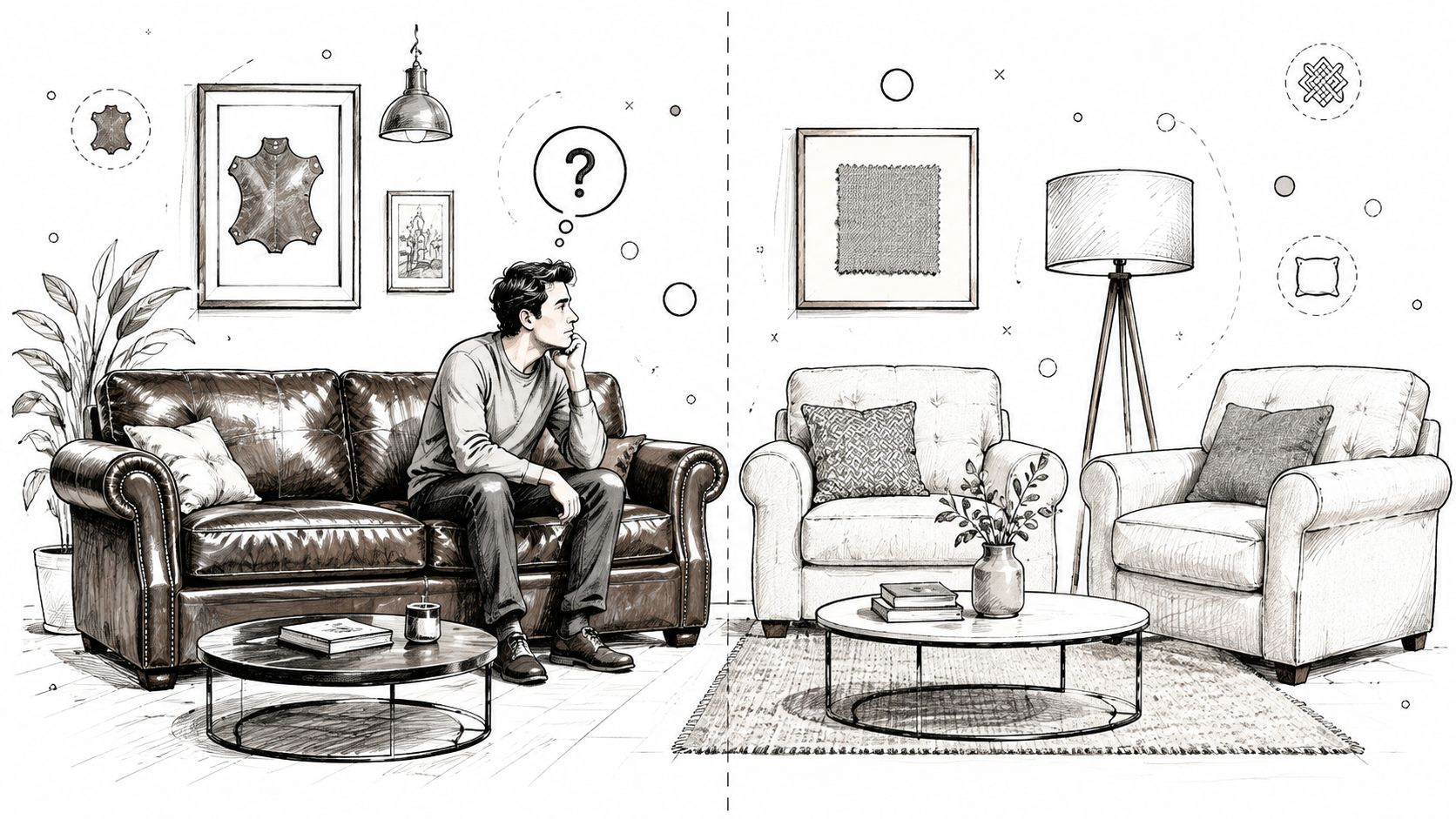
The biggest mistake is trying to split the room evenly between the two materials. Equal visual weight usually creates competition, not balance. Instead, make one large piece the anchor, usually the sofa or sectional, then let the second material play a supporting role in chairs, benches, ottomans, or pillows.
That approach lines up with practical design guidance that says mixed rooms look intentional when one material leads and repeat elements connect the rest, rather than forcing a 50/50 split (Tanger's Furniture). A room with a leather sofa and fabric chairs feels deliberate when both pieces share a style language and a color note. A room with no hierarchy feels like a compromise.
Practical rule: Let the largest upholstery piece decide the room's tone, then make every other piece answer it.
For homeowners who want to understand the upholstery decision before shopping, our guide to everything you need to know about upholstery materials gives a clean starting point. The point isn't to choose a winner. The point is to assign each material a job.
A leather-and-cloth mix also makes sense because everyday durability isn't identical across materials. In a 2025 survey of 1,333 Which? members and general consumers who bought a sofa in the previous 10 years, 40% of real-leather sofas showed damage or wear, compared with 30% for cotton-blend sofas and an average of 33% across all materials. Faux leather performed worse at 57%, while wool and wool blends performed better at 16% and 21%. That's exactly why many households mix materials instead of pretending one surface has to do everything.
The Four Decisions That Make a Mix Look Intentional
Good mixed upholstery doesn't happen by accident. Our associates in Fernandina Beach and Waycross see the same pattern over and over, the rooms that work are the ones where the homeowner makes four clear decisions before buying anything. The room needs an anchor, a proportion plan, undertone matching, and connective details.
Choose the anchor first
The anchor is the biggest piece, and it should carry the strongest visual presence. A Lexington leather sofa can ground a formal living room with polished structure. A fabric sectional can do the same job if the room needs softness first. The anchor should be the piece that tells the eye where to land.
Set the proportion before the pattern
A heavy leather sofa paired with light, shaped fabric chairs usually works. A leather sofa paired with equally bulky fabric seating usually does not. The rule is straightforward, one material should look visually stronger, and the other should feel lighter in form or finish.
Match undertones, not just colors
Warm leather belongs with warm fabric. Cool leather belongs with cool fabric. That doesn't mean the room has to be monochrome, it means the undertone conversation has to stay consistent. Natural light and evening light can change how those tones read, so samples need to be viewed in both.
Add connectors that repeat on purpose
Connectors are the details that stop the room from feeling chopped up. Pillows, throws, and rugs should repeat at least one tone already in the room, then echo the furniture style. A Wesley Hall accent chair can become the bridge piece when its shape stays clean and its fabric echoes the sofa's warmth.
A textured fabric sample can help the mix feel finished before anything is ordered. For a close look at surface feel and how it changes a room's tone, see our textured upholstery fabric guide.
| Decision | What to Choose | Common Mistake |
|---|---|---|
| Anchor | One large piece leads the room | Two pieces fighting for attention |
| Proportion | One material carries more visual weight | Equal bulk on both sides |
| Undertone | Warm with warm, cool with cool | Mixing temperatures without a bridge |
| Connectors | Rugs, pillows, throws, repeat tones | Treating accessories like afterthoughts |
The room feels intentional when the eye can travel from one material to the other without hitting a visual wall.
Room-by-Room Layouts That Pull the Mix Together
A mixed-material room needs layout discipline. The furniture can be beautiful and still feel wrong if the leather ends up concentrated on one side or the seating blocks the flow of the room. Across South Georgia and North Florida, the most common failure is weight imbalance, with all the leather pushed into one corner and all the fabric scattered elsewhere.

Living room balance
A living room usually wants a leather sofa as the anchor and fabric chairs as the softening layer. Place the sofa on the longest wall or across the best sightline, then angle the chairs so they complete conversation, not traffic blockage. If the room is open, distribute leather across the seating zone instead of clustering it near the entry wall.
The simplest pairing is a Stressless recliner with a Rowe fabric sectional. That combination works because the recliner stays visually distinct while the sectional softens the overall seating group. Small tables and a rug should sit close enough to unify the zone, not so far apart that the pieces look isolated.
Family room movement
Family rooms need easier circulation and lower visual drama. Put the strongest piece where the room naturally settles, then keep the second material lighter in profile. If the family room gets daily use, fabric on the larger sectional and leather on the smaller motion piece often feels more practical than the reverse.
A good rule is to keep the walk path open on at least one side of the room, especially if the space connects to a kitchen or hallway. In our small spaces guide, the same principle shows up again and again, fewer bulky pieces and cleaner lines make mixed furniture read better in tighter plans. That advice applies just as much to a compact den as to an apartment living room.
Bedroom seating and the finish point
Bedrooms handle mixed upholstery well when the leather appears in one crisp form and the fabric stays supportive, not busy. A Hooker Furniture leather bed paired with a Smith Brothers bench gives the room a clear hierarchy, the bed leads and the bench quiets the edge of the room. Keep the bench at the foot of the bed or near a window, not floating in the center where it interrupts circulation.
Placement rule: Leather should never sit only on one side of the room. Spread it out so the room feels composed, not weighted down.
Coastal, Farmhouse, and Traditional Playbooks
The same mixed-material logic shifts cleanly across style families, but the finish language has to stay true to the room. A coastal home wants breezy contrast. A farmhouse room needs texture with warmth. A traditional room can handle richer leather and more structured cloth.
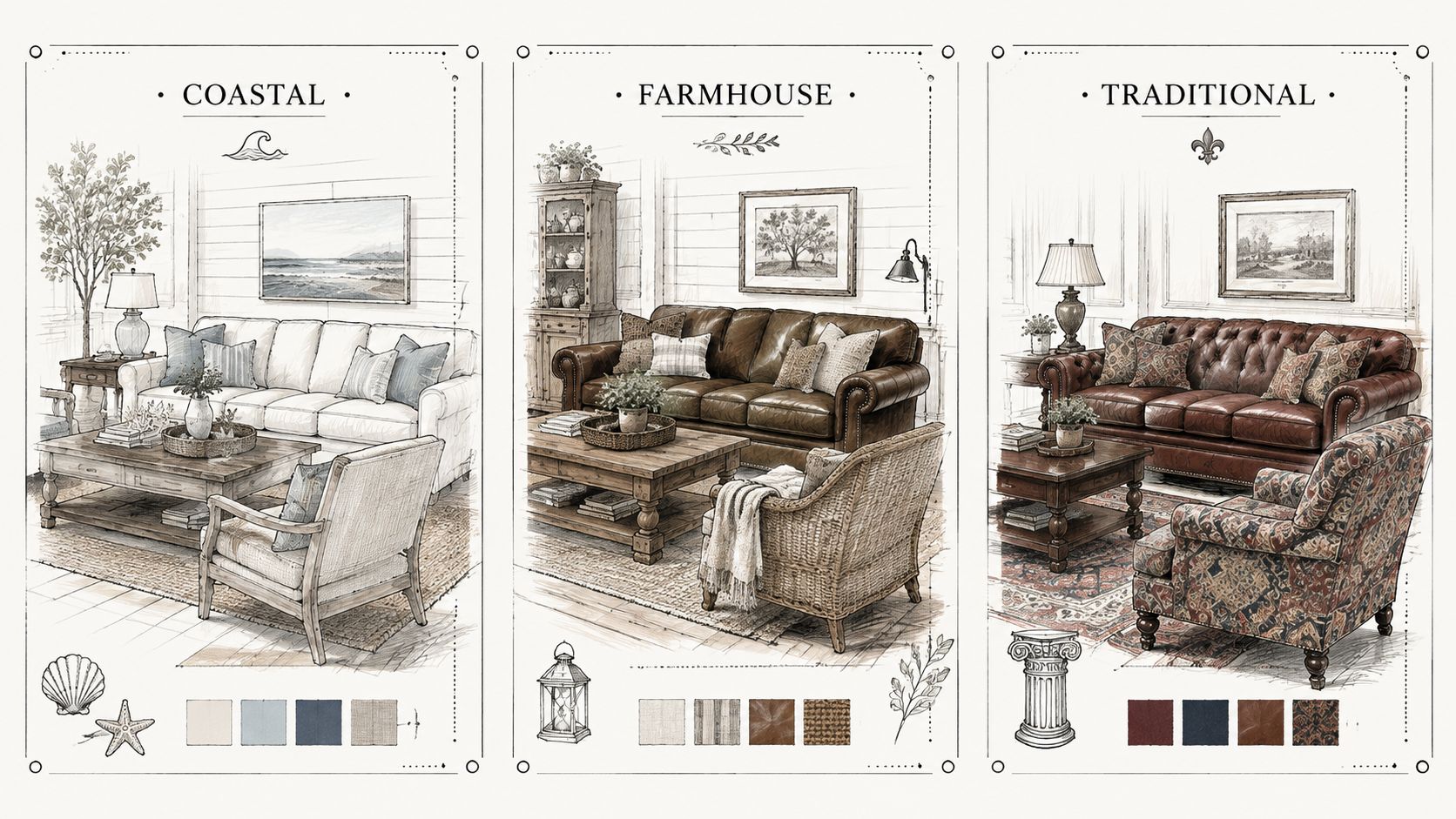
Coastal feels light and edited
Coastal rooms do best when leather looks washed and cloth looks breathable. Whitewashed leather, linen-grain fabric, and pale wood finishes keep the room airy. The style quizzes on our site help confirm whether the home leans coastal, modern, or transitional before a purchase gets locked in.
Farmhouse wants texture over polish
Farmhouse mixing works when distressed leather sits next to cotton or wool blends. The room should feel collected, not showroom-stiff. A relaxed sofa, a stitched chair, and a simple bench create the kind of comfort that suits a family room without making it feel overdone. For color direction, our farmhouse color schemes guide gives a practical starting point for tone matching.
Traditional needs tailoring
Traditional rooms can handle Chesterfield-style leather with detailed tapestry or velvet-touch fabric. The key is discipline, the silhouettes need to match in formality. A richly detailed leather sofa next to a refined fabric chair looks elegant. A formal leather piece next to a casual slipcovered chair looks accidental.
To keep the room grounded, repeat the strongest finish at least twice. That could mean leather on the sofa and one chair, or leather on the sofa and a bench with leather trim. The room feels more finished when the eye sees the same material show up more than once.
A useful way to narrow the style quickly is to use the brand-agnostic prompt inside the quiz, choose the space that feels closest to home, then compare the materials against that setting. The style should support the architecture and daily use, not fight either one.
Choosing Cushions, Throws, and Rugs That Connect the Two Materials
Connector pieces do the quiet work in a mixed room. They bridge the gap between smooth leather and woven cloth, and they stop the space from looking like disconnected purchases. The wrong pillow or rug can make the contrast harsher. The right one makes the whole room feel settled.
Pick connectors that repeat a tone
A cushion should pull a color from the leather and echo it inside the fabric, not invent a new story. A throw can introduce a third texture, but it shouldn't introduce a third idea. Keep the repeat visible. That's what makes the room feel composed rather than decorated at random.
Rugs should sit under both upholstery types with enough presence to unify the seating group. A rug that is too small leaves the mix floating. A rug that carries both tones, even subtly, can make leather and cloth look like they were planned together from the start.
Prioritize performance in the soft layers
For homes with kids or pets, performance fabric is the cleaner choice on accent seating because it keeps the softest pieces useful longer. Leather still works well as the easy-to-wipe anchor, especially on high-contact spots like arms and fronts. In mixed rooms, that combination gives the homeowner practical control without giving up refined comfort.
La-Z-Boy and Smith Brothers both offer performance fabric options through our Special Order Program, which matters when the room needs durability without looking utilitarian. The point isn't just stain resistance, it's preserving the look of the room after real daily use.
Choose the throw and pillow first by texture, then by color. If the hand feel is wrong, the room will never feel finished.
A thoughtful throw can also pull the whole composition together without crowding it. A separate look at throw blanket ideas for 2026 is useful for homeowners who want a living room layer that feels current without chasing a trend.
For shoppers comparing materials online before visiting the store, our layering furniture and decor guide helps translate a mixed upholstery plan into a finished room. That's especially useful when the fabric and leather samples are already close, but the room still needs a final connector.
Why the Mix Often Outperforms Going All-In on One Material
A room built only in leather can look too hard if the seating is large and the finish is dark. A room built only in cloth can feel too flat if there's no anchor to give it shape. Mixing lets each material handle the job it does best.
The durability pattern supports that logic. In the Which? survey noted earlier, real leather showed more wear than cotton blends, while faux leather performed worse than both. That doesn't mean cloth is always the answer or leather is always the wrong pick. It means the homeowner should place the more visually structured material where the room needs definition, then use the other material where comfort, softness, or wear performance makes more sense.
Straight answer: the mixed room usually ages better visually because no single surface carries the whole burden.
That is where mixed sourcing wins. Leather can anchor the room at the largest scale, especially on the main sofa or sectional. Cloth can appear in the pieces that get handled differently, like reading chairs, benches, or accent seating. The result is a room that feels intentional on day one and still makes sense after the home starts living in it.
Mixed materials also handle changing tastes better. A homeowner who wants a warmer room later can swap in new pillows or a different throw. A room built around one dominant material leaves less room to adjust. The mixed plan gives flexibility without starting over.
Caring for Both Materials and Bringing the Plan to Lott's
Mixed upholstery stays sharp when the maintenance is simple and regular. Leather should be conditioned on a sensible schedule, fabric should be vacuumed before dust settles in the weave, and connector pieces should be spot-cleaned before they become permanent distractions. For suede-like finishes around the house, a practical reference such as fix stained suede footwear can help homeowners think through gentle cleaning habits without overworking the surface.
The ordering process matters just as much as the upkeep. Our Special Order Program lets most vendors personalize fabrics, finishes, and comfort levels, so the leather chair, fabric sofa, or mixed accent pieces can be customized to the room instead of forced into it. Our Style Quizzes, Mattress Guide, and in-store associates help narrow the design direction before anyone commits to a final combination.
Shoppers can move from the digital catalog to our showrooms in Fernandina Beach, FL, then compare the same materials in person with guidance from our team. That online-to-showroom transition matters because leather and cloth need to be seen together, not guessed at from a screen. In South Georgia and North Florida, that hands-on step saves a lot of second-guessing.
Every piece also goes through our Lott's Delivery standard, with white-glove, in-home delivery and a rigorous multi-point inspection before it reaches the customer. That's the part that makes the sourcing plan feel complete, the furniture is selected carefully, checked carefully, and placed carefully in the room it was meant for.
If the room needs leather and cloth to work together, Lott's Furniture can help sort the mix with Special Order options, style quizzes, and showroom guidance in Waycross and Fernandina Beach. Visit Lott's Furniture to browse the digital catalog, compare fabrics and leathers, and set up a style consultation that turns the plan into a finished room.