Save 50% Off MRSP on Lexington | Shop the Catalog >

Sectional Sofa Vintage


You're scrolling through an online listing late at night when a sculpted green sectional stops the search. The curves are right, the upholstery has the kind of patina a new showroom piece can't imitate, and the room in the photograph looks effortlessly finished. Then the practical questions arrive. Will the sectional sofa vintage find fit through the front door, support everyday lounging, and look intentional beside modern lighting and a family's actual clutter?
That hesitation is sensible. A vintage sectional rewards careful buying, but it punishes wishful thinking. Era, frame construction, assembled footprint, upholstery condition, restoration requirements, and delivery access all matter. For homeowners across South Georgia and North Florida, the strongest path combines the personality of a one-of-a-kind frame with the comfort, inspection, customization, and in-home service expected from an investment-quality furniture purchase.
Why a Vintage Sectional Sofa Is Worth a Second Look
A vintage sectional offers something a catalog reproduction often struggles to deliver, visual character built into the frame. Rounded corners, clean-lined arms, unusual proportions, and naturally softened upholstery can make a living room feel collected rather than assembled. The appeal isn't limited to appearance. Historical accounts place sectional furniture in Virginia by at least 1800, with a documented example from 1820 in Fredericksburg, Virginia. Early examples used multiple sofa pieces joined with metal latches, and researchers identify the Rapidan River area of Central Virginia as an important development region between 1800 and 1820. The historical record of Virginia sectional furniture gives the style deeper roots than its mid-century reputation suggests.
A later resurgence in the 1930s and 1940s helped move sectionals from regional curiosity to practical home furnishing. Manufacturing, shipping, and customization became easier, which made multi-piece seating more useful for changing living rooms. That same flexibility remains valuable in open-plan homes, especially where a sectional needs to define a conversation area without building a wall.

The real value sits beneath the upholstery
A sound vintage frame can justify the extra inspection. The buyer isn't choosing color and shape, but evaluating joinery, suspension, cushion geometry, and whether the piece can be restored without losing its proportions. That requires a more disciplined process than saving a listing photo and hoping for the best.
A buyer should settle five questions before placing a deposit:
- What era does the silhouette represent? The answer helps predict scale, leg shape, seat depth, and likely upholstery work.
- How does the frame feel under pressure? Movement, wobble, or a shifting corner deserves attention.
- What footprint will the pieces create together? A sectional can overwhelm a room even when each component looks manageable alone.
- Will the existing upholstery support daily life? Original fabric may be beautiful but unsuitable for pets, children, or heavy use.
- How will the furniture reach the room? Doorways, corners, stairs, flooring, and placement all belong in the purchase decision.
A vintage sectional deserves a second look because it can become the room's architectural anchor. It also deserves a measured decision, not a romantic one. Buyers who want a related but more curated starting point can review American-made furniture while comparing construction standards and custom-order possibilities.
How to Identify Vintage Sectional Eras and Styles
Era identification starts with the frame, not the fabric. Upholstery can be replaced, faded, or changed by a previous owner, while the leg profile, arm pitch, back construction, and corner geometry usually reveal more about the original design. A convincing retro print doesn't make a recent reproduction an authentic vintage sectional.
Read the silhouette before studying the label
Mid-century modern sectionals typically sit low, expose tapered wood legs, and use tight backs or restrained loose cushions. The arms often appear slim and level with the seat, creating a lifted profile that works well in rooms with clean architectural lines. Look for consistent joinery, carefully shaped wood, and an underside that appears designed rather than hastily closed.
The 1970s brought deeper seating, chunkier bases, rounded forms, and earth-tone upholstery. Brown, olive, rust, and warm neutrals often support the look, but color alone proves nothing. A true period feel comes from the relationship between the broad base, generous depth, thick cushions, and softened corners.
Earlier Hollywood Regency and Danish-influenced designs may show more pronounced curves, tufted backs, decorative feet, or a carefully framed corner unit. Brass-capped feet, unusual arm details, dovetailed corner blocks, and original tag placement can strengthen the case for authenticity. None of those details should replace a construction inspection, but together they create a more reliable picture.

Use surrounding finishes to test the design
A sectional should belong to the house, not look stranded in it. Wood floors can either reinforce or soften a vintage silhouette, so a homeowner considering a renovation may benefit from reviewing mid century modern hardwood options before finalizing a room palette. The point isn't to recreate a period set. It's to understand how floor tone, wall color, rug texture, and furniture height will frame the sectional.
Era also predicts livability. A low mid-century frame may suit a clean, sleek room but feel too upright for someone who wants to stretch out. A deep 1970s piece can offer lounge appeal while consuming more circulation space. Curved corner units can create a conversation-friendly arrangement, yet their turning radius may complicate delivery and placement.
Tags deserve attention, especially when they sit beneath cushions, along the underside, or inside a concealed seam. A tag can support a date or maker identification, but missing documentation doesn't automatically invalidate a piece. Buyers should judge the whole object, including its frame, construction, proportions, and restoration history. For a complementary decorative direction, marquetry furniture can help balance an upholstered vintage centerpiece with crafted wood detail.
Inspecting Condition and Construction Like a Pro
Photographs conceal movement, odor, compression, and weak suspension. A serious buyer needs a sit test and a hands-on inspection, whether the sectional sits in a showroom, warehouse, private home, or video call.
Start with the frame. Kiln-dried hardwood, corner blocks, dowels, and secure joints generally offer a stronger foundation than particleboard panels held together with scattered staples. Lift one corner and watch the opposite sections. A frame that twists, rocks, or separates under mild movement may need structural work before anyone discusses fabric.
Check each layer in a deliberate order
The suspension determines how the sectional carries weight. Eight-way hand-tied springs can be carefully repaired, while sinuous wire and webbing each have their own service requirements. The key question is how the seating feels, not which construction sounds most impressive. A seat that sinks unevenly, produces a sharp rub, or feels unsupported needs closer examination underneath.
Cushions tell a similar story. Down-wrapped cushions may feel relaxed and luxurious, while high-resilience foam offers a more controlled sit. Original foam can compress, crumble, or lose its shape with age. Pet odor can also remain trapped in down wraps even after surface cleaning, so the buyer should inspect and smell every cushion rather than relying on a fresh-looking cover.
The restoration workflow for vintage upholstery is labor-sensitive. The upholsterer usually removes material in reverse order, preserves the original patterns, cuts replacement pieces slightly oversized for trimming, refreshes foam and batting, sews zipper-backed cushion covers, and staples a dust cover underneath. A documented vintage sofa reupholstery workflow shows why seam placement and panel sequence matter as much as fabric selection.
| Component | Signs of Quality | Red Flags |
|---|---|---|
| Frame | Hardwood structure, stable corner blocks, firm joints | Wobble, twisting, cracked rails, loose corners |
| Suspension | Even support with clean ties, intact wire, or sound webbing | Sagging springs, sharp pressure points, patched underside |
| Cushions | Recoverable shape, resilient fill, consistent height | Spongy foam, permanent compression, trapped odor |
| Upholstery | Straight seams, secure zippers, controlled wear | Seam slippage, torn zipper, deep abrasion, persistent smell |
| Underside | Neat repairs and an orderly dust cover | Random staples, exposed repairs, torn or heavily patched cover |
Inspection rule: Sit firmly in each seat, run a hand along the back rail, lift one corner, and inspect the underside before judging the sectional's value.
Buyers who prefer a classic suspension system can learn more about eight-way hand-tied springs, but the inspection still needs to focus on the actual piece. A vintage sectional can look exceptional online and fail immediately when the seat bottoms out or the corner joint shifts.
Measuring Your Room and the Assembled Footprint
A vintage sectional should be measured as a path through the house and as a finished arrangement in the room. Documented vintage and restoration examples range from approximately 107.9 inches wide by 85.25 inches deep by 27.5 inches high, to 127 inches wide by 100 inches deep by 30 inches high across three pieces, and to 142 inches wide by 32 inches deep by 31.75 inches high. Published mid-century sectional dimensions make the practical point clearly. Total width isn't enough. Depth and corner curvature can decide whether the piece functions as a room divider or blocks the entire circulation route.
Tape the room before committing
Painter's tape gives the buyer a reality check without moving a single piece of furniture. Mark the full assembled footprint, then outline a 30- to 36-inch walk zone behind or beside the sectional wherever people need to pass. Add the chaise depth, ottoman clearance, door swings, and the visual space required for a corner curve.
Coffee table spacing deserves its own measurement. Leave 14 to 18 inches between the table edge and the seat front so people can sit down, stand up, and stretch their legs without knocking knees. Check ceiling height if the sectional has a tall back, and make sure base rails won't collide with baseboards, outlet covers, or vents.
Measure every pinch point:
- Front entry: Record the clear opening, not the door slab's total width.
- Hallway turns: Measure both width and turning space at the corner.
- Stair landings: Note railings, ceiling slopes, and the direction each piece must rotate.
- Room entry: Check the tight corner where the sectional bends.
- Final placement: Confirm outlets, registers, baseboards, and window trim remain accessible.
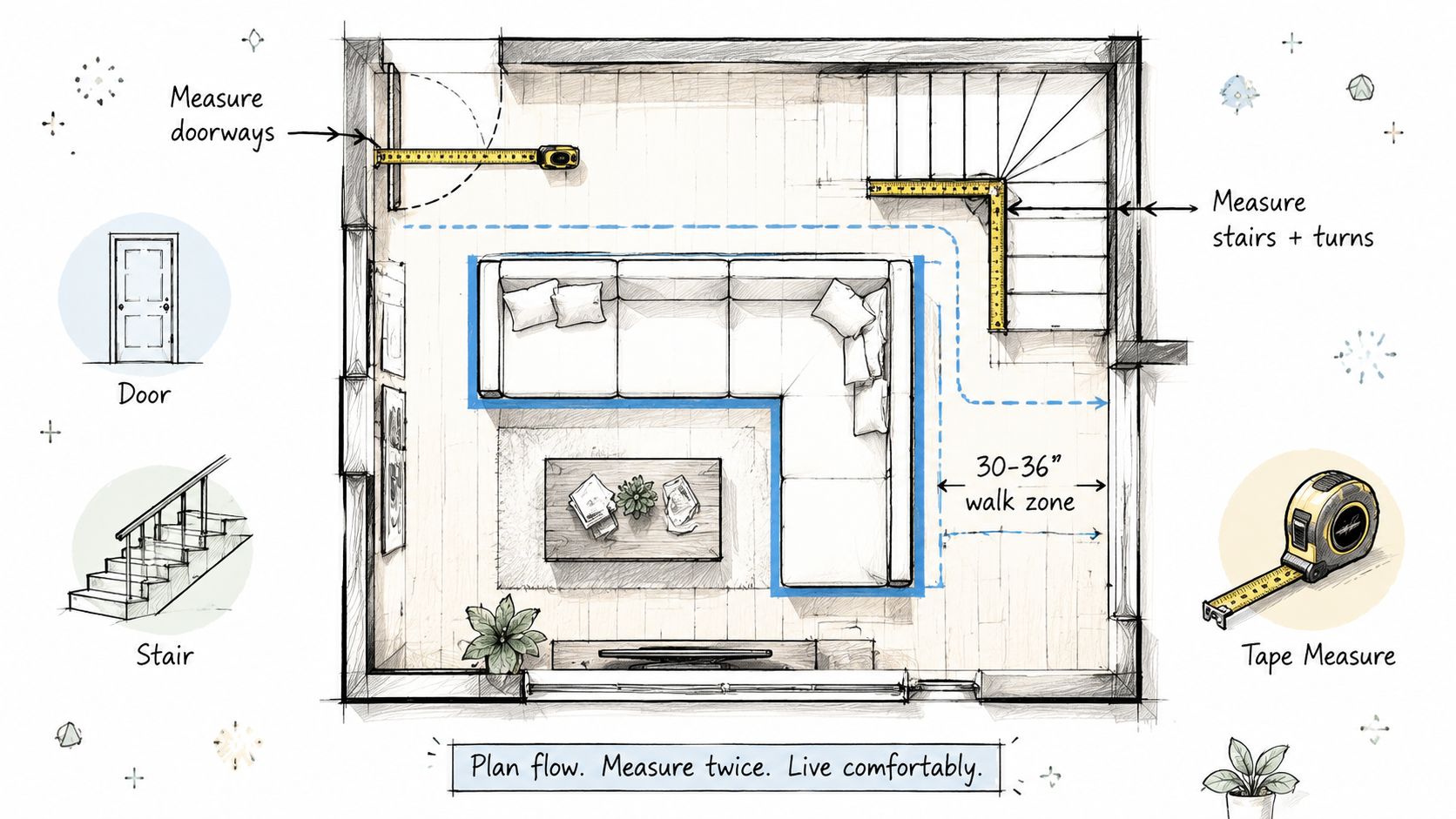
Photograph each doorway and turn with the tape still in place. Those images give a design associate useful context when matching modular pieces to the actual entry path. A homeowner who wants a more complete measuring routine can use this furniture measuring guide before visiting a showroom or arranging an inspection.
Restoration and Reupholstery Options Compared
Three restoration paths usually make sense, and the right choice depends on whether the buyer values originality, everyday resilience, or a completely refreshed appearance. Keeping the original upholstery is the most authentic approach, but it only works when the fabric remains structurally sound, odors are absent, and the pattern still suits the room.
Partial restoration is the sensible middle ground for a solid frame with tired seating. Cushion inserts, webbing, batting, or one damaged panel can be addressed without replacing every visible surface. Full reupholstery makes more sense when springs sag, foam has collapsed, seams have failed, or the silhouette deserves a modern comfort upgrade.
Compare the decision before the deposit
| Approach | Cost Range | Authenticity | Best For |
|---|---|---|---|
| Keep original upholstery | Varies by cleaning and pad work required | Highest | Structurally sound fabric with desirable original character |
| Partial restoration | Varies by cushions, suspension, and panel repairs | High | Strong frame with localized wear or weakened support |
| Full reupholstery | Varies by labor, fabric, cushion work, and frame repairs | Selective | Daily-use seating needing refreshed performance and appearance |
These cost ranges are intentionally qualitative because labor, fabric yardage, frame condition, and regional availability can change the result. The important comparison is not the invoice alone. It's the combination of labor hours, material requirements, downtime, and how much original evidence the project preserves.
A full teardown must be documented carefully. The upholsterer needs the original panel sequence, seam placement, cushion dimensions, and silhouette before cutting new material. New pieces are often cut slightly oversized and trimmed during fit-up, which protects the final shape when old frames no longer have perfectly uniform dimensions.
Choose materials for the life the sofa will live
Custom upholstery programs can involve far more than fabric. Arm style, leg style, welt or no-welt treatment, cushion core, back fill, and finish can all alter the final character. Some programs provide more than 500 fabric and leather cover options, while another sectional collection offers 300-plus fabric and top-grain leather options, along with leg-finish and seat and back cushion choices. Custom upholstery configuration examples and sectional material and finish options illustrate how many variables can affect comfort and appearance.
Fabric selection should follow use. Performance fabric suits children, pets, and frequent entertaining. Leather can simplify surface care while changing the visual weight of the sectional. A patterned textile can preserve a period mood, but a quiet solid may make an unusual vintage frame easier to live with for years.
A buyer updating nearby painted furniture or wood accents can also review practical guidance on spray painting furniture before committing to a finish. For upholstery-specific decisions, the upholstery materials guide helps frame the trade-off between texture, maintenance, durability, and visual authenticity.
Styling a Vintage Sectional with Modern Pieces
A vintage sectional should anchor the room, not force every other object into the same decade. The strongest rooms use contrast in shape, scale, and material, allowing the sectional's curves or tapered legs to remain distinctive without turning the space into a themed set.
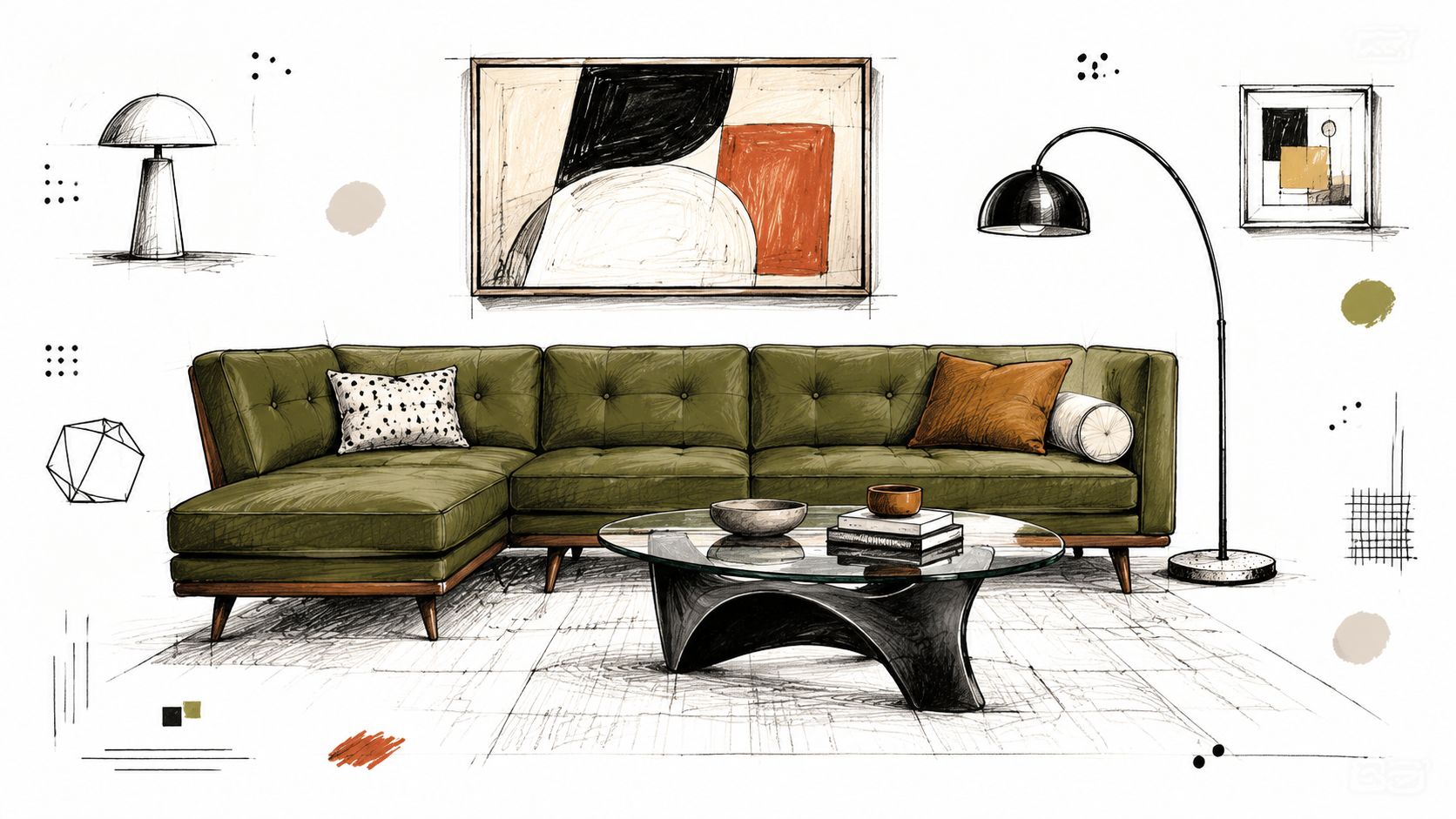
A low-slung mid-century piece pairs well with a substantial modern ottoman, a slim black floor lamp, and a flat-weave rug. One sculptural accent chair can carry the contemporary note without competing with the sectional's geometry. If the sectional already has a strong pattern, the chair should usually stay quieter.
Build bridges instead of matching everything
Mixed wood tones look intentional when one tone appears repeatedly. A wood leg, side table, and picture frame can create that repetition without requiring an identical furniture set. Linen drapery, bouclé pillows, and one geometric throw soften the transition between old upholstery and newer surfaces.
Wall art should support the sectional's scale. Large, loosely framed or unframed work gives the sofa room to read as an architectural object. Small, tightly grouped period prints can make the entire arrangement feel staged, particularly when the sectional already includes tufting, pattern, or pronounced curves.
Lighting does the most after-dark work. A paper lantern, picture light, and warm dimmable bulbs can make an older frame feel inviting rather than murky beside new fixtures. The goal is a curated sanctuary with personalized comfort, not a showroom reproduction of a historical room.
Styling principle: Repeat one material or color three times, then introduce contrast through a different shape.
The sectional's footprint should guide the rest of the room. A deep corner piece needs a coffee table that remains reachable without crowding the walk zone. A long, narrow arrangement may benefit from nesting tables or a slim console instead of one oversized table. Modern accessories should clarify how the room works, not merely decorate the space around an attractive sofa.
Shopping Locally and Custom Ordering in the Region
A regional showroom gives a vintage-sectional buyer something an anonymous listing often can't, accountability. The shopper can sit on comparable silhouettes, inspect fabric and wood in person, discuss reupholstery, and ask how the piece will travel through a specific home. That matters across South Georgia and North Florida, where a room may be in a coastal home, a historic property, a compact rental, or a wide-open family space.
The local process should be concrete:
- Start with the silhouette. Bring room photographs, taped floor plans, and the listing's dimensions.
- Review the Special Order Program. Most vendors support personalized designs involving fabrics, finishes, and comfort levels.
- Test the seating. Compare cushion firmness, seat depth, back support, and arm height rather than choosing from a photograph.
- Confirm the finish. Fabric, leather, leg style, welt treatment, and cushion construction can change the character of a vintage-inspired piece.
- Schedule inspection and delivery. The furniture should be checked before it enters the home.
The Special Order Program is especially useful when a homeowner loves vintage proportions but needs modern performance. A local associate can help pair a mid-century profile with durable upholstery, or adapt sectional components to a room that can't accept a massive corner arrangement. Core brands such as La-Z-Boy, Smith Brothers, Lexington, Stressless, and Hooker Furniture provide different approaches to comfort, upholstery, and living-room design, so the showroom conversation can stay focused on the homeowner's needs rather than a single aesthetic label.
Lott's Furniture appears as one regional option for shoppers comparing vintage-inspired and customizable sectional solutions. Its service model includes showrooms in Waycross and Fernandina Beach, a digital catalog, in-store associates, Style Quizzes, interactive style guidance, and a Mattress Guide for broader comfort decisions. The shopping journey can move from online browsing to a showroom visit in Fernandina Beach, FL, without losing the context gathered during the first conversation.
The trade-off is honest. Local custom ordering exchanges instant gratification for verified quality and a more deliberate selection process. One-of-a-kind vintage finds may require patience and a prompt deposit hold, but a regional contact can help coordinate inspection, reupholstery consultation, and convenient delivery rather than leaving the buyer to solve every problem alone.
Bringing Your Vintage Sectional Home with Confidence
The right vintage sectional should feel like a fit, not a gamble. Before purchase, the buyer should have a documented path from listing to living room, a clear opinion about restoration, and enough information to decide whether the frame's character is worth preserving.
Five checks deserve completion:
- Measure every doorway and turn. Include stair landings, ceiling height, railings, and the sectional's curved corner.
- Match era to architecture. A low mid-century profile, deep 1970s form, or tufted earlier design should support the room rather than fight it.
- Inspect in person or by live video. Check joinery, suspension, cushions, seams, zippers, odor, and the underside.
- Choose original upholstery or restoration before paying. A beautiful frame can become a poor value if the required work is ignored.
- Reserve a protected delivery window. Floors, walls, door trim, and the furniture itself need careful handling during placement.
Delivery deserves the same attention as selection. White-glove furniture service can include unpacking, placement in the room of choice, debris removal, final inspection, and sign-off. Published delivery and inspection guidance also emphasizes inspecting the item before signing delivery documents. Lott's delivery standard follows that careful approach, with every piece undergoing a rigorous multi-point inspection before it reaches the customer and professional in-home placement rather than a simple drop-off.
For a move or room transfer, homeowners can review the Endless Storage moving guide for practical furniture-protection measures. The guide's value is simple, protect vulnerable corners, control the route, and treat the flooring and upholstery as part of the moving plan.
A style consultation can make the final decision easier. Shoppers can begin with the digital catalog, take a Style Quiz, bring room photographs to an associate, or visit the Fernandina Beach showroom to test silhouettes and materials. The smooth transition between online research and showroom guidance gives a buyer momentum without sacrificing the hands-on judgment a vintage sectional requires.
Lott's Furniture helps homeowners across South Georgia and North Florida compare vintage-inspired sectionals, custom upholstery choices, comfort levels, and delivery requirements through its Special Order Program and in-store guidance. Visit Lott's Furniture to browse the digital catalog, schedule an online style consultation, or stop by the Fernandina Beach showroom with measurements and a specific vintage sectional listing.

