
White Metal Headboard Guide for a Lighter, Lasting Bedroom


A homeowner can spend an afternoon comparing two very different bedroom moods: one bed framed by soft upholstery, the other outlined by an airy white metal headboard. The upholstered option promises custom comfort. The metal silhouette brings brightness, romance, and the clean ease of a coastal retreat. The hesitation usually comes down to one practical question: will that beautiful white finish still look composed after years in a humid South Georgia or North Florida bedroom?
The answer depends less on the color than on the construction, coating system, fit, and care routine. A white metal headboard can be an investment-quality choice, but it isn't maintenance-free furniture. The showroom conversation should begin with finish quality, then move to measurements, styling, and delivery.
Why a White Metal Headboard Still Earns Its Place
Construction, coating system, fit, and care routine determine whether a white metal headboard remains a smart bedroom choice. As the largest visual element above the mattress, the headboard controls more than the wall behind the bed. Its scale affects how spacious the room feels, its material sets the emotional temperature, and its outline helps the bedroom read as refined, romantic, relaxed, or contemporary.
A homeowner comparing a cushioned headboard with a white iron silhouette sees the trade-off quickly. Upholstery creates a cocooning, comfort-first atmosphere. White metal reflects natural light and leaves more visual space around the bed. That open structure can make a smaller bedroom feel less crowded, and it works with a broad range of linens, quilts, wallpaper, painted walls, and wood finishes.
The openness creates one design responsibility: the wall stays visible. A white metal headboard will not hide an unattractive paint color, uneven wall texture, or an overcrowded arrangement of art. The backdrop becomes part of the composition, so plan it with the bed.
The look is lighter, but not weightless
White metal suits homeowners who want a bedroom that feels bright without becoming stark. Scrollwork adds a romantic, heirloom-quality note, while simple tubing gives the bed a cleaner architectural profile. The style also has commercial relevance beyond a passing décor moment. Metal headboards represented 17.2% of headboard market share in 2025, with an estimated value of about $0.72 billion, and the category was projected to grow at a 5.7% CAGR, according to recent headboard market reporting.
That demand makes sense in value-focused bedrooms, youth rooms, rental properties, and coastal homes. Metal provides a durable structural material, while white can blend with changing bedding instead of locking the room into one upholstery pattern.
Showroom rule: Choose a white metal headboard for the way it shapes light and space, not simply because white feels safe.
The humidity question comes first
The romantic appeal cannot erase the unglamorous reality of humid rooms. Powder coating protects steel only while its film remains intact. A scratch, chip, thin edge, or poorly sealed weld can expose the metal beneath, allowing moisture and oxygen to start corrosion. Guidance on powder-coated steel and rust explains why powder coating stops being a rust-proof barrier after the surface has been breached.
In South Georgia and North Florida, inspect pretreatment, edge coverage, weld quality, and maintenance support before choosing a silhouette. Finish failure often begins in the small areas buyers overlook, then becomes especially visible against white.
For more context on how metal details work throughout a room, homeowners can review what to know about metal accents. Finish quality determines whether the purchase lasts or whether the investment falls apart.
From Iron Mills to Modern Bedrooms
The scrolls, finials, and spindle patterns seen on a white metal headboard aren't recent inventions. Metal beds trace back to ancient civilizations, then became especially prominent during the 19th-century Industrial Revolution, when mass production made metal beds more affordable and widely available. Victorian examples were commonly painted white or black and finished with brass accents, a combination that helped establish the bright decorative language still associated with white iron beds today. Historical accounts place the peak era of iron bed production roughly from 1880 through the 1920s, when steel tubing, solid iron rod, and cast metal joints shaped decorative headboard construction. These details are documented in the history of wrought-iron beds.
Today, shoppers generally encounter three construction families. Each creates a different balance of weight, visual character, and handling requirements.

Three metal constructions to recognize
- Solid wrought iron has the most substantial hand-forged feel. The stock is dense, the frame feels weighty, and the decorative work often appears more sculptural. It can suit a traditional bedroom, but its mass affects handling and delivery.
- Welded steel tubing uses hollow sections, so manufacturers can create lighter frames with crisp, modern lines. This is often the sensible choice for upper-floor bedrooms or homes where installers need to maneuver furniture through tighter passages.
- Cast aluminum or zinc alloys allow intricate motifs to be formed from molds. The result can reproduce Victorian flourishes with less mass than solid iron, though cast components need careful inspection around joints and attachment points.
Use weight as an in-store clue
A floor sample can reveal more than a product description. With an associate present, lift one corner rather than trying to move the entire piece. A dense, resistant lift points toward solid construction, while an unexpectedly light frame may indicate tubing or cast alloy. That doesn't make one option automatically superior. It helps a buyer match the construction to the room, access route, flooring, and desired sense of permanence.
Most ordinary bedroom floors don't require reinforcement for a typical headboard, but unusually heavy combinations deserve a delivery review, especially on upper levels or older structures. Weight also affects convenient delivery, stair navigation, and the amount of care needed during placement.
Homeowners interested in broader construction standards can explore American-made furniture as part of the purchasing conversation. The key is to ask what the frame is made from, how the joints are formed, and whether the finish covers every exposed edge.
What Makes a White Finish Last
In humid South Georgia or North Florida, a white metal headboard can look romantic and fail underneath that polished color. The finish matters more than the shade. A typical white metal headboard uses a powder-coated steel coating system, with dry powder applied to prepared metal and cured into a continuous protective film. It resists moisture and oxygen while intact, but corrosion can begin at scratches, chips, weld seams, and thin coverage. Powder-coating guidance on rust protection and salt-spray performance explains why similar-looking finishes can perform very differently.
Pretreatment sets the foundation. The manufacturer should remove oils and contaminants, prepare the steel for adhesion, and select a coating system suited to humid or salt-air conditions. A single coat over poorly prepared steel may look excellent at delivery. A multilayer system with proper pretreatment and sufficient film build gives the headboard a stronger defense.
Read finish specifications with skepticism and care
Salt-spray testing offers a comparison, not a guarantee of bedroom service life. Well-prepared powder-coated steel commonly reaches about 500 to more than 2,000 hours before visible corrosion. Higher-performance furniture systems may target roughly 500 to 1,000 hours for general indoor or outdoor use and 1,500 to 3,000 hours for coastal exposure. Treat those figures as testing benchmarks, not promises.
For demanding locations, zinc-phosphate pretreatment or a zinc-rich primer can improve under-film corrosion resistance and adhesion. Ask whether the welds are sealed, whether corners receive complete coverage, and whether the film build suits the room. Guidance on salt-spray testing discusses builds around 80 to 120 microns and marine-oriented formulations for harsher exposure.
| Finish Type | Pretreatment | Film Thickness | Typical Salt-Spray Rating | Coastal Suitability |
|---|---|---|---|---|
| Single-coat powder over bare or lightly prepared steel | Unclear or limited | Unspecified | Unreliable | Poor choice |
| Standard prepared powder-coated steel | Appropriate conversion pretreatment | Manufacturer specified | About 500 to 1,000 hours | Suitable for many indoor rooms |
| Higher-performance furniture coating system | Zinc-phosphate or comparable system | Around 80 to 120 microns | About 1,500 to 3,000 hours | Better suited to coastal exposure |
Bright white also reveals chalky ultraviolet breakdown sooner than ivory or cream, especially near strong windows. Choose the shade, exposure location, and surface preparation together.
Finish selection applies to wood and casegoods, too. Guidance on custom cabinet finishes reinforces the practical point: finish is a materials decision, not merely a color decision. For a white metal headboard, prioritize sealed welds, complete coverage, and documented pretreatment before you fall for the color.
Measuring and Matching Your Bed Frame
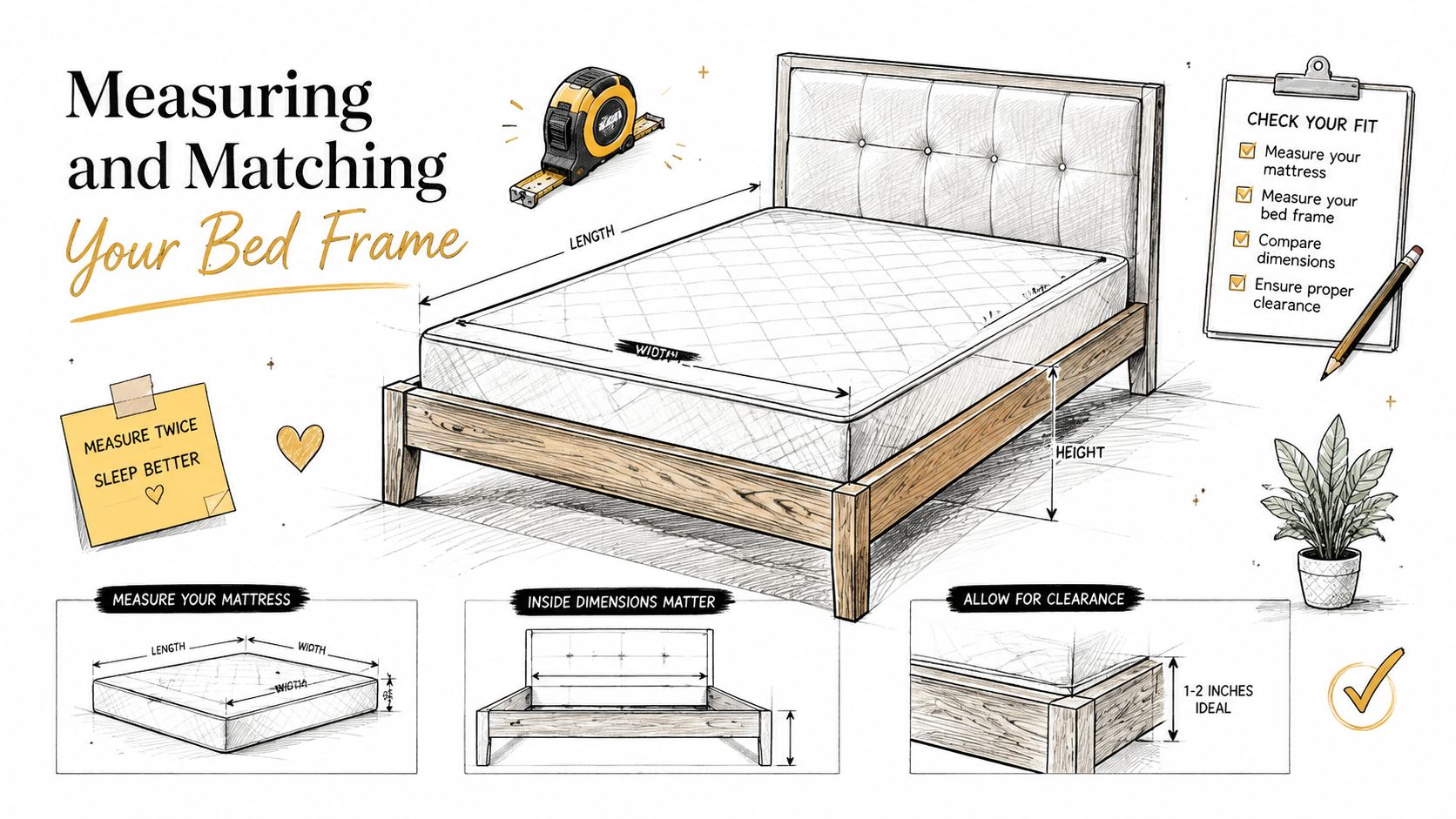
The mattress determines the starting point. Measure its width and thickness, then confirm that the headboard's listed mattress range accommodates both dimensions. A headboard that looks correctly scaled in a showroom can sit too low, too high, or too far apart from the frame once a thick mattress and foundation are in place.
Common mattress widths include:
- Twin, 38 inches
- Full, 53 inches
- Queen, 60 inches
- King, 76 inches
- California king, 72 inches
Those figures are useful starting points, but the frame itself still controls the installation. California king frames can differ by an inch or two in rail-to-rail length, so the label alone isn't enough.
Match the attachment system
A headboard may attach with a bolt-on bracket, hook-on hardware, or a universal plate. The mounting holes must align with the bed frame's spacing. Mismatched holes are the most common installation surprise because shoppers often confirm the mattress size but never inspect the bracket pattern.
Ask for the technical drawing before ordering. Verify:
- Hole spacing, measured from center to center
- Bracket height, including any adjustable range
- Rail width, so the headboard doesn't sit inside or outside the frame
- Foundation height, including a box spring or low-profile base
- Wall clearance, especially behind finials and deep scrollwork
Plan 2 to 4 inches beyond the headboard's deepest point for wall clearance, so decorative projections don't press into the wall or catch bedding. If the headboard sits between the frame and wall, measure the baseboard height too. A baseboard can force the entire piece forward and change the apparent alignment.
Test the sample before tightening
A floor-sample test takes minutes. Slide the headboard into position, sight down the rail, and confirm that the frame is level before tightening bolts. Adjustable-height legs deserve the modest upcharge for non-standard box springs, low-profile foundations, or mattresses with unusual thickness.
For a broader measuring routine, homeowners can use this furniture measuring guide. Accurate measurements protect the design and prevent avoidable delivery complications.
Styling a White Metal Headboard Three Ways
A white metal headboard succeeds when the bedding and wall finish establish the mood first. The frame should support the room's story, not compete with every pillow, throw, and artwork choice. Three directions work especially well, but they shouldn't be mixed carelessly.
| Style | Frame Silhouette | Finial Choice | Best Finish Tone | Bedding Direction |
|---|---|---|---|---|
| Coastal | Open scrollwork with airy spacing | Palm or wave-inspired details | Bright white | Washed linen, woven layers, sea-glass accents |
| Farmhouse | Chunkier tubular frame | Simple spear or knob | Off-white or antique white | Grain-sack stripes, chunky quilts, warm neutrals |
| Modern | Clean rectangular outline | No finials | Matte or satin white | Restrained texture with one strong artwork moment |
Coastal keeps the room open
Coastal styling benefits from negative space. Open scrollwork, restrained wave details, rope or woven bed skirts, washed linens, pale oak, and sea-glass accents create a relaxed composition without turning the bedroom into a theme room. This approach works particularly well in a south-facing room with strong natural light, where white metal can feel crisp rather than cold.
Farmhouse needs warmth
Farmhouse rooms should avoid optic white if the surrounding materials are distressed wood, warm textiles, and aged finishes. A chunkier tubular frame with simple spear or knob finials gives the bed authority, while antique white or a gently aged tone keeps the composition welcoming. Grain-sack stripes, substantial quilts, and reclaimed wood nightstands prevent the metal from feeling too delicate.
Modern should stay edited
Modern styling works best with a rectangular frame, no finials, and a matte or satin powder coat. The open area above the mattress becomes a deliberate field of negative space, allowing one oversized artwork piece to carry the wall. Bright white feels cooler and more contemporary, while ivory and antique white feel warmer and more traditional.
Design decision: Choose the bedding texture before choosing the silhouette. The headboard should be the supporting player, not the loudest voice in the room.
Soft, comfort-led bedrooms are gaining attention through rounded forms, tactile surfaces, and multifunctional headboards with storage or lighting, while metal remains a smaller, steadier niche. That makes the styling question more important. A white metal headboard feels intentional when the wall, bedding, and finish tone all agree.
Care That Prevents Rust and Yellowing
Homes exposed to Atlantic moisture or rooms without reliable dehumidification demand more from a metal headboard's finish than occasional dusting. In South Georgia and North Florida bedrooms, the powder coat determines whether romantic white stays crisp or turns into a maintenance problem. Moisture can enter through micro-abrasions, chips, thin spots, and unsealed joints, creating orange creep or staining beneath the coating.
Use this routine consistently:
- Clean twice monthly: Wipe the frame with a damp microfiber cloth and a small amount of pH-neutral dish soap.
- Dry every joint: Follow with a dry cloth, focusing on welds, corners, and hardware.
- Repair chips immediately: Apply the manufacturer's touch-up paint or a matched appliance-grade enamel.
- Protect the wall gap: Keep the headboard about six inches from an exterior wall when the room allows.
- Control indoor moisture: Run a dehumidifier to keep indoor relative humidity below 55 percent.
- Vent bathroom steam: Crack a window after showers so warm moisture does not migrate into the bedroom.
- Perform seasonal service: Deep-clean the frame and retighten bolts as humidity changes affect connected wood components.
Exposed steel can oxidize quickly in humid conditions. Treat every chip as a breach in the finish, not a cosmetic detail for later. Touch-up paint will not recreate a factory coating, but it can close the opening before corrosion spreads beneath the surrounding powder coat.

Inspect before the damage becomes visible
During seasonal cleaning, run a dry fingertip along lower rails and corners. Check for roughness, pinholes, bubbling, discolored welds, and spots where bedding hardware rubs. Corrosion often starts at a concealed edge while the visible white surface still looks clean, so inspect areas the room's lighting misses.
For a broader reference, review this guide to rust protection for structural steel. The same principles apply to bedroom furniture: keep moisture away from exposed steel, maintain full coating coverage, and repair damage before it spreads.
White can yellow or lose visual clarity when cleaning products leave residue or sunlight affects the finish. Harsh abrasives and strong solvents have no place on powder-coated metal. Mild cleaning, complete drying, and sensible window management preserve the finish better than aggressive scrubbing. In humid coastal rooms, choose the better coating system first, then choose the shade of white.
Bringing It Home with Confidence
A white metal headboard earns its place in the bedroom only after the practical details are settled. Put finish-first, fit-second, fashion-third into practice. A graceful silhouette cannot rescue a coating that fails in humid South Georgia or North Florida, and a well-protected finish still creates trouble if the attachment points do not match your bed.
The six-point purchase check
Climate-appropriate finish
Ask how the steel was pretreated, whether welds are sealed, and whether the coating system suits humid or salt-air conditions. A coastal vacation home deserves closer scrutiny than a dry inland guest room.Frame-fit measurements
Bring the mattress size, mattress thickness, foundation height, and bed-frame attachment details. Confirm hole spacing instead of relying only on a twin, queen, king, or California king label.Silhouette style
Decide whether the room needs coastal openness, farmhouse substance, or modern restraint. Finials and scrollwork should support the room's existing architecture rather than compete with it.Bedding palette
Bring a swatch or photograph of the current bedding. Bright white, ivory, and antique white can change the room's temperature against warm wood or cool wall paint.Care routine
Be honest about cleaning, humidity control, wall clearance, and touch-up responsibilities. If regular joint inspections will not happen, choose a setting and finish that require less attention.Delivery logistics
Measure doorways, stair turns, hallways, and the final wall position. The delivery team needs the intended placement before the frame enters the home.
Before purchasing, bring a mattress-size note, a swatch of existing bedding, and a wall-clearance photo to the showroom. These three items let an associate verify scale, color direction, and placement with far less guesswork.
Local guidance changes the conversation
Lott's Furniture serves South Georgia and North Florida through showrooms in Waycross, Georgia, and Fernandina Beach, Florida. That local reach helps buyers address different room conditions, from humid inland bedrooms to salt-air coastal homes and vacation properties. In the showroom, shoppers can examine coating consistency, compare finish tones, test frame proportions, and discuss how brands such as La-Z-Boy, Smith Brothers, Lexington, Stressless, and Hooker Furniture fit into a larger bedroom plan.
The Special Order Program gives shoppers more control. Most vendors support personalized designs, including fabrics, finishes, and comfort levels, so the headboard does not have to dictate every other material in the room. Associates can also use the Style Quizzes and Mattress Guide to clarify whether the bedroom suits Coastal Chic, Modern Farmhouse, or a more traditional direction. In-person guidance resolves proportions and finish differences that photographs cannot show.
The digital catalog and showroom experience work together. Browse online, save possibilities, then visit Fernandina Beach or Waycross to inspect proportions and finish samples. An online consultation can cover sizing verification, finish comparison swatches, and delivery scheduling before the showroom appointment or without a trip.
Delivery is part of the purchase
A headboard is not finished when it reaches the curb. Lott's Delivery includes white-glove, in-home delivery, and every piece undergoes a rigorous multi-point inspection before it reaches the customer. That process matters for white metal, where scratched corners, damaged welds, coating chips, and rubbed edges should be addressed before sign-off.
Inspect packaging, corners, edges, seams, finishes, hardware, and moving parts before signing completion documents, as described in this furniture delivery and assembly guidance. The delivery process may also include inspections before loading and at arrival, checking for existing damage, transit damage, packaging problems, and the condition after unpacking and placement.
Save your measurements, bedding reference, and wall photo on your phone before the showroom visit. They give the conversation a clear starting point and help prevent a romantic white finish from becoming an avoidable bedroom mismatch.