Save 50% Off MRSP on Lexington | Shop the Catalog >

Eight Way Hand Tied Springs Explained


A sofa can look perfect on the sales floor and still feel wrong the moment someone sits down. One cushion settles with a quiet, even give, while another feels flat, springy, or oddly stiff, and that difference usually starts below the fabric, not above it. For homeowners furnishing a primary living room or a coastal retreat in South Georgia and North Florida, understanding that hidden structure can turn a guessing game into a confident choice.
Why Eight Way Hand Tied Springs Deserve a Closer Look
A shopper often notices the feel before the label. A hand runs across the cushion, weight shifts to one side, and the question comes fast, why does one sofa feel settled and another feel hollow? That moment is exactly where eight way hand tied springs earn attention, because they're not a marketing flourish, they're a heritage support system that still shows up in premium upholstery today.
The construction has staying power because each spring is tied in eight directions, which keeps the coil field locked together instead of letting springs drift or twist over time. That matters on a sofa, chair, loveseat, sectional, or recliner that's supposed to carry daily use without losing its shape. It also explains why this method is still treated as a benchmark for craftsmanship, especially in pieces meant to anchor a home for years rather than seasons. For shoppers comparing upholstered seating, the construction sits in the same conversation as other higher-end suspension systems, which is why it remains a recognizable marker of quality in the showroom and in a high-end living room collection.
Why the phrase still matters to homeowners
The words matter because they point to a real build method, not just a comfort promise. In a well-made seat, the springs work together as a unified structure, so the load spreads across the deck instead of sitting on one weak point. That kind of support is part of why these pieces are often associated with heirloom-quality living spaces and carefully furnished second homes.
Practical rule: If a sales tag says hand-tied, the real question is whether the construction is genuinely tied in eight directions and supported by a quality frame, not whether the phrase sounds premium.
For shoppers who want a deeper look at upholstery layers around that spring bed, our upholstery materials guide can help connect the hidden structure to the visible finish. We also see this same curiosity in our showrooms, where Style Quizzes, the Mattress Guide, and in-store associates help turn a vague comfort preference into a clear direction. That's useful whether the buyer starts online in our digital catalog or heads straight to our showrooms in Fernandina Beach, FL.
The Anatomy of an Eight Way Hand Tied Spring System
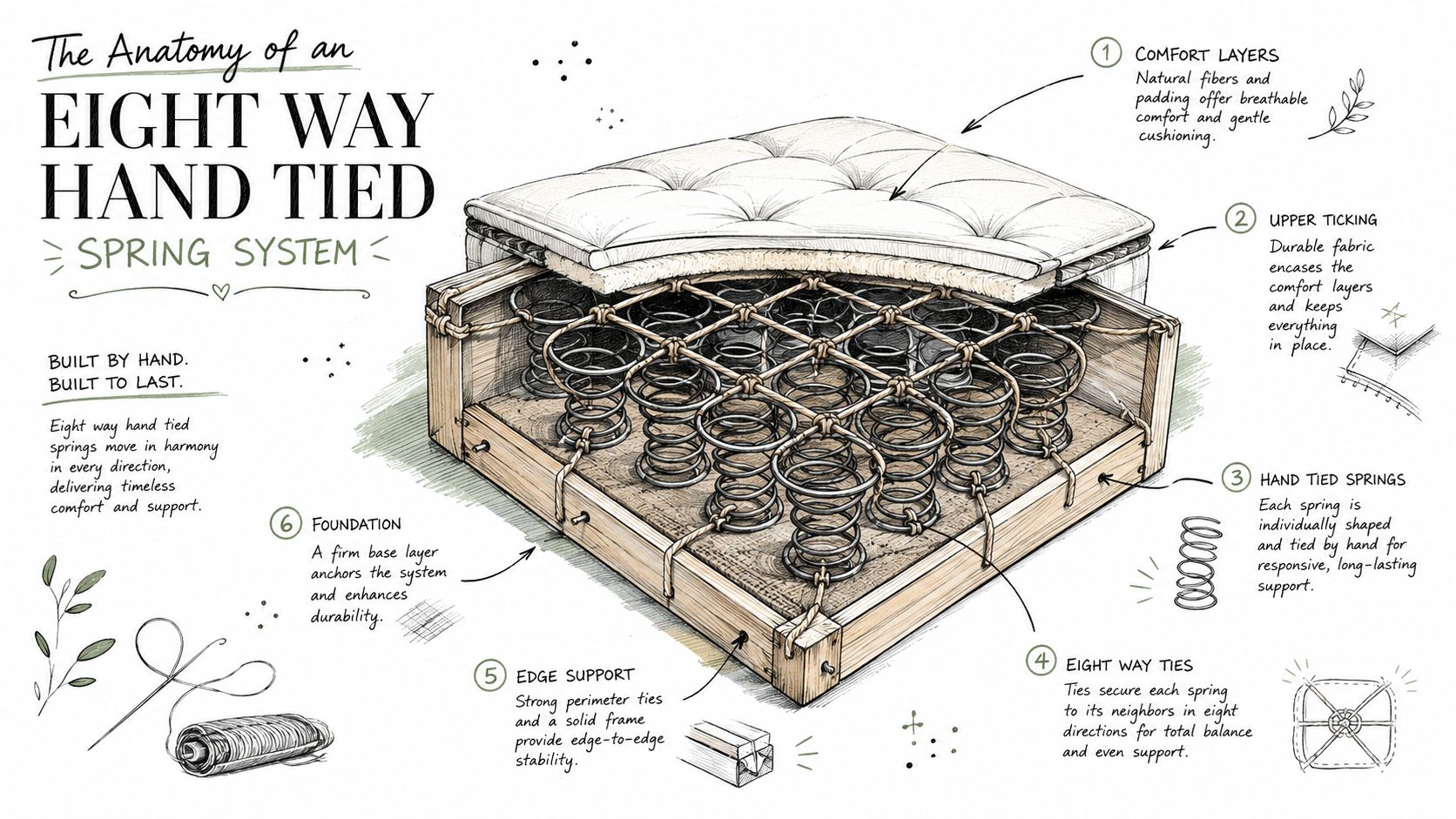
Under the cushion, the build is more deliberate than many shoppers expect. Each coil spring rests on a webbed jute base, then is tied to its neighbors at eight equidistant points, north, south, east, west, and the four diagonals. That eight-point pattern is the mechanical heart of the term, and it is what separates true construction from a loose “hand-tied” label.
How the spring network holds together
The spring field works like a linked grid of small supports. When weight lands on one coil, the neighboring coils take on part of the movement instead of letting one spot collapse on its own. Because the load spreads across the seat deck, the cushion can flex as one working surface rather than a set of isolated wires.
The twine matters too. Upholstery work depends on hand tension, angle, and placement, and small changes in those details alter how the seat feels once it is covered. If the tie angle is off, the spring can tilt and lose its natural flex path, which is why this method is still treated as geometry-sensitive craft rather than a job that can be rushed through by machine.
For the thread-and-needle side of upholstery work, the B-Sew Inn sewing guide helps show why strong handwork tools matter in textile and trim work. For readers who want to connect the hidden spring layer to the visible finish, our upholstery materials overview gives useful context on how the layers inside a sofa work together.
That is also why a showroom test matters. Sit near one arm, then near the center, and notice whether the seat answers as a single surface or feels like separate parts under you. A true eight-way seat does not just bounce, it coordinates.
Comparing Eight Way Hand Tied, Sinuous Springs, and Pirelli Webbing
The premium conversation usually comes down to three suspension systems, eight way hand tied springs, sinuous springs, and Pirelli webbing. In contemporary furniture construction, the hand-tied method remains a premium benchmark because it competes with the two alternatives most commonly used across the industry, and its eight-direction tying helps prevent shifting under repeated use. That doesn't make it automatically superior in every room, but it does put it in a different class of build than many shoppers first realize. For a practical checklist while shopping, our sofa and chair buying guide is a useful companion.
Suspension Systems at a Glance
| Suspension System | Comfort Feel | Durability Profile | Typical Use Case |
|---|---|---|---|
| Eight Way Hand Tied | Cohesive, contouring, and supportive with a unified seat feel | Built for long-term structural stability when executed well | Higher-end sofas, chairs, loveseats, sectionals, and recliners |
| Sinuous Springs | More uniform, with a firmer or simpler spring response | Common and widely used, but less individualized in motion | Broad range of upholstered seating |
| Pirelli Webbing | Flexible and often associated with a lighter seat feel | A major modern alternative in upholstered construction | Contemporary seating and some premium applications |
How shoppers can read the difference
The easy mistake is assuming the label alone settles the question. Eight-way hand-tied construction is valued because the seat moves as a coupled network, which can create more individualized contouring, stronger motion isolation, and a very even sit. Sinuous springs and Pirelli webbing can still make comfortable furniture, especially when the frame, foam, and tailoring are done well, so the job is to match the structure to the room and the way the furniture will be used.
That's why a showroom conversation should go beyond the word “spring.” A buyer looking at La-Z-Boy, Smith Brothers, or Stressless seating should ask how the spring bed is built, how the frame is joined, and how the cushion package affects feel over time. Some pieces are designed to feel softer at first sit, others to hold a more disciplined posture, and the right answer depends on the home, not the label.
The Case for Healthy Skepticism About Spring Labels
A premium phrase can still be overused. Consumer Reports has said to “Disregard the term ‘eight-way hand-tied springs.’ It's no longer synonymous with comfort or high quality,” and it also notes that other spring types such as coil, cone, S-shaped, and grid can be comfortable too. That caution deserves respect because it keeps shoppers from buying a buzzword instead of a sofa.
Why the build details matter more than the phrase
The label only tells part of the story. A true hand-tied spring bed can still underperform if the frame is weak, the ties are inconsistent, or the seat layers above it are poorly chosen. A well-designed alternative can also feel excellent when the rest of the construction is honest and well executed.
A showroom associate should be part of the process, not an afterthought. A useful conversation includes the coil gauge, the tie pattern, the frame material, and how the seat is intended to feel after break-in. It also helps to sit twice, once casually and once with attention, because a seat that feels inviting for ten seconds can tell a different story after a minute.
Buy the structure, not the slogan. The actual question is whether a sofa's full build matches the way the home will use it.
That mindset works especially well for families shopping in our special order program, where fabric, finish, and comfort decisions can be matched to the room instead of guessed from a tag. It also pairs neatly with our Style Quizzes and Mattress Guide, which give shoppers another way to narrow down the feel they want before they ever sit down in person.
What Hand Tied Construction Feels Like in Daily Living
A good eight-way seat feels settled when weight shifts around it. One person can sit near the arm while another takes the middle, and the structure does not act like a loose board or a single stressed strip of wire. It spreads the load across the seat, so the surface feels composed and motion stays more contained from one cushion area to the next.

The lived-in feeling homeowners notice
That shared movement gives the seat shape without making it feel swallowed. Families often describe good hand-tied pieces as supportive under the thighs, steady in the back, and less likely to send everyone toward the same low spot in the center. That is one reason these systems are often linked with a longer service life than simpler spring layouts.
The difference becomes easier to notice in daily use, movie nights, reading corners, and a front room that gets constant traffic. A child climbing into the corner does not create the same isolated dip that a weaker base might show, and a long evening of use does not leave the same tired impression as quickly. The coupled spring network helps the seat feel unified, even as different people sit in different places.
For shoppers building a pet-friendly space, our best sofas for pet owners guide can help connect durable upholstery choices with the support system underneath. In well-made premium seating brands, the spring bed becomes part of the comfort story instead of a hidden feature no one talks about.
A sofa earns its keep when the structure still feels settled after the room has lived in it for years, not just after the first afternoon on the floor.
Showroom Tests That Reveal Real Eight Way Construction
The quickest way to separate a true spring system from a sales phrase is to test the seat with your own hands. In a showroom, that means slowing down, pressing where the sofa will be used, and paying attention to how the structure responds. Start online if that's easier, then bring the shortlist into the store so the test is tactile, not theoretical.
What to do on the floor
- Lift the cushion first: A real construction story starts below the upholstery, so check whether the seat platform feels balanced and well supported before judging the fabric.
- Press and release evenly: A good seat should come back with controlled rebound rather than a hollow snap or a sluggish collapse.
- Sit near one edge, then the other: The seat should stay composed, not swing wildly from one side to the next.
- Listen for movement: Hand-tied twine and quality build work differently from loose, mechanical fasteners, so the sound of the seat can be revealing.
- Ask direct questions: Coil gauge, tie pattern, frame joinery, and spring layout are all fair topics for a sales associate.
The goal is not to memorize a script. The goal is to teach the hands what quality feels like, so the buyer can sense the difference in a Stressless recliner or a Hooker Furniture sofa without waiting for a tag to explain it. That same process works whether the first stop is the digital catalog or the showroom in Waycross or Fernandina Beach.
A simple question set for associates
A helpful conversation sounds like this:
- How are the springs tied? The answer should make the eight-direction geometry clear.
- What supports the spring base? A proper frame and foundation matter as much as the spring itself.
- How does the seat age? The associate should explain how the comfort profile is expected to change with regular use.
That kind of conversation turns furniture shopping into informed evaluation. It also fits the way our associates work across South Georgia and North Florida, where the point is to help shoppers find the right fit, not push them toward a louder label.
Customization, Warranty, and Care for an Heirloom Sofa
An eight-way spring system makes the most sense when the rest of the piece is built to last with it. That is why our Special Order Program matters, because many vendors support personalized designs, including fabric choices, finishes, and comfort levels, so the spring bed can match the way the home is used. For a direct starting point, the custom order guide explains how that process works from the first conversation onward.
What tailoring can look like
A showroom visit should make customization feel concrete, not abstract. Start by looking at how the frame, fabric, and cushion choices work together, because a spring system only earns its keep when the rest of the sofa is selected with the same care.
- Fabric and leather libraries: Buyers can choose from a wide range of textures and patterns, which helps the sofa fit a coastal, traditional, or transitional room.
- Performance finishes: Families with children or pets often prefer materials made for easier everyday living.
- Comfort options: Cushion firmness, arm styles, and wood finishes can often be selected through the vendor rather than forced into one default build.
That kind of customization matters because an heirloom sofa should fit the room and the household, not just the catalog photo. A handcrafted suspension system becomes more valuable when the upholstery, scale, and finish are chosen with equal care, especially in pieces from premium seating brands that offer made-to-order options.
Care and delivery that protect the investment
A quality seat still needs reasonable care. Rotate and fluff cushions, keep sharp debris off the deck, and check that the sofa sits level so the structure keeps its shape over time. Those habits are simple, but they work. They help the spring bed, cushions, and fabric age together instead of wearing unevenly.
Delivery matters too. Every piece goes through a careful multi-point inspection before white-glove, in-home delivery, so the furniture arrives ready for its room rather than needing a handoff at the curb. That final check is part of the purchase, not an afterthought.
Practical note: Good upholstery care is not fussy, it is consistent. The piece lasts longer when the owner treats the spring bed, cushions, and fabric as one system.
That combination of support, customization, and careful delivery is why the purchase feels more like a long-term furnishing decision than a quick replacement. It also gives shoppers a clear path through our showrooms, digital catalog, Style Quizzes, and Mattress Guide when they want expert help without pressure.
Bringing It All Together and Planning Your Visit
Eight way hand tied springs are a heritage construction method built around eight-direction tying, not a vague comfort promise. They still matter because the spring bed can distribute weight cleanly, feel composed under daily use, and give a showroom buyer a real benchmark for craftsmanship. The smartest next step is simple, compare the build, test the seat, and ask the questions that reveal what's under the cushion.
Visit Lott's Furniture to browse our digital catalog, explore custom order options, and feel spring construction in person at our showrooms in Fernandina Beach and across our service area in South Georgia and North Florida. Our associates can help you compare comfort, fabrics, and finishes, then arrange white-glove in-home delivery once the right piece is chosen.