Save 50% Off MRSP on Lexington | Shop the Catalog >

Custom Upholstered Bed: Your Design Guide


The mattress is comfortable, the room has character, and yet the bed frame still looks wrong. Perhaps the headboard crowds a window, the rails leave an awkward gap beside the wall, or the available fabric shows wear wherever the family leans to read. A custom upholstered bed solves those frustrations by treating the bedroom as a real room with real proportions, not a blank rectangle waiting for a standard package.
For homeowners across South Georgia and North Florida, the right custom order combines refined comfort, durable materials, structural planning, and careful delivery. A beautiful silhouette matters, but so do mattress compatibility, clearance, fire performance, and the route from the front door to the bedroom. The result should feel like an heirloom-quality piece, curated for restful living and built around the home.
Designing a Tailored Bedroom Sanctuary
A homeowner in Fernandina Beach might have a primary bedroom with a narrow passage between the bed and a dresser. Another family near Waycross might be furnishing a guest room beneath a sloping ceiling. A coastal vacation home may need a headboard that fits an alcove without overwhelming the view. In each case, a standard bed can force compromises that become more irritating every day.
The custom upholstered bed offers a better answer because the design begins with the room and the people using it. The headboard can be scaled to the wall, the frame can coordinate with existing case goods, and the upholstery can support the desired mood, from quiet linen-like texture to fitted leather or a performance textile selected for everyday resilience. The bed becomes part of the architecture rather than an object squeezed into it.
Upholstered furniture also carries a long craft tradition. Early padded furniture has been traced to ancient Egypt, where it was associated largely with royalty and elites. European upholstery developed through the Renaissance and the 17th and 18th centuries, when rich fabrics and increasingly complex techniques became common; historical context on upholstery craftsmanship helps explain why upholstered beds still communicate comfort, status, and decorative richness.
Customization that serves the room
Our Special Order Program gives homeowners a practical way to personalize a bed instead of settling for a fixed silhouette. Most vendors support choices such as:
- Fabrics and leathers: Select color, texture, pattern, and hand-feel from broad material libraries.
- Finishes and details: Coordinate leg styles, wood tones, metal accents, nail trim, or tufting.
- Comfort priorities: Choose construction details and comfort levels that suit reading, lounging, and sleep.
- Configuration: Order a complete bed frame, a custom headboard only, or a storage-based solution when the room calls for it.
The broader upholstered-furniture category reflects sustained interest in comfort and visual softness. It was valued at USD 68.88 billion in 2025 and is projected to reach USD 122.45 billion by 2034, with a projected 6.55% CAGR; beds and mattresses account for approximately 32% of that market share, according to Fortune Business Insights. That scale supports a simple conclusion: upholstered beds aren't a passing decoration. They're a durable design direction for homeowners who want personalization and comfort to coexist.
A homeowner doesn't need to make every decision alone. Style Quizzes can help identify a direction, the Mattress Guide can clarify support and comfort preferences, and in-store associates can help translate a room photo or rough idea into an order that works. The digital catalog and showrooms in Fernandina Beach, FL, make it easy to browse online, then visit in person to assess fabrics, finishes, and proportions before committing.
For further bedroom planning inspiration, homeowners can also review how to style a bedroom while considering how the new bed will relate to lighting, rugs, bedding, and bedside storage.
Mastering Room Dimensions and Proportions
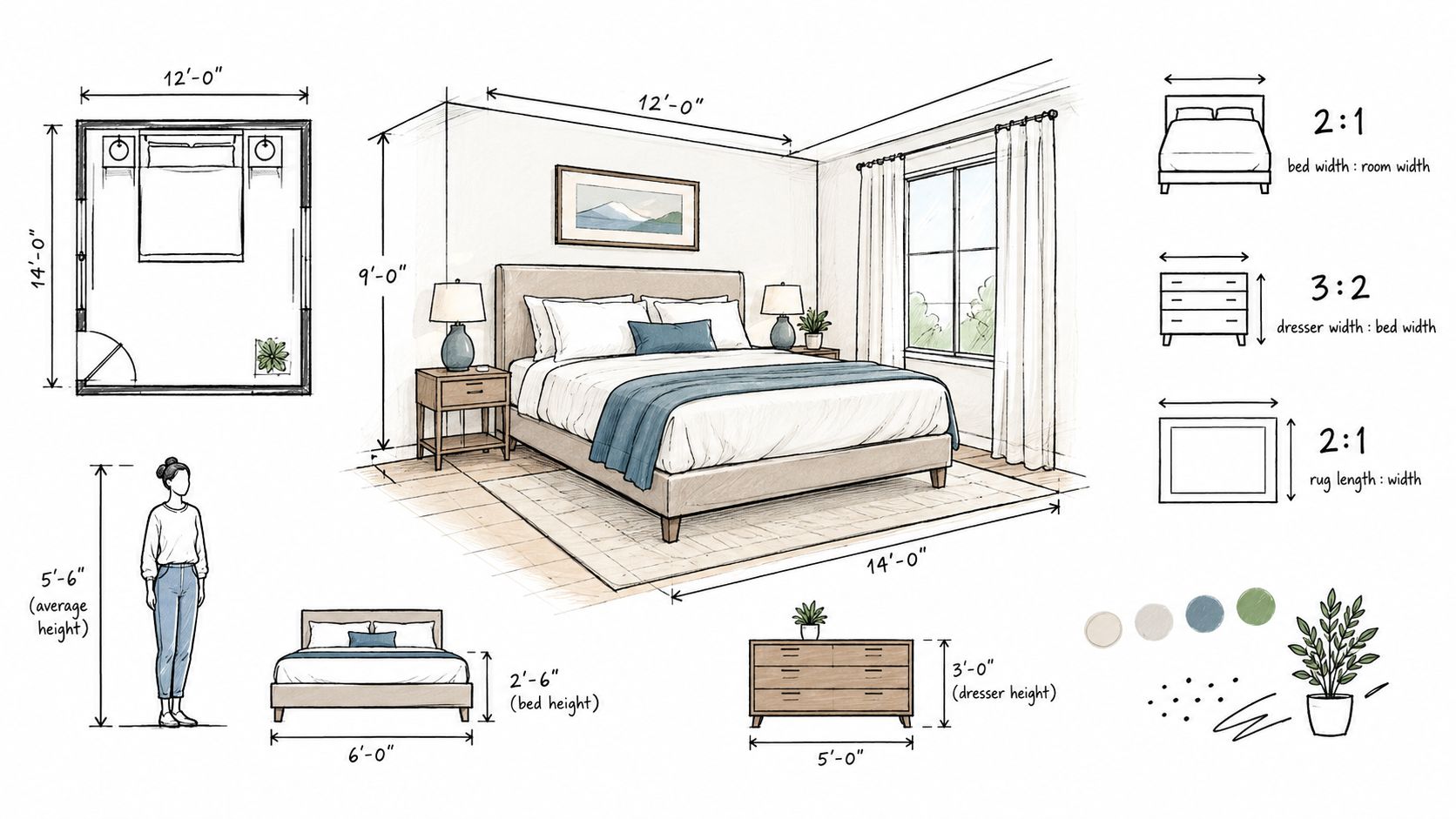
A custom order should begin with a tape measure, not a fabric swatch. Precise dimensions determine whether the headboard clears windows, whether the rails align with the mattress, and whether delivery crews can position the finished piece without damaging walls or adjacent furniture.
The practical workflow is straightforward:
- Confirm the mattress dimensions. Record the mattress length, width, and thickness. Include any foundation or support system that will sit beneath it.
- Measure the room itself. Capture wall lengths, ceiling height, door openings, windows, vents, outlets, trim, and architectural projections.
- Mark furniture clearance. Account for nightstands, dressers, benches, doors, drawers, and walking paths.
- Check the delivery route. Measure hallways, stairwells, elevator openings, gates, and tight turns before production begins.
- Review the proportions. Compare the planned headboard height and frame depth with the room scale and ceiling line.
- Approve shop drawings. A clear drawing gives the homeowner and maker a shared reference before construction starts.
Why measurement controls the entire project
Skipping an on-site measurement is the most common technical mistake in custom bed building. A few inches can affect whether the headboard covers a switch, whether a thick mattress rises above the side rails, or whether a winged design blocks a passage. Guesswork also creates rework, production changes, and installation delays.
The planning sequence should follow this order:
- Room and mattress dimensions first: These establish the usable envelope.
- Design concept second: The silhouette, storage needs, and upholstery direction should respond to that envelope.
- Shop drawing approval third: The drawing confirms the relationship between the headboard, rails, mattress, and surrounding pieces.
- Production last: Construction should begin only after the measurements and proportions are settled.
A detailed furniture measuring guide can help homeowners prepare before an appointment. Professional proportion checks remain valuable because an associate can spot conflicts that a homeowner may overlook, particularly in rooms with layered trim, uneven walls, or unusual ceiling angles.
Awkward rooms need a different recommendation
A full custom frame makes sense when the homeowner wants coordinated rails, a precise platform height, integrated storage, or a unified upholstered profile. A custom headboard alone may be the smarter solution for a rental, second home, coastal cottage, or room where the existing support system already works.
For placement questions, a practical guide to where to put your bed can provide useful context before the design appointment. The final recommendation should consider sightlines, circulation, natural light, outlets, and access for making the bed. A custom piece earns its value when it improves the room's function as well as its appearance.
Selecting the Perfect Frame and Headboard Silhouette
The headboard is the visual anchor, but the frame determines how the bed performs. Two designs can use the same fabric and still create very different experiences because their depth, support, height, and relationship to the mattress aren't the same.
A full upholstered bed creates a complete, coordinated envelope. Upholstered rails conceal the support structure, establish a finished side profile, and can make a room feel more settled. This option suits a homeowner who wants a unified statement and has enough clearance for the frame's full footprint.
A custom upholstered headboard gives more flexibility. It can transform an existing frame, fit an alcove, or create a strong focal point without changing the mattress support system. It's often the right choice for a smaller room, a guest space, or a vacation property where access and delivery complexity deserve careful attention. Lott's selection of upholstered headboards illustrates why a headboard-only approach can be a meaningful design solution rather than a compromise.
Match the silhouette to the architecture
A low, minimalist platform profile keeps the sightline calm and works well beneath lower ceilings. A tall, shaped headboard can add drama in a room with generous vertical space, but it needs enough wall area to avoid appearing crowded. Winged sides create enclosure and softness, while a clean rectangular panel can make a narrow room feel more orderly.
Common silhouettes include:
- Channel-back: Repeated vertical channels add rhythm and a refined, contemporary feel.
- Button tufting: Buttons introduce decorative depth and a more traditional sense of craftsmanship.
- Paneled upholstery: Separate upholstered sections create structure and make a large wall feel composed.
- Wingback profiles: Side wings frame the mattress and add a sheltered reading presence.
- Minimalist platforms: A restrained frame places emphasis on bedding, art, and the room's architecture.
- Curved or bespoke shapes: A custom outline can soften a stark room or echo an arched window.
The key is proportion. A broad headboard can visually unify two nightstands, while an overly narrow one may look detached from the rest of the arrangement. Similarly, a deep rail can make a tight room feel congested even when the mattress itself fits comfortably.
Construction should support the style
Decorative richness only works when the underlying frame remains stable. The order should specify how the frame is built, how the rails connect, what supports the mattress, and how the upholstery wraps corners and seams. Foam and padding should create comfort without allowing edges to collapse or fabric to loosen at high-contact points.
A custom bed also carries centuries of upholstery knowledge into a modern setting. Historical upholstery moved from elite hand-finished furniture toward broader access as manufacturing developed, while foam and synthetic textiles expanded durability and customization in the 20th century. Today's maker can combine that decorative heritage with accurate cutting, engineered supports, and repeatable upholstery techniques.
The most useful design question isn't “Which headboard looks prettiest?” It's “Which structure gives this room the right scale, support, access, and daily comfort?” That question leads to a more satisfying purchase.
Choosing Performance Fabrics and Safety Standards
A custom upholstered bed earns its place in the bedroom through daily contact, not a showroom glance. Shoulders rest against the headboard, hands touch the rails, pillows rub the upholstery, and bedding is adjusted repeatedly. Start with performance and safety documentation, then choose the color, texture, and finish that suit the room.
The Wyzenbeek abrasion test expresses upholstery durability in double rubs and provides a useful North American comparison. Residential fabrics commonly fall within the 10,000 to 25,000 double-rub range, while commercial-grade fabrics often range from 35,000 to 250,000 double rubs, as described by upholstery construction and fabric guidance. These figures do not predict every type of wear, but they help identify textiles suited to frequent contact.
Read the performance information correctly
A high abrasion rating does not settle the choice. Ask about cleaning instructions, colorfastness, seam behavior, fiber content, backing, and the fabric's response to pets, children, humidity, and direct sunlight. For a bed, also confirm how the textile behaves where shoulders, pillows, and bedding make repeated contact.
| Metric | Standard / Range | Best Application |
|---|---|---|
| Wyzenbeek abrasion | Residential fabrics commonly 10,000 to 25,000 double rubs | Bedrooms with ordinary residential use |
| Wyzenbeek abrasion | Commercial-grade fabrics often 35,000 to 250,000 double rubs | High-contact areas and demanding hospitality-style use |
| U.S. flammability references | Applicable furniture and mattress-related safety requirements | Confirming compliance for the selected configuration |
The applicable U.S. flammability references for upholstered frames and mattresses are listed in the table above. Ask the maker to confirm in writing which requirements apply to your specific configuration and to supply the compliance documentation with the order. The upholstered frame, mattress, foundation, and bedding can have different requirements. A fabric rating alone does not certify the complete sleep system.
Fire safety belongs before the swatch
Fire performance deserves direct attention because a bed combines upholstery, foam, a mattress, sheets, blankets, and other combustible materials. Research on residential sleep furniture reports that after the U.S. mattress standard was introduced, bed fires fell 12%, injuries fell 34%, and deaths fell 82% between 2005–2006 and 2015–2016, as documented in this residential sleep furniture safety research. The research also states that bedding sets do not have standard flammability requirements, so ask how the mattress, foundation, upholstery, barriers, and bedding function together.
The same source reports that beds and mattresses were the first-ignited item in 1.5% of domestic fire incidents and 6% of fire fatalities, and the main material responsible for fire development in 2% of fires and 11% of fire fatalities. These findings do not make custom upholstered beds unsafe by nature. They make verified materials, compatible components, and documented compliance part of a responsible order.
Safety-first rule: Choose the textile after the maker confirms that the construction and mattress pairing meet the applicable requirements.
Keep luxury practical
Performance textiles give families more freedom without sacrificing everyday care. A softly textured fabric can support a relaxed coastal bedroom, while leather, woven textiles, and other upholstery-weight materials can add warmth without making the bed feel visually heavy. Request the actual care instructions before approving the swatch, especially for households with children, pets, or strong sunlight.
Care protects the investment. Vacuum with an appropriate attachment, address spills promptly, and follow the maker's instructions rather than applying an unapproved cleaner. Guidance on when professional upholstery cleaning helps can supplement the fabric documentation supplied with the order. Lott's performance fabrics for upholstery can help narrow the selection when the household needs a more resilient finish. Ask the maker to record the approved fabric, construction, mattress pairing, and care requirements with the order. That record supports safer use and protects long-term satisfaction.
Navigating Pricing, Lead Times, and Financing
The visible design isn't the whole price of a custom upholstered bed. Construction, padding, fabric, labor, finishing details, and in-home assembly all contribute to the final quotation. Independent furniture guidance identifies those elements as major quote drivers and notes that fabric and labor can shift the total substantially, especially when a design includes unusual dimensions or elaborate upholstery.
A transparent quote should answer several questions before approval:
- What is included in the frame: Confirm rails, support system, platform, legs, and any storage base.
- What the upholstery includes: Review fabric grade, leather selection, foam, padding, seams, pattern matching, and finish work.
- Which configuration is quoted: A complete bed and a headboard-only order are different products with different material and labor needs.
- How assembly is handled: Clarify whether final installation and in-home placement are part of the service.
- What happens after approval: Ask how shop drawings, production updates, delivery coordination, and inspection are managed.
Lead time follows the design decision
A custom order moves through a sequence rather than appearing as an immediate floor purchase. The process generally includes consultation and measurement, design refinement, material selection, estimate approval, frame construction or cutting, upholstery, and final installation. Each stage protects the next one, so changing the fabric or dimensions after approval can affect the production schedule.
A homeowner planning a bedroom renovation should coordinate the bed with flooring, paint, lighting, window treatments, and mattress delivery. Vacation-home owners should also account for access windows, property managers, gates, stairs, and seasonal occupancy. A realistic schedule protects the room from sitting half-finished while other trades wait for the bed's final dimensions.
Financing should preserve the design standard
Value-focused planning doesn't mean removing the features that make the order work. It means separating essential construction from optional decoration. A homeowner might prioritize the correct platform height, durable upholstery, and proper clearance before adding nail trim, specialty legs, or elaborate tufting.
Lott's Furniture provides an online and in-store path for custom ordering, including access to financing tools such as Shop Now, Pay Later. The custom order starting guide can help shoppers prepare questions before meeting an associate. Financing terms and availability may change, so the final agreement should be reviewed carefully before approval.
The strongest custom purchase balances three things: a structure that fits the room, materials that suit the household, and a payment plan that doesn't undermine long-term satisfaction. A restrained silhouette in excellent materials will usually serve the bedroom longer than decorative upgrades that ignore proportion or performance.
The White-Glove Delivery and Inspection Standard
A custom bed isn't protected just because it left the workshop. Upholstered corners, finished legs, seams, and broad headboards can be vulnerable during handling, especially when the piece must pass through tight hallways or turn on stairs. Professional delivery is part of protecting the design, not an optional flourish added at the end.
White-glove service typically includes in-home placement, unpacking, professional assembly when needed, debris removal, and a final inspection with the customer present. This overview of white-glove delivery gives useful context for the difference between room-of-choice service and a basic drop-off.
What a careful delivery team checks
Lott's Delivery follows a rigorous multi-point inspection standard. Checks should take place before loading, upon arrival, during unpacking, and at final sign-off. The inspection covers more than visible fabric.
- Packaging integrity: The team checks cartons, protective wrapping, corners, and signs of impact.
- Frame and hardware: Rails, connections, legs, supports, and moving parts receive attention.
- Upholstery finish: Seams, corners, edges, surfaces, pattern alignment, and trim are reviewed.
- Room placement: The bed is positioned according to the approved layout, with attention to walls, lighting, and surrounding furniture.
- Final customer review: The homeowner inspects the piece before the crew leaves and can raise concerns immediately.

Placement protects the room as well as the bed
A headboard that looks proportionate in a drawing still needs careful positioning in the finished room. The crew must account for baseboards, outlets, sconces, window coverings, and the way the mattress sits within the rails. Removing packaging and debris also keeps fabric, flooring, and pathways clear during the final setup.
Independent delivery guidance recommends inspections at multiple stages, including pre-loading, arrival, unpacking, and final sign-off, with attention to packaging, seams, corners, edges, surfaces, hardware, and moving parts. That structured approach matters because damage or misalignment is easier to address before the delivery team departs than after the bed has been used and rearranged.
A custom upholstered bed represents coordinated decisions about structure, material, scale, and comfort. White-glove placement preserves those decisions through the last mile and gives the homeowner confidence that the finished piece is ready for immediate enjoyment.
The experience is designed to work online and in person. Homeowners can begin with a digital catalog, use Style Quizzes and the Mattress Guide, then visit the Waycross or Fernandina Beach showroom to meet an associate and assess the options directly. That smooth transition serves customers throughout South Georgia and North Florida, whether they're furnishing a primary bedroom, guest suite, rental, or coastal retreat.
Lott's Furniture offers Special Order Program guidance, material and finish selection, mattress support, and white-glove in-home delivery for custom upholstered bed projects. Visit Lott's Furniture to begin an online style consultation or stop by the Waycross or Fernandina Beach showroom to plan a bed that fits the room, the household, and the way the space will be lived in.