
Solid Wood vs Veneer: A Homeowner’s Buying Guide

A couple stands beside a dining table, running a hand across the top, then glancing underneath to see how it's built. One tag says solid wood. Another says veneer. A third uses both. That's usually the moment the confusion starts.
For homeowners furnishing a curated sanctuary in South Georgia and North Florida, the solid wood vs veneer question isn't really about which label sounds more impressive. It's about how a piece will live in a real home. Humidity changes, family dinners, moving day, sunlight, scratches, and years of use all matter more than a simple materials claim.
The biggest myth in furniture shopping is that 100% solid wood is always the best choice. Sometimes it is. Sometimes it isn't. The better question is whether the right material is being used in the right place.
The Great Debate Solid Wood and Veneer Defined
Shoppers often stand in a showroom and assume veneer means imitation wood. It doesn't. Veneer is real wood. The difference is in how that wood is used.
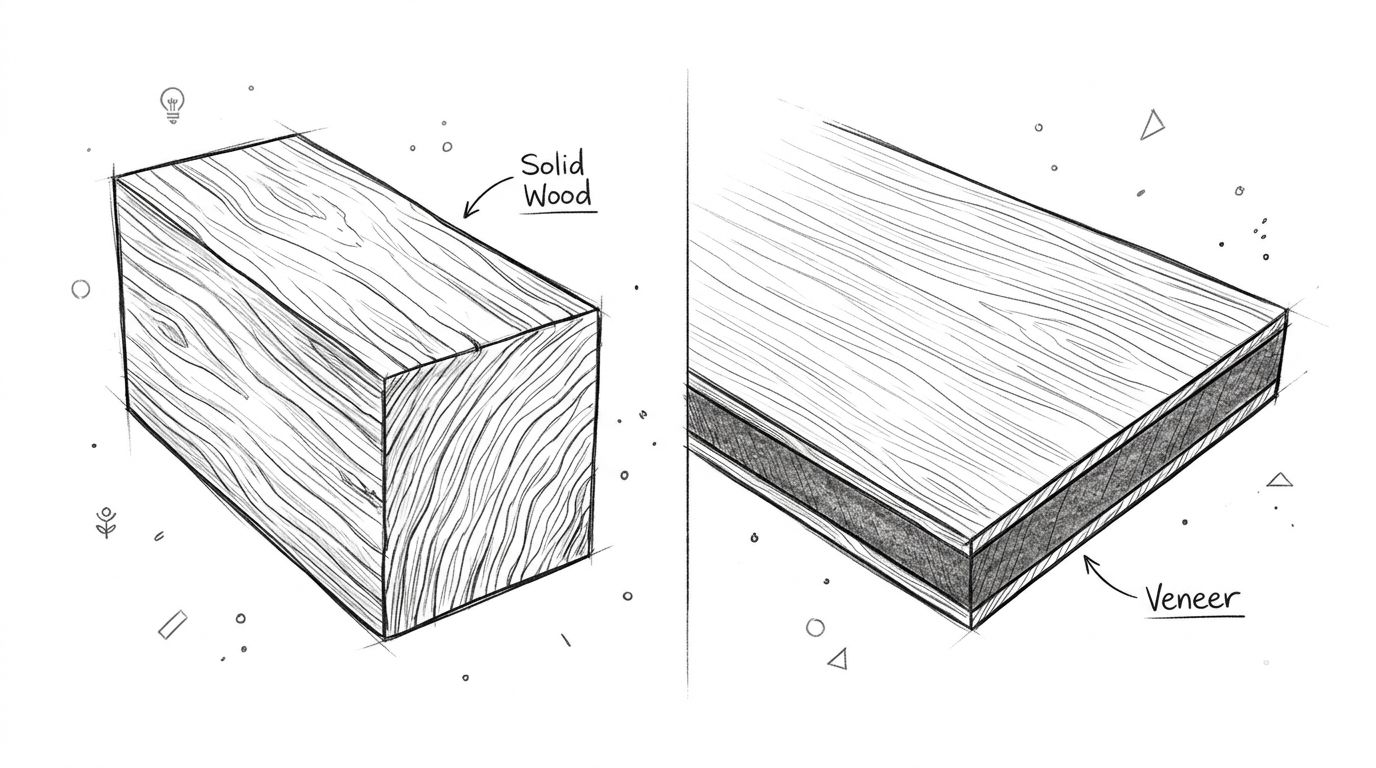
What solid wood means
Solid wood furniture is made from boards or components cut from lumber. If a table apron, chair leg, or drawer front is solid maple, oak, cherry, or walnut, that piece is wood through and through. Natural grain variation, mineral streaks, and texture are part of its appeal.
Solid wood often carries the strongest heirloom reputation because it can age beautifully and, in the right applications, hold up for generations. It also feels honest in the hand. Edges are wood. Corners are wood. If it gets a deep scratch, there's more material available for repair.
What veneer means
Veneer is a thin layer of real wood applied over a stable core such as plywood or another engineered panel. That surface can still be walnut, mahogany, oak, or another desirable species. The visible beauty is genuine wood grain, not a printed lookalike.
That matters because many buyers hear “veneer” and picture a value-focused shortcut. In reality, veneer is often a deliberate design and engineering choice, especially for large flat surfaces that need to stay flatter over time.
Practical rule: Veneer isn't fake wood. It's real wood used differently.
A surprising industry reality helps reset expectations. Approximately 80-90% of American factory-produced furniture utilizes some form of veneer in its construction, reflecting the industry's reliance on veneer for consistent appearance, cost control on rare woods, and large stable surfaces that resist warping inherent in solid wood, according to Dashner Design & Restoration background referenced here.
Why these terms confuse people
Part of the confusion comes from marketing language. “Solid wood” sounds premium, and sometimes it absolutely is. But quality furniture rarely comes down to one label. Construction, joinery, finish quality, and how the material is used all matter.
Shoppers who want a deeper understanding of species and wood selection often benefit from an expert guide to cabinet woods, especially when comparing visible grain, hardness, and overall character. For a broader look at how different wood choices affect longevity and style, this wood furniture overview is also useful.
A Guide to Identifying Furniture Construction
A furniture tag doesn't always tell the full story. The fastest way to understand construction is to inspect the piece with a careful eye and a few simple habits.
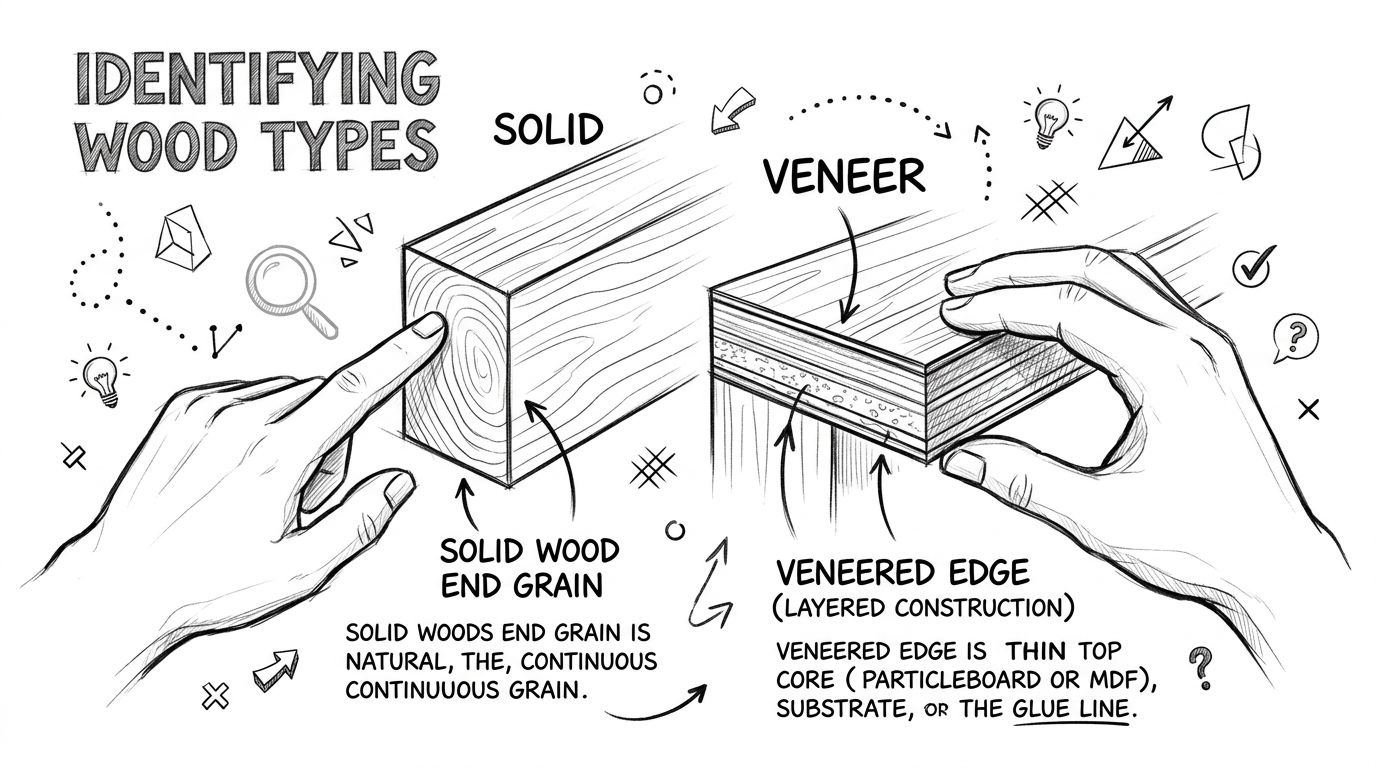
Start with the edges
The edge of a tabletop, cabinet side, or shelf often gives the clearest clue. On solid wood, grain usually continues naturally over the edge, even if the pattern shifts. On veneer, the top surface may look beautifully natural, but the edge may reveal a separate band, a change in grain direction, or a more uniform repeating look.
This isn't a defect. It's evidence of layered construction.
Flip the piece if possible
The underside tells the truth quickly. A solid wood top usually shows wood on the underside as well. A veneered piece may reveal a core material or a panel structure that differs from the face.
That's especially helpful with case goods such as buffets, chests, and cabinets. Buyers comparing storage pieces can use the same inspection habits described in this guide to buying chests, dressers, and cabinets.
Use touch, not just sight
Shoppers often rely only on color and grain. Touch adds another layer.
- Lift carefully: Solid wood is often heavier, especially in dense species and thick parts.
- Tap lightly: A large veneered panel over a stable core may sound different from a thick solid board.
- Feel the temperature: Wood and engineered cores can feel slightly different in a conditioned room, though this is the least reliable clue.
A well-made veneered piece can look so convincing that the edge and underside become more useful than the finish itself.
Look for where each material makes sense
A dining chair may have solid wood legs and a veneered seat panel. A dresser may use solid wood in structural areas and veneered side panels. A desk may combine both for a better balance of strength and surface stability.
Buyers can stop thinking in all-or-nothing terms. Construction is often mixed because each material solves a different problem. Readers considering cabinetry details and face-frame styling may also appreciate Jennifer Gilmer on cabinet styles, which helps train the eye to notice design and construction choices more carefully.
Comparing Durability Longevity and Investment Value
Some furniture decisions are about immediate appearance. This one affects how a piece will age.
The strongest answer in the solid wood vs veneer debate depends on what kind of wear the piece will face, how long the owner plans to keep it, and whether repairability matters more than short-term visual perfection.
Solid Wood vs. Veneer At a Glance
| Feature | Solid Wood | Veneer |
|---|---|---|
| Construction | Lumber-based parts made from natural wood throughout | Real wood surface bonded to a stable core |
| Surface repair | Better for sanding and deeper repair | More limited once surface damage breaks through |
| Large flat panels | More prone to movement with humidity | More stable for wide tops and panels |
| Long-term refinishing | Strong advantage over time | Usually limited by thin face layer |
| Best use cases | Legs, frames, chairs, high-impact parts | Broad tops, door panels, decorative faces |
Where solid wood wins
Repairability is solid wood's clearest long-term advantage. A scratch, dent, or heat mark doesn't always mean the piece is finished. In many cases, the surface can be sanded and refinished again.
That's why solid wood often earns its heirloom-quality reputation in dining tables, chair frames, bed components, and other pieces that take daily abuse. According to this background on long-term cost of ownership in solid wood vs veneer furniture, solid wood offers a distinct long-term economic advantage through its ability to be refinished multiple times, while veneered wood becomes vulnerable to irreversible damage once the thin surface layer, often as thin as 0.5mm, peels or chips through to the substrate.
Where veneer struggles
Veneer has one weakness buyers shouldn't ignore. Once the surface is breached, repair options narrow quickly. A deep gouge at the edge, peeling near a corner, or wear-through on a heavily used top can expose what lies beneath.
At that point, the conversation changes from restoration to replacement or specialty repair. That doesn't make veneer poor quality. It means its lifespan depends heavily on whether the surface stays intact.
Impact and structural endurance
Solid wood also tends to perform better in hard-use structural zones. In mechanical endurance details from Moores Furniture, solid wood furniture components such as legs and structural frames are described as outperforming veneer under impact and stress, with solid wood failing at approximately 1,500 psi compared with veneer's 800 psi threshold before substrate crushing or edge peeling occurs. The same source notes that dining tables in solid wood remain a gold standard for longevity because they can often be refinished 5–10 cycles, while veneer typically allows only 1–2 refinishes before the thin layer is compromised.
Investment lens: If a household wants a piece that can be restored after years of use, solid wood usually offers more forgiveness.
Daily ownership matters
None of this means veneer lacks value. It means buyers should match material to lifestyle. A family with young children, frequent entertaining, and a habit of using the dining table for everything from meals to homework may prefer more repair margin. A formal cabinet that mainly needs to stay flat and look refined may benefit from veneered panels.
Routine care matters either way. A good finish, proper humidity control, and prompt cleanup all extend the life of wood furniture. Owners comparing maintenance practices can get practical help from this guide on wood furniture care.
The Engineering of Fine Furniture Why We Use Both
The phrase “all solid wood” gets treated like a seal of superiority. In fine furniture, that's often too simplistic.
The best-made pieces frequently combine materials on purpose. A maker may choose solid wood where strength and joinery matter most, then use veneered panels where width, flatness, and visual consistency matter more. That's not compromise. It's engineering.
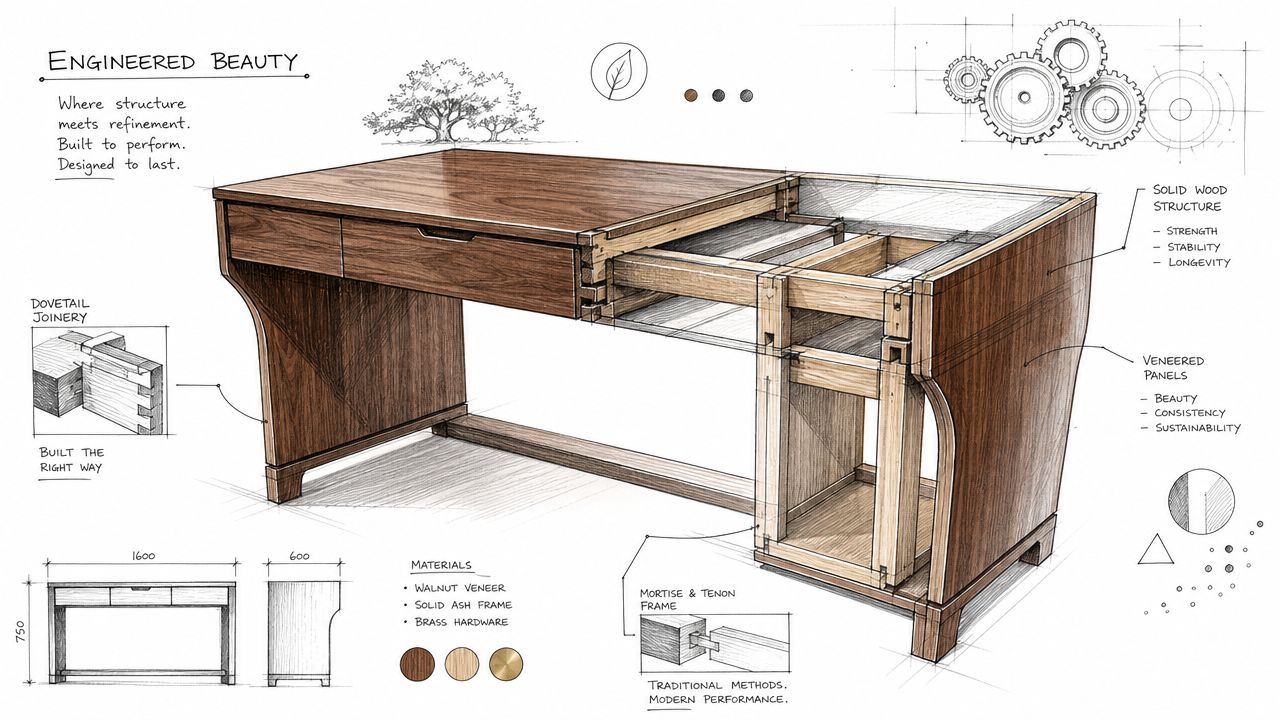
Mixed construction is often the premium solution
A table leg has a different job than a tabletop. A cabinet frame has a different job than a broad door panel. One part must carry load and absorb bumps. Another must stay straight, smooth, and attractive through seasonal change.
That's why mixed construction appears so often in respected furniture lines, including pieces associated with brands such as Lexington and Hooker Furniture. The goal isn't to hide materials. The goal is to use the right one in the right place.
Humidity changes the conversation
This matters even more in South Georgia and North Florida. Homes in this region live through humidity swings that challenge wood movement. Wide solid boards naturally react to ambient moisture, which can lead to expansion, contraction, and cupping if the design doesn't account for it.
That's where veneered panels earn their place. Fine furniture today often uses over 90% plywood/veneer for specific parts to prevent the warping that solid wood is susceptible to, and expert woodworkers argue that using solid wood for structural frames with veneer for large flat panels is a gold standard for stability, according to this woodworker discussion of mixed construction.
“Quality” doesn't always mean one material everywhere. It often means disciplined material selection.
Why this approach lasts
A broad desk top, buffet side panel, or entertainment console face has to remain visually calm. Owners don't want seams telegraphing through, corners lifting, or surfaces changing shape with the weather. Veneered construction helps control those risks.
At the same time, no one wants wobbly legs or weak frames. Solid wood still shines in those locations because it handles fasteners, joinery, and repeated physical stress so well.
For readers renovating utility spaces as carefully as living spaces, the broader discussion in this laundry cabinet advice for renovators can be helpful because it reinforces a practical idea: the smartest material choice depends on use, moisture, and wear pattern. Decorative techniques also play a role in high-end case goods, and this look at marquetry furniture shows how layered wood artistry can become part of fine design rather than a shortcut.
Best Uses For Each Material In Your Home
The smartest purchase usually isn't a verdict on one material. It's a room-by-room decision.
Solid wood belongs in high-impact zones
Dining chair legs, table bases, bed rails, and other structural components benefit from solid wood. These are the parts that get kicked, bumped, leaned on, dragged, and tightened over time. A deeper scratch or dent is easier to live with when the material can be repaired more confidently.
For households that treat the dining room as command central, this matters. Chairs get shifted constantly. Table bases absorb foot traffic. Bench legs take side pressure. Solid wood is well suited to those jobs.
Veneer excels on broad surfaces
Large surfaces create a different challenge. A wide dining tabletop, buffet top, cabinet side, or expansive desk panel needs visual elegance, but it also needs dimensional control.
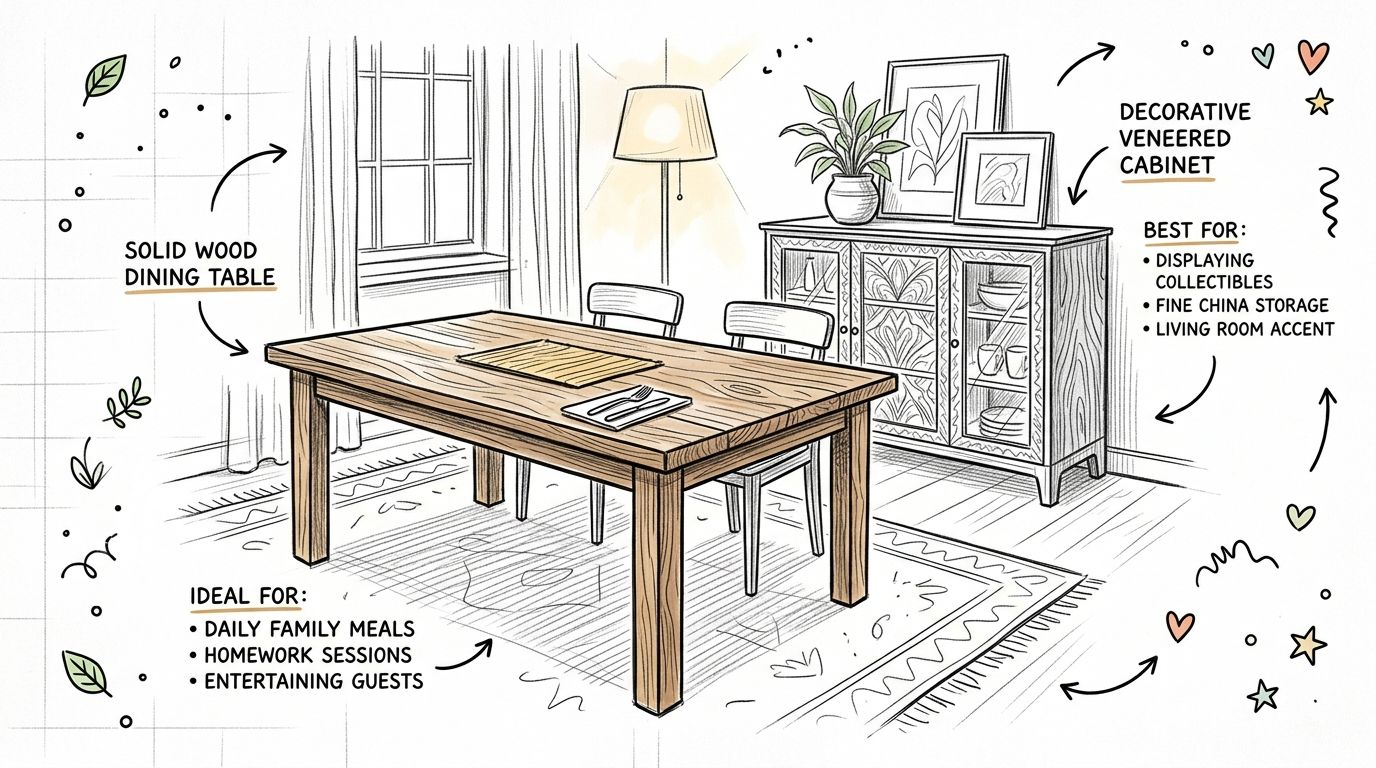
In Canadian Woodworking's discussion of veneer stability, solid wood exhibits significantly higher dimensional instability than veneer, expanding and contracting up to 0.2% across the grain with a 1% change in ambient equilibrium moisture content, while veneer bonded to stable substrates limits this movement to less than 0.05%. That makes veneer the superior benchmark for large surface areas like dining table tops, where solid wood would otherwise require more complex joinery to resist cupping.
A practical room-by-room guide
- Dining rooms: Solid wood for legs, pedestals, and chair frames. Veneer can be an excellent choice for wide tabletops if stability is the top priority.
- Bedrooms: Solid wood works beautifully in bed frames and drawer fronts that may see knocks and wear. Veneered panels often make sense on larger case sides and tops.
- Home offices: Desks often benefit from mixed construction because writing surfaces need to stay flatter over time while bases need strength.
- Storage pieces: Buffets, armoires, and media consoles frequently perform best with a combination of structural wood and veneered panels.
Homeowner shortcut: Judge each part by its job. Ask what must stay flat, and ask what must absorb impact.
Households that want to preserve the finish on either material should pay close attention to pads, felt protectors, and moisture control. This guide to protecting wood furniture from scratches and stains offers useful habits that help both solid wood and veneer age more gracefully.
Curating Your Perfect Space with Lott's Furniture
Choosing between solid wood and veneer gets easier once the labels lose their mystery. The main goal is to match construction to daily life, personal style, and the room itself.
For many households across South Georgia and North Florida, the best answer won't be all one thing. It may be a dining table with a stable veneered top and strong solid wood base. It may be a bedroom suite with substantial solid framing and beautifully finished panels. It may be an executive desk that balances refined appearance with engineering that handles the local climate gracefully.
Personalization matters as much as material
Furniture should fit the home, not just the floor sample. That's where special ordering becomes valuable. For furniture retailers, special order programs allow the configuration and customization of furniture, including fabrics, finishes, and comfort levels, without stocking every variation, as outlined in this special order program overview.
Many vendors support custom choices that help a piece feel intentional rather than off-the-rack. That can include:
- Fabric and leather selection: A sofa can align with family use, pet needs, or a more formal room.
- Finish choices: A wood tone can work with existing floors, trim, or cabinetry.
- Comfort adjustments: Seating can be shaped around preferred cushion feel and support.
In many stores, a special order isn't the same as a custom build from scratch. A special order generally refers to a ready-made piece a retailer doesn't normally stock, while a custom order involves selecting the frame and or upholstery to create a more personalized result, according to this explanation of special order and custom order furniture. Some retailers also note that many special orders begin with only $50 upfront before production starts, as described in this retail example of special-order timing and deposits.
Guidance helps buyers avoid the wrong shortcut
Material education is only one part of a confident purchase. Shoppers often need help with scale, finish coordination, comfort, and room flow. That's where design support becomes just as important as product selection.
Useful support often includes:
- Style Quizzes: These help narrow the look before anyone steps into a store.
- A Mattress Guide: Bedrooms need comfort guidance just as much as case goods need material guidance.
- In-store associates: Real conversation still matters when comparing finish samples, drawer construction, and seating feel.
Brands with broad construction styles and customization pathways, such as La-Z-Boy, Smith Brothers, Stressless, Lexington, and Hooker Furniture, give buyers room to align function with aesthetics instead of settling for whatever happens to be on the floor.
The experience should feel seamless
A modern furniture purchase should move easily between digital research and in-person confidence. Browsing a digital catalog online lets shoppers compare silhouettes and finishes at home. Visiting a showroom in Fernandina Beach, FL lets them test comfort, inspect grain, and evaluate construction firsthand.
Delivery matters too. The strongest retailers don't stop at the sale. Every piece should go through a rigorous multi-point inspection before it reaches the customer, and white-glove, in-home delivery should place the furniture exactly where it belongs for immediate enjoyment.
For homeowners ready to compare solid wood vs veneer in person, Lott's Furniture offers a straightforward path from digital inspiration to showroom confidence in Fernandina Beach, FL and across the broader South Georgia and North Florida region. Browse the online catalog, explore Style Quizzes and the Mattress Guide, or connect with an associate for an online style consultation. Every piece is backed by white-glove, in-home delivery and a rigorous multi-point inspection, so the final choice feels as refined as the room it's going into.


