
Maximize Your Sleep: Latex Mattress Benefits


A lot of people start mattress shopping at the same moment. They wake up after a full night in bed and still feel worn down, stiff through the lower back, or irritated that sleep never felt deep enough to count. The mattress looked fine from the outside. The body says otherwise.
That's why a mattress shouldn't be treated like a filler piece in the bedroom. It's the foundation of a personal retreat, the place that either restores the body or works against it night after night. Among the most compelling latex mattress benefits is that latex often feels less like a short-term purchase and more like an investment-quality part of the home, much like choosing an heirloom-quality recliner from Stressless or a custom sofa from Smith Brothers for a living space meant to last.
An Investment in Your Sanctuary of Sleep
A mattress decision often gets delayed because the problem builds slowly. First it's a little shoulder tension. Then it's more tossing at night. Then mornings start with that familiar thought that sleep happened, but recovery didn't.

For households across South Georgia and North Florida, that pattern feels even more frustrating because the bedroom should be the calmest room in the house. It's the one space that ought to feel cool, supportive, and dependable at the end of a long day. A high-quality latex mattress fits that vision well because it's built around resilience, responsive comfort, and long-term value instead of quick replacement.
Why a mattress belongs in the same category as other lasting home investments
People tend to think carefully about a living room chair they'll sit in every evening or a dining table they hope to keep for years. The same mindset belongs in the bedroom. A mattress influences comfort, posture, and how refreshed a person feels walking into the next day.
That's part of why educational tools matter. Resources such as this guide on why investing in a high-quality mattress is essential for your long-term health help shoppers connect the price of a mattress to its daily effect on well-being, not just to the label on the floor.
A mattress earns its value one ordinary morning at a time. Better comfort shows up in how the body feels getting out of bed.
The first signs that latex may be worth a closer look
Latex usually enters the conversation when someone wants support without feeling stuck, cushioning without that heavy sink, and durability that matches the rest of a thoughtfully furnished home. That makes it especially appealing for buyers who already gravitate toward investment-quality pieces from brands such as Lexington, Hooker Furniture, and La-Z-Boy.
It also helps to pair mattress changes with better bedtime habits. For readers looking to improve sleep habits tonight, practical sleep hygiene can work hand in hand with a more supportive sleep surface.
A strong buying experience matters too. Many homeowners want more than a mattress dropped at the front door. They want expert guidance, customized comfort options through a Special Order Program, and the ability to browse a digital catalog before visiting a showroom in Fernandina Beach, FL. They also want confidence that white-glove, in-home delivery and a rigorous multi-point inspection will protect that investment from the start.
The Core Latex Mattress Benefits for Restorative Sleep
The best latex mattress benefits aren't abstract. They show up in fewer painful pressure points, easier movement at night, a sleep surface that doesn't hold heat the same way many foams do, and a cleaner-feeling environment for people sensitive to dust and moisture.
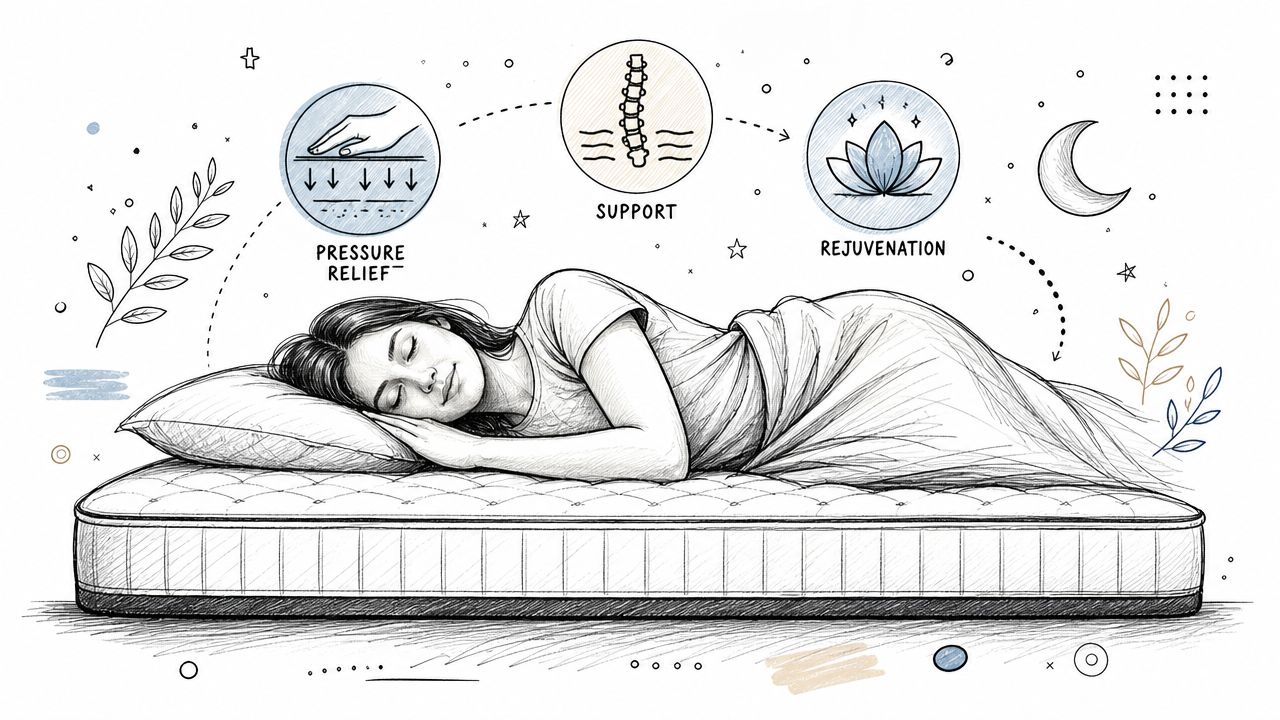
Responsive support that helps the body settle
Latex is known for contouring without swallowing the sleeper. It compresses where weight lands, then responds quickly as position changes. That matters for people who wake because hips, shoulders, or lower backs never quite relax.
A clinical study found that users sleeping on latex foam mattresses experienced a 48% reduction in nights with tossing and turning and a 41% reduction in nights with aches and pains, directly linking the material's responsive support to pain reduction, according to the clinical latex sleep study.
Breathability that makes sense in a warm coastal climate
For homes in South Georgia and North Florida, cooling isn't a luxury feature. It's part of basic comfort. Latex has an open, porous structure with air channels and pinholes that help airflow move through the mattress rather than trap warmth near the body, as explained in this overview of how latex supports cooler, more comfortable sleep.
That's one reason hot sleepers often notice a more balanced feel on latex than on denser foams. Readers comparing cooling options may also find this guide to the best mattress choices for hot sleepers useful while narrowing down materials.
Practical rule: If a sleeper regularly throws off the covers, flips the pillow, or avoids foam because it feels too warm, latex deserves a serious try.
A cleaner sleep environment with less fuss
Latex also appeals to buyers who want fewer added chemicals and a sleep surface naturally resistant to dust mites, mold, and mildew. Natural latex is hypoallergenic, and organic variants contain fewer volatile organic compounds than conventional foam mattresses, according to this explanation of the science behind latex mattresses and better sleep.
For people working on whole-body sleep recovery, the Wesley Chapel guide to restorative sleep offers another helpful perspective on habits that support deeper rest.
Durability that matches a long-view home
Latex stands out because comfort and longevity often come together. Instead of buying for the shortest-term solution, many shoppers choose latex for the same reason they choose enduring furnishings from Lexington or Hooker Furniture. They want performance that holds up over time.
That long-view mindset also pairs well with personalized shopping. Style Quizzes, a Mattress Guide, and in-store associates can help clarify preferred comfort levels, while Special Order options from many vendors allow a more customized sleep setup. The experience feels even smoother when shoppers can move from the online catalog to the Fernandina Beach showroom, then receive white-glove, in-home delivery after a rigorous multi-point inspection.
Understanding Latex Types Talalay vs Dunlop
Many shoppers hear “latex” and assume every latex mattress feels the same. It doesn't. The two names that create the most confusion are Dunlop and Talalay, and the difference becomes easier to understand once the feel is connected to something familiar.
Dunlop feels denser and steadier
Dunlop latex is often compared to a pound cake. The material tends to feel a bit denser, more grounded, and more substantial. That makes it a strong candidate for the deeper support portion of a mattress, especially for sleepers who prefer a stable, planted feel instead of a lofty cushion.
A shopper lying on a Dunlop support core may notice that it feels sturdy without becoming rigid. The body gets support, but there's still enough give to avoid that hard, unyielding sensation some firm beds create.
Talalay feels lighter and more uniform
Talalay latex is closer to angel food cake in feel. It's often described as lighter, airier, and more consistent from top to bottom. Because of that, manufacturers frequently use Talalay in comfort layers where a sleeper wants pressure relief and buoyancy together.
The key point isn't that one is good and the other is bad. It's that they solve different comfort goals. A side sleeper who wants more gentle surface plushness may gravitate toward Talalay near the top. A back or stomach sleeper who wants a stronger underlying pushback may appreciate Dunlop deeper in the build.
A useful shortcut is simple. Talalay often feels more buoyant. Dunlop often feels more grounded.
Natural, synthetic, and blended latex
Another point that trips people up is the label itself. Some mattresses use natural latex, some use synthetic latex, and some use blends. Buyers looking for long-term value usually focus closely on material quality because the feel, resilience, and overall character can differ.
Expert guidance matters. Online Mattress Guides help narrow the field, but lying on different constructions in person often makes the decision much clearer. Many shoppers also appreciate that Special Order programs can open the door to more personalized comfort levels, finishes, and design details across the home, whether the purchase involves a mattress, a La-Z-Boy recliner, or a Smith Brothers sectional.
For households that like to research online first, then confirm comfort in person, the most convenient path is usually omnichannel. Browse digitally, save favorites, then visit a showroom in Fernandina Beach, FL to feel the difference with an associate who can translate technical terms into plain language.
Latex vs Memory Foam and Innerspring Mattresses
Comparing mattress types gets easier when shoppers stop asking which material is “best” in general and start asking which tradeoffs they can live with every night. Latex, memory foam, and innerspring mattresses each create a different sleep experience.
Mattress Comparison at a Glance
| Feature | Latex | Memory Foam | Innerspring |
|---|---|---|---|
| Feel | Responsive, buoyant contouring | Slow-moving, deeper sink | More lifted, spring-based feel |
| Pressure relief | Strong pressure relief with easier repositioning | Close contouring, often more enveloping | Varies widely by build |
| Temperature feel | Generally more breathable | Often retains more heat | Often allows airflow through coil structure |
| Motion response | Quick recovery | Slow recovery | Bouncier surface response |
| Long-term shape retention | Strong durability | More prone to compression over time | Depends heavily on coil and comfort layers |
| Edge character | Often stable and supportive | Can feel less stable at the perimeter | Varies by coil design |
Where latex differs from memory foam
The clearest distinction is feel. Memory foam tends to let the body sink in and stay cradled for a moment before the material rebounds. Some people love that close hug. Others find it restrictive, especially if they change positions often.
Latex contours too, but it does so with more spring and less of that stuck-in-place sensation. It supports curves without making the sleeper feel buried.
Durability is another major dividing line. High-quality natural latex foams retain more than 90% of their original thickness and support after testing equivalent to 15–20 years of use, whereas premium memory foam cores often show 5–15% compression set after just 5–7 years, according to this review of latex durability compared with memory foam.
Where latex differs from innerspring
Innerspring mattresses can feel familiar and supportive, especially for shoppers who like a more traditional bed. But many depend heavily on the comfort materials above the coils to provide pressure relief. If those top layers wear out first, the mattress can lose comfort even when the coil unit still has structure.
Latex often gives a more integrated feel. Support and cushioning work together within the foam itself, so the bed can feel more consistent across the surface. That's one reason buyers comparing categories often use educational tools such as this look at memory foam vs innerspring mattress differences before deciding whether latex better matches their priorities.
Some households still choose innerspring for familiarity. Others move toward latex because it combines contouring and resilience in one material.
For special situations, such as temporary recovery setups or basic support needs, this example of a mattress for home care comfort helps illustrate why innerspring designs still have a place. But for shoppers seeking investment-quality comfort with a longer horizon, latex often stands apart.
Many people use the same decision logic they apply to enduring furniture. A well-made bedroom set from Hooker Furniture isn't chosen only for how it looks on day one. It's chosen for how it performs year after year. Latex speaks to that same long-view approach, and it pairs naturally with guided shopping tools, in-store mattress testing, and white-glove, in-home delivery after a rigorous multi-point inspection.
Is a Latex Mattress Right for Your Home
A latex mattress isn't the right answer for every sleeper. It is, however, a strong fit for specific households, especially those who value durability, responsive comfort, and a more adaptive sleep surface.
Sleepers who often benefit most
Side sleepers frequently appreciate latex because it cushions high-pressure areas without feeling unstable. Shoulders and hips can settle in enough to feel supported, while the rest of the body stays on a more even plane.
Hot sleepers are another natural match. In humid coastal conditions, a mattress that breathes more easily can make the bedroom feel less stuffy and less frustrating by midnight.
Eco-conscious shoppers often take a close look as well. They're usually drawn to natural materials, fewer added chemicals, and a product meant to stay in service for many years instead of being replaced quickly.
A sleeper profile that often gets overlooked
One of the most practical latex mattress benefits has nothing to do with buzzwords. It's edge usability. For seniors, post-surgical sleepers, or anyone with mobility concerns, the perimeter of the mattress matters every single day.
Ergonomic tests show latex mattresses have sturdier perimeters that extend the effective sleepable surface by up to 10 inches and offer 15–25% lower interface pressure peaks than memory foam, a notable benefit for mobility-challenged users who need dependable edge support, according to these findings on latex edge support and usability.
That can translate into a bed that feels steadier while sitting to put on shoes, easier to use when standing up, and more dependable across the full surface. For many households in South Georgia and North Florida, especially aging-in-place households, that practical stability matters as much as plushness.
The honest drawbacks
Latex usually comes with a higher initial investment than more value-focused options. It can also be heavy, which makes setup harder if someone is trying to move it alone.
Those drawbacks are real, but context matters. The higher upfront cost often reflects stronger materials and longer usable life. And the weight becomes far less of a concern when a buyer chooses white-glove, in-home delivery rather than trying to wrestle a mattress through hallways and doorframes.
A good self-check is whether the shopper wants a mattress that works for now, or one that supports a longer-term plan for comfort. For buyers still sorting through sleep positions and needs, this guide on how to choose the right mattress for your sleeping style can help clarify the fit.
The same personalized thinking applies across the home. Many vendors support special orders with customized comfort levels, fabrics, and finishes, while style tools and in-store associates make it easier to turn broad preferences into a confident choice. That blend of customization, expert guidance, and an online-to-showroom path is especially helpful for second homes, coastal residences, and year-round family homes.
How to Choose Your Perfect Latex Mattress at Lotts
A good latex mattress choice starts the same way a good furniture investment starts at home. Picture a room you use every day, in every season, for years. Along the South Georgia and North Florida coast, that matters. Heat, humidity, salt air, guest visits, and daily wear all test whether a purchase was built for the long haul or only looked good in the showroom.
At Lott's, the goal is to help you choose a mattress that fits your body, your home, and the way you plan to live with it over time. The easiest way to sort the options is to move in order. First check what it is made of. Then test how it feels. Then make sure the buying and delivery process supports the investment you are making.
Start with certifications and material clarity
Mattress labels can feel like reading a new dialect. A few terms are enough to get your footing.
Certifications such as GOLS and Oeko-Tex help confirm what materials are inside and what standards those materials have met for testing and safety. For households that care about cleaner indoor air, fewer mystery layers, and better long-term confidence, those labels are a practical checkpoint, not just marketing language.
Material clarity matters for another reason too. A true latex mattress should tell you whether the latex is natural, organic, blended, or synthetic, and how the comfort layers and support core are built. That information helps you judge value the same way you would with a dining table made from solid wood instead of veneer. The outside may look similar at first glance, but the inside determines how well it ages.
Match the feel to the sleeper, not the display tag
Comfort is personal. A side sleeper often needs more give at the shoulders and hips. A back sleeper usually needs a steadier, more level surface. Couples may need a feel that keeps one person from sacrificing support just to make the other person happy.
That is why in-store testing matters. A mattress can sound perfect online and still feel wrong after ten minutes of lying still. Guided testing shortens that learning curve and helps shoppers notice the details that affect real sleep, such as whether the lower back stays supported or whether the shoulders feel pressed.

The best mattress on paper still has to feel right in real life. Testing comfort with guidance shortens the learning curve.
Lott's also gives shoppers a way to prepare before they step into the showroom. The Mattress Guide and online browsing tools help narrow the field at home, which makes the showroom visit more productive and less overwhelming.
Use the buying experience to protect the investment
A high-quality latex mattress is rarely an impulse buy, and it should not be treated like one. It is closer to choosing a lasting piece for your home, something that should serve your household well through changing routines, changing seasons, and changing sleep needs.
That is where personalized service earns its keep. A showroom visit in Fernandina Beach lets you compare comfort levels with help from associates who know how construction, firmness, and body type work together. Special order options can also make a real difference for buyers who want a more customized comfort feel instead of settling for the closest match on the floor.
Buyers who want to shop with a clearer checklist can review these tips for buying a new mattress before visiting the showroom to organize their questions.
Delivery matters too. Latex mattresses are substantial, and that weight often reflects the density and quality people are paying for. White-glove, in-home delivery and a careful multi-point inspection help the mattress arrive ready for use, without turning setup day into a lifting project or a guessing game. For many families, that final step is part of what makes the purchase feel like a lasting addition to the home rather than another boxed item to deal with later.
For homeowners in South Georgia and North Florida who want comfort that holds up and value that lasts, Lott's Furniture offers a thoughtful path from research to rest. Browse the digital catalog, use the Mattress Guide, or visit the Fernandina Beach showroom for one-on-one help choosing a latex mattress that suits your home and the way you sleep.


