Swivel Recliners for Small Spaces: A Buying Guide


The sofa fits, but the corner beside it still feels unfinished. An armchair would provide a reading spot, yet a separate ottoman would crowd the walkway, and a conventional recliner might leave someone facing the television when everyone else is talking across the room. That's the small-room dilemma: finding a comfortable seat without making the rest of the room harder to use.
Swivel recliners for small spaces work best when shoppers measure the chair in motion, not just the chair in the photograph. For homes across South Georgia and North Florida, the right choice starts with a complete plan, from the delivery doorway to the footrest's final position.
Why Swivel Recliners Work in Small Spaces
Consider a compact living room with a sofa along one wall, a television opposite it, and a window overlooking the porch. A fixed chair has to favor one view. A swivel recliner lets its occupant change direction while keeping the seating arrangement intact.
The appeal isn't that the chair is small. It's that one seat can support several activities without requiring a collection of separate pieces. Reading, conversation, and resting can happen in the same corner, leaving more of the room available for everyday movement.
A Better Use of a Hardworking Corner
A useful small-space chair earns its place throughout the day. In a bedroom, it might serve as a quiet reading seat before becoming a comfortable resting spot. In a den, it can complete a conversation arrangement without permanently facing away from the television.
That versatility matters most when a room doesn't have an obvious furniture layout. Rather than adding another occasional chair to address an awkward viewing angle, a homeowner can choose a seat that changes orientation.
- Combined functions: An integrated footrest removes the need to find a permanent parking spot for a separate ottoman.
- Flexible placement: A chair can sit at the edge of a seating group rather than becoming another large piece lined up against a wall.
- Dedicated comfort: A personal lounge seat can make a modest room feel like a curated sanctuary without requiring a larger sofa.
Compact Doesn't Mean Clearance-Free
The important distinction is between the upright footprint and the operating envelope. The first describes the chair at rest. The second includes the space needed for reclining, rotation, controls, and the person using it.
A chair can look beautifully proportioned beside a sofa yet become impractical once someone puts their feet up. Likewise, a narrow frame doesn't guarantee comfortable seating for a taller or broader adult.
A small-space recliner succeeds only when the room remains usable while someone is relaxing in it.
The strongest recommendation is straightforward: choose the smallest chair that fits the intended user comfortably and operates properly in the available space. Don't choose the smallest chair on the sales floor and hope comfort follows.
How to Measure Your Room for a Swivel Recliner
Start at the delivery entrance, not the living-room corner. A chair that fits its destination still needs to travel through exterior doors, interior openings, hallway turns, and any stairs or elevator involved.
The furniture-measuring guide provides a useful starting point for recording access dimensions. Bring photographs of tight turns and architectural obstacles alongside the measurements so an associate can understand the route rather than interpret isolated numbers.
Record the Delivery Route and Room Boundaries
Use a tape measure, paper, and removable painter's tape. Sketch the room with doors, windows, outlets, vents, and furniture that will stay.
Measure the clear opening, not the decorative frame around it. Note anything that narrows passage, including handrails, door hardware, low ceilings, and built-in shelving. Ask whether the selected chair ships assembled, whether its back is removable, and which dimensions apply during delivery.
Keep these records separate:
- Shipping dimensions: The packaged size, if packaging must pass through the access route.
- Delivery configuration: The actual size and shape the delivery team will move through the home.
- Upright footprint: The chair's width and depth when closed.
- Fully reclined footprint: The furthest reach of the back and footrest during use.
- Required swivel zone: The boundary swept by the chair through its permitted rotation.
Don't estimate a swivel radius from seat width alone. The base's pivot location and the projecting corners of the arms, back, and footrest affect the chair's movement.
Tape the Chair at Maximum Extension
Mark the proposed upright position, then add the fully reclined outline using the selected model's specifications. Mark the rotational boundary separately, including any restriction on swiveling while reclined.
Space-planning guidance recommends approximately 900 mm (36 in) for a primary circulation path, 750–900 mm for a secondary path, and 400–450 mm (16–18 in) between seating and a coffee table for comfortable reach, although manufacturer clearances and applicable accessibility requirements take priority over these general room-planning guidelines.
Measure between the nearest projecting edges. A table's overhanging top counts, as does an extended footrest. Coffee-table spacing is a reach guideline, not permission to place a table inside the mechanism's travel.
Key Measurements for a Swivel Recliner
| Measurement | Typical Range | Why It Matters |
|---|---|---|
| Overall width | Model-specific | Determines whether the frame fits beside existing furniture |
| Closed depth | Model-specific | Shows the chair's everyday upright footprint |
| Fully reclined depth | Mechanism-specific | Identifies the maximum front-to-back requirement |
| Rear wall clearance | Manufacturer-specified | Prevents contact between the moving back and wall |
| Swivel radius or operating boundary | Base- and position-specific | Reveals potential collisions during rotation |
| Delivery clearance | Route- and configuration-specific | Confirms access before an order is finalized |
Print a Measurement Worksheet
Print this checklist and complete it for each serious contender. Recording the same fields makes showroom comparisons much more useful than comparing photographs.
- Chair identification: Model name ______; upholstery choice ______.
- Delivery route: Narrowest opening ______; tightest turn ______; stairs or elevator restrictions ______.
- Closed dimensions: Width ______; depth ______; height ______.
- Open dimensions: Reclined depth ______; rear clearance ______; footrest projection ______.
- Rotation: Permitted range ______; maximum boundary ______; reclined-swivel restrictions ______.
- Room test: Door swing clear ______; main route clear ______; nearby furniture clear ______.
Walk around the taped outline while carrying a laundry basket or serving tray. Open nearby doors and drawers. If the arrangement only works when everyone carefully sidesteps the chair, select a different position or model.
Key Features to Look For in a Compact Swivel Recliner
Mechanism choice matters more than a compact label. Similar-looking chairs can move differently, require different clearances, and feel entirely different when someone tries to close the footrest.
The diagram below highlights the dimensions and movement that deserve attention before upholstery becomes the deciding factor.

Wall-Hugger Mechanisms and Rear Clearance
Standard recliners generally require approximately 12 to 20 inches behind the chair, while wall-hugger designs can operate with only a few inches because the seat moves forward during reclining, according to this recliner mechanism and clearance guide.
That forward movement is useful beside a wall, but it doesn't erase the need for space elsewhere. Zero-wall doesn't mean zero clearance. The mechanism still has to extend into the room, and the chair's permitted swivel movement must remain unobstructed.
The wall-hugger recliner explanation can help shoppers identify the mechanism worth discussing in the showroom. Don't assume every compact swivel model also has wall-hugging operation, or that every mechanism permits rotation in every reclined position.
For a tight room, the manufacturer's operating instructions should settle those questions. Appearance alone won't.
Swivel Control and Everyday Operation
Try the chair from a normal seated position. Rotation should feel manageable to its intended user, with no need to grab a neighboring table or push against a wall.
Evaluate the complete sequence: sit down, turn, recline, return upright, close the footrest, and stand. A comfortable open position isn't enough if the user struggles to get out of it.
- Manual operation: Test the actual lever, push-back action, and footrest-closing effort rather than assuming the mechanism will loosen into an acceptable fit.
- Powered operation: Check button placement, cord routing, outlet access, and the manufacturer's instructions for power interruption.
- Swivel limits: Ask whether stops restrict movement and whether a locking feature is available or appropriate.
- Control access: Confirm that a side table won't hide the release handle or force an awkward reach.
For someone with limited strength, choose based on a supervised showroom trial rather than a blanket preference for manual or powered seating. A swivel feature isn't a substitute for transfer assistance.
Body Fit Before Styling Details
Reclining furniture has a long connection to adjustable comfort. An 1873 adjustable reclining-chair patent model held by The Metropolitan Museum of Art offers a useful reminder that these are engineered seating pieces, not decorative chairs.
Check the intended user's posture while seated upright. Feet should rest flat or be appropriately supported, the lower back should contact the lumbar area, and forearms should rest without lifting the shoulders.
Seat depth deserves particular attention. A petite-looking chair that leaves someone perched forward isn't a successful space-saving purchase. Neither is a deep seat that forces a shorter adult to slide forward and lose back support.
Showroom test: The right chair should be comfortable to enter, adjust, and leave, not just comfortable once someone has settled into it.
Household members who will share the chair should each try it. If their preferred positions differ substantially, adjustable support may matter more than a slightly narrower frame.
Choosing Fabrics and Materials That Last
The right upholstery is the material a household can comfortably live with and properly maintain. A pale textured fabric, a smooth leather, and a performance-treated textile may all suit the same room visually, but their care requirements deserve separate consideration.
Start with daily habits. Will the chair become the preferred reading seat, a pet's afternoon resting place, or a regularly used chair in a coastal vacation home? Select for those conditions rather than for an untouched showroom appearance.
Performance Fabric, Standard Upholstery, or Leather
Performance fabric deserves consideration where spills and frequent use are realistic concerns. Ask what the specific textile is designed to resist, which cleaning methods are approved, and what its warranty excludes. A worry-free label shouldn't replace written care instructions.
Standard upholstery remains a sensible option when its texture, feel, and maintenance needs match the household. Leather should receive the same scrutiny: inspect a sample, ask about the finish, and confirm the recommended cleaning products before deciding.
| Material choice | What to evaluate | Practical recommendation |
|---|---|---|
| Performance fabric | Stain-resistance claims, approved cleaning methods, texture | Request the actual fabric's care documentation |
| Standard upholstery | Weave, surface feel, cleaning code, pattern | Choose it deliberately rather than treating it as a lesser option |
| Leather | Finish, feel, care requirements, appearance variation | Handle a sample and discuss the intended room conditions |
The performance fabric versus leather guide can help narrow the discussion before a showroom visit. Neither category is automatically the better investment for every household.
Match Maintenance to the Whole Room
For a vacation property, consider who will clean the chair and whether that person will have the correct supplies. For a family room, consider snacks, pets, and the likelihood that a spill will sit unnoticed.
A broader resource from Interiors by DeX on low-maintenance interior materials Chennai offers a companion topic for homeowners considering upkeep across an entire interior. For recliner upholstery, however, the selected manufacturer's care instructions should remain the deciding reference.
- La-Z-Boy: Ask an associate to identify the upholstery and performance options available for the selected seating model.
- Smith Brothers: Explore fabric choices for coordinating upholstered furniture, with availability confirmed for each piece.
Material selection should include comfort as well as cleaning. A 2025 survey of 2,000 adults found that 41% named a recliner their favorite relaxing chair and 27% valued a chair that had adjusted to their body, reinforcing the importance of personalization in the reported findings on seating preferences.
Request a sample before committing to a personalized design. View it beside existing furnishings in the room's daylight and evening light, then handle it long enough to decide whether its texture belongs in that household's daily routine.
Styling Ideas for Small-Space Layouts
A successful layout gives the recliner a purpose without turning it into an obstacle. Place it beside a main traffic route rather than across one, and let its relationship to the sofa, window, and lighting determine the final angle.
The illustrated arrangements below show how seating can feel intentional without filling every available corner.
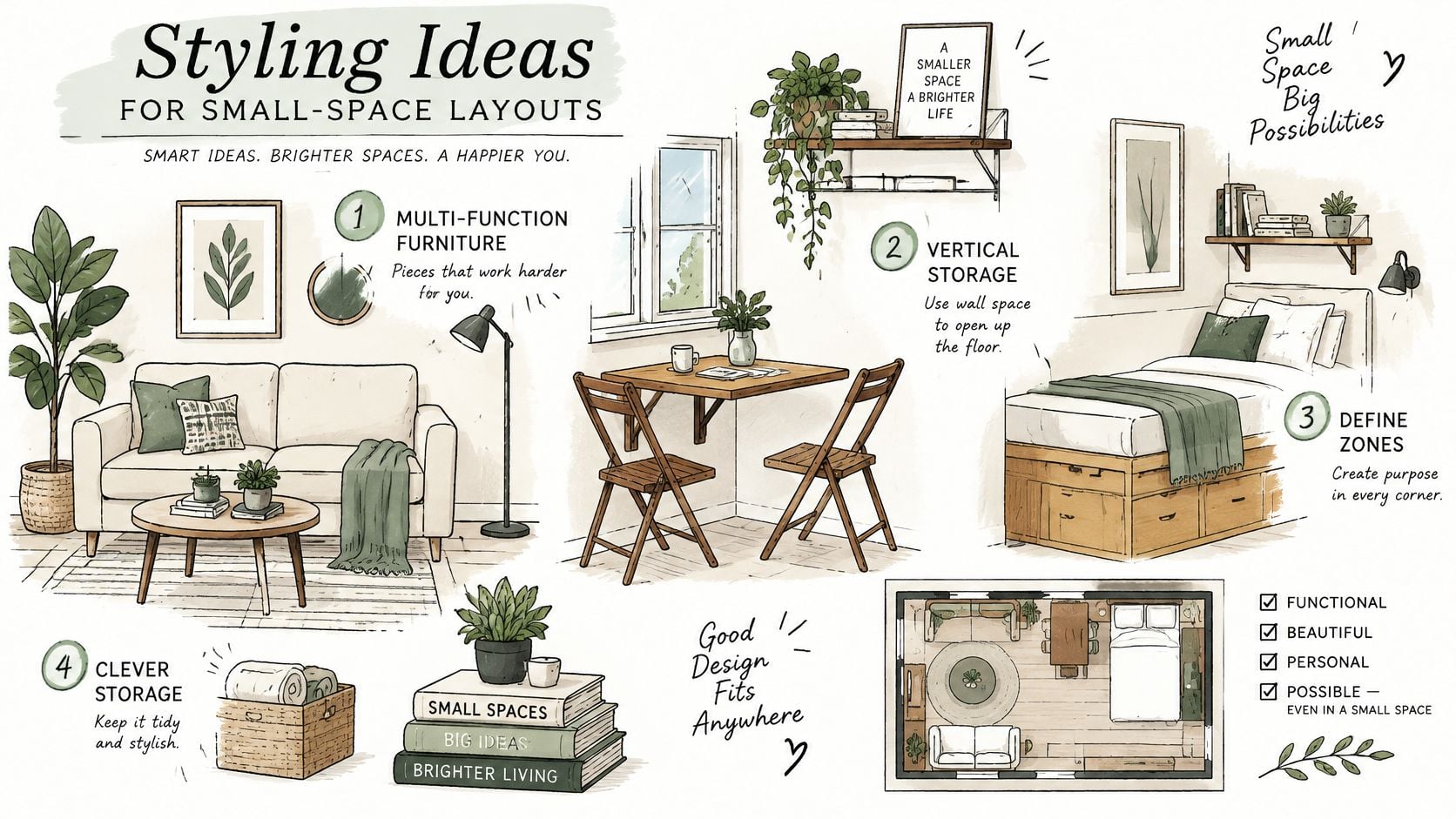
A Living-Room Seat Between Conversation and the View
Consider a narrow living room with a sofa facing the television and a window on the adjacent wall. Position the recliner near the end of the sofa, leaving the entrance side of the room open.
A compact side table can hold a drink or book, but it should sit outside the chair's marked movement boundary. Place a lamp where the occupant can reach its switch without stretching across the reclining mechanism.
The chair doesn't need to match the sofa exactly. A shared undertone, related texture, or repeated wood finish can make the combination feel considered without creating a rigid matched set.
For broader placement questions, Vizcraft's guide to how to arrange living room furniture is a useful companion resource. The recliner's documented clearances still determine whether a particular arrangement is practical.
A Bedroom Reading Nook That Still Functions as a Bedroom
In a smaller bedroom, begin with access to the bed, dresser, and closet. The recliner belongs in the remaining usable area, not in the path someone follows while dressing or carrying linens.
Choose a nearby surface that holds the essentials without extending across drawer openings. A wall-mounted light may be worth considering where a floor lamp would complicate placement, provided its location suits the room and installation requirements.
- Keep storage usable: Test dresser drawers and closet doors with the chair in its intended position.
- Keep accessories restrained: A well-chosen throw may be more practical than decorative cushions that need another place to land.
- Keep the seat accessible: Leave enough room to approach and stand without bracing against neighboring furniture.
A bedroom chair should feel like a quiet retreat, not an extra object squeezed into leftover floor space.
Test the Finished Arrangement, Not an Empty Floor
Furniture-planning guidance recommends placing seating at its actual scale, measuring between furniture edges, and testing the mechanism with nearby tables, rugs, door swings, and walking routes in place, as outlined in these practical furniture-clearance checks.
That means the final test should include the lamp base, rug edge, charging cable, and table that will remain beside the chair. An arrangement that works without accessories can fail once the room is finished.
Leave an attractive corner partly open rather than filling it with a chair that makes the room awkward to use.
The small-space living-room furniture ideas offer additional starting points for coordinating the surrounding pieces. The aim is a balanced room where comfort, storage, and movement each have a place.
Swivel Recliners vs Other Seating Options
A swivel recliner isn't automatically the right answer for every compact room. It's the strongest candidate when someone wants a dedicated lounge seat that can address different parts of the space.
A swivel base allows the occupant to turn toward a television, window, conversation area, or side table instead of repositioning a heavy chair, a functional distinction described in the overview of reclining-chair design. If that directional flexibility won't be used, another type of seating may be a more sensible choice.
Choose According to the Room's Main Job
| Seating option | Strongest use case | Main trade-off |
|---|---|---|
| Swivel recliner | Personal lounging with changing viewing directions | Requires both reclining and rotational clearance |
| Stationary recliner | Relaxing while facing a consistent focal point | Offers less directional flexibility |
| Standard armchair | Upright conversation or occasional seating | Doesn't provide integrated reclining |
| Loveseat | Shared seating in a compact gathering area | Must be evaluated for seating capacity and room proportions |
| Sofa | A room organized around household or guest seating | Can leave less space for a dedicated personal chair |
A stationary recliner deserves serious consideration where the television and conversation area share the same direction. There's little reason to prioritize rotation if the chair will always face forward.
A standard armchair can be the better answer in a room used mainly for conversation. If supported lounging isn't a priority, avoiding a reclining mechanism may simplify the arrangement.
Don't Trade Needed Seats for an Unused Feature
A loveseat or sofa may make better sense when the room's real shortage is places for people to sit. A beautifully comfortable personal chair won't solve that problem if it displaces shared seating the household uses daily.
Likewise, replacing a sofa with individual lounge chairs should follow an honest discussion about visitors, family routines, and preferred seating positions. The right layout depends on who uses the room, not just which furniture looks compact.
- Choose a swivel recliner when directional flexibility and personal lounging are both regular needs.
- Choose a stationary recliner when supported rest matters but rotation adds little.
- Choose an armchair when a fixed upright seat suits the room's purpose.
- Prioritize shared seating when accommodating the household matters more than creating an individual retreat.
Compare Cost Without Inventing Value
Compare actual written quotations for the specific pieces under consideration. Include upholstery, mechanism, selected options, delivery, and any required assembly rather than assuming one furniture category always costs less than another.
A feature is worth paying for only if the intended user benefits from it. Similarly, a smaller frame isn't good value if the occupant avoids it because the seat feels cramped or the controls are awkward.
Body fit is a purchase requirement, not an optional upgrade. A slightly different layout with a comfortable chair is preferable to a visually tidy arrangement built around seating nobody wants to use.
Budget, Custom Ordering, and Lott's Delivery
Set a spending plan around the finished purchase, not the opening price on a product card. The useful comparison is between complete solutions that fit the room, suit the intended user, and include the service the household needs.
An investment-quality purchase should have a clear explanation behind it. Shoppers should understand what they're selecting, which features affect the quotation, how the furniture will arrive, and what support applies afterward.
Spend on the Features That Matter Daily
Prioritize fit and operation before decorative extras. Then compare upholstery, construction information, warranty terms, and service arrangements for the actual model being considered.
A value-focused decision doesn't require choosing every available feature. It requires separating daily benefits from options that sound appealing but won't be used.
- Request an itemized quotation: Identify the chair, upholstery, mechanism, selected options, and delivery charges.
- Read the applicable warranty: Confirm coverage for the frame, upholstery, mechanism, and electrical components where relevant.
- Clarify order terms: Ask about deposits, changes, cancellations, and returns before approving the purchase.
- Confirm timing: Obtain the current estimate for the selected configuration rather than relying on a general expectation.
There's no need to promise a particular lifespan to make a careful purchase. Clear specifications and realistic expectations provide a stronger basis for comparing alternatives.
Use Custom Ordering With a Defined Plan
The Special Order Program supports personalized designs, with most vendors offering choices in fabrics, finishes, and comfort levels. Availability depends on the manufacturer and model, so an associate should confirm which adjustments apply to the selected chair.
Bring the completed measurement worksheet, room photographs, and upholstery preferences to that conversation. Customization works best after the suitable frame and mechanism have been identified, not as an attempt to correct an unsuitable fit.
Style Quizzes can help establish an aesthetic direction, while in-store associates can translate preferences into coordinated furniture decisions. For a broader bedroom project, the Mattress Guide provides a separate starting point for evaluating sleep comfort alongside the new reading nook.
Shoppers can move from the digital catalog online to hands-on testing in the showrooms in Fernandina Beach, FL, or Waycross, Georgia. That transition combines convenient browsing with the opportunity to compare support, controls, textures, and proportions in person.
Confirm the In-Home Delivery Plan
The Lott's Delivery standard includes white-glove, in-home delivery, and every piece undergoes a rigorous multi-point inspection before reaching the customer. The professional delivery team places furniture in the room of choice and positions it for use.
Share access concerns before delivery is scheduled. Ask how a tight hallway, stair landing, or other restriction will be handled, and confirm any preparation the household needs to complete.
White-glove service doesn't make an undersized doorway larger. It makes early communication and accurate measurements especially valuable, so the purchase can move from showroom selection to comfortable daily use without avoidable surprises.
For homes across South Georgia and North Florida, Lott's Furniture offers compact reclining options, personalized ordering, and white-glove in-home delivery. Bring room photographs and the completed measurement worksheet to the Waycross or Fernandina Beach showroom, or request an online style consultation to narrow the choices before visiting.