Save 50% Off MRSP on Lexington | Shop the Catalog >

Modular Furniture for Small Spaces: Design Your Sanctuary

A small living room can feel like it's asking too much from every piece inside it. One corner needs to work as a reading spot, a guest zone, and a place to stretch out and unwind. The furniture that looked right in a showroom can suddenly feel oversized, rigid, and oddly out of step with real life.
That's where modular furniture earns its place. Instead of forcing a room to adapt to one fixed layout, modular pieces let the layout change with the household. A seating arrangement can open up for company, tighten for daily living, or shift to create clearer movement through the room. For homeowners and renters across South Georgia and North Florida, that kind of flexibility isn't a trend. It's practical design.
Reclaiming Your Space With Modular Furniture
Modular furniture for small spaces starts with a simple idea. A room doesn't need more furniture. It needs furniture that can do more.
That idea has moved well beyond a niche design preference. The global modular furniture market reached USD 89 billion in 2025 and is projected to reach USD 145.6 billion by 2035, driven by urbanization and the shrinking average size of homes. The appeal is easy to understand. Smaller homes ask for pieces that save space, serve multiple functions, and adapt over time.
A compact home feels calmer when every item has a reason for being there. A modular sofa can separate into smaller seats. A storage bench can hold linens while doubling as extra seating. A wall-based system can bring order without crowding the floor. Readers looking for more inspiration on that front may also enjoy these Endless Storage space-saving ideas, especially for rooms that need hidden utility without visual heaviness.
Practical rule: The best small-space furniture doesn't just fit the room. It protects how the room feels to live in.
That's often where people get stuck. They measure for width, then forget to plan for movement, storage needs, or how the room changes from morning to night. A sofa that technically fits may still dominate the room. A coffee table with no hidden storage may leave daily clutter in plain view. A rigid layout can make a home feel smaller than it is.
A better approach starts with function first. The room should support how the household lives, not how a catalog photo stages it. For anyone sorting through the practical side of that process, this guide to storage furniture that does the job offers helpful direction on pieces that work harder without making a room feel crowded.
The Art of Adaptability What Is Modular Furniture
Modular furniture is best understood as a set of refined building blocks for the home. Each module is designed to work on its own and also connect with the others in useful, intentional ways. That means one furniture purchase doesn't lock a household into one permanent arrangement.

A traditional sofa is one object with one footprint. A modular sofa, by contrast, is a system. Its sections can create an L-shape, a more open lounge layout, or separate seating zones. The same principle applies to shelving, media storage, and convertible dining arrangements. Households that entertain in tighter quarters often appreciate how expandable formats solve occasional needs without asking for a permanently oversized piece. For that reason, many readers find inspiration in DK Fabrications dining furniture, where flexibility and craftsmanship meet in a way that suits changing room demands.
Flexibility Changes Daily Living
Flexibility is the most visible benefit. A room can shift for movie night, overnight guests, children's play space, or holiday gatherings. That matters because small rooms rarely serve only one purpose.
The confusion usually comes from assuming flexibility means compromise. It doesn't have to. Good modular furniture feels composed in its everyday arrangement, not temporary or unfinished. The room should still look settled and welcoming, even if the pieces can move later.
Scalability Protects the Investment
Scalability matters just as much. A household might begin with a compact configuration and add pieces later as needs change. That's especially helpful for first homes, downsizing households, and vacation properties where furnishing decisions often happen in phases.
A useful example appears in this guide to choosing multi-functional furniture for modern homes. The strongest pieces aren't merely smaller versions of standard furniture. They're chosen because they can evolve with the room instead of being replaced when life shifts.
A modular piece should solve today's layout without limiting tomorrow's options.
Personalization Makes Modular Feel Finished
The final piece is personalization. Modular doesn't mean generic. The shape may be adaptable, but the finished look can still feel deliberate. Upholstery, arm profiles, wood finishes, and cushion comfort all influence whether a room feels custom or cobbled together.
That's why modular furniture for small spaces works best when households treat it like planning, not improvisation. The goal isn't to fill a room with movable parts. The goal is to create a sanctuary that can bend without losing its character.
Exploring Common Modular Furniture Systems
Not all modular systems solve the same problem. Some improve seating. Others hide clutter. Others create dual-use rooms that can shift from day to evening without a full reset. Knowing which category matters most helps narrow the search quickly.
The current market reflects that divide. Data on modular and small-space furniture shows that modular sofas make up 28.3% of the product type segment in the global modular furniture market in 2024, while storage units hold a 28.3% market share in the broader small-space furniture category. In plain terms, people shopping for compact homes are prioritizing two things. Adaptable seating and smarter storage.
Modular Sofas for Seating That Shifts
Modular sofas are often the first stop because the living room usually carries the heaviest burden in a small home. It may need to seat guests, support everyday lounging, and preserve enough openness to keep the room from feeling closed in.
Brands such as La-Z-Boy and Smith Brothers are often associated with this category because modular seating works best when comfort and construction are taken seriously. A sectional built in pieces should still feel unified, tailored, and stable in daily use.
Look for these advantages:
- Flexible layouts: Rearranging sections can open a walkway or create a more social conversation area.
- Customizable comfort: Some modular programs allow choices in cushion feel, arm style, and finish details.
- Long-term adaptability: Additional pieces can extend the layout later instead of requiring a full replacement.
For readers comparing shapes before they shop, this overview of what to know before buying a sectional helps translate showroom dimensions into real-room decisions.
Storage Systems for Visual Calm
Storage modules solve a different problem. They don't usually become the focal point of the room, but they often determine whether the room feels peaceful or busy.
A low cabinet under a window can hold games, throws, or seasonal décor. Stackable shelves can create vertical organization without consuming precious floor area. Entry pieces with drawers and open cubbies can catch the daily spill of shoes, bags, and mail before it spreads.
In a small room, visible clutter steals space even when it doesn't change the square footage.
Convertible Pieces for Multiuse Rooms
Convertible modular pieces are ideal for households that need one room to wear several hats. A guest room may also be a home office. A studio apartment may need a dining area that disappears after dinner. A den may need to welcome overnight family without looking like a spare bedroom every day.
Names like Hooker Furniture and Lexington often come into the conversation. Their broader furniture lines speak to households that want utility without giving up a polished, investment-quality look.
Comparing Modular Furniture Types
| Modular Type | Best For | Key Features | Lott's Brand Example |
|---|---|---|---|
| Modular sofas | Living rooms that need adaptable seating | Reconfigurable sections, scalable layouts, tailored comfort options | La-Z-Boy, Smith Brothers |
| Modular storage | Rooms with clutter pressure and limited floor area | Stackable or low-profile units, hidden storage, vertical organization | Hooker Furniture |
| Convertible modular pieces | Spaces that serve more than one purpose | Dual-function design, flexible placement, room-to-room versatility | Lexington |
A household doesn't always need all three categories at once. Sometimes the right first move is a better sofa. Sometimes it's storage that restores order. Sometimes a convertible piece opens up an entire room.
How to Plan Your Small Space With Modular Furniture
A beautiful modular piece can still fail in a small room if the layout isn't planned carefully. The smartest buying decision often happens before anyone steps into a showroom. It begins with a tape measure, painter's tape, and a clear sense of how the room needs to function.
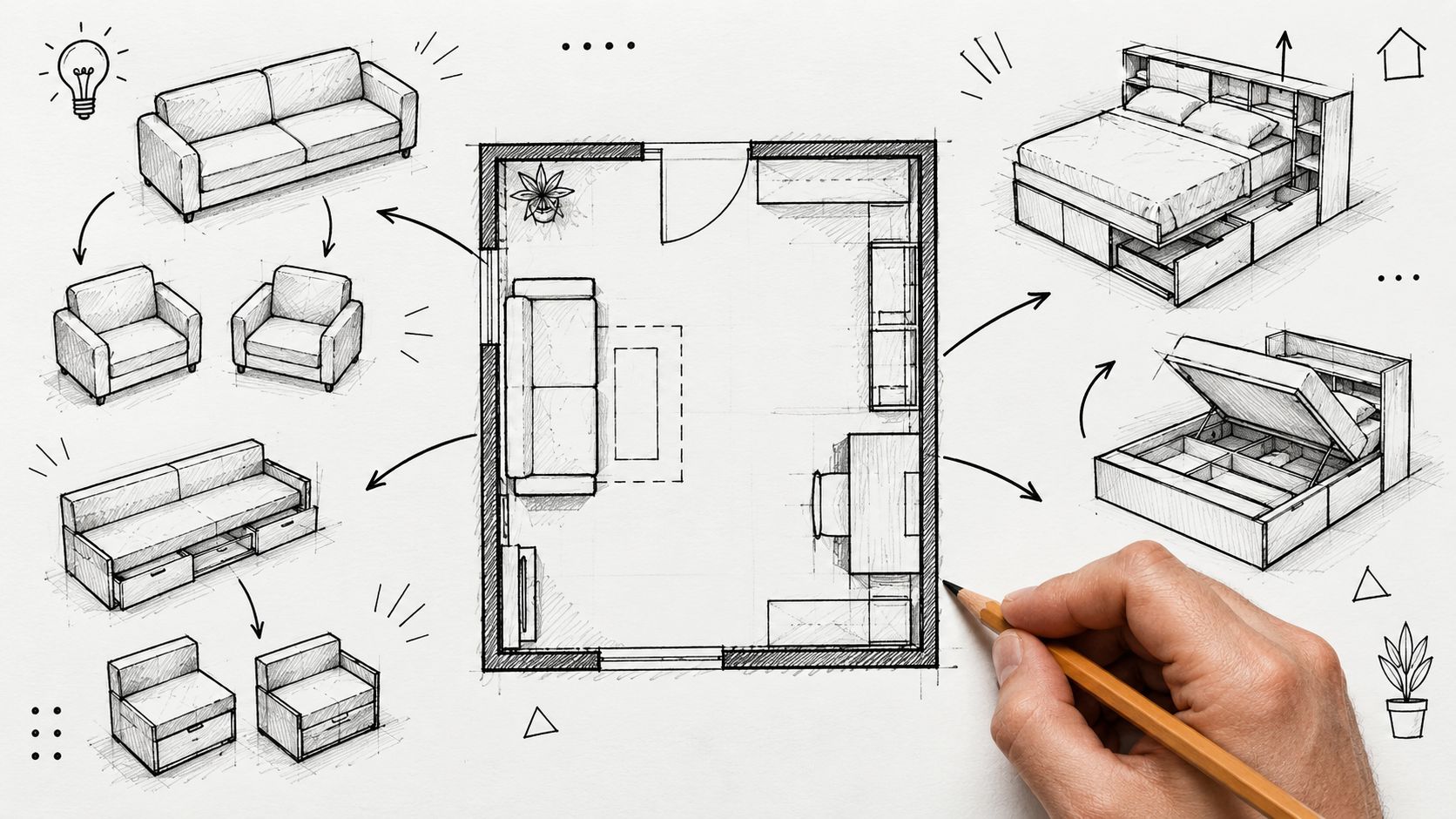
One of the most useful technical ideas behind modular furniture is the grid. Radiant Furn's discussion of modular grids and room planning notes that modular furniture commonly relies on 600mm, 900mm, or 1200mm modules for smooth reconfiguration. The same source also stresses the importance of pre-measurement and footprint taping to preserve 30 to 36 inches of clear pathway, since poor sizing can restrict walkways by up to 18 inches.
Start With Movement, Not the Furniture
A common starting point is asking, “What size sofa can fit here?” A better first question is, “How do people move through this room?”
Door swings, traffic paths, and sightlines matter more than many shoppers expect. A room can hold a handsome sectional and still feel frustrating if the arrangement pinches access to a hallway or forces people to sidestep around an ottoman every day.
A simple planning sequence helps:
- Measure the room shell: Note wall lengths, windows, doors, vents, and major architectural features.
- Mark circulation paths: Identify where people naturally walk from one point to another.
- Tape furniture footprints: Use painter's tape on the floor to test the actual footprint before buying.
- Check comfort zones: Sit, stand, pass through, and imagine ordinary routines.
Readers who want a second perspective on layout thinking may enjoy these modular furniture tips for small spaces, especially for seeing how flexible systems can support more than one room function.
Use the Tape Test Before You Commit
The tape test saves people from expensive mistakes. It turns dimensions into something visible and physical. Once the outline is on the floor, the room tells the truth quickly.
A taped sectional may reveal that the chaise blocks a key walkway. Two ottomans may look appealing on paper but prove awkward in the daily path to a balcony or adjacent room. A low storage unit may fit beautifully under a window while preserving more openness than a taller cabinet.
Layout check: If a room only works when no one is carrying laundry, setting down groceries, or walking through with a child or pet, the furniture is too large.
Plan for Real Life, Not a Static Photo
A small room changes throughout the day. Morning light may make one corner ideal for reading. Evening television may call for a different seating angle. Guests may require extra perches that don't permanently crowd the space.
That's why modular furniture for small spaces should be planned around scenarios, not just dimensions. A household may need:
- Quiet evenings: Seating oriented toward comfort and relaxation
- Work hours: A clearer floor area and a surface for temporary tasks
- Weekend hosting: Extra seating modules or ottomans that can move into service
- Overnight needs: A layout that can support sleeping or guest overflow
Those ideas often come together more clearly with visual guidance. This collection of living room furniture ideas for small spaces gives helpful examples of how proportion, openness, and storage can work together.
In-store associates can also help households translate room measurements into a workable plan, especially when the challenge isn't just square footage, but shape. Narrow rooms, offset windows, and open-concept layouts each call for a different strategy.
Choosing Materials for Heirloom-Quality Modular Pieces
Modularity only works well if the furniture can handle being moved, reconfigured, and lived with over time. A piece that looks clever on the sales floor can become disappointing if the frame weakens, the seat loses shape, or the connections start to feel unstable.
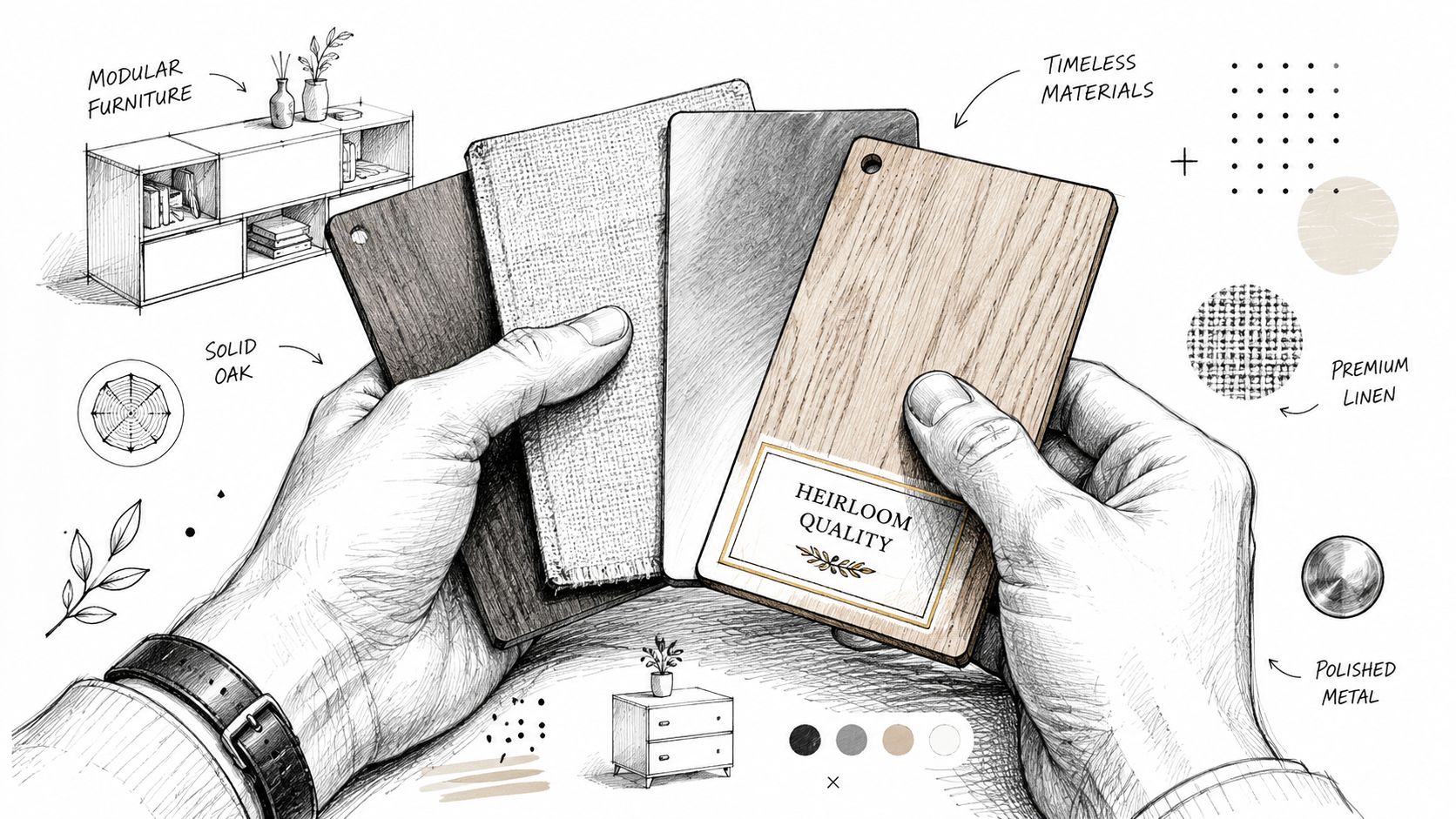
Material quality is where investment value shows up most clearly. Expert benchmarks for modular seating call for kiln-dried hardwood frames, sinuous springs, and high-resilience foam with a 1.8 to 2.0 lb density to help cushions maintain shape. That same guidance notes that moving away from quality materials can increase spatial clutter and reduce usability.
What to Look for in the Frame
The frame is the quiet structure that supports everything else. In modular pieces, that matters even more because sections need to remain aligned through repeated use and occasional rearrangement.
A stronger frame usually brings these advantages:
- Kiln-dried hardwood: Better long-term stability than lower-grade alternatives
- Well-engineered joinery: A more secure feel when sections connect
- Consistent support: Less chance of sagging or uneven settling over time
This is one reason respected names such as Lexington and Stressless carry weight with quality-focused shoppers. Construction standards shape how the furniture feels after years of use, not just how it photographs on day one.
Cushioning and Upholstery Matter Every Day
People notice cushions immediately, even if they can't name why one seat feels more supportive than another. High-resilience foam helps a modular piece keep its crisp profile instead of looking tired too early.
Upholstery choice matters just as much in a small space because the furniture often occupies a large share of the room's visual field. The fabric needs to feel good, wear well, and support the overall mood of the room. In compact homes, a durable performance fabric can be a wise choice, especially for households with children, pets, or frequent guests.
A small room magnifies every detail. When the sofa cushions slump or the upholstery wears unevenly, the whole room feels less composed.
Stability Is Part of Comfort
People often focus on size and fabric first, then think about stability later. That order should be reversed. A modular piece that shifts too easily or feels uncertain at the seams won't inspire confidence, no matter how attractive it looks.
The best modular furniture for small spaces should feel settled once configured. Sections should connect securely. Ottomans should feel intentional, not adrift. Every movable component should support flexibility without introducing wobble or visual disorder.
Heirloom-quality thinking is essential. A well-made modular piece isn't just adaptable. It stays graceful through years of changing layouts, evolving family routines, and everyday wear.
The Lott's Furniture Experience From Plan to Placement
A well-planned modular room comes together more smoothly when the shopping experience supports the same level of care. The strongest experience blends digital convenience, thoughtful guidance, customization, and dependable delivery.

For shoppers in South Georgia and North Florida, that process can begin online and continue in person at the Fernandina Beach, FL showroom. Browsing a digital catalog helps narrow styles and silhouettes at home. Visiting the showroom adds the essential layer of real-world testing. Seat depth, cushion feel, arm height, and finish tone are much easier to judge in person.
Customization and Expert Guidance
Customization is where modular furniture becomes especially meaningful. Through a Special Order Program, many vendors support personalized decisions in fabrics, finishes, and comfort levels. That includes customized comfort options from names such as La-Z-Boy and Smith Brothers, allowing households to shape a piece around both aesthetic goals and daily use.
Expert guidance also matters at the decision stage. Digital tools such as Style Quizzes and the Mattress Guide help shoppers sort through preferences before visiting. In-store associates can then refine those ideas, helping with scale, room planning, and finish coordination so the final choice feels considered instead of rushed.
Readers interested in that personalized process can explore getting started with custom order, where the path from inspiration to customized design becomes more concrete.
White-Glove Delivery and the Lott's Delivery Standard
Delivery is the last part of the design experience, and it shapes the first day of ownership more than many people expect. According to Lott's store policies, in-home white-glove delivery for modular furniture typically requires a 2 to 4 hour window due to multi-point inspection protocols. That standard helps ensure that every Lexington or Hooker Furniture modular unit reaches customers in South Georgia and North Florida in defect-free condition.
That attention matters. Modular furniture arrives with more than one component, more than one connection point, and more opportunity for small issues to affect the finished result. A rigorous inspection and in-home placement process protects the investment and spares the household from unnecessary frustration.
The result is a more smooth path from planning to placement. Digital browsing, showroom testing, customization, style guidance, and white-glove delivery all support the same goal. A small space that feels intentional, comfortable, and fully lived in.
Lott's Furniture helps homeowners and renters across South Georgia and North Florida create rooms that feel customized, comfortable, and beautifully resolved. Browse the online catalog, try the Style Quizzes, explore the Mattress Guide, or visit the Fernandina Beach showroom to work with an associate on a modular furniture plan that fits the home with precision.