
Beachy Dining Room Tables: A Coastal Buying Guide


The pale wood table looks right in the inspiration photo, but the dining area at home has a busy walkway, upholstered chairs worth keeping, and an air-conditioning vent nearby. A finish sample can settle the color question. It can't settle whether the table will fit comfortably or tolerate the room's changing conditions.
The best beachy dining room tables combine relaxed coastal character with construction suited to everyday meals, visiting family, and humid weather. For homeowners across South Georgia and North Florida, the useful starting point isn't a particular shade of white. It's a table that fits the household, handles moisture sensibly, and remains repairable after the first scratches appear.
Table Sizes and Seating Counts for Beachy Dining Rooms
Beachy dining table sizes and seat counts by shape
The planning examples below use the residential dimensions in Learn Architecture's dining-table guide and seating allowances from WoodBin's furniture-design reference: approximately 24 inches per rectangular-table diner, approximately 26 inches per round-table diner for smaller groups, and a standard table height of 28–30 inches.
| Shape | Common size | Seats | Layout note |
|---|---|---|---|
| Round | 40 in diameter, smallest common size | 2–4 | Suits compact rooms; curves ease walkway flow |
| Round | Approximately 50 in diameter, calculated from the round-table allowance | 4–6 | Check pedestal clearance and place-setting depth before using full capacity |
| Oval | Choose a top with usable seating edges that meet the per-diner allowance | 4–6 | Softens corners in narrow rooms; confirm size with an associate |
| Rectangular | 60 in | 4 | Two diners per long side at about 24 in each |
| Rectangular | 72 in, calculated from three seating zones | 6 | Three diners per long side; about 24 in of edge per diner |
| Rectangular | 96 in, calculated from four seating zones | 8 | Four diners per long side; confirm extension leaves |
These are layout starting points, not guaranteed capacities. A round table may have enough perimeter on paper but insufficient depth for generous place settings and shared dishes. A rectangular table can lose usable seating space to bulky legs or a deep trestle.
Check the chair relationship before choosing the finish
WoodBin's guidance also places chair seats approximately 11–13 inches below the tabletop and gives a common rectangular-table width of 36–42 inches. That relationship matters more than a matching collection name: a thick apron can obstruct knees even when the tabletop height looks correct.
Learn Architecture identifies 60–80 inches as a common residential rectangular range and recommends approximately 36 inches behind chairs where circulation is needed, with 30 inches functioning as a constrained minimum. Its guidance also allows about 2 additional inches per diner for armchairs.
Curved tops remove corners from circulation paths, but they don't eliminate the need to measure occupied seating. Tape the proposed footprint onto the floor, pull existing chairs into position, and test the route between the kitchen and surrounding rooms.
Fit check: Measure the room as people use it, not as it looks with every chair tucked away.
The dining table size guide provides another planning reference. For an unusually generous circular layout, MODERN LYFE's resource can help shoppers compare materials for large round tables, while keeping base placement and room access central to the decision.
Include the extended footprint in the floor test. Leaves are useful only when the expanded table still leaves workable routes and the household has suitable storage for removable sections.
Finishes, Shapes and Colors That Signal Beachy Style
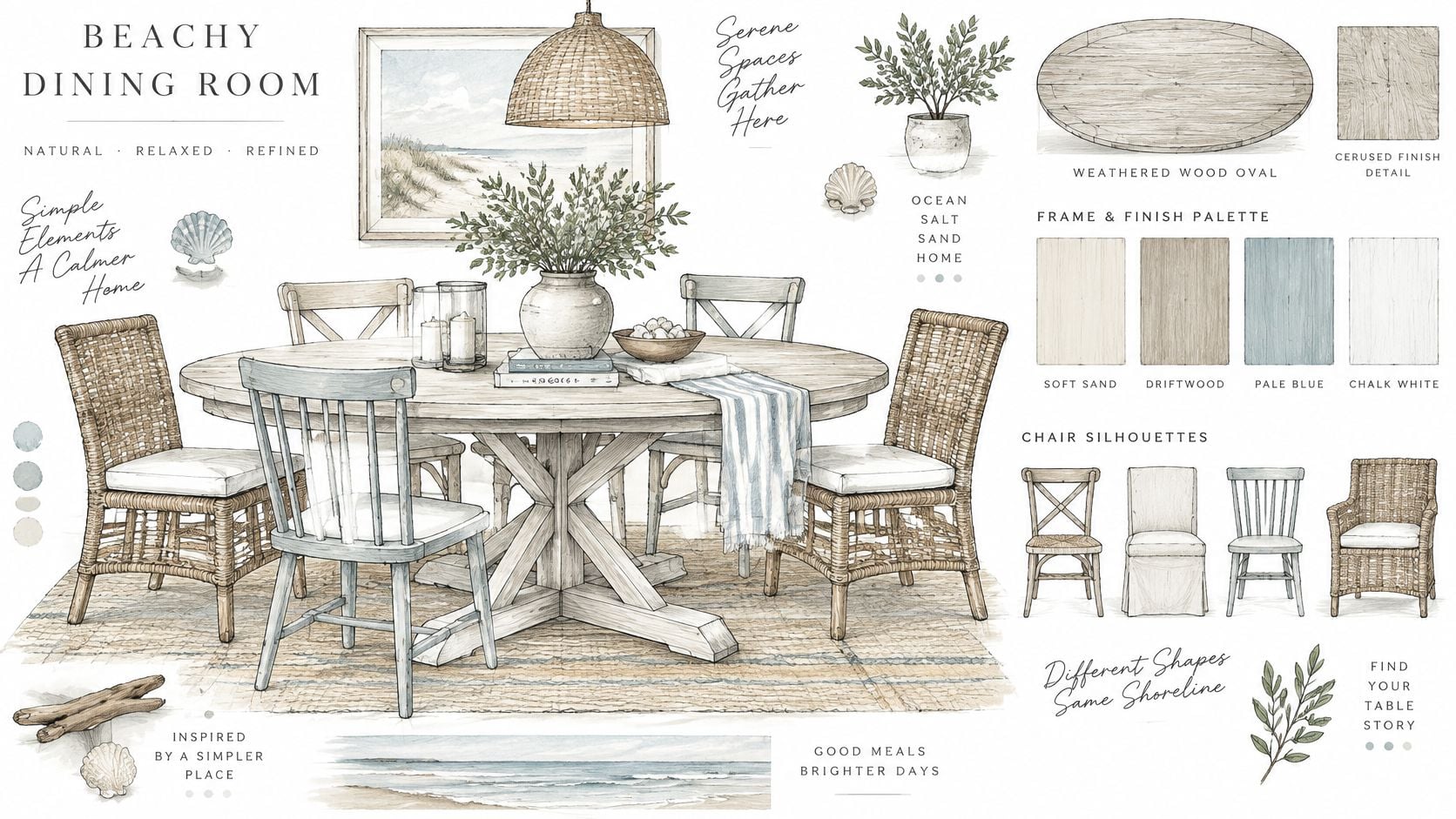
A pale oak table beside sand-colored chairs can feel coastal without a shell, anchor, or nautical stripe in sight. The effect comes from light-reflecting finishes, visible grain, and restrained texture, rather than a collection of beach-themed decorations.
Recognize the finish beneath the styling
Whitewashed wood leaves the grain visible beneath a pale veil. Cerused finishes emphasize the grain pattern, while weathered finishes soften the contrast between darker and lighter areas. Painted frames in soft white or sea-glass shades offer a clearer color statement.
Distressed edges suggest age, but the wear should look intentional. Examine whether the treatment complements the table's shape or makes vulnerable edges harder to assess.
- Airier silhouettes: Oval tops and pedestal bases reduce visual clutter beneath the tabletop.
- Traditional coastal character: Thick plank tops and turned legs create a more substantial, cottage-inspired presence.
- Woven accents: Cane chair backs or rattan details add texture without requiring a fully woven dining arrangement.
A pale table, sand-toned upholstery, and a deeper navy or driftwood-gray accent generally create more flexibility than an entirely white composition. Repeating woven details on every surface can also make a room feel themed rather than collected.
A coastal room should feel calm enough for everyday breakfast, not staged only for a vacation photograph.
The coastal-style interior design guide helps connect these choices with the surrounding home. For a dining room that doubles as a gathering space, ROCKS Whiskey Chilling Stones' selection of thoughtful lake house gifts for whiskey lovers offers accessory inspiration without requiring another large furniture statement.
The final visual test is simple: the table should have character while the room still feels open. That appearance is worth keeping only when the construction is equally convincing.
Which Beachy Table Construction Survives Humid Coastal Air and Earns Its Price
Table construction and humidity behaviour compared
| Construction | Humidity behaviour | Repair path | Best fit |
|---|---|---|---|
| Solid wood top | Moves most across the grain; can cup or check if placed badly | Sand or refinish when suitable; specialist repair or replacement of damaged breadboard ends | Families and frequent use; repairs well over time |
| Veneer over core | Faces can remain stable; edges and seams can lift after standing water | Veneer patch repair; limited refinishing | Refined look in climate-controlled rooms |
| Engineered wood | Generally steadier than solid wood across seasons; core composition matters | Limited refinishing; top may need replacing | Rooms with steady air conditioning |
| Mixed base with wood top | Top moves while a dimensionally stable frame stays comparatively steady | Refinish the top; tighten or replace suitable fasteners | Balance of coastal appearance and durability |
| Painted or distressed solid wood | Paint and distressing change appearance but don't stop wood movement | Repair, then repaint or restore worn protection | Strong coastal finish for owners who accept upkeep |
No construction wins every comparison. Solid wood offers a useful repair path, but it requires movement-friendly construction. A well-made veneered top can provide an elegant, stable surface, yet damaged edges demand a different repair approach.
Understand what humidity does to wood
The USDA Forest Service's guidance on wood moisture and dimensional change explains that wood exchanges moisture with surrounding air, shrinking as cell-wall moisture decreases and swelling as it increases. Tangential movement is typically greatest, radial movement is approximately half as large, and longitudinal movement is minimal.
That matters in coastal homes because the table isn't exposed to a single, unchanging environment. An air-conditioned dining room, an open patio door, and a sunlit window can create different conditions around the same piece.
Ask about properly acclimated lumber, the top's attachment method, and protection on exposed surfaces. Solid-wood tops need attachments that accommodate cross-grain movement rather than rigidly restraining it. Breadboard ends should also accommodate the panel's movement instead of forcing it into an immovable frame.
The kiln-dried hardwood guide explains a useful construction term, but kiln drying alone isn't a lifetime guarantee against movement. Joinery, acclimation, placement, and indoor conditions still matter.
Match the repair path to the household
For daily family dining, a refinishable solid-wood surface can justify a larger initial investment. Before assuming that benefit applies, confirm that the finish and construction permit refinishing. An elaborate surface treatment may require specialist work to reproduce.
Veneer isn't automatically an inferior choice. Its appeal includes a consistent grain presentation over a suitable core, but aggressive sanding can cut through the decorative layer. Examine edge banding, seams, and the protection around leaf connections.
Engineered wood needs a more specific description than its category name. Ask what the core contains and how edges are sealed. A stable panel can still suffer serious damage if water reaches a vulnerable substrate.
For mixed-material tables, inspect the connection between the top and base. A steady metal frame doesn't prevent a wood top from moving, so the attachment must accommodate both materials.
Judge value beyond the label
A U.S. consumer survey reported by Home Accents Today found that 57% said they would be likely to buy furniture labeled sustainable, while 55% identified price as the top barrier. A useful buying decision therefore needs more than an appealing environmental label.
Look for accessible fasteners, replaceable hardware, repairable surfaces, and clear care information. Reclaimed appearance doesn't prove reclaimed content, and reclaimed content doesn't by itself establish sound construction.
For light use or a shorter ownership horizon, a value-focused table with a protected surface may be sensible. For a long-term family home, repair potential deserves greater weight.
Before committing, inspect the top's material, the tightness of its joints, and finish coverage at edges and underneath. Keep solid wood away from concentrated HVAC discharge, damp exterior walls, and intense direct sun. A distressed or cerused finish creates character; it doesn't waterproof the table.
Mixing a Beachy Table With Chairs, Rugs and Lighting
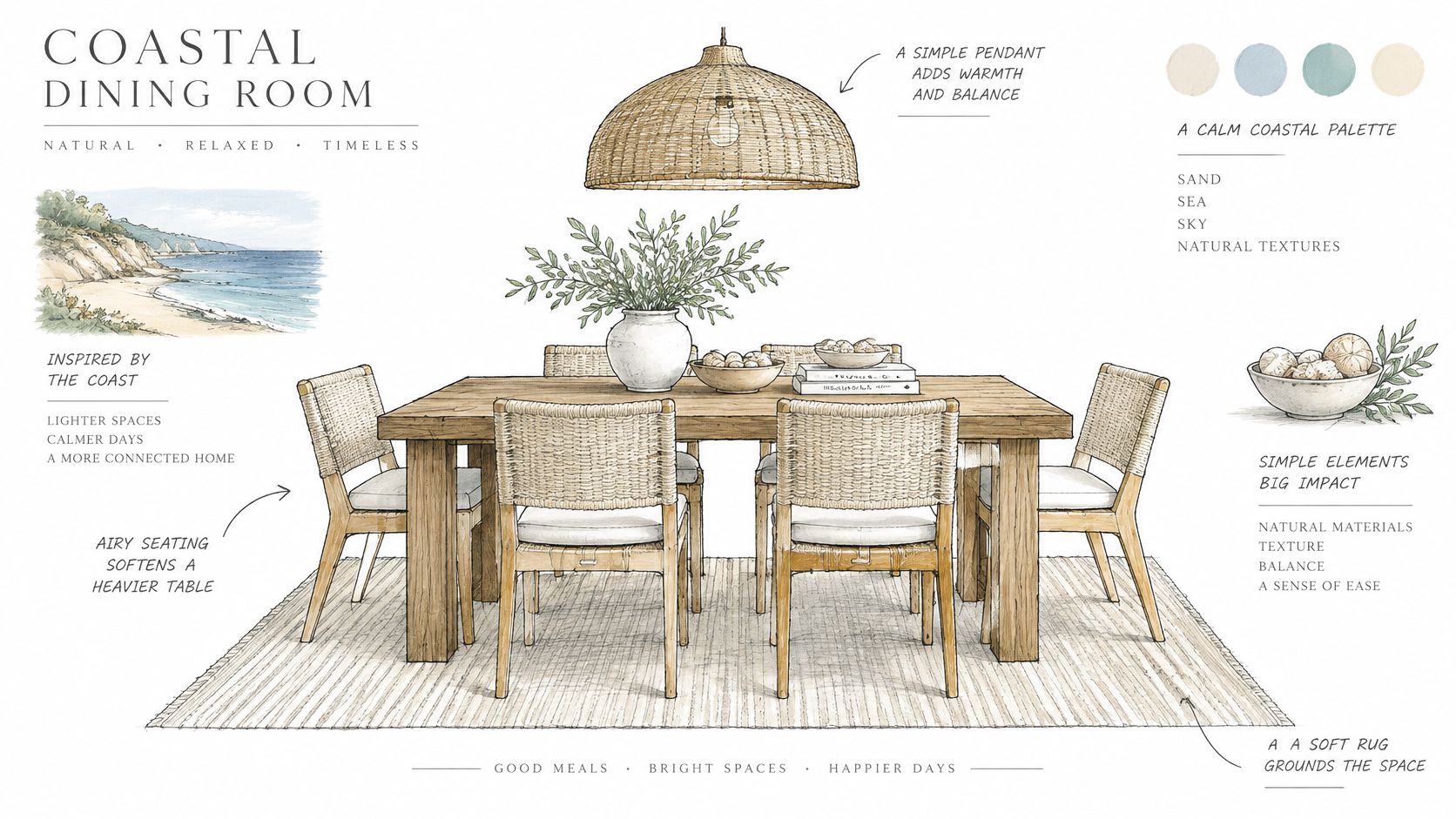
A substantial wood table needs some visual breathing room. Lighter chair frames, a low-profile rug, and a translucent pendant can balance its weight without making the dining area feel unfinished.
Build a coordinated coastal composition
Start with chairs that fit between the table's legs and feel comfortable beneath its apron. Then layer materials with different jobs: linen-look cushions soften seating, a woven rug defines the dining area, and glass or rope lighting adds detail overhead.
The guide to choosing dining chairs helps narrow the practical choices. A chair that looks delicate may still have arms that won't tuck beneath the table.
Lott's Furniture carries Lexington, Hooker Furniture, and Smith Brothers, allowing coordinated dining and adjoining living-space decisions within a broader home plan.
- Lexington direction: Consider upholstered dining chairs that echo a pale table's softness without matching its wood finish exactly.
- Hooker Furniture direction: Evaluate painted or light-finish pieces alongside sea-glass colors and sand-toned textiles.
- Adjacent seating: Let nearby upholstered furniture repeat a color or texture rather than duplicating every dining-room detail.
Flooring is part of that composition, too. A reference such as Nexora Flooring's Cali Longboards Sea Breeze Oak flooring can help illustrate the pale-oak direction, but physical samples should be compared under the room's actual light.
Use undertones to connect unlike pieces
Choose a dominant wood tone and a deliberate contrast rather than collecting unrelated finishes. A warm beige oak table can sit comfortably with creamy upholstery; a cooler gray-washed table needs a more careful comparison against yellow-toned flooring.
Lott's Furniture's Style Quizzes and style guides identify design preferences through a few simple questions. Interactive guides help with texture and scale, and in-store associates can assist with design decisions.
The strongest connection is often a shared warm or cool undertone. Matching every finish isn't necessary when the underlying palette feels intentional.
Customizing a Beachy Table Through Our Special Order Program
A coastal inspiration photo rarely matches the room, the seating count, and the furniture a household already owns. Customization earns its keep when it closes those gaps one decision at a time.
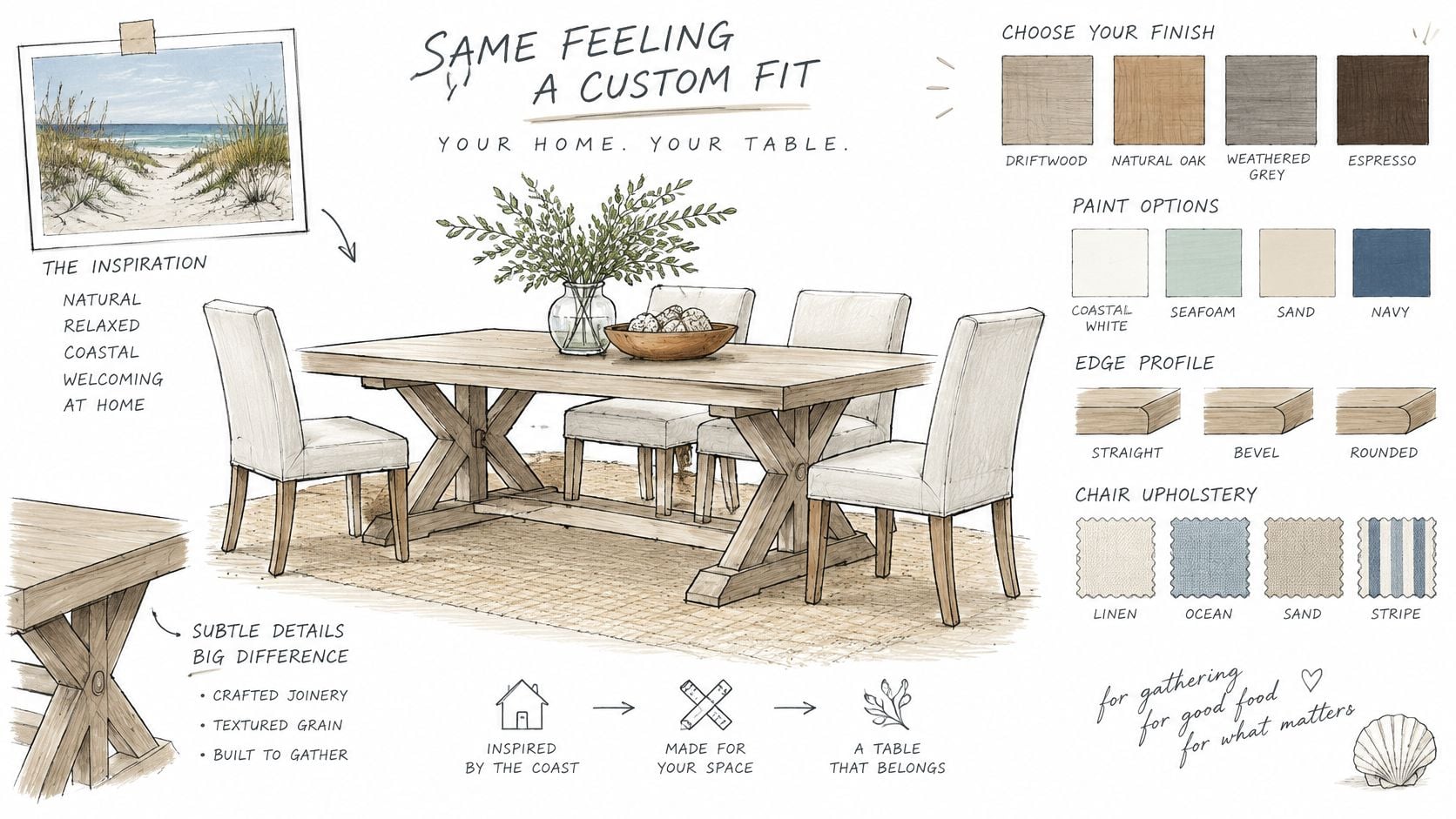
Lott's Furniture's Special Order Program supports personalized designs, and most vendors offer special orders. Depending on the collection, selections can include fabrics, wood finishes, cushion firmness, and arm styles. Not every option applies to every dining piece, so the first question at the desk is which choices that specific table allows.
Make customization solve practical problems
Bring room photographs, a measured floor plan, and samples of finishes that will remain. A picture of an existing sideboard can reveal more about the required wood tone than a broad request for a beachy look.
Fabric and leather libraries offer thousands of textures, patterns, and colors across the home. Lott's Furniture designers show customers a variety of fabric designs that meet their upholstery needs, which narrows the field quickly for households with children or pets. For a coastal room, ask how a candidate fabric handles damp air and whether it wipes clean, because a pale linen weave that looks right under showroom lighting can mark permanently after one humid summer of daily meals.
Finish choice carries the same double duty. A painted or light-stained top reads beachy, but sheen and texture decide whether it can be touched up later. Air conditioning pulls moisture from the air while open-window weeks push it back in, and a top that moves with those swings shows the result at the seams. Confirm the touch-up story and the collection's ordering timeline before you build moving or delivery dates around it.
In the 2025 Digital Furniture Index survey of 9,000 American consumers, 31% ranked personalization among their top purchase criteria. In a dining room, that preference pays off when the extra choices produce a better fit you can live with at every meal.
Set custom decisions in a useful order
- Size: Establish daily seating and occasional hosting needs.
- Shape: Choose the outline that suits circulation and conversation.
- Base: Check chair access, knee space, and visual weight.
- Top finish: Compare the chosen tone with flooring, retained furniture, and the humidity the room sees.
- Chair fabric: Balance texture, cleanability, and the surrounding palette.
- Comfort level: Confirm support and cushioning wherever the collection permits a choice.
Order matters, because each decision narrows the next. Locking size and shape first keeps the finish conversation from drifting toward a table that seats too few people at a holiday dinner. Locally owned and operated, Lott's Furniture pairs that sequence with staff who can walk a collection with you, piece by piece. Special ordering is most useful when it produces a better-fitting table for everyday meals.
Care Routine and Fixes for Beachy Table Finishes
Care starts with identifying the surface. Painted wood, clear-coated oak, waxed wood, and veneer may look equally relaxed, but they shouldn't automatically receive the same cleaner or repair treatment.
Beachy table symptoms, likely causes and first fixes
| Symptom | Likely cause | First fix |
|---|---|---|
| Cupping or gaps in a solid top | Humidity swings or a vent blowing on the table | Move away from vents and stabilize indoor humidity |
| White rings or haze on the finish | Moisture trapped beneath or within the finish after a spill | Dry promptly; test gentle buffing with a finish-safe polish |
| Lifting veneer edge | Standing water or heat near a seam | Dry the area, stop the source, then arrange professional regluing |
| Loose leg or apron joint | Seasonal movement or loose hardware | Tighten accessible hardware carefully; a shifting glued joint needs professional repair |
| Dull, dry-looking finish | Sun exposure, surface buildup, or wear | Clean appropriately; restore wax or topcoat only when compatible with the original finish |
Keep the routine simple and finish-specific
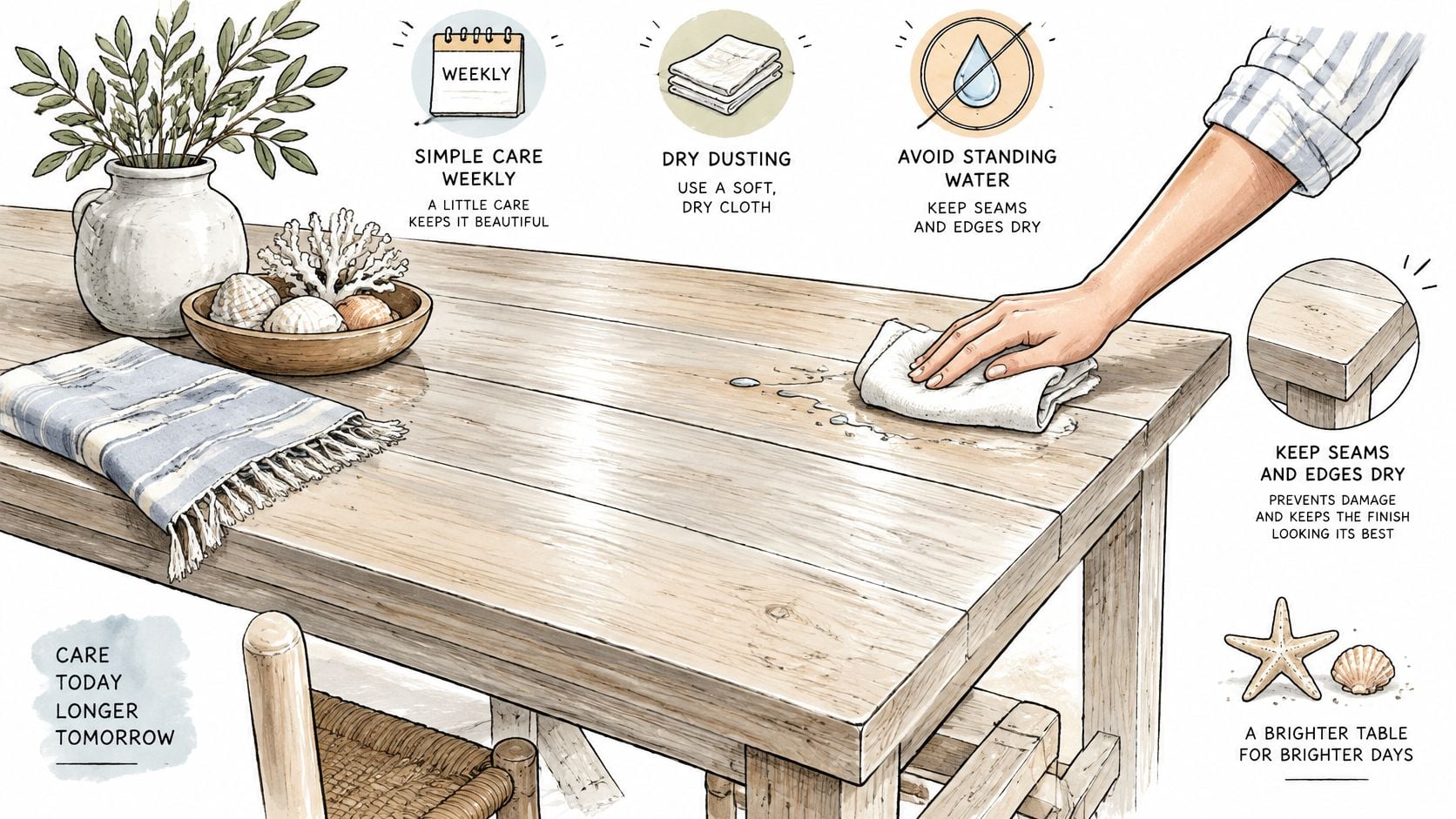
Daily, blot spills promptly with a soft cloth, then dry the area. Don't leave damp placemats, flowerpots, or condensation against seams and edges.
Weekly, remove grit with a dry microfiber cloth. If cleaning is needed, use a finish-compatible pH-neutral cleaner diluted according to its directions, applied to the cloth rather than poured onto the table. Avoid routine oil-based treatments that can leave buildup or haze.
Monthly, use a hygrometer to watch for changes in indoor humidity and inspect leaf joints, end grain, and leg-to-apron connections. The wooden dining table protection guide offers additional preventive-care guidance.
Know when a home fix should stop
Light surface marks may respond to an approved polish, but scratches through the finish require a different treatment. Don't aggressively buff a matte or distressed surface, because the repaired patch may become shinier than its surroundings.
Seasonal care means checking protection, not automatically adding another coating. Wax belongs only on compatible finishes, and a worn topcoat may need professional preparation rather than a household touch-up.
Repair boundary: A lifted veneer edge or a glued joint that shifts under normal use needs more than cosmetic polish.
If a symptom returns, reassess placement and indoor conditions before repeating the treatment. Recurrence can also indicate a failed joint or damaged substrate, so persistent problems deserve professional evaluation rather than another coat of finish.
Book Your Showroom Visit or Style Consultation
A showroom visit works best when you arrive with four things settled: the seating count you need, the room's usable footprint in inches, the construction you are willing to pay for, and the finishes already in your home. Bring room photos and a rough tape-measure sketch. An associate can then tell you whether your inspiration photo is a look you like or a table that will fit, and those are often two different answers.
Lott's Furniture's professional sales staff aims to help each customer transform a house into a beautiful and comfortable home. In a coastal dining room, that conversation should cover how the table feels during a long meal, how much clearance chairs need to push back, and how much upkeep the household will realistically do. A distressed paint finish that hides everyday wear still needs wiping. A natural wood top shows every ring, and knowing that before you order changes which one you pick.
Connect online planning with a hands-on visit
Shopping the digital catalog online and visiting the Fernandina Beach showroom can be two parts of one decision. Save promising styles at home, then use the visit to examine grain, compare finish samples, and sit at a table with an associate nearby to answer questions about scale.
The store is at 2110 Sadler Square, Fernandina Beach, FL 32034, phone 904-261-6333. If the dining room is one piece of a larger refresh, the same trip can cover bedroom and mattress needs.
Know what delivery actually covers
White-glove, in-home delivery is the difference between a table left at the curb and a table placed where you will use it. At Lott's Furniture, every piece undergoes a rigorous multi-point inspection before it reaches the customer, and the delivery team brings the furniture inside and positions it in the room of choice. Ask during the design stage which pieces qualify for that service, and measure the doorway and stair run before you commit, because a wide pedestal base that clears the floor space can still fail a tight turn.
That is also the moment to settle care expectations in writing: which finish you are choosing, what the first humid summer will do to it, and which cleaner the maker recommends. Confirming it before the order beats discovering it after the first scratch.
Lott's Furniture offers personalized design guidance, Special Order choices, and white-glove delivery for coastal dining spaces across South Georgia and North Florida. Visit Lott's Furniture to explore the digital catalog, plan a Fernandina Beach showroom visit, or arrange an online style consultation for a beachy dining table that fits both the room and the household.

