Full Grain vs Top Grain Leather Sofa: A Buyer’s Guide


A homeowner stands in a showroom between two leather sofas with nearly identical silhouettes. One has a rustic, lightly waxed surface with visible markings. The other has a smooth, even finish that looks polished from every angle. Both feel substantial. Both are genuine leather. The difficult question isn't which sofa carries the more prestigious label. It's which surface will suit the household, the room, and the way the sofa will be used every day.
That choice matters in South Georgia and North Florida, where humidity, bright coastal sunlight, children, pets, and air-conditioned interiors can influence how upholstery looks and feels over time. A full-grain sofa may be the right choice for a quiet room where natural character is part of the design. A well-built top-grain sofa may serve a busy family room better, especially when predictable color and simpler maintenance matter more than visible patina.
Two Sofas, One Big Decision
The homeowner in the showroom runs a hand across both cushions. The full-grain leather feels alive, with small variations in texture and color that make each panel distinctive. The top-grain leather feels more consistent and refined, with a finish that seems easier to understand at a glance.
A salesperson who pushes the most expensive-looking option isn't giving useful advice. The better question is practical: who will sit on the sofa, how often will it be used, and how should it look after years of living?
Full-grain and top-grain leather come from the same outer portion of an animal hide. Full grain keeps the complete natural grain layer, while top grain is lightly sanded or buffed to remove blemishes and create a more uniform appearance. Both remain genuine hide, and both can make a comfortable, investment-quality sofa. The difference is the amount of natural surface retained and the way that surface is finished. A detailed guide to leather types explains why the grain layer matters to the hide's fiber structure, breathability, and resistance to abrasion.
The room should decide before the label
A full-grain sofa can be beautiful in a study, formal sitting room, or heirloom-focused living area. Natural pores, scars, wrinkles, and color shifts become part of the room's story. In a family room with children, pets, snacks, and constant activity, those same marks may feel less like character and more like maintenance.
Top grain often makes sense for a coastal home near Fernandina Beach, especially when the buyer wants a coordinated sectional with an even appearance. It can also suit a primary family room in Waycross where spills, frequent seating, and straightforward care take priority. That doesn't make top grain an inferior choice. It makes it a more practical finish for a particular household.
Practical rule: The wrong leather in the wrong room can disappoint faster than a less expensive leather selected for the right room.
The comparison below keeps the decision grounded in use rather than prestige.
| Buying concern | Full grain | Top grain |
|---|---|---|
| Surface | Natural grain, pores, scars, and markings remain visible | Surface is corrected for greater visual consistency |
| Feel | Breathable, tactile, and likely to soften with use | Often smoother and more uniform, with finish affecting hand feel |
| Aging | Natural variation and patina become more noticeable | Appearance generally stays more consistent while the finish remains sound |
| Spill tolerance | Depends heavily on finish, dye system, and protection | A protective coating may make everyday cleanup more predictable |
| Best match | Buyers who value authenticity and visible aging | Families and entertainers who prefer uniformity and easier specification |
| Main caution | Natural marks may show quickly | “Top grain” doesn't define one fixed performance level |
The right decision includes construction, finish, cushion design, care, sunlight, warranty language, and intended lifespan. A showroom test sit remains more useful than a label alone.
What Full Grain and Top Grain Actually Mean
The terms describe where the leather comes from and how its surface is processed. They don't function as universal performance grades.
Full-grain leather retains the original grain surface after the hair and epidermis are removed. The natural pores, healed scars, wrinkles, and fiber variations remain visible because the surface hasn't been buffed, snuffed, or split away. The Leather Research Laboratory's explanation of full grain and top grain also makes an important distinction: “top grain” can refer to the same outer hide layer as full grain, rather than automatically identifying a separate quality tier.
The hide is first prepared and tanned. Tanning may use plant-derived tannins or mineral systems, and the final upholstery can receive aniline dye, semi-aniline protection, pigment, wax, or another finish. Those choices affect color depth, touch, breathability, stain response, and how the leather reacts to repeated bending. Buyers considering an aniline leather sofa should ask precisely how much surface protection the upholstery has, because “full grain” alone doesn't answer that question.
Surface correction changes the goal
Top-grain leather begins with the same outer portion of the hide, but the visible surface may be lightly sanded or buffed to reduce scars and inconsistencies. The manufacturer may then add pigment or embossing to create a coordinated pattern. That process can produce the smooth, refined appearance many homeowners prefer for a sectional or motion sofa.
The amount of correction matters. A lightly corrected hide and a heavily embossed hide can both be called top grain, even though they may feel and perform differently. An upholstery leather guide from American Leather describes surface correction as an abrasive process that creates a smoother finish and reduces visible follicles.
Labels below the grain layer need clarification
Top grain shouldn't be confused with bonded or faux leather. Top grain remains genuine animal hide. Bonded leather combines leather fibers with adhesive and a surface coating, while split leather comes from a lower layer of the hide and may receive substantial surface treatment.
A buyer should ask the retailer to identify:
- Hide section: Is the visible upholstery full grain, corrected top grain, split leather, or a combination?
- Finish type: Is it aniline, semi-aniline, pigmented, waxed, or embossed?
- Coverage: Are the outside back, sides, and matching pieces made from the same leather, or are some areas synthetic?
- Testing: What flex, abrasion, color-transfer, and cold-crack information applies to the actual upholstery?
Authenticity and uniformity are different design goals. Full grain preserves more of the hide's original identity. Top grain edits that identity to create consistency. Neither description tells the whole sofa's story.
Side by Side on Look, Feel, and Aging
A full-grain sofa suits a household that wants leather to show its history. Pores, healed scars, wrinkles, and small differences between panels remain visible. These marks are part of the hide's character, not manufacturing defects. A guide to natural-grain leather explains that natural markings reflect the material's original surface.
Full grain softens with use and can develop richer highlights where hands, clothing, and sunlight make regular contact. Choose it for a relaxed room, a family that accepts visible change, or a space where character matters more than perfect matching. In a bright coastal home, however, expect sunlight and daily wear to make that change more noticeable.
Top grain usually presents a smoother, more coordinated surface. Its feel can be supple, firm, or coated, depending on the finish. A protective coating may make early spill management more predictable, but it can also reduce breathability and shape how the leather ages. The sofa may keep a consistent appearance for longer, then show wear as the coating thins.
For shoppers comparing partner collections in Lott's Waycross and Fernandina Beach showrooms, sit on both types under the same lighting. Look at the panels, run your hand across the surface, and decide whether you prefer visible character or controlled uniformity. If a recliner is part of the plan, our best leather recliner chair guide covers what to check before you sit down.
Full Grain vs Top Grain at a Glance
| Attribute | Full grain | Top grain |
|---|---|---|
| Natural markings | Pores, scars, wrinkles, and fiber variation remain visible | Many surface imperfections are reduced or concealed |
| Color | May vary across panels and deepen with use | Usually more even and coordinated |
| Hand feel | Often tactile and breathable, with a surface that can soften | Often smoother, with feel determined strongly by the coating |
| Patina | Visible and central to the look | More restrained, with the finish shaping the aging process |
| Spill response | Depends on the finish and care instructions | A coating may provide more predictable initial resistance |
| Visual consistency | Panels may not look identical | Matching panels are generally easier to coordinate |
| Best fit | Character, authenticity, and gradual change | Consistency, practical upkeep, and a tailored appearance |
Leather grade alone does not settle the durability question. One published comparison reported that full-grain samples retained 92% of original tensile strength after 10,000 flex cycles, while corrected top-grain samples retained 64%. That presentation was indicative, not a universal industry benchmark. The comparison and its limitations are discussed in this leather guide.
A separate controlled finishing study found a different trade-off in its tested materials. Corrected grain recorded the highest measured strength, yet also the lowest elongation, water absorption, water-vapor permeability, and flex resistance among the compared finishes. The full study is available in this leather-finishing research document.
The best leather is the one whose aging story fits the homeowner's expectations.
Choose full grain when you welcome a changing surface and can live with natural variation. Choose top grain when coordinated color, easier initial upkeep, and a more tailored appearance matter more. Judge the actual sofa, finish, climate, and household habits, not the grade name alone.
Why the Leather Label Is Only Part of the Story
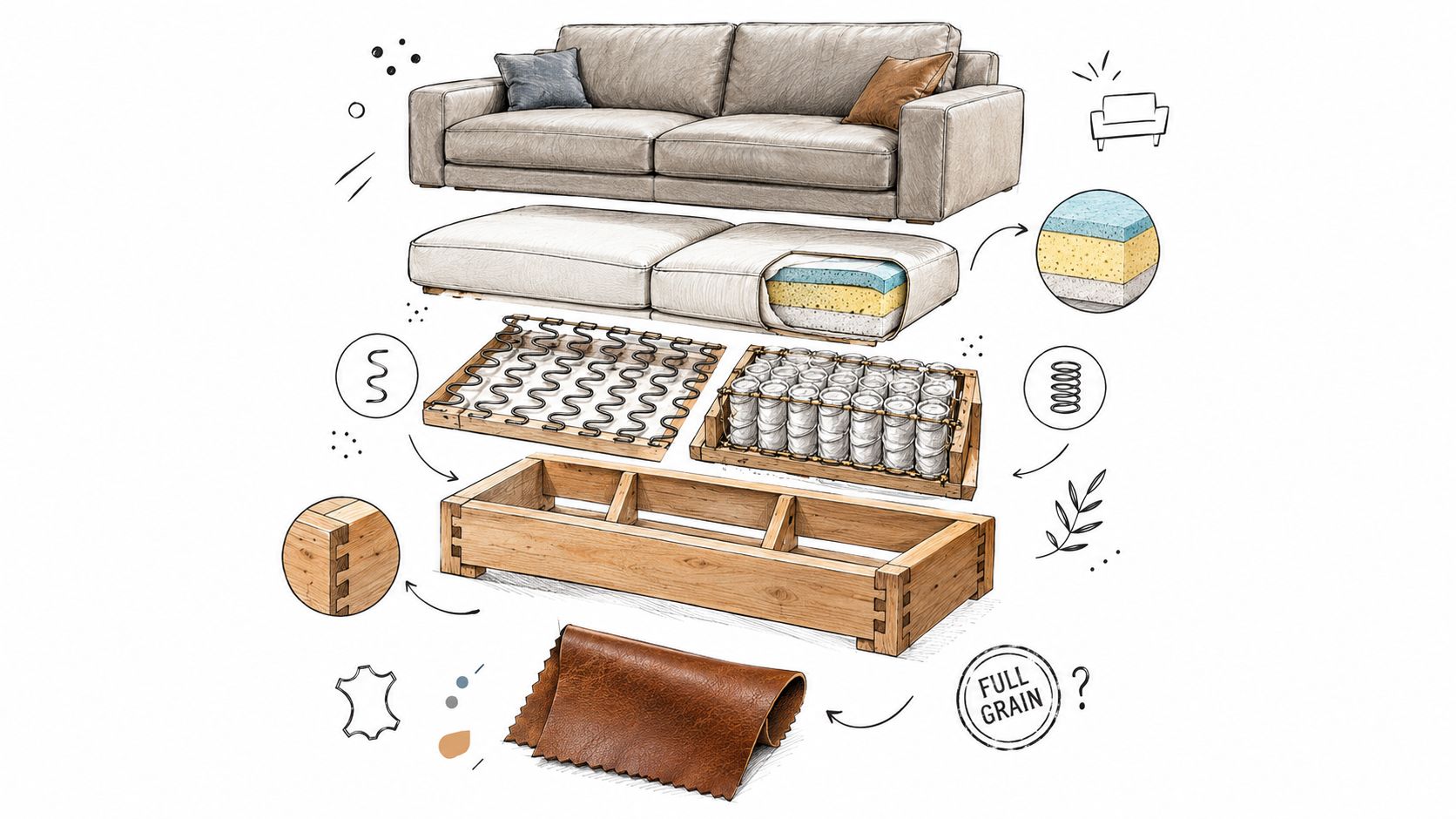
A full-grain cover can't rescue a weak frame. A top-grain cover can't compensate for cushions that collapse, loose seams, or a suspension system that doesn't distribute weight properly. Whole-sofa durability begins underneath the leather.
Frame material and joinery deserve close inspection. Kiln-dried hardwood, reinforced corners, and secure joints provide a stronger foundation than a frame that flexes or creaks under modest pressure. Suspension also changes the seating experience. Eight-way hand-tied systems, sinuous springs, webbing, and other designs can all work when properly engineered, but the construction should match the sofa's intended use.
Cushion design matters just as much. A resilient cushion core can recover after repeated seating, while an unsuitable fill may flatten even when the upholstery still looks excellent. Seam placement, thread quality, reinforcement at stress points, and the finish's resistance to repeated bending all influence the sofa's service life.
A showroom inspection earns its place
A buyer doesn't need to be an upholsterer to identify warning signs. A deliberate test reveals more than a quick glance at a leather swatch.
- Lift one corner carefully: A stable, substantial frame should feel composed rather than flimsy or excessively flexible.
- Ask about the frame: Look for kiln-dried hardwood and clear information about corner blocks, joinery, and structural warranty coverage.
- Press the cushions: Notice how quickly the cushion core recovers and whether the seat feels supported rather than hollow.
- Study the seams: Look for even stitching, clean transitions, and reinforcement where the upholstery changes direction.
- Test the finish appropriately: A showroom associate can identify an approved hidden-area test for friction, color transfer, or surface response.
- Inspect every visible side: Confirm whether the outside back and arms use matching leather, split leather, or synthetic material.
This guide to bonded and genuine leather helps clarify why the material description should cover the complete upholstered piece, not only the seating surface.

Ask for test information, not marketing adjectives
Leather testing can include wet and dry flex resistance, abrasion, upholstery-finish flex, and cold-crack resistance. Relevant methods include ISO 5402-1, ISO 17076-1, ASTM D2097, and ASTM D1912, but these standards don't impose one universal pass or fail value for every sofa. Leather physical testing methods and their intended use are outlined by CTC Groupe.
The practical request is simple: ask for results tied to the actual leather and finish combination. A premium label without construction details is weaker evidence than a clear explanation of the frame, suspension, cushion core, finish, and warranty.
Lott's Furniture carries brands such as La-Z-Boy, Smith Brothers, Lexington, Stressless, and Hooker Furniture, giving shoppers an opportunity to compare upholstery, motion mechanisms, frames, and cushion comfort in person. The retailer's associates can also explain how a chosen leather option fits the complete sofa rather than treating the hide label as the entire purchase.
Care, Climate, and Daily Habits That Extend Sofa Life
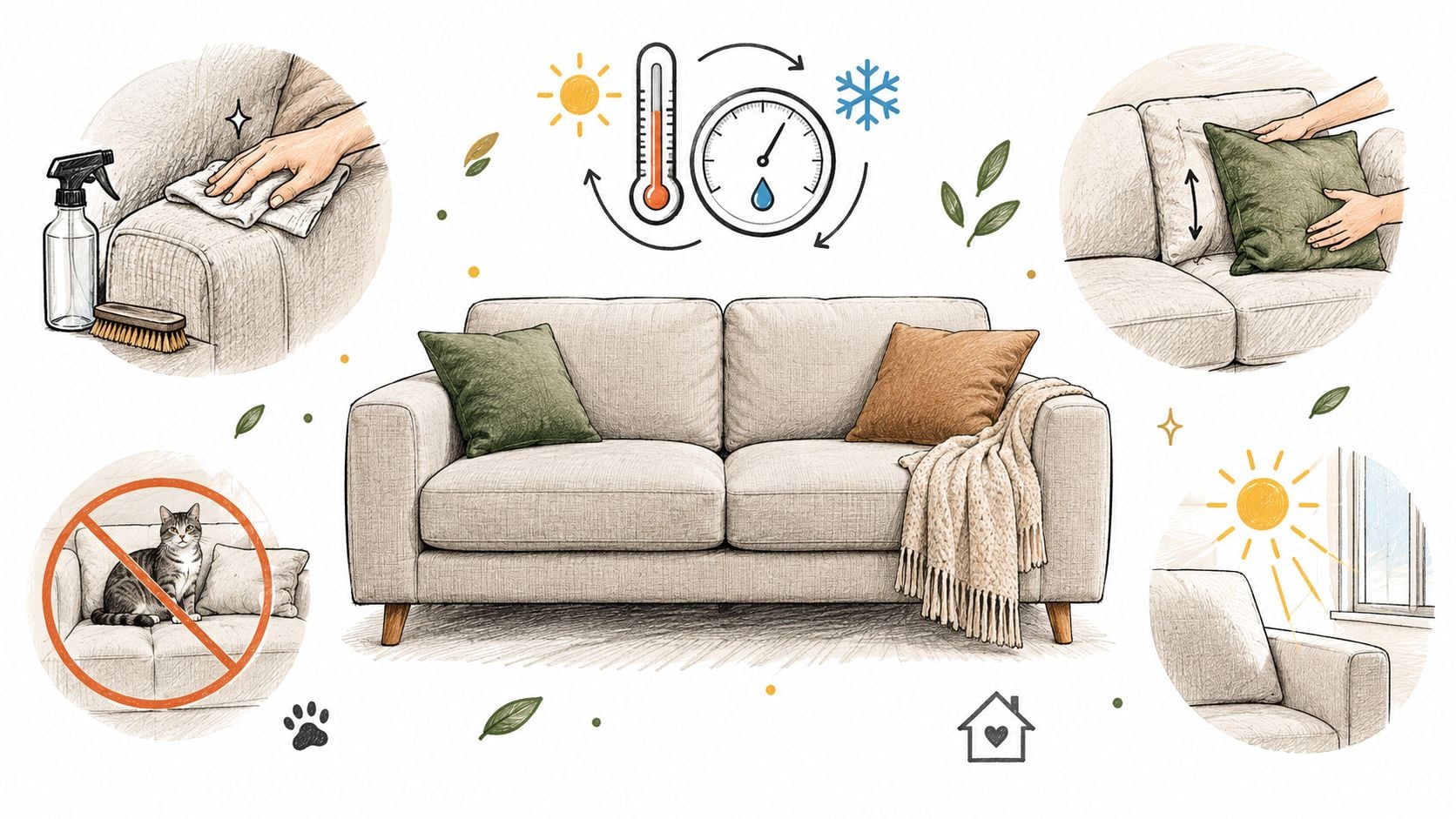
Leather care should follow the finish manufacturer's instructions, not a household cleaning shortcut. Weekly dusting with a soft cloth prevents grit from working into seams and contact areas. Spills should be blotted promptly, never scrubbed, and a pH-balanced leather cleaner is safer than an improvised household product.
Full grain often rewards careful conditioning because its natural surface can respond noticeably to dryness and handling. Top grain may need less frequent conditioning, but its coating still requires appropriate care. A schedule of every six to twelve months is a common starting point, but the right interval depends on the finish, room conditions, sunlight, and manufacturer guidance. Since that cadence varies by product, the care label should control the routine.
Southern rooms need placement discipline
South Georgia and North Florida homes can expose leather to humidity swings, intense window light, and dry conditioned air. Leather-care guidance warns that relative humidity below 40% can remove moisture and make leather harder and less elastic. The referenced care and climate guidance also supports keeping upholstery away from direct heat and prolonged sunlight.
Practical placement makes a difference:
- Control the window exposure: Use curtains or shades where Florida-facing sunlight reaches the sofa for long periods.
- Avoid damp exterior walls: Leave sensible space between leather and walls that collect moisture.
- Limit heat sources: Keep sofas away from vents, fireplaces, radiators, and other concentrated heat.
- Keep conditions stable: Sudden changes can stress leather more than a reasonably consistent indoor environment.
- Protect high-contact areas: A washable throw can reduce oil and friction on a favorite arm or seat.
Pet nails should stay trimmed, and cushions should be rotated when the construction allows it. Those small habits reduce concentrated wear without turning the sofa into a showroom display that nobody is allowed to use. Property and hospitality teams can also review asset protection for hotel managers for broader stain-prevention principles that translate to heavily used seating.
For product-specific instructions, the guide to cleaning leather furniture at home offers a useful reference before applying any cleaner or conditioner. A retailer should provide finish-specific recommendations at purchase, particularly for aniline and semi-aniline upholstery.
Price, Warranty, and Real Lifecycle Cost
A higher upfront price doesn't guarantee a longer service life. Full grain often commands a premium because it preserves more of the natural surface and may involve selective hide grading, distinctive finishing, and more visible material variation. Top grain can offer a more controlled appearance and a value-focused ownership path, but the final price still depends on frame construction, size, motion features, cushion design, brand, and finish.
Because there is no universal price band that applies to every sofa, shoppers should compare complete specifications rather than leather labels. A well-constructed top-grain sectional can represent stronger long-term value than a poorly built full-grain sofa. The purchase should be evaluated by years of useful comfort, maintenance demands, repairability, and how well the piece continues to suit the room.
Leather Sofa Price and Lifecycle Comparison
| Factor | Full grain | Top grain |
|---|---|---|
| Upfront cost | Often higher because more natural surface remains and hide selection can be more demanding | Often offers a more controlled entry point, though construction and features may raise the price |
| Main cost drivers | Hide selection, tanning, finish, frame, cushion system, size, and craftsmanship | Correction level, coating, frame, cushion system, size, and craftsmanship |
| Maintenance | Requires finish-appropriate cleaning and conditioning, with visible natural change expected | Protective finish may simplify everyday cleanup, but coating care remains important |
| Potential repairs | Natural surface can make selected marks part of the character, while finish damage still requires assessment | Surface damage may require finish-specific repair or recoloring |
| Ownership value | Can suit heirloom buyers who want patina and long-term character | Can suit households prioritizing predictable appearance and practical upkeep |
| Resale or inheritance appeal | Depends on construction, condition, provenance, and whether the owner values natural variation | Depends on construction, condition, finish integrity, and design relevance |
| Financial question | Is the additional investment justified by the desired material character and complete build? | Does the sofa provide the required comfort, protection, and durability without paying for unwanted character? |
Warranty language needs plain-English translation
A “lifetime frame” warranty generally concerns the frame, not the leather, cushions, labor, moving damage, or normal wear. Leather coverage may exclude scratches, fading, body oils, stains, cracking from improper care, or changes considered normal aging. Labor can have a separate term or may not be included at all.
Before ordering, a buyer should request the warranty in writing and ask:
- What is covered: frame, springs, cushions, leather finish, seams, or all of these?
- Who pays labor: Is inspection, transport, repair, or installation included?
- What voids coverage: Does an unapproved cleaner, relocation, pet damage, or commercial use affect the claim?
- How is the remedy handled: Repair, replacement panel, replacement cushion, or another resolution?
- Are color changes normal wear: This matters especially for natural full-grain surfaces and sunlit rooms.
The Special Order Program adds another decision layer. Most vendors support personalized designs involving fabrics, finishes, comfort levels, cushion firmness, arm styles, and wood finishes. A customized order should be approved only after the household understands the leather finish, care requirements, warranty terms, and room conditions.
Choosing the Right Sofa for Your Home
The most useful recommendation is direct. Choose full grain when natural variation is part of the appeal. Choose top grain when surface consistency and practical maintenance matter more. Then inspect the sofa beneath the upholstery before making the final decision.
Full grain suits an heirloom-minded buyer, a pet-free household, or a quiet living room where the sofa can become a curated focal point. A Heritage League sofa with visible natural markings can reward an owner who sees small shifts, highlights, and patina as evidence of a life well lived. That recommendation isn't based on the label alone. The frame, suspension, cushion core, seams, finish, and warranty still need to meet the intended standard.
Top grain is the stronger practical recommendation for families with children, frequent entertainers, and coastal homeowners near Fernandina Beach who want a more uniform surface. It also fits shoppers who prefer a stocking-depth Olli brand sectional with coordinated panels or a Natuzzi Editions motion sofa with a polished, consistent appearance. Protective finishing may make daily care more predictable, but the finish still needs protection from harsh sunlight, heat, and unsuitable cleaners.
Lott's Brand Match by Leather Type
| Shopper profile | Recommended Lott's partner | Best-fit leather |
|---|---|---|
| Heirloom buyer who welcomes natural markings | Heritage League | Full grain with a character-forward finish |
| Family room with children and frequent use | Olli | Top grain with a consistent protective finish |
| Coastal home seeking coordinated upholstery | Natuzzi Editions | Top grain selected for predictable appearance |
| Buyer prioritizing tailored comfort and motion | Stressless | Either, based on the actual upholstery specification |
| Traditional room needing refined upholstery | Smith Brothers or Lexington | Full grain for visible character, or top grain for coordinated color |
A buyer can browse Lott's fabric and leather options before visiting, then compare actual swatches under the lighting of the intended room. The retailer's Special Order Program supports personalized designs because most vendors allow shoppers to select fabrics, finishes, and comfort levels rather than settling for a single floor model.
Expert guidance remains available through Style Quizzes, the Mattress Guide, and in-store associates who can help connect design preferences with construction and comfort. The same shopping journey moves easily from the digital catalog to showrooms in Waycross and Fernandina Beach, where homeowners can sit on both leather types, test cushions, examine seams, and ask direct questions.
Lott's delivery standard also matters after the purchase. Every piece receives a rigorous multi-point inspection before reaching the customer, followed by white-glove, in-home delivery that places the sofa in the room of choice. That service supports the full purchase, from a first online search to the final inspection inside a South Georgia or North Florida home.
Visit Lott's Furniture in Waycross or Fernandina Beach to sit on full-grain and top-grain sofas, compare swatches in real room lighting, and speak with an associate about the Special Order Program. An online style consultation can also help narrow the right leather, frame, cushion comfort, and finish before a showroom visit.