Save 50% Off MRSP on Lexington | Shop the Catalog >

Aniline Leather Sofa Guide: What to Know Before You Buy

A homeowner can stand in front of a leather sofa and feel two things at once, admiration and hesitation. The hand is beautiful, the surface looks honest, and the room already has a big south-facing window, a dog that jumps on the cushions, and kids who treat the sofa like a landing pad. That's the core aniline question, not whether the leather looks luxurious in a showroom, but whether it will still feel right once it's living in a normal house.
Aniline leather earns its reputation because it shows the hide, not a mask. That honesty is exactly why some families love it and others should pass without guilt. The right call depends on the room, the light, the pets, and how much visible aging a household can live with.
Why the Aniline Leather Sofa Conversation Starts in Your Living Room
A shopper usually knows the answer before the salesperson finishes the pitch. The sofa feels like a perfect fit the moment a hand lands on it, then the practical questions arrive, sunlight, spills, pet claws, sticky fingers, all the things a real living room produces. That tension is why aniline is so often misunderstood, because it looks like a dream piece and behaves like a deliberate lifestyle choice.
The smartest buyers don't ask whether aniline is “good” in the abstract. They ask whether it matches the way the room gets used. A quiet den with controlled light is one thing, a bright family room with a retriever and two kids is another, and those are not the same buying decision.
Practical rule: if a sofa has to stay spotless to feel successful, aniline usually isn't the right finish.
That's where a guided furniture process matters. A good layout conversation starts with room flow, seating habits, and the kind of wear the piece will take over time, which is why a broader furniture plan like how to choose living room furniture belongs in the decision before the first swatch gets approved.
A homeowner who wants heirloom-quality character can absolutely make aniline work. A homeowner who wants a more forgiving surface should say that out loud and move on to a different finish without apology. The leather isn't the problem, the mismatch is.
What Aniline Leather Actually Is and How It Is Made
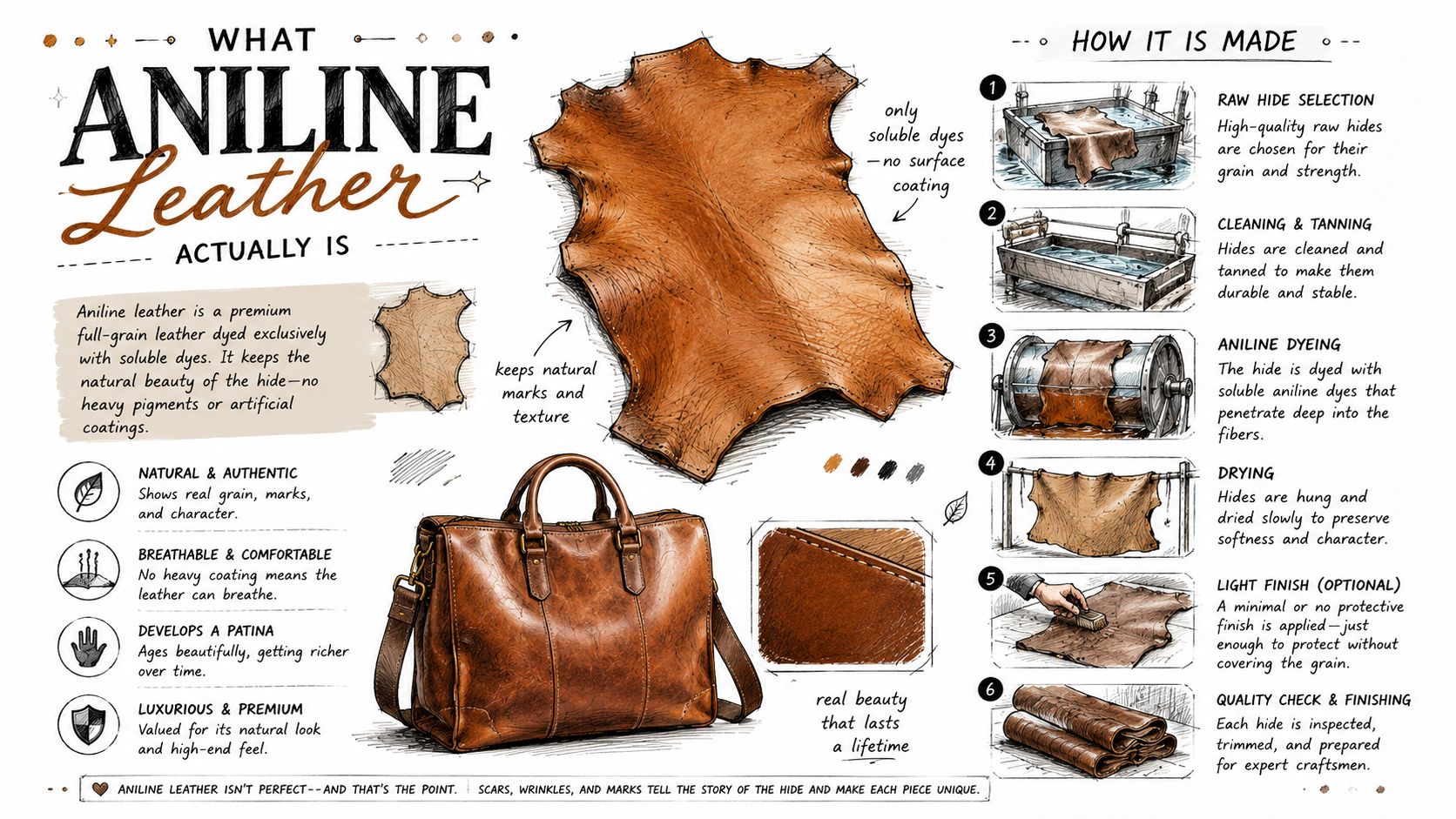
Aniline leather is a finish, not a grade. That distinction matters more than most showroom labels admit, because the word tells you how the leather is dyed and protected, not whether the hide is top quality on its own. In practice, the finish uses translucent, soluble dyes that soak in without hiding the hide's natural marks, pores, wrinkles, or grain, which is why every panel looks a little different and why those differences are part of the appeal.
A stain lets the grain stay visible, while paint covers the surface and makes everything uniform. Aniline works the same way on leather, which is why it feels more natural under the hand and looks less manufactured than a coated surface.
Why the Hide Still Shows Through
Because the dye doesn't sit under an opaque pigment layer, a good aniline piece has visible scars, wrinkles, and tonal variation. That is not a defect, it's a premium marker, and it's one reason industry guides place aniline in top-grain or full-grain leather made from the highest-quality hides. Buyers who want perfectly even color are usually happier elsewhere, while buyers who want natural character tend to like exactly this.
That same minimal-processing approach is also why aniline has the soft, luxurious hand homeowners want in a sofa. It's less built up, less sealed over, and more open to the feel of the hide itself. The trade-off is simple, the finish looks alive because it hasn't been heavily disguised.
For shoppers comparing upholstery types, everything you need to know about upholstery materials is a smart companion read before narrowing to one leather finish.
The premium positioning shows up in price too. Aniline leather is commonly reported at about $20 to $30 per square foot, with some lower-end examples around $8.35 per square foot (GentCreate), which helps explain why a full sofa usually lands in the investment-quality tier instead of the value tier. A sofa takes a lot of square footage, and that adds up fast.
Aniline Versus Semi-Aniline and Pigmented Leather
This is the comparison that helps people decide. All three finishes can be real leather, but they behave very differently once the sofa is in a home that sees sunlight, spills, and daily use. More finishing usually means more protection and more color uniformity, but it also means less of the natural hand that makes aniline so appealing.
| Criterion | Full Aniline | Semi-Aniline | Pigmented |
|---|---|---|---|
| Appearance | Most natural, most visible grain and markings | Natural, but more even | Most uniform and covered |
| Softness | Softest, least coated feel | Soft with some protection | More coated and less supple |
| Stain Resistance | Lowest | Better than full aniline | Highest |
| Fade Resistance | Lowest | Better than full aniline | Highest |
| Best Fit | Quiet rooms, careful households | Everyday premium seating | High-traffic rooms and families |
How the Trade-Off Really Works
Full aniline uses translucent, pigment-free dye and leaves the hide at its most visible and expressive. Semi-aniline still lets the grain show, but adds a thin protective topcoat, which is why it gives buyers some breathing room without losing all of the character. Pigmented leather goes further, with a more opaque surface and a more uniform look that handles rougher use better.
The practical result is straightforward. Every step toward more finishing improves wipeability, consistency, and everyday resilience, while every step away from it preserves more of the hide's natural beauty. That's the actual decision, authenticity and softness versus easier maintenance and a calmer surface.
A shopper who wants the most natural-looking leather should stay with full aniline and accept the discipline it demands. A shopper who wants a premium feel with fewer worries should move to semi-aniline. A shopper with kids, pets, and a bright family room should probably stop romanticizing the showroom sample and choose the more protected finish.
For those comparing construction details before buying, bonded vs genuine leather is worth reviewing because finish choice and leather category are not the same thing.
Bottom line: the more the leather is protected, the less fragile it behaves, but the less purely natural it looks and feels.
The Honest Pros and Cons of Owning Aniline Leather
Aniline wins on feel first. It feels soft, warm, and inviting, and the touch is different enough that homeowners notice it the second they sit down. It also develops patina, which is the kind of gentle aging that gives a sofa more depth over time instead of making it look worn out.
What Makes It Worth Wanting
The appeal isn't hard to understand. Aniline shows the hide, and that transparency is what makes the piece feel curated rather than mass-produced. A room with wood tones, layered textiles, and quiet lighting usually benefits from that kind of surface because the sofa reads as part of the architecture, not just a seat.
The downside is equally clear. Because pure aniline has little to no protective topcoat, liquid can darken the surface quickly, and one expert source notes that it can happen within about 30 seconds (Furniture Clinic). That speed is why spills, body oils, sunlight, and claws matter so much more here than they do on a coated leather.
What Buyers Need to Accept
Direct sunlight is a real enemy, and so is repeated friction in the same spots. High-contact areas can shift tone, and the leather can mark where hands, feet, and pets spend the most time. That doesn't mean the sofa is failing, it means the finish is doing exactly what aniline does, it shows the life happening on it.
For households trying to decide whether to protect an existing leather sofa or rethink the finish altogether, leather sofa care and cover ideas can be a useful supplemental resource. The important part is matching the care strategy to the finish, not pretending all leather behaves the same.
The best aniline sofas usually belong in homes where visible aging feels like character, not damage.
For pet-heavy households, best sofas for pet owners is a more realistic starting point than a style-first search, because claws and aniline rarely get along gracefully. This is investment-quality leather, not a carefree one.
How to Shop Smart for an Aniline Leather Sofa
A smart showroom visit starts with the leather, but it shouldn't end there. The buyer should look at the grain pattern, the way color varies panel to panel, and the hand of the surface, then move down to the seams, the cushion fill, and the frame. A beautiful hide over weak construction is still a weak sofa.
What to Inspect Before Saying Yes
The first signs are visual and tactile. Good aniline usually shows visible pores, irregular grain, and natural markings without looking flat or plastic, and the color should feel rich rather than painted on. If the leather looks too uniform, too shiny, or too sealed, it may not be the finish the tag suggests.
A showroom-ready checklist helps keep the decision grounded:
- Check the grain: natural variation is expected, but the surface should still look refined.
- Feel the finish: the hand should feel soft and open, not coated or slick.
- Inspect the seams: stitching should stay tight, even, and aligned.
- Sit on the cushions: comfort level matters as much as leather finish.
- Ask about the frame: premium leather deserves a stable foundation.
- Confirm the finish: full-aniline and semi-aniline are not the same thing.
- Request a swatch: color and feel should be verified in person.
- Review the care plan: approved cleaners and conditioners should be specific.
- Ask about warranty coverage: natural marks and finish issues are not always treated the same way.
Questions Worth Asking an Associate
A good associate should be able to say which brand built the sofa, what finish is on top, whether the leather is full-aniline or semi-aniline, and what the warranty covers. The buyer should also ask about customization, because the best sofas aren't always the ones sitting on the floor. Through a strong Special Order Program, most vendors can personalize fabrics, finishes, comfort levels, arm styles, and cushion firmness, which is especially useful with brands like La-Z-Boy, Smith Brothers, and Lexington.
That matters because aniline is a visual choice, but the rest of the sofa still has to suit the household. A shopper in Waycross or Fernandina Beach should be able to compare options online, then move from a digital catalog to a showroom seat without restarting the process from scratch. That's how confident buying happens.
Caring for Aniline Leather the Right Way
Aniline care is not complicated, but it is unforgiving when ignored. The routine should be simple enough that a family follows it, weekly dusting with a soft dry cloth, periodic conditioning, and immediate blotting when a spill happens. A leather finish this open doesn't reward procrastination.
The Routine That Keeps It Looking Right
Dust the sofa weekly with a soft dry cloth so grit doesn't abrade the surface. Condition it every six to twelve months with an aniline-safe conditioner, because the finish needs support that's made for its absorbent surface, not a generic all-purpose spray. Keep the sofa out of direct sunlight when possible, or filter it through curtains, because light and heat can accelerate fading and drying.
For spills, the first 30 seconds matter most. Blot, don't rub, and use a clean dry cloth before the liquid has time to spread into the hide. Water saturation is a bad idea, and so are silicone-based products and general cleaners that aren't approved for the exact finish.
A separate leather-care reference like upholstery cleaning for Greater Hartford homeowners can be helpful for understanding broader leather-cleaning discipline, but aniline always needs finish-specific treatment. The wrong cleaner can do more damage than the original spill.
Why Climate Makes a Difference
In South Georgia and North Florida, strong sun, humidity swings, and coastal salt air raise the stakes. A sofa in a bright room near a window needs more thoughtful placement than one in a shaded den, and a home near the coast should pay closer attention to conditioning and exposure than a cooler, drier inland space. That doesn't make aniline impossible, it just means placement matters as much as product choice.
Keep aniline away from heat vents, direct rays, and the kind of daily splash zone that turns cleanup into a recurring chore.
For households that want a more forgiving surface without leaving leather behind, stain-resistant upholstery fabric is the better comparison point. Aniline can be beautiful, but it shouldn't be forced to act like protected upholstery.
Styling Aniline Leather and Choosing Where It Belongs
Aniline looks best in rooms that can wear age gracefully. Warm wood, textured rugs, linen curtains, and low-gloss finishes all make the leather feel intentional instead of fragile. In that setting, the sofa reads like part of a curated sanctuary, not a piece that needs constant defending.
Where It Belongs and Where It Doesn't
A formal living room is a strong fit. A reading nook works too, because the use is slower and the visual payoff is high. A coastal vacation home can also be a good match if the owner values the look and accepts the realities of light and upkeep.
The wrong placements are easier to name. South-facing windows, HVAC vents, and rooms that function as kid zones or pet highways put too much pressure on this finish. If the sofa is going to get jumped on, clawed, and sat on in full sun every afternoon, the buyer is fighting the material instead of enjoying it.
How the Shopping Experience Should Feel
A well-run furniture process makes this decision calmer. Style quizzes narrow the look before anyone spends a weekend chasing swatches, the mattress guide shows the same kind of comfort-level thinking used in upholstered seating decisions, and in-store associates can translate those preferences into real product choices. A buyer can browse the digital catalog online, then sit in the actual sofa in the showroom in Fernandina Beach, FL, without losing momentum.
That's where a local service area matters. South Georgia and North Florida homeowners deserve a hands-on process, not a guess-and-hope purchase. The right retailer also backs the sofa with white-glove, in-home delivery and a rigorous multi-point inspection before it reaches the customer, because a premium finish should arrive ready for the room, not the repair list.
Brands like Stressless, Hooker Furniture, and Lexington show why the final decision should be about fit, not just finish. The leather matters, but the frame, comfort, and room placement matter too.
If aniline leather feels right for the room, the next step is simple. Visit Lott's Furniture in Waycross or Fernandina Beach, or start with an online style consultation to compare finishes, comfort levels, and special-order possibilities before you buy.