
Old Furniture Removal: Top Tips for FL & GA 2026


That older sofa in the den, the guest room dresser that never quite fit, the dining set that's carried a family through years of meals. These pieces often stay in place longer than they should because moving them out feels harder than choosing what comes next. For homeowners across South Georgia and North Florida, that's where home refresh plans often stall.
Old furniture removal doesn't have to feel like the exhausting part of the project. Handled well, it becomes the clean first move toward a calmer room, a better layout, and a home that feels more intentional. A cleared corner can become a reading spot. An overfilled living room can open up for customized comfort and better traffic flow. An outdated bedroom can finally make room for a more restful retreat.
Making Space for Your New Sanctuary
A room can feel finished and unfinished at the same time. The walls may be painted, the lighting may be right, and the vision may be clear, but one oversized or worn piece still controls the whole space. That's often the actual obstacle. Not the design plan, but the old piece that no longer belongs in it.
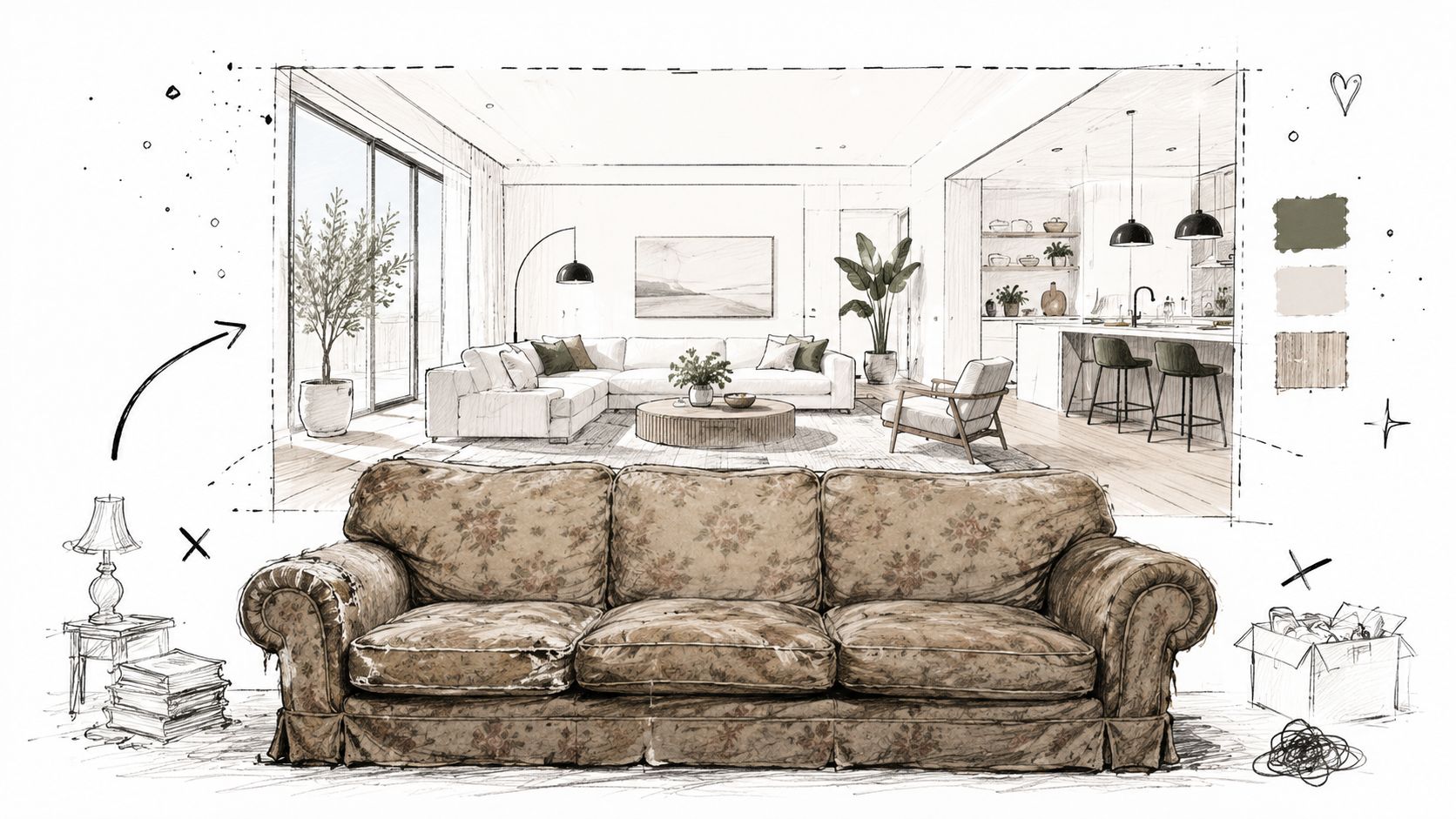
In many homes, the turning point comes before a new sofa or bedroom set ever arrives. It starts when the homeowner decides the room deserves better function and better proportion. A bulky recliner may be blocking a walkway. A faded sectional may be swallowing natural light. A heavy table may be keeping a breakfast nook from becoming the bright, relaxed spot it could be.
Why removal is part of the design process
Old furniture removal works best when it's treated as part of the redesign, not as a separate errand. Once that mindset shifts, decisions become easier.
- Clear purpose: Is the goal to free up floor space, improve flow, or replace a single statement piece?
- Better sequencing: Removing first helps avoid cramped delivery paths and last-minute reshuffling.
- Stronger design choices: An empty room reveals scale, sightlines, and what the next piece needs to do.
Practical rule: If the existing piece makes the room harder to use, it's already shaping the design in the wrong direction.
That same practical thinking matters beyond furniture alone. Households and business owners dealing with larger cleanouts often benefit from adjacent resources, including this guide to commercial appliance recycling for businesses, especially when a renovation includes outdated appliances along with furniture.
Creating room for what fits now
A home isn't static. Families grow, downsizing happens, guest rooms become offices, and open-concept spaces ask more from each piece. Sometimes the smartest design decision is removing what no longer serves the room.
Clutter pressure usually starts with one item, then spreads. A sofa becomes storage behind the sofa. A spare chair turns into a clothes catch-all. A crowded room begins to feel smaller than it is. Helpful reset ideas often begin with practical editing, and ways to solve clutter issues once and for all can support that first pass before any replacement pieces are selected.
For many households, that first cleared space brings instant relief. The room feels lighter. The next decision feels possible. The transformation has already started.
How to Prepare Furniture for a Smooth Hand-Off
Preparation makes every removal route easier. Whether a piece is headed to donation, resale, recycling, curbside pickup, or a hauling crew, the hand-off goes better when the furniture is safer to carry and easier to assess.

An expert method starts with condition review and then moves into careful breakdown. As outlined in this step-by-step furniture removal methodology, the process begins with a condition evaluation, followed by strategic disassembly: removing drawers and shelves to reduce weight and prevent component damage during transport, securing loose parts with zip ties or string, wrapping sharp edges in bubble wrap or old towels, and covering fabric surfaces in plastic to protect against dirt.
Start with condition and destination
Before touching a screwdriver, the piece needs an honest review. That single step decides almost everything that follows.
- Check structural soundness. Wobbling frames, split rails, broken joints, and torn support systems usually move a piece away from donation and toward disposal or material recovery.
- Look at surface condition. Scratches and minor wear may still be acceptable for resale or donation. Severe staining, odors, or heavy fabric damage often narrow the options.
- Choose the likely path. A solid wood chest may be worth selling. A clean guest bed may suit donation. A broken veneer desk may be better dismantled for disposal.
If a piece still has function, keeping its parts organized protects its value and makes the next owner's life easier.
Use a simple prep kit
A small tool set can save a surprising amount of frustration during old furniture removal.
- Basic hand tools: Screwdrivers, wrenches, and pliers handle most furniture hardware.
- Fasteners and labels: Zip ties, masking tape, and sticky notes keep parts grouped and identified.
- Protective materials: Old towels, bubble wrap, and plastic sheeting shield corners, fabric, and nearby walls.
- Phone camera: Photos taken at each step help with reverse assembly later.
Original assembly directions are worth checking if they're still available. Working backward from those instructions is often safer than guessing.
Disassemble only as much as needed
Not every piece needs to be stripped down completely. The goal is controlled handling, not creating a pile of mystery parts.
- Remove drawers, shelves, and detachable legs first.
- Keep hardware in labeled bags taped to the main frame or packed in a marked envelope.
- Secure swinging doors and loose panels before the move starts.
- Wrap sharp or protruding edges to protect door frames, floors, and hands.
Anyone planning to list a piece before removal can also benefit from a stress-free process for selling furniture, especially for deciding what to clean, photograph, and keep assembled for buyers.
A final check matters. Measure hallways, doorways, stair turns, and elevator clearances before moving day. For oversized items, how to measure furniture for a proper fit helps prevent the classic problem of getting a piece halfway out and discovering it won't clear the opening.
Your Local Furniture Removal Options Explored
Once a piece is prepped, the right removal path depends on condition, timing, labor, and location. That last factor matters more than many guides admit. In cities, pickup systems are often easier to find. In South Georgia and North Florida, especially outside town centers, the options can look very different.
Research on rural access gaps notes that while urban pickup systems are well documented, 42% of rural households in the Southeast may resort to improper disposal due to lack of access, a problem many mainstream guides don't address, as discussed in this overview of transfer and disposal access gaps. That's a serious reminder that old furniture removal needs local planning, not generic advice.
Donation, sale, and recycling trade-offs
A usable piece deserves a closer look before it heads to disposal. Donation works well for furniture that's clean, functional, and still practical for another household. Sale can make sense for branded, solid, or distinctive pieces, but it requires photos, messages, scheduling, and patience.
Recycling is often the better path for items with salvageable wood or metal but no second-life appeal as complete furniture. Material recovery can take more effort because not every facility handles mixed materials the same way.
Rural homeowners often need to think in routes, not just options. The nearest workable solution may be a drop-off, a scheduled collection day, or a combined trip with other household items.
For households also sorting obsolete electronics during a larger cleanout, Smyrna e-waste disposal solutions can be a useful companion resource for non-furniture items that shouldn't be mixed into general junk loads.
Municipal pickup and private hauling
Municipal bulky-item pickup can be convenient where offered, but rules vary widely by county and town. Some areas require advance scheduling. Others restrict item types or placement. In rural communities, there may be no regular service at all, which means residents need to verify local solid-waste policies before dragging furniture to the curb.
Private hauling is often the simplest answer for heavy, damaged, or awkward pieces. It's especially practical when furniture sits upstairs, in a tight hallway, or as part of a broader cleanout. The trade-off is cost. The payoff is labor relief, faster removal, and less risk of damage to walls or flooring.
Furniture Removal Options at a Glance
| Method | Typical Cost | Effort Level | Best For |
|---|---|---|---|
| Donation | Often low-cost or no-cost when accepted | Medium | Clean, functional furniture with life left in it |
| Sell locally | Varies | High | Desirable pieces and homeowners with time to list and coordinate |
| Recycle materials | Varies by facility and transport needs | Medium to High | Broken items with recoverable wood or metal |
| Municipal pickup | Depends on local service rules | Low to Medium | Areas with established bulky-item programs |
| Private junk hauling | Service-based pricing | Low | Heavy, damaged, upstairs, or time-sensitive removals |
What tends to work best
For many households, the most effective sequence is simple.
- Best first step: Separate furniture into donate, sell, and dispose categories before making calls.
- Most overlooked detail: Confirm whether rural service is available before assuming curbside pickup exists.
- Smartest labor saver: Disassemble only enough to move safely and keep hardware labeled.
- Most realistic choice for damaged pieces: Schedule hauling or arrange a disposal route instead of waiting weeks for a buyer.
This is also the point where replacement planning can happen alongside removal planning. One practical option in the broader furnishing process is Lott's Furniture, where homeowners can browse a digital catalog and then visit the showroom in Fernandina Beach, FL to compare materials, scale, and comfort in person before arranging convenient delivery for the next chapter of the room.
Responsible Disposal and Its Environmental Benefits
Furniture removal has a household benefit that's easy to see. More floor space, better function, and less visual weight. The environmental side is less visible, but it matters just as much.
In the United States, more than 12.1 million tons of furniture are discarded annually, and less than 0.5% of what reaches landfills is recovered for recycling, according to these furniture waste statistics. That gap is large enough to change how many homeowners think about one unwanted couch, one broken dresser, or one outdated bedroom suite.

Small decisions shape the waste stream
A responsible decision doesn't require perfection. It requires pause. If a piece is still usable, donation keeps it in service longer. If it's beyond repair but contains reclaimable parts, recycling can preserve some material value. Disposal should be the last route, not the automatic one.
That approach also changes buying habits over time. Households that move away from throwaway furnishings often start choosing better construction, more durable upholstery, and classic silhouettes that won't feel dated quickly.
- Longer use cycles: Well-made furniture is easier to keep, repair, or pass along.
- Better material value: Solid components often offer more recovery potential than heavily composite construction.
- Less churn at home: Fewer replacement cycles usually mean fewer disruptive removals.
A room feels more grounded when its furnishings are chosen for longevity, not just for filling space quickly.
Quality and stewardship belong together
Responsible removal pairs naturally with responsible replacement. Investment-quality pieces support a more durable home and a more thoughtful furnishing cycle. That's one reason many homeowners gravitate toward established collections from names such as Smith Brothers, Lexington, and Hooker Furniture when they're ready to refurnish with a longer view in mind.
Handcrafted and character-rich furnishings also remind homeowners that older pieces don't always need to leave the home entirely. Some can be refinished, repurposed, or relocated. Inspiration often starts with distinctive surfaces and timeworn finishes, and hand-painted furniture ideas show how personality and longevity can coexist beautifully.
The wider lesson is straightforward. Old furniture removal isn't only about subtraction. It's also a chance to choose a better rhythm for the home going forward.
Effortless Transitions with Lott's In-Home Delivery
A room only feels finished when the new piece is in place, properly positioned, and ready to use. That final handoff is where many projects either come together smoothly or turn stressful again. Delivery quality matters because it closes the loop between removal, design planning, and everyday living.

White-glove standards matter here. As detailed on Lott's delivery service page, every piece undergoes a rigorous multi-point inspection before it reaches the customer, and professional delivery teams place furniture in the customer's room of choice with positioning intended for immediate enjoyment.
What a clean transition looks like
A proper in-home delivery process should solve problems, not create new ones. Homeowners usually need more than a box left near the front door.
- Room-of-choice placement: Large pieces are carried to the correct space instead of being left for the homeowner to manage.
- Assembly support: Items that require setup are handled by the delivery team.
- Packaging removal: Cardboard, wrap, and protective materials don't stay behind as a second cleanup job.
- Final positioning: The piece is placed where it makes sense for use and flow.
That matters even more with larger silhouettes and premium brands. A Stressless recliner, a Hooker Furniture bedroom group, or a bespoke seating piece with custom upholstery should arrive ready to contribute to the room, not waiting for another round of heavy lifting.
Why this matters for design confidence
A smooth delivery experience supports better design decisions earlier in the process. Homeowners are more comfortable selecting larger scale pieces, custom silhouettes, or full-room updates when they know the final setup will be handled carefully.
That confidence also connects to personalization. Most vendors support customized designs with selected fabrics, finishes, and comfort levels, and many custom orders are completed on timelines that typically range from 5 to 6 weeks after the design is finalized, as explained in this overview of special-order customization. It also helps to understand that a special order is different from a custom order. A special order is a ready-made piece a retailer doesn't normally stock, while a custom order lets the customer choose the frame and or upholstery for a more personal result, as described in this explanation of special order and custom order furniture.
Good delivery protects more than furniture. It protects the homeowner's momentum and the feeling that the room is finally becoming what it should've been.
For those planning a full-room update, furniture delivery and assembly details help clarify what a well-managed final step should include.
From Empty Space to Your Curated Sanctuary
Once the old piece is gone, the room tells the truth. It shows where the light falls, where people naturally walk, and what kind of comfort is missing. That's why old furniture removal can feel unexpectedly energizing. The room stops apologizing for what no longer works and starts offering possibilities.
A formal living room may be ready for softer seating and better conversation angles. A spare bedroom may need to become a guest retreat that still works for everyday life. A family room may need performance upholstery, a more grounded color palette, and seating scaled to the people who use it.
Better choices start with better guidance
Design confidence doesn't always begin with knowing the exact sofa or bed. Sometimes it starts with discovering what style feels right and what comfort level suits the household.
Lott's broader design support reflects that reality through tools and people that make selection easier:
- Style Quizzes: These help narrow aesthetic direction for homeowners who like several looks but haven't named one yet.
- Mattress Guide: This offers a practical starting point for comparing comfort and support before stepping into the store.
- In-store associates: These provide hands-on guidance for scale, fabric, layout, and finish decisions.
The shopping path is also flexible. Homeowners can start online with the digital catalog, then continue in person at the showroom in Fernandina Beach, FL, where materials, proportions, and comfort can be assessed firsthand. That omnichannel ease is especially useful for households balancing renovation schedules, second-home furnishing, or phased room updates across South Georgia and North Florida.
Personalization turns a room into a destination
Curated homes rarely happen by accident. They come together through proportion, texture, and pieces that suit the household instead of forcing the household to adapt. That's where the Special Order Program becomes especially valuable.
Most vendors support personalized designs, allowing shoppers to choose specific fabrics, finishes, and comfort levels. That makes it easier to create customized comfort instead of settling for whatever happens to be on the floor. Brands such as La-Z-Boy, Smith Brothers, and Lexington fit naturally into that process because they offer a wide enough range of silhouettes and materials to support meaningful personalization.
Room planning matters just as much as product selection. Furniture that looks beautiful in isolation still has to function as a group, and living room furniture layout ideas can help translate an empty floor plan into a cohesive, comfortable arrangement.
An open space is more than an absence of furniture. It's an invitation to build a home that feels calmer, more refined, and more like the people who live there.
Visit Lott's Furniture to explore the digital catalog, take a style quiz, or connect with an associate for an online style consultation. Homeowners across South Georgia and North Florida can also stop by the Fernandina Beach showroom to see finishes, test comfort, and start shaping a room that feels like a curated sanctuary from the moment the old piece leaves.