Dining Set Solid Wood: A Buyer’s Guide for Lasting Value


The dining room often starts with an empty corner, a tape measure, and a hopeful picture of family meals gathered around the right table. Then the questions arrive. Will the set overwhelm the room? Does “solid wood” mean solid throughout? Will the finish handle children, guests, and everyday cleanup? And will the design still feel right years from now?
A dining set solid wood purchase deserves more than a species preference or a quick showroom impression. The table must fit the room, the chairs must support comfortable meals, the joinery must allow seasonal movement, and the finish must suit the household's habits. The guidance below treats the decision as a complete furnishing investment, from honest material descriptions to Lott's Special Order Program, inspection process, and white-glove delivery across South Georgia and North Florida.
Standing in Your Dining Room Trying to Picture the Right Set
A homeowner stands where the dining table might go, turning sideways to imagine chairs pulled out. The room looks generous until the imaginary table meets a doorway, a sideboard, and the path between the kitchen and living area. A rectangular table looks elegant in a photograph, but a round or extendable design might serve the actual room better.
That moment captures the core challenge. The shopper isn't choosing between attractive tables alone. The shopper is deciding how much space daily meals require, which wood character belongs with the existing interior, whether the finish can absorb ordinary family life, and whether the construction justifies the price.

Start with the room, not the showroom
The most common mistake is falling for a table before measuring the space. A substantial solid-wood top may look perfectly balanced on a showroom floor, yet its apron, legs, and required chair clearance can make a home dining area feel cramped. The table also needs to work during ordinary breakfasts, not only during holiday gatherings.
The shape deserves equal attention. A round versus rectangular dining table changes conversation, circulation, and the way the room feels. Round tables can soften compact spaces, while rectangular tables often provide efficient wall alignment and useful extension options.
Questions worth answering before ordering
A confident buyer should be able to answer these questions before selecting a finish or fabric:
- Room function: Will the table host daily meals, formal entertaining, homework, or several of these activities?
- Traffic pattern: Can people move behind seated diners without brushing chair backs?
- Material claim: Does the specification identify solid lumber, veneer, mixed species, or engineered components?
- Maintenance tolerance: Does the household prefer a finish that offers a stronger barrier or one that can be refreshed locally?
- Future flexibility: Would an extension leaf, bench, or alternate chair configuration make the set useful through a move or renovation?
Practical rule: A beautiful dining set earns its place only when the room can support its footprint, its care requirements, and the way the household actually eats.
Lott's Furniture helps shoppers carry that evaluation from the digital catalog to showrooms in Fernandina Beach, FL, where associates can help assess proportions and seating. The same process supports a customized purchase through personalized finishes, fabrics, and comfort levels, rather than forcing the room to adapt to a one-size-fits-all arrangement.
What Solid Wood Really Means at the Dining Table
A dining set earns the solid-wood label through its construction, not through a premium-sounding product name. Solid wood can describe the lumber used in key structural parts, while other components may contain veneer or another principal species. Buyers should read the specification line by line and confirm which materials appear in the table, chairs, and sideboard.
“Solid oak,” for example, may describe exposed construction while a drawer panel, back, or secondary component uses veneer. Ask where solid lumber begins and ends, which species are included, and whether the manufacturer identifies mixed materials clearly. Honest labeling matters because it connects the price to the structure you are buying.
Three material categories to separate
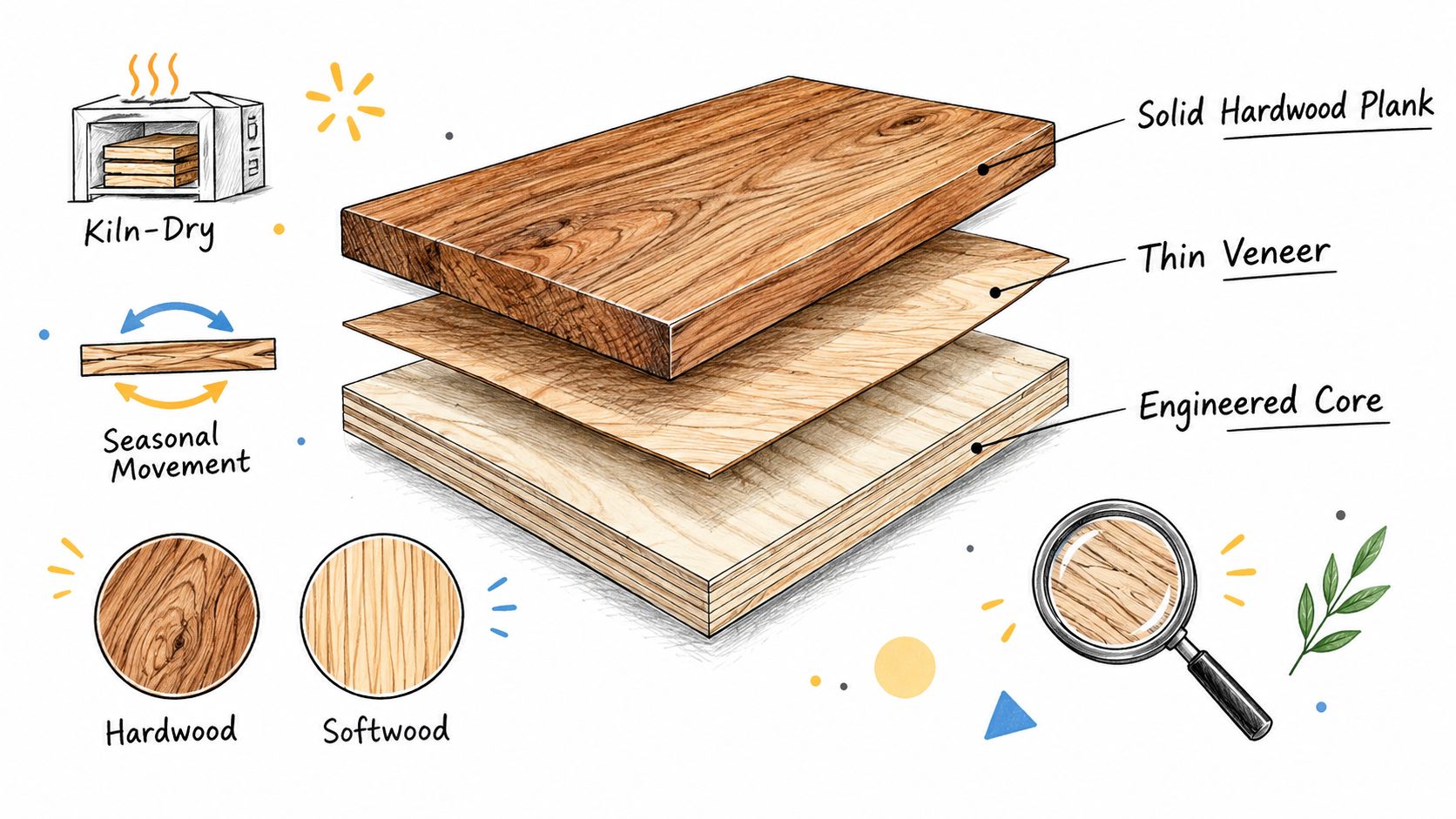
Solid wood uses lumber through the relevant structural portions. It can usually be sanded, repaired, or refinished more readily than a thin surface layer. It also responds to indoor humidity, so the design must allow for seasonal movement.
Veneer uses a genuine wood surface over a stable core. Good veneer offers authentic grain and consistent appearance, but the specification should identify it accurately. Knowing where veneer is used helps you judge durability, repair options, and value.
Engineered wood forms panels from wood fibers, strands, or particles. It can perform well in suitable applications, yet it is a different material from solid lumber and should not be presented as interchangeable with it.
A concise overview of solid hardwood flooring explains useful differences between solid wood and layered construction, even though flooring and dining furniture face different demands. That vocabulary helps you ask about cores, surface layers, and refinishing. The solid wood versus veneer guide offers another practical reference for separating material authenticity from construction performance.
Construction matters more than the species name
Wood absorbs and releases moisture as indoor humidity changes. A solid tabletop therefore moves over time, with shrinkage and swelling occurring mainly across the grain. The table needs joints and fasteners that accommodate that movement rather than restraining it.
Ask how the top attaches to its base, whether the lumber was kiln-dried for furniture use, and how the maker accounts for seasonal conditions in South Georgia and North Florida. Rigidly fixing a wide top can create stress, joint problems, and finish damage. The right purchase combines clear material labeling, repairable finishes, and joinery designed for the room's humidity.
Choosing the Right Wood Species for Your Home
Species selection should follow the household's habits and the room's visual language. Oak, maple, walnut, cherry, and mahogany each bring a distinct combination of grain, color, hardness, and formality. None is automatically right for every dining room.
Oak for active households
Oak remains a dependable choice for a busy family dining area. Its pronounced grain gives small marks and ordinary wear visual texture, while its natural color range works with coastal, farmhouse, transitional, and traditional rooms. White oak often reads calmer and more contemporary, while red oak can bring warmer, more pronounced character.
Oak is a strong candidate for a table that will see homework, family projects, frequent entertaining, and regular chair movement. The grain doesn't make damage impossible, but it can make everyday variation less visually severe than it may appear on a very uniform surface.
Maple for clean, tailored interiors
Maple offers a smoother, quieter grain and a lighter appearance. It suits Scandinavian, contemporary, and updated traditional rooms where the dining set should feel refined rather than visually dominant. Its clean surface can show dents or marks more plainly, so finish quality and household care deserve attention.
Maple also works well when the room already contains strong architectural details or patterned upholstery. The table provides calm structure instead of competing with surrounding elements.
Walnut for depth and restraint
Walnut brings rich brown coloration and a relatively quiet grain. It belongs naturally in modern, mid-century-inspired, and refined transitional interiors. A walnut table can anchor a room without relying on ornate carving or heavy visual mass.
That visual depth makes walnut especially effective when paired with lighter walls, woven textures, or upholstered chairs. Buyers should inspect color variation in the actual sample or finished piece, since natural wood doesn't behave like a printed color chip.
Cherry for evolving warmth
Cherry appeals to homeowners who enjoy a finish that gains depth over time. Its warm color and restrained grain support traditional, transitional, and collected interiors. It can make a dining room feel established without appearing overly formal.
Cherry suits a household that sees natural aging as part of the furniture's character. Buyers who want the surface to remain visually unchanged should discuss finish and light exposure with an associate before ordering.
Mahogany and softer options
Mahogany carries a formal, classic presence and works well with traditional rooms, architectural millwork, and heritage-inspired furnishings. It can create an heirloom-quality focal point, particularly when the table design uses restrained proportions rather than excessive ornament.
Lower-density hardwoods and softwoods may also appear in dining furniture. They can suit a particular look or value-focused plan, but daily dining use exposes tops, chair rails, edges, and legs to repeated contact. A useful reference on hardness and cost of cabinet woods helps explain why density and hardness influence practical performance, although cabinet use and dining use aren't identical.
The natural wood dining table collection gives shoppers a starting point for comparing grain, finish, and silhouette. The correct species is the one that matches the room and the household's tolerance for visible wear, not just the one with the most prestigious reputation.
Sizing and Seating Your Dining Set the Right Way
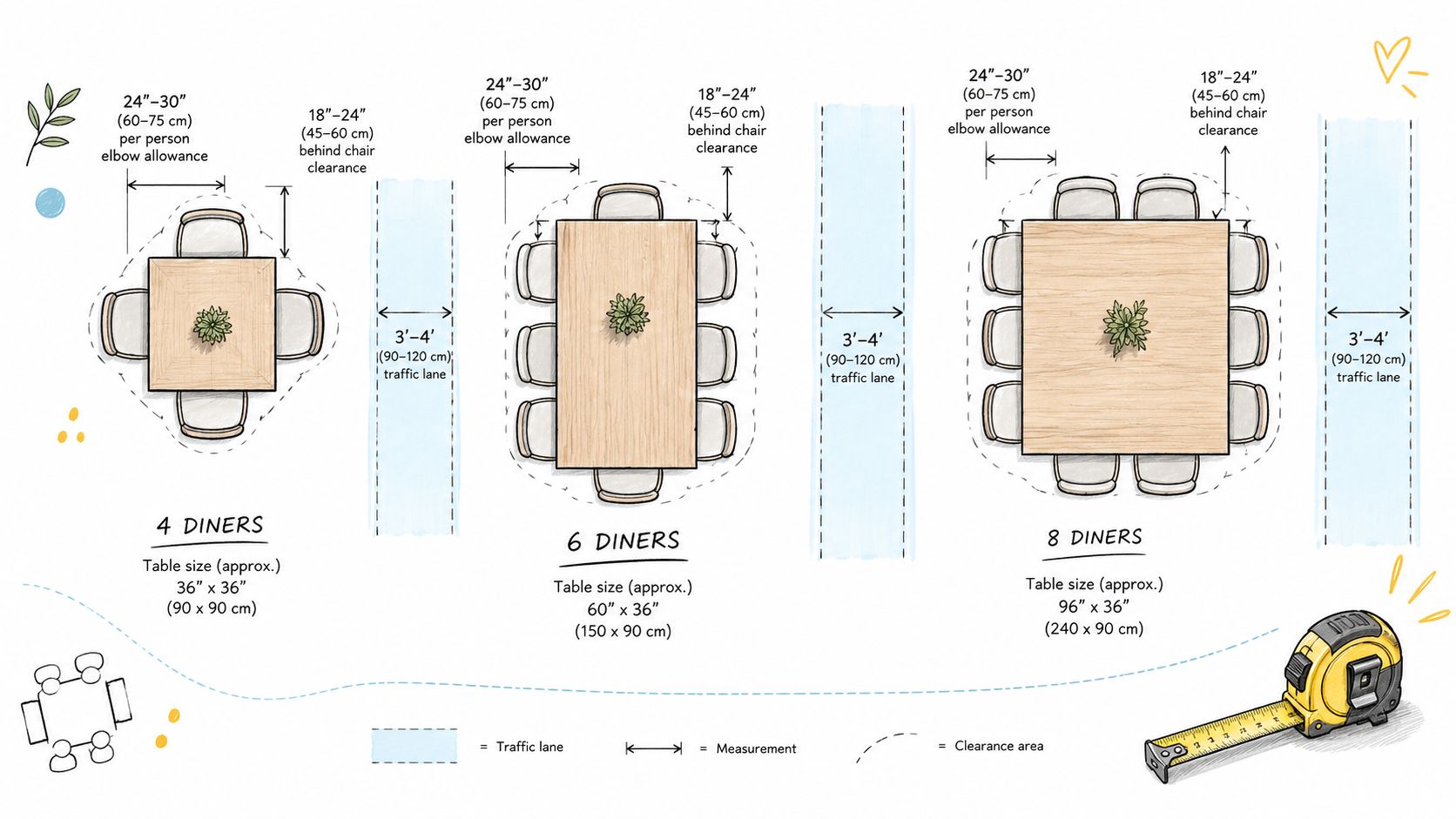
A dining table can technically seat six and still fail the room. Comfortable planning depends on the space allotted to each diner, knee clearance beneath the top, the depth of the chairs, and the circulation route behind them.
Neutral ergonomic guidance places roughly 50 to 60 centimeters of table-edge space per diner, while a six-person table commonly needs about 72 inches of length. Under-table clearance should be at least approximately 26 to 27 inches to reduce knee interference. These figures are summarized in the dining ergonomics reference, and they should be treated as planning checkpoints rather than permission to skip a room measurement.
Common Solid-Wood Dining Set Sizes and Where They Fit
| Set Size | Typical Table Dimensions | Best Room Footprint | Notes |
|---|---|---|---|
| Four diners | Compact round or small rectangular format | Breakfast area, apartment dining corner, smaller cottage | Prioritize chair pull-out space and door clearance |
| Six diners | A table commonly reaching about 72 inches in length | Dedicated dining room or open-plan dining zone | Allow room for comfortable edge space and traffic behind chairs |
| Eight diners | Longer rectangular or extendable format | Larger dining room or generous open-plan area | Check extension storage, leg placement, and circulation at both ends |
These dimensions are starting points, not fixed rules. A thick apron can reduce usable knee space even when the tabletop appears large enough. Chair arms, deep seats, and a bench also change the amount of room required around the table.
A home measurement worksheet
Before visiting a showroom, a shopper should record:
- Room dimensions: Measure wall to wall, then note windows, columns, vents, and built-in features.
- Traffic lanes: Mark the route between the kitchen, living area, exterior doors, and storage pieces.
- Chair depth: Measure the actual chair, including the distance required to pull it out fully.
- Table extensions: Identify whether leaves remain in the table, store separately, or require a different leg position.
- Delivery access: Measure doorways, stair turns, hallways, and elevator openings where relevant.
- Visual footprint: Use painter's tape or flattened cardboard to mark the tabletop and chair positions on the floor.
Round tables improve conversation and can make circulation feel less rigid. Rectangular tables use wall length efficiently and often suit larger gatherings. Extendable tables give a household a smaller daily footprint with additional capacity for guests, but the extension mechanism must feel stable and the chairs must still fit comfortably around the expanded edge.
The dining table size guide can support the initial worksheet. An in-store associate can then test the actual chairs, check apron clearance, and assess whether the chosen arrangement feels comfortable rather than merely possible.
Finishes, Joinery, and Construction That Hold Up
A thick tabletop can look impressive in the showroom, but construction details decide how the set performs at home. Look for properly seasoned wood, attachments that accommodate seasonal movement, sound joinery, protected end grain, and a finish suited to your cleaning routine. These choices matter more than thickness alone.
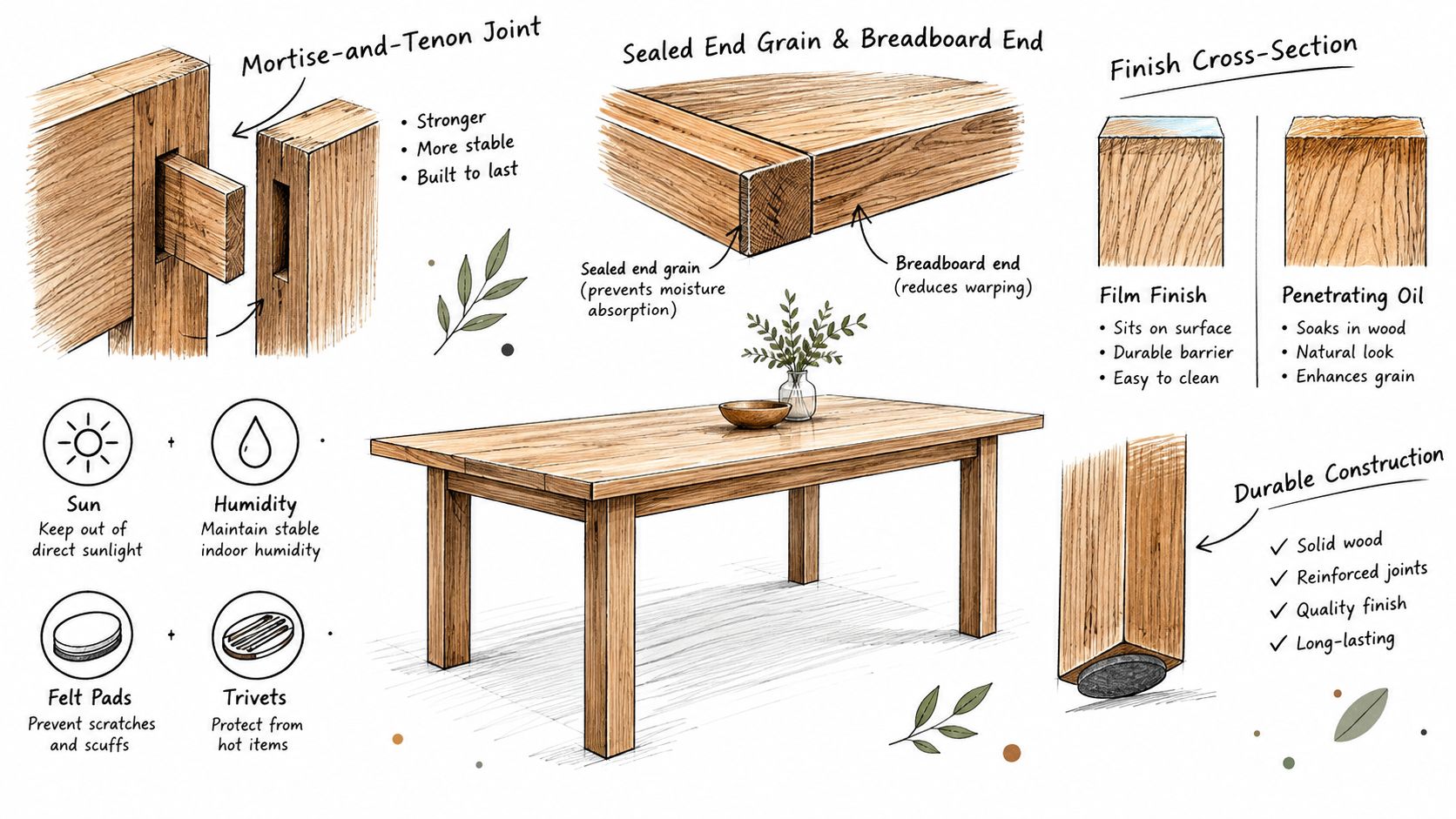
Wood expands and contracts across its grain as indoor humidity changes. Tabletop fasteners should allow that movement instead of locking boards rigidly together. Check for elongated slots, figure-eight connectors, or other movement-friendly attachments. Joinery that accommodates changing conditions helps reduce stress, cracking, and joint failure over time.
Choose the finish according to real use
A film-forming finish creates a continuous surface barrier against short-term liquid exposure. It suits a busy family table that regularly sees spills, although repairs can be difficult to blend invisibly.
Penetrating oil-and-wax finishes are easier to refresh in a small area and preserve more of the wood's tactile character. They require more frequent care and provide less barrier protection. Either finish still needs coasters, trivets, prompt spill cleanup, and approved cleaning products.
Ask the showroom whether the finish has documented abrasion and adhesion testing. ASTM D4060 measures coating abrasion resistance with a Taber apparatus, while ASTM D3359 evaluates coating adhesion. These tests help compare finishes, but neither predicts full resistance to hot dishes, standing water, or chemical spills.
Inspect the parts that carry the load
- Tabletop attachment: Look for elongated slots, figure-eight connectors, or engineered breadboard ends that allow cross-grain movement.
- Chair joints: Ask about mortise-and-tenon construction, corner blocks, and the way the seat frame handles repeated movement.
- Extension hardware: Operate every leaf. The table should close evenly without excessive force.
- End grain: Sealed end grain limits uneven moisture exchange at vulnerable cut surfaces.
- Care instructions: Confirm which cleaners, pads, oils, and solvents the manufacturer permits.
Placement affects performance, especially in humid coastal homes. Keep the set away from HVAC discharge, radiators, direct sunlight, and persistently damp walls. A stable indoor environment helps more than an excessively heavy finish. Coatings slow moisture exchange, but they do not stop wood from responding to humidity.
For a lighter decorative treatment, Hayes Painting and Decorating tips explain whitewashed wood finishes and the visual choices involved. Lott's guide to understanding wood finishes connects those choices with everyday dining-table care.
Treating the Purchase as a Long-Term Investment
Solid-wood dining furniture has a documented history reaching back at least to the 18th century. The Victoria and Albert Museum records an English mahogany dining table made between 1780 and 1800, along with another table from approximately 1770 to 1780 that could fold down and move aside when not in use. These examples show that substantial hardwood dining furniture and adaptable forms addressed changing household needs more than two centuries ago, as documented by the Victoria and Albert Museum collection.
Britain's wartime Utility Furniture Scheme made durability an explicit design priority. Introduced by the Board of Trade in 1942, it promoted furniture described by the museum as solid, durable, well designed, and appropriate for modern living. Production officially ended in 1952. The lesson for today's buyer is practical: a dining set should be judged as a furnishing intended to remain useful through changing interiors, homes, and generations.
The environmental argument also depends on service life. A peer-reviewed reuse study uses a 10-year functional-life benchmark for whole furniture products and reports that approximately 10 million tonnes of furniture are discarded annually in Europe, with only about 10 percent recycled. The study is available through the peer-reviewed furniture reuse research.
Sustainability requires documentation
Solid wood isn't automatically the most sustainable choice. Species, forest management, kiln drying, transportation, finish chemistry, repairability, and years of service all affect the outcome. A responsibly manufactured engineered-wood product may be a more considered choice than poorly sourced hardwood that travels long distances and is replaced frequently.
A shopper asking for evidence should request:
- Chain-of-custody information: FSC certification provides traceability controls for certified material through purchasing, separation, records, and audited management systems, as explained by the Forest Stewardship Council furniture guidance.
- Species and origin: The seller should identify the principal wood species and country of origin where available.
- Repair pathway: Ask whether scratches, worn areas, and loose joints can be repaired or refinished.
- Finish details: Clarify the finish system, permitted cleaners, and local repair options.
- Expected service approach: Favor construction intended for maintenance instead of replacement.
A value-focused purchase may cost more at the outset, but it earns its place when the household uses it consistently, maintains it properly, and can adapt it through future changes.
How Lott's Guides You From Style Quiz to White-Glove Delivery
The buying process can begin online with Lott's Style Quizzes, which help identify directions such as Coastal Chic, Modern Farmhouse, or Timeless Traditional. The Mattress Guide serves a different category, but it reflects the same broader approach to guided decisions. In-store associates remain available for the dining room's harder questions, including scale, finish coordination, chair comfort, and room flow.
The Special Order Program supports personalized designs across most vendors, including choices involving fabrics, finishes, and comfort levels. Dining shoppers can discuss wood color, table proportions, chair upholstery, and mix-and-match configurations. Relevant brand families include:
- La-Z-Boy and Smith Brothers for customizable upholstery options.
- Lexington for coordinated dining room collections.
- Stressless for comfort-focused seating.
- Hooker Furniture for dining and case-good selections.
The digital catalog and showrooms in Fernandina Beach, FL, offer a smooth transition between online browsing and in-person testing. A shopper can review styles digitally, then sit in the chairs, inspect the tabletop, and discuss special-order details at a showroom serving South Georgia and North Florida.
Before delivery, every piece undergoes a rigorous multi-point inspection. Lott's white-glove, in-home delivery places the furniture in the room of choice and checks its condition before the first meal is served.
Lott's Furniture offers solid-wood dining tables and complete dining configurations, along with special-order guidance for size, finish, seating, and room fit. Visit Lott's Furniture to begin an online style consultation or plan a showroom visit in Fernandina Beach, FL, where the dining set can be tested, customized, inspected, and delivered with care.