Save 50% Off MRSP on Lexington | Shop the Catalog >

Dining Room Tables with Leaves Stored in Table: Expert Guide


Sunday lunch runs long. Someone pulls up an extra chair from the breakfast nook, another guest leans on the doorway, and the host starts doing the quick mental math that happens in so many homes across South Georgia and North Florida. Is there enough room for everyone to sit comfortably, pass dishes, and stay at the table awhile?
That's the moment dining room tables with leaves stored in table designs start to make perfect sense. They keep the room scaled for everyday life, then open up when birthdays, holidays, and drop-in dinners call for more seating. For households that want a home to feel polished but still easy to live in, that flexibility matters.
A well-made self-storing table also solves a problem many homeowners know too well. Loose leaves end up in a guest closet, garage corner, or under a bed, where they're harder to protect and easier to forget. A table that keeps its extension inside the piece itself feels cleaner, more intentional, and better suited to real family life.
The Art of Effortless Entertaining
A dining room should support the way people gather. On an ordinary weeknight, a smaller footprint keeps the room open and calm. On a holiday or game-day weekend, that same room needs to welcome more people without feeling improvised.

That's why so many homeowners start looking for a table that can change with the occasion. The appeal isn't only extra seating. It's the ability to host without dragging in folding furniture, hunting for a missing panel, or living every day with an oversized table.
A table that adapts to real life
The self-storing leaf came from a practical household need. Families needed one table for daily meals and larger gatherings, and the design evolved so the extension could be stored inside the table itself to reduce loss or damage and avoid separate storage needs, a detail explained in this overview of how self-storing dining table leaves work.
That history still matters now. A hidden leaf isn't just a clever extra. It usually points to a table built with more planning, more interior engineering, and more attention to how the piece will be used over time.
Practical rule: The best entertaining furniture doesn't ask a room to stay in party mode all year. It shifts when the household needs it to shift.
Homeowners often think of a leaf table as purely functional, but there's also a design side to it. A table that closes neatly keeps sightlines cleaner and helps the room feel composed instead of crowded. That balance between beauty and usefulness is part of what makes custom dining tables for togetherness such a helpful read for anyone planning a home around gathering.
Why this category feels premium
Self-storing leaves are most common in premium, engineered dining tables because the table has to make room for rails, hardware, and storage inside the structure. That's a construction choice, not a surface detail.
For homeowners, that usually means three things:
- Better day-to-day function because the leaf is already with the table
- Cleaner room planning because there's no need to find storage elsewhere
- Stronger long-term value because the feature often comes with higher craftsmanship
In homes across South Georgia and North Florida, that combination makes sense. Many families want a dining room that feels welcoming every day and ready for a crowd when the calendar fills up. A table that stores its own leaves does both with far less fuss.
Understanding Self Storing Leaf Mechanisms
A self-storing leaf table can look simple on the showroom floor. Under the top, though, it works more like a well-built piece of cabinetry. Rails have to glide true, the top has to stay aligned, and the stored leaf has to fit inside the frame without making the table feel bulky or weak.
That is why two tables that appear similar can feel very different in daily use. One opens with a light, controlled motion and locks into place with confidence. Another may drag, shift, or need two people every time you set it up. For families who host often, the mechanism is not a small detail. It decides whether the table becomes a pleasure to use or a chore you put off until company arrives.
Most self-storing designs fall into three familiar categories: butterfly leaves, draw leaves, and drop leaves. Each one solves the same problem in a different way. The best choice depends on how you live, how often you expand the table, and whether you want the look of a formal dining table, a flexible family table, or something that can do both.
Butterfly leaf tables
A butterfly leaf works like a folded panel tucked into the center of the table. You pull the top apart, lift the leaf, and open it into position.
Homeowners often like this mechanism because the change happens quickly and the leaf stays hidden inside the table when not in use. In a busy household, that matters. You are not hunting through a closet or spare room for an extra piece right before dinner.
- Best fit: Homes that host regularly, medium-sized dining rooms, families who want fast setup
- Main strength: Quick expansion with the leaf stored inside the table
- Main consideration: The table needs enough interior space and precise joinery to hold the folded leaf without sacrificing stability
Draw leaf tables
A draw leaf stores beneath the main top and slides outward when needed. The motion is direct and easy to understand, which appeals to shoppers who want a mechanism with fewer steps.
This style also keeps the main tabletop visually consistent during everyday use. From a craftsmanship standpoint, support matters here. A draw leaf puts real demand on the understructure, so the runners, frame, and extension supports need to be built with care if you want the table to feel solid years from now.
- Best fit: Traditional dining rooms, households that prefer a simple pull-out action
- Main strength: Straightforward operation with the extension kept with the table
- Main consideration: Stability depends heavily on hardware quality and the strength of the base structure
Drop leaf tables
Drop leaf tables use hinged sections attached to the table itself. When you need more surface area, the leaf lifts. When you need open floor space, it folds back down.
This is one of the easiest designs to understand because you can see the mechanism doing its work. It is especially practical in breakfast nooks, smaller dining rooms, and multipurpose spaces where the table cannot stay at full size all week. The trade-off is visual. A drop leaf has its own look, and seating can be shaped by where the supports sit underneath.
- Best fit: Smaller rooms, casual dining areas, homes where flexibility matters every day
- Main strength: Compact footprint with built-in expansion
- Main consideration: Seating flow and appearance differ from center-extension tables
Comparison of self-storing leaf mechanisms
| Mechanism Type | How It Works | Best For | Considerations |
|---|---|---|---|
| Butterfly leaf | Table opens at the center and a folded leaf unfolds upward into place | Homes that host often and want quick expansion | Requires interior storage space and precise alignment |
| Draw leaf | Extension pulls out from beneath the tabletop | Shoppers who prefer a simple pull-out motion | Support and hardware quality affect stability |
| Drop leaf | Hinged section lifts from the side and stays attached to the table | Smaller rooms and flexible everyday layouts | Shape, seating flow, and support design affect usability |
A good mechanism should feel smooth, steady, and repeatable. If it binds in the showroom or wobbles when extended, that problem usually becomes more obvious at home.
For homeowners in South Georgia and North Florida, the primary question is not only how the table opens. It is how well that mechanism is built into solid wood construction that can handle holidays, Sunday dinners, and everyday wear without losing its shape. That is where local guidance helps. A store that knows the makers, the wood species, and the customization options can explain why one mechanism suits a compact breakfast room while another makes more sense for an heirloom dining table meant to stay in the family.
Storage planning also affects the rest of the room. If you are choosing a table, chairs, and case goods together, this guide on how to select a dining storage piece that works with your table and layout can help you plan the room as one complete space, not a series of separate purchases.
Finding Your Perfect Fit Sizing and Space Planning
A self-storing table only works well if the room can handle it in both forms. Many homeowners measure for the closed size, fall in love with the extension feature, and only later realize the open table changes chair clearance and traffic flow.
That's why sizing has to start with the table at full operation, not just everyday mode.

One industry guide notes that self-storing leaf tables often seat 6 to 8 people in compact form and expand to 10 to 12 or more when leaves are deployed. The same guide gives an example of a design with three internal leaves that increases seating from 4 to 12, a threefold jump in capacity through internal storage alone, as described in this extendable dining table guide.
Start with the room, not the product tag
A strong measuring routine is simple:
Measure the dining area itself
Include wall-to-wall dimensions, but also note windows, door swings, vents, and nearby case pieces.Mark the closed size on the floor
Painter's tape helps homeowners see how the table will sit in everyday use.Mark the extended size too
This step catches most mistakes. The room may look generous until chairs are added.Test the walk paths
People shouldn't have to turn sideways to move through the room during dinner.
Think through everyday seating and guest seating
Some households only need expansion a few times a year. Others host often enough that opening the table becomes part of regular life. The right choice depends on which version of the room matters most.
A compact table with a generous extension can be ideal for:
- Busy family homes where weeknight meals are smaller than holiday gatherings
- Open-concept layouts where a permanently large table would crowd circulation
- Second dining spaces such as breakfast areas that occasionally serve a bigger crowd
For shape and layout ideas, this article on maximizing dining space with table shapes and seating arrangements is a useful companion when comparing rectangles, rounds, and other room-friendly configurations.
Leave room for the chairs people actually use, not just the tabletop footprint. A table can fit a room on paper and still feel cramped once everyone sits down.
Where homeowners usually get confused
The most common misunderstanding is assuming more extension is always better. It isn't if the room only functions well in the smallest configuration. A table should serve daily life first, then expand gracefully.
Another point of confusion is chair count. The table may technically open wide enough for more guests, but the room still needs to let those guests sit, slide back, and move around without interrupting the whole evening. That's where in-store associates and digital planning tools become valuable. Style Quizzes help narrow the look, and showroom guidance helps translate room measurements into a table that fits the way the home works.
Materials and Durability for Heirloom Quality
A dining table with a self-storing leaf does more work than it appears to do.
On an ordinary Tuesday, it may serve four people and a homework spread. At Thanksgiving, the same table has to open, carry more weight, and still feel steady under serving dishes, elbows, and constant movement. That kind of daily-to-holiday range puts real demands on the materials and the build. If the wood is too soft, the top shows wear early. If the joinery is weak, the table can loosen over time. If the slides and supports are poorly made, the extension stops feeling dependable.
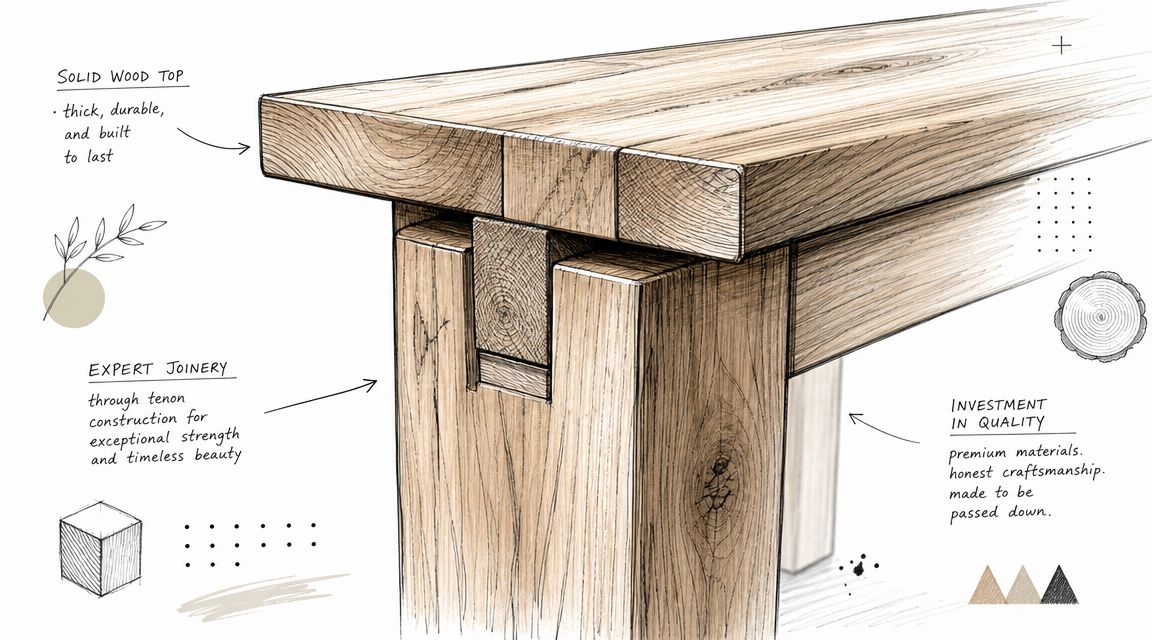
That is why homeowners shopping for heirloom-quality pieces should look past the headline feature and study the structure underneath. A self-storing leaf is a convenience feature, but it also acts like a test of craftsmanship. The table has to open cleanly, close squarely, and hold its alignment year after year. Builders who get that right usually put equal care into the frame, the apron, the slides, and the fit of the leaf itself.
Why wood choice matters
Wood species shapes both the look of the table and the way it lives in your home over time. In a busy household, that matters as much as color.
- Oak has pronounced grain and a sturdy, grounded appearance. It tends to suit homes that want texture and visible character.
- Cherry brings warmth and often develops a richer tone as the years pass. Many families choose it for a more traditional or collected look.
- Maple has a smoother, finer grain. It fits well in cleaner, quieter interiors and can take a wide range of finishes.
If you want a clearer sense of how each species wears, looks, and fits different styles, this guide to choosing the right hardwood for longevity and style is a useful next step.
Finish matters just as much. A good finish protects the top from the small abuses dining tables see every week, from warm serving bowls to dragged placemats to the simple habit of setting keys or mail down for a minute. On a well-made table, the finish should also match consistently across the main top and the leaf, so the table looks like one complete piece in both sizes.
Where craftsmanship shows up
Furniture experts often start by checking the parts most shoppers never see first. That habit comes from experience. The hidden construction usually explains how the table will perform after years of opening, closing, and regular family use.
Look closely at these details:
- Slides and support rails that let the top move without binding or racking
- Joinery at the apron and base that keeps the table stable as the seasons and humidity change
- Leaf fit and surface alignment so the expanded top sits level and feels intentional
- Consistent finish work across every section, including the stored leaf
The easiest comparison is a good exterior door. If it is built and hung properly, it opens and closes with little effort and stays true over time. A quality dining table works the same way. The movement should feel controlled, the parts should meet cleanly, and the strength should be there even when no one is looking underneath.
A dining table becomes heirloom-worthy when the hidden parts are built with the same care as the visible ones.
That standard means a lot in South Georgia and North Florida, where furniture has to hold up to real family use, changing seasons, and homes that host often. Homeowners who buy carefully built solid wood tables usually notice the difference in small ways first. The top feels steady. The leaf stores properly. The table keeps its shape and presence. Years later, those small differences are what make a piece worth handing down.
Designing Your Custom Dining Table
A leaf mechanism can solve the function. Customization is what makes the table belong in the room.
Many homeowners start by thinking they need to choose from what's already on the floor. In practice, the better path is often to start with the room, the finish palette, and the way the household hosts. Then the table becomes a customized solution instead of a compromise.
The custom details that change the whole result
A dining table's silhouette can shift dramatically with a few choices. Leg shape, base profile, edge detail, and finish color all affect whether the piece reads coastal, traditional, transitional, or more formal.
That matters in homes where the dining room connects visually to nearby living spaces. A table doesn't sit in isolation. It needs to speak the same design language as the flooring, the chairs, and the surrounding case pieces.
Many vendors support personalization through special ordering, including options such as:
- Wood finishes that coordinate with existing interiors
- Base and leg styles that change the table's character
- Scale options that help the piece fit the room more naturally
- Chair pairing choices to create a cohesive dining set
Why guided customization works better
Too much choice can slow a project down. That's where a structured process helps. A homeowner may know the room feels too dark, or that a current table is too formal, without knowing which finish or profile will fix it.
Digital inspiration tools can narrow direction before a showroom visit. Style Quizzes help identify whether the room leans more relaxed, classic, or structured. In-store associates can then connect those preferences to actual wood tones, table shapes, and extension styles. The same household that uses a Mattress Guide for comfort decisions can use that same guided approach to make more confident furniture decisions across the home.
For shoppers who want to see how the process works, custom furniture made simple outlines a straightforward path from idea to finished piece.
A better way to think about the purchase
The most satisfying dining rooms rarely come from selecting a table in isolation. They come from matching mechanism, material, and design details to the life of the home.
That's why brands associated with customization, including Smith Brothers and La-Z-Boy in broader whole-home planning conversations, matter to many households even outside the dining category. They reinforce the idea that furniture should reflect the people living with it, not just fill a space.
Within that same mindset, Lott's Furniture offers a Special Order Program that allows shoppers to move beyond stock-floor decisions and select personalized finishes and design details through participating vendors. For homeowners building a curated sanctuary instead of replacing a table, that flexibility can make all the difference.
The Lott's Furniture Difference From Showroom to Home
A dining table can look right online and still feel completely different in person. That's especially true with self-storing leaves, where the movement, weight, finish, and scale all matter. Homeowners often need both views. The convenience of browsing a digital catalog and the confidence that comes from opening the table by hand in a showroom.
That's where omnichannel shopping works best. A household can begin by narrowing styles online, save favorite finishes, and then visit Fernandina Beach to compare proportions, wood tones, and extension mechanisms in real life. For many families in South Georgia and North Florida, that combination removes guesswork without adding pressure.
Guidance that supports the decision
A strong showroom experience isn't about talking someone into a piece. It's about helping the room make sense.
Useful support often includes:
- Digital browsing first so shoppers arrive with a clearer direction
- Style Quizzes and room-planning help to translate taste into actual furniture choices
- Associate guidance in person for evaluating scale, finish, and function
- Brand perspective across collections such as Stressless, Hooker Furniture, and Lexington when coordinating adjoining spaces
Delivery is part of the decision too. A large extension table isn't a simple parcel purchase, and homeowners shouldn't have to manage the hardest part alone.
What happens after the purchase matters
A premium dining table should arrive ready for its place in the home. That's why white-glove service matters. Every piece should be handled carefully, placed in the correct room, and checked before the homeowner starts living with it.
Lott's delivery standards include in-home delivery and a rigorous multi-point inspection before the piece reaches the customer. That process matters for extendable dining furniture because alignment, finish condition, and mechanism performance all need to be right from the start. Homeowners who want to understand that process can review the details of furniture delivery and assembly.
For a purchase this central to the home, service shouldn't stop at checkout. The table has to arrive well, function well, and feel like it belongs the day it's set in place.
Homeowners across South Georgia and North Florida who are ready to compare dining room tables with leaves stored in table designs can explore options through Lott's Furniture. Browsing the digital catalog is an easy place to start, and a showroom visit in Fernandina Beach offers the chance to see finishes, test extension mechanisms, and work with an associate on a table that fits the room, the household, and the way people gather.