Save 50% Off MRSP on Lexington | Shop the Catalog >

Recliners That Don’t Look Like Recliners: A Shopping Guide

You know the chair we mean. It feels wonderful after a long day, but it looks like it wandered in from another house entirely. If your living room has layered textiles, a thoughtful color palette, and furniture you chose with care, a bulky old-school recliner can feel like the one note that throws the whole room off.
That tension comes up often for homeowners across South Georgia and North Florida. You want a chair that supports your back, lets you put your feet up, and invites you to stay awhile. You also want it to look like it belongs beside your sofa, under your lamp, and within the home you've worked hard to shape. The good news is that recliners that don't look like recliners are no longer a compromise category. They're a real design category with better engineering, better tailoring, and far more style range than many shoppers realize.
Table of Contents
- The End of the Style Versus Comfort Dilemma
- Decoding the Designs of Hidden Recliners
- What to Look for in an Investment-Quality Recliner
- Ensuring a Perfect Fit for Your Space and Body
- Styling Your Recliner for a Cohesive Look
- Your Style Your Way The Lott's Experience
The End of the Style Versus Comfort Dilemma
A few years ago, many people treated recliners like a guilty secret. They went into dens, bonus rooms, or corners nobody styled too carefully. That's changed. Today, a recliner can read like a club chair, a crisp transitional armchair, or even a sculptural accent piece.
That shift didn't happen by accident. The category became large enough for furniture makers to design beyond pure function. One market estimate placed the global recliner chair market at about USD 6.5 billion in 2023, with a projection of roughly USD 10.2 billion by 2032 in the recliner market outlook discussed here. At that scale, manufacturers can justify more refined frames, hidden motion systems, slimmer arms, and upholstery choices that suit open-plan homes and design-forward rooms.
For shoppers, that means the old tradeoff has softened. You can choose a chair for lumbar comfort and evening relaxation without automatically signing up for oversized padding, visible handles, and a heavy silhouette.
Why homeowners respond to this category
Consumers aren't asking for a “motion chair.” They're asking for something simpler. They want:
- A cleaner profile that doesn't dominate the room
- Better daily comfort for reading, watching television, or resting
- Flexible styling that works with sofas, sectionals, and accent tables
- A chair that ages well visually instead of feeling dated after one redesign
We see this especially in homes with layered living spaces. One room may need to host conversation, television time, visiting family, and quiet mornings with coffee. A stationary accent chair can look beautiful and still fall short on comfort. A hidden recliner often solves both problems.
Practical rule: If a chair only looks good when nobody sits in it, it isn't doing enough for a real home.
Brands such as La-Z-Boy, Stressless, and Smith Brothers all approach this idea differently. One might lean into classic tailoring. Another might emphasize ergonomic engineering. Another may open the door to extensive fabric or leather customization. The common thread is that the chair no longer has to announce its mechanism from across the room.
That's why the category matters. It isn't just about disguising a footrest. It reflects a broader move toward multi-functional furniture that feels as polished as it is comfortable.
Decoding the Designs of Hidden Recliners
Some shoppers know they want a recliner that looks refined, but they don't yet know what shape or mechanism they're looking at. That's where confusion starts. A chair can have a trim profile and still operate in very different ways.
The category also became easier to shop once design media started treating it as a recognizable style family. As noted in this overview of recliners that don't look like recliners, home décor publications began grouping these chairs by use case, such as living room, nursery, and small-space seating, rather than only by hardware type. That helped shoppers think visually first.
The three looks most shoppers confuse
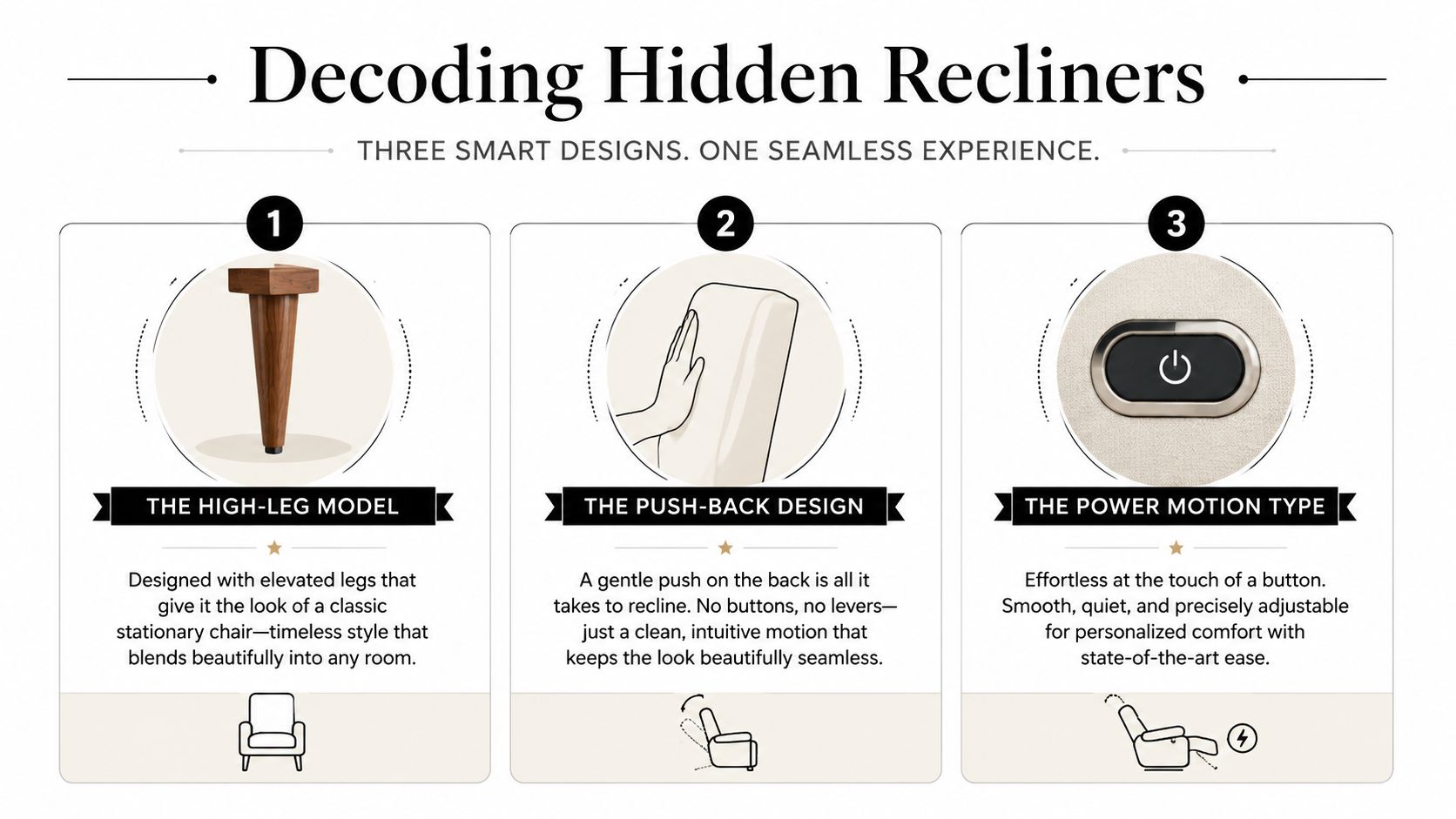
High-leg recliners are the easiest to mistake for stationary chairs. They usually have exposed legs, a tidier base, and arms that resemble traditional accent seating. In a formal living room or a coastal sitting area, this style tends to disappear into the design in the best possible way.
Push-back recliners skip the obvious lever. You recline by leaning back into the chair, which keeps the outer profile cleaner. If you prefer a crisp, well-fitted look and don't want visible controls, this is often the first style to try.
Power motion recliners have become much more discreet. The controls are commonly tucked into the side panel or arm area, and some styles keep the lines surprisingly crisp. If easy operation matters most, this category deserves a close look. Our guide to types of power reclining seating helps clarify how those options differ in everyday use.
Why the silhouette matters so much
Two chairs can offer similar comfort and feel completely different in a room. That comes down to silhouette.
A Stressless design often reads lighter because the engineering feels intentional and the proportions stay controlled. A La-Z-Boy hidden recliner may lean more familiar and transitional, which can be helpful if you want comfort technology wrapped in a classic living-room shape. Some Lexington-influenced spaces call for a more collected, polished look, where a high-leg recliner can sit beside a tailored sofa without breaking the room's rhythm.
Here's a quick visual shorthand that many shoppers find useful:
| Style type | Best visual fit | What to notice |
|---|---|---|
| High-leg | Formal, transitional, coastal, traditional rooms | Exposed legs, trim base, accent-chair appearance |
| Push-back | Living rooms and reading corners | No visible lever, clean side profile |
| Power motion | Everyday lounging, media rooms, aging-in-place comfort | Hidden buttons, smoother assisted adjustment |
A good hidden recliner should make you ask, “Is that a recliner?” before it makes you ask, “Where's the button?”
If you're browsing online first, this vocabulary makes a big difference. Once you know the difference between high-leg, push-back, and discreet power motion, you can narrow the field quickly and walk into the showroom with a much clearer eye.
What to Look for in an Investment-Quality Recliner
A handsome chair can win you over in seconds. The true test comes later, after months of sitting, reclining, cleaning, and living with it. That's why we encourage shoppers to evaluate hidden recliners the same way they'd evaluate a sofa. Start with structure, then comfort, then upholstery, then finishing details.
Start with the mechanism
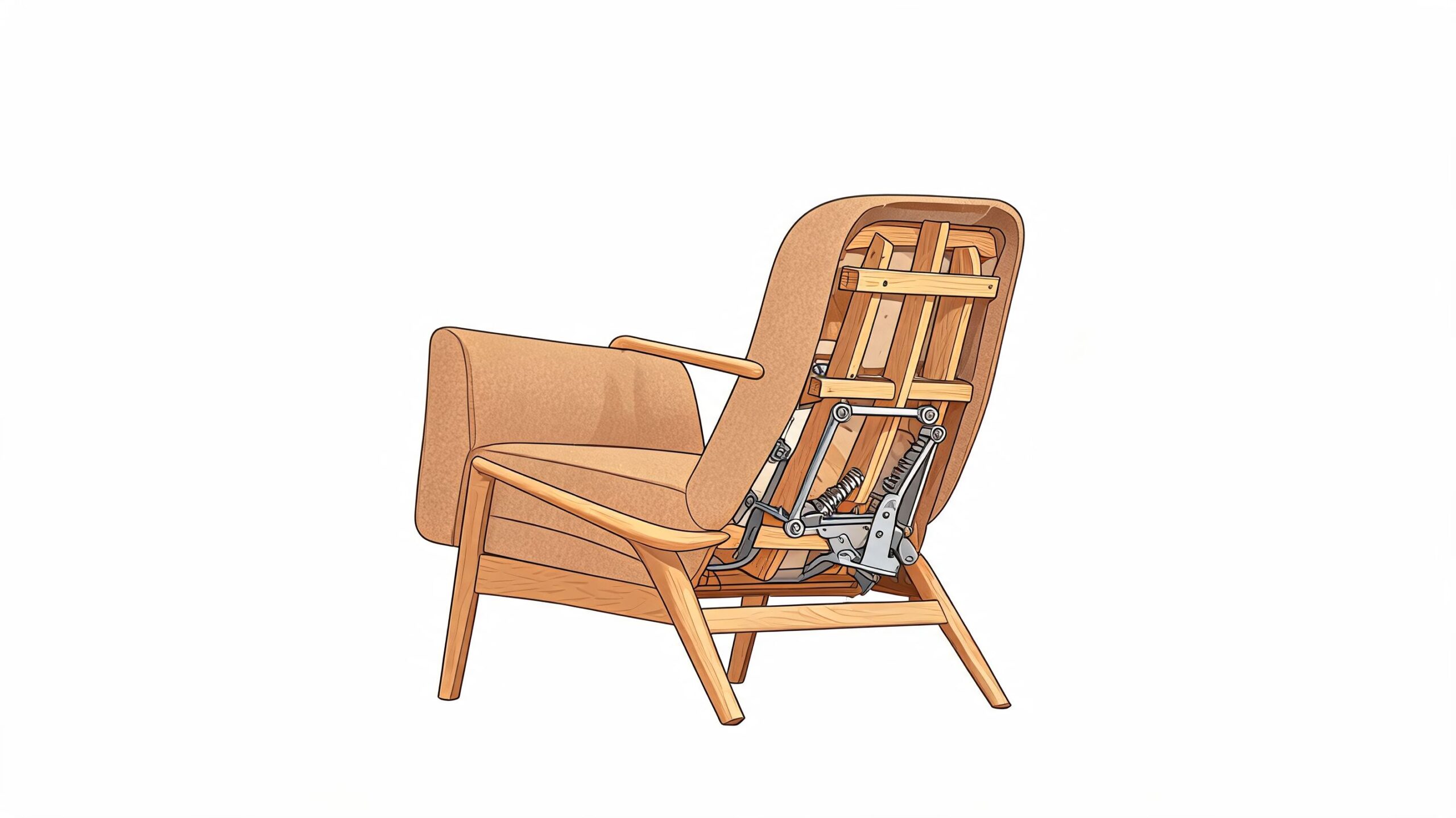
The mechanism is the heart of the chair. It affects how the piece looks, how it feels to operate, and how gracefully it fits into a room. Houzz highlights one key difference in stylish motion seating: some models use body-weight glide systems instead of visible levers, allowing the chair to recline by shifting your weight while preserving a cleaner silhouette, as described in this Houzz feature on hidden recliners.
That matters because hardware affects appearance. A visible handle, oversized side panel, or heavy base can make a chair read bulkier than it is. A cleaner mechanism often supports a cleaner profile.
Here's the practical breakdown:
- Manual push-back works well if you want simplicity and a more classic exterior.
- Body-weight glide feels intuitive and keeps visual clutter low.
- Discreet power motion can be ideal if ease of use is a top priority.
For a broader checklist, our ultimate recliner buying guide is useful to review before you sit down to compare models.
Then inspect what you can't see at first glance
A quality recliner should feel stable before it ever reclines. Sit down without using the motion feature. Does the chair feel planted? Do the arms feel firm when you rest your hands on them? Does the back stay supportive, or does it compress too quickly?
Look closely at these areas:
- Frame integrity matters. A strong hardwood frame generally gives a chair a more confident, quieter feel over time.
- Seat support should feel even, not hollow in the center or overly soft at the front edge.
- Cushion recovery tells you a lot. After you stand up, the seat should regain its shape rather than looking tired immediately.
- Upholstery attachment should be neat and smooth, especially where the moving parts meet the finished exterior.
With Smith Brothers, for example, many shoppers appreciate the chance to focus not only on fabric or leather choice, but also on how the cushion and tailoring feel in daily use. That's where “investment-quality” becomes real rather than just a label.
Details that separate tailored comfort from bulky comfort
The best hidden recliners are often the ones with restraint. They don't rely on overstuffed padding to communicate comfort. They use proportion, support, and good tailoring.
Watch for details like:
- Slimmer arms that reduce visual weight
- Tight or semi-attached backs that keep the shape neat
- Clean seams without puckering
- Leg style and base treatment that match the room's design language
- Upholstery options such as performance fabrics or leather that suit your household
If a recliner looks refined from the side, the back, and the front, the designer probably solved the hard problems well.
That's the difference between a chair you tolerate for comfort and a chair you choose because it strengthens the room.
Ensuring a Perfect Fit for Your Space and Body
Even a beautifully made chair can disappoint if it's too deep for your body or too large for your room. Hidden recliners solve the style problem, but they still need enough space to move properly and enough support to fit the person using them most.

Measure the room before you fall in love
Start with the footprint of the chair in its closed position. Then consider the path of the back and footrest as it opens. Don't forget nearby tables, rugs, fireplaces, or traffic lanes.
A simple measuring routine helps:
- Mark the chair width on the floor with painter's tape.
- Account for reclining depth behind and in front of the chair.
- Check traffic flow so people can still move through the room comfortably.
- Measure doorways and hallways so delivery and placement go smoothly.
If you need a refresher on dimensions, our guide on how to measure furniture is a helpful starting point.
Test the chair like a designer and a comfort shopper
Once you sit in the chair, don't rush. Let your body tell you what works.
Ask yourself:
- Do your feet rest naturally? If they dangle or your knees lift awkwardly, the scale may be off.
- Does the headrest support your neck? You shouldn't feel pushed forward.
- Is the lumbar area supportive? Comfort should land in the lower back, not just in soft padding.
- Can you operate the motion easily? A chair should feel intuitive, not fussy.
In-store testing is essential for this reason. Online browsing works well for narrowing your taste, comparing silhouettes, and saving favorites. The showroom helps you catch what photos can't show. Seat height, arm pitch, cushion response, and neck support are highly personal.
For many shoppers in South Georgia and North Florida, the most efficient route is hybrid. Start with the digital catalog, use the Style Quizzes to clarify your look, then come into Fernandina Beach to test what seems right on screen.
Sit in a recliner for longer than you think you need to. The first thirty seconds tell you very little. The next few minutes tell you a lot.
That little pause often saves people from choosing a chair that looks right but never feels fully settled.
Styling Your Recliner for a Cohesive Look
A well-designed recliner should feel intentional in the room, not apologetic. Styling is what makes that happen. Once the chair is in place, the supporting pieces around it tell the eye that this is part of the plan.
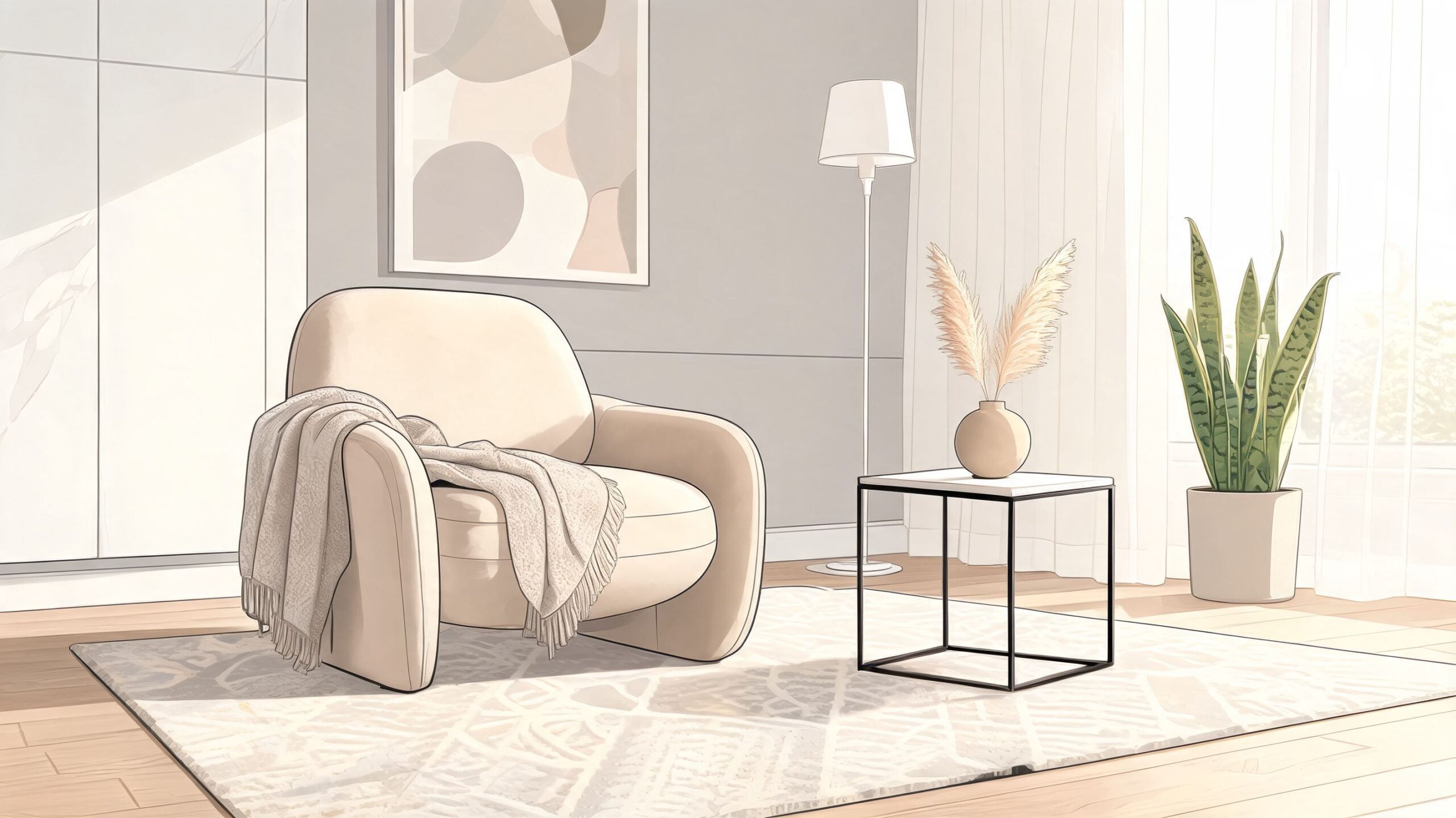
Placement that feels intentional
In a conversation area, angle the recliner slightly rather than pushing it flat against the wall unless the room requires it. That small shift often makes the chair feel more like a participant in the layout and less like a utility piece.
A few strong placements work again and again:
- By a floor lamp and small table for a reading corner
- At one end of a sofa grouping where comfort matters most
- In a bedroom corner paired with a soft throw and a drink table
- In a nursery or sitting nook where gentle motion and comfort matter daily
If you're building the whole room around comfort and flow, our living room essentials guide can help connect the recliner to the rest of the furnishings.
Use texture and companions to make it belong
Many hidden recliners either succeed or fail visually on this point. If the chair sits alone with no companion pieces, it can still feel separate. Add the right partners and it becomes a vignette.
Try these design moves:
- Repeat a color from the rug or sofa in a pillow or throw
- Use a side table with visual weight that matches the chair's scale
- Add a lamp with height so the corner feels anchored
- Introduce contrast through leather, boucle, linen, or wood tone
A leather recliner beside a woven basket and a matte lamp can feel grounded and collected. A fabric recliner with a soft lumbar pillow can bridge the palette between your sofa and drapery. If your room feels unfinished, the issue often isn't the recliner itself. It's the lack of context around it.
Let the room style guide the recliner, not the other way around
A coastal room may call for a lighter fabric, exposed wood tone, and a breezier silhouette. A traditional room may want a shaped arm, crisp skirt-free base, or richer leather. A contemporary room can handle cleaner lines and fewer decorative details.
If you're still defining your aesthetic, the Style Quizzes are a smart place to begin. They help you identify whether your space leans coastal, transitional, traditional, or modern before you start selecting upholstery.
The goal is simple. Your recliner should read as a beautiful chair first, and a comfortable retreat second, even though you know it delivers both.
Your Style Your Way The Lott's Experience
A good recliner purchase rarely comes from choosing the first chair that looks tidy online. It comes from matching mechanism, scale, upholstery, and room style carefully. That process gets much easier when you have both customization and informed guidance.
Customization makes the difference
Many of the strongest recliners in this category become far more convincing once they're customized for the room. The silhouette may be right, but the showroom fabric isn't. Or the leather is beautiful, but you need a different finish to connect with nearby case goods.
That's why the Special Order Program matters. Most major vendors support meaningful personalization, including:
- Fabric and leather choices for color, texture, and performance
- Wood finishes that connect with existing furniture
- Comfort preferences such as cushion feel, depending on the vendor
- Style adjustments in select collections
For shoppers considering a custom path, getting started with custom order lays out the process clearly. This is especially useful if you've found the right frame from Smith Brothers, Hooker Furniture, or La-Z-Boy, but need it customized for your home.
Guidance online and in the showroom
Shopping for motion seating is one area where digital and in-person tools work best together. Start online with a broad visual search. Save the silhouettes you respond to. Use the Style Quizzes to refine your preferences. If sleep comfort is also part of your furnishing project, the Mattress Guide is there as a practical planning tool for another important category.
Then come in and test. In Fernandina Beach, FL, our associates help shoppers compare scale, sit depth, and upholstery in real time. That hands-on step matters because comfort is personal. A chair that looks perfect on screen may feel too deep, too upright, or too soft once you sit in it.
If you want help imagining how a chair might sit with your existing room, an outside planning resource like this AI interior visualization guide can be useful for early concepting before you finalize fabrics and placement.
The retailer side matters too. Lott's Furniture offers a digital catalog and showroom experience that let shoppers move between online research and in-person testing without starting over each time.
The easiest furniture decisions happen when you can compare the image in your head with the chair in front of you.
Delivery that protects the final result
The final step is often overlooked. Delivery can protect a good purchase or undermine it.
Our Lott's Delivery standard includes white-glove, in-home delivery, not a boxed drop at the door. Every piece also undergoes a rigorous multi-point inspection before it reaches the customer. For households across South Georgia and North Florida, that matters because recliners are mechanical furniture. Proper handling, placement, and inspection help preserve both appearance and function.
That same care supports the whole experience:
- Browse digitally when you want to compare shapes and finishes from home
- Visit the showroom when you want to test comfort and scale
- Work with associates when you need practical design guidance
- Receive in-home delivery with placement handled for you
A hidden recliner should feel like a natural extension of the room you've built. With the right frame, the right mechanism, and the right upholstery, it can.
If you're ready to find a recliner that feels supportive and still looks at home in a well-designed room, browse Lott's Furniture online, take our Style Quizzes, or visit our showroom in Fernandina Beach, FL. We're proud to help homeowners across South Georgia and North Florida compare brands, explore Special Order options, and choose pieces delivered with white-glove care and a careful in-home setup.