
The Ultimate Round to Oval Dining Table Guide


A dining room can feel perfect on Tuesday and cramped by Saturday. A small household wants cozy, face-to-face meals most nights, then needs extra seating for holiday brunch, game night, or visiting family. That's where a round to oval dining table earns its place. It gives a room one personality for daily life and another when the guest list grows.
For many homes across South Georgia and North Florida, that flexibility matters more than ever. Open living spaces, breakfast-area dining, and mixed-use rooms ask a table to do more than sit still and look pretty. A well-made extension table answers that challenge with smart engineering, better circulation, and a shape that keeps the room feeling welcoming instead of overfilled.
The Art of Flexible Dining
A family of four may love the ease of a round table during the week. Everyone faces one another. The shape feels balanced. The room has breathing space around it. Then the weekend arrives, grandparents come over, two neighbors stay for dessert, and the table that felt just right suddenly feels one chair too small.
That's the everyday problem a round to oval dining table solves. Closed, it keeps the softness and intimacy people love in a round shape. Open, it stretches into a longer silhouette that welcomes more guests without forcing the room into the rigid feel of a full rectangle.
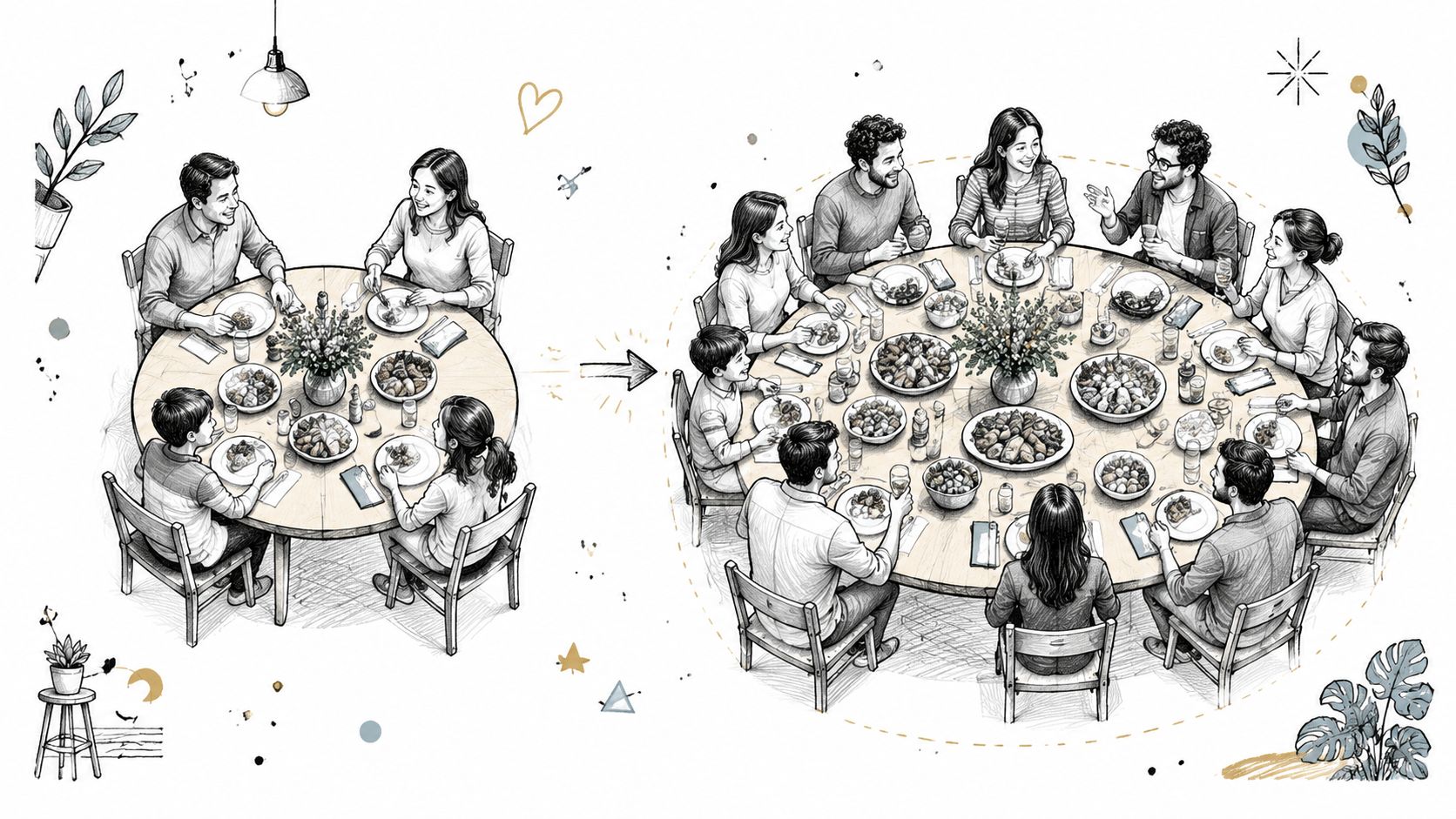
Why this shape feels so livable
A round table often works best for ordinary life. It supports conversation well because nobody feels pushed to the far end. It also tends to sit more gently in a room, especially in homes with walkways crossing behind the dining area.
An oval extension changes the table's job without changing its character. The edges stay curved, so the room still feels relaxed and refined. Yet the longer top creates more usable edge for guests, serving pieces, and those moments when a casual supper turns into a longer gathering.
A good dining table shouldn't force a homeowner to choose between everyday comfort and gracious hosting.
A table that adapts to real homes
That adaptability is part of what makes this type of table feel investment-quality rather than temporary. It suits a formal dining room, but it's just as at home in a breakfast nook, an open-plan great room, or a vacation property near the coast.
Three practical reasons homeowners keep coming back to this design:
- Daily comfort: The closed round form feels compact and easy to live with.
- Entertaining flexibility: The extended oval form handles a larger meal without needing a second table.
- Softer room flow: Curved edges help the dining area feel less crowded than a boxy shape.
The best versions don't just extend. They extend smoothly, sit level, and preserve the beauty of the tabletop once the leaf is in place. That's where understanding the mechanics makes all the difference.
Understanding the Round to Oval Dining Table
A round to oval dining table isn't a round table with extra parts. It's a table designed around a shape change. That distinction matters because the top, apron, slides, and support structure all have to work together once the table opens.
What actually changes when the table extends
In its closed form, the tabletop is circular. Once opened, the table separates at the center, a leaf or leaves are inserted, and the round top becomes an oval. The original width usually stays consistent while the length increases, which is what creates the new silhouette.
That sounds simple, but readers often get confused about one point. They assume the leaf only adds seats. In practice, it also changes how the room works. A longer table alters traffic paths, chair placement, centerpiece scale, and the way people interact across the table.
Why this design has lasted so long
This isn't a new furniture trick. A 19th-century design shift documented in furniture history noted that 72-inch round dining tables were modified with large leaves to become oval forms, specifically to seat up to 10 adults when extended. That development came from a practical need. Homeowners wanted more seating in formal dining rooms without giving up the visual grace of a curved edge.
That heritage still explains the appeal today. The round shape supports a more equal, conversational feeling. The oval shape introduces capacity and a more directional layout. One table serves both purposes.
The social effect homeowners notice
A round table tends to make every seat feel similar. That's one reason families enjoy it for ordinary meals. An oval still feels inclusive, but it creates a gentle long axis through the room. That can help larger groups settle in more naturally because there's a clearer sense of where extra chairs belong.
Practical rule: If a homeowner loves the friendliness of a round table but needs better hosting capacity, the round to oval form is often the most natural next step.
Two common misunderstandings are worth clearing up:
- “Oval means formal.” Not necessarily. The shape can read casual, coastal, traditional, or refined depending on the base, finish, and chairs.
- “Any leaf table works the same way.” It doesn't. A round to oval design needs careful engineering to avoid wobble, uneven seams, and awkward proportions once extended.
That's why size planning matters before style decisions. A beautiful table still has to fit the room in both versions.
How to Measure for a Round to Oval Table
Measuring for this kind of table takes two passes, not one. A homeowner needs to know how the table fits when it's closed and how it behaves when it's extended. Skipping that second step is one of the quickest ways to end up with a table that looks excellent in the showroom and frustrating at home.

Start with the room, not the table
Measure the full dining zone first. Include walls, nearby cabinetry, islands, sideboards, and any paths people use to move through the room. In open-plan homes, mark the practical dining area rather than assuming the whole room belongs to the table.
The key rule is straightforward. Dining layout guidance for table spacing recommends a minimum clearance of 36 inches between the table and walls or cabinetry so chairs and diners can move comfortably.
Measure in two setups
Use painter's tape on the floor to mark the table in both forms. This makes the decision much easier because the room starts telling the truth right away.
- Tape the closed round size where the table will sit most of the time.
- Tape the extended oval size using the full length and width.
- Pull out a few dining chairs or stand-ins to see how far they project.
- Walk the room as if someone is seated and another person needs to pass behind.
That floor test often reveals what a paper measurement won't. A table may technically fit and still feel inconvenient in daily use.
Where readers usually get tripped up
The biggest mistake is measuring only to the table edge. Chairs need room too. A second common mistake is centering the table perfectly in the room even when the room isn't used symmetrically. If one side opens toward a kitchen or hallway, the table may need to sit slightly off-center to preserve the best traffic lane.
A few useful checkpoints help:
- For walls and built-ins: Keep that 36-inch minimum around the table where people need to move.
- For open-plan layouts: Tape the chair positions too, not just the tabletop.
- For serving comfort: Avoid tops that feel too narrow for place settings and shared dishes.
Bring those measurements into a showroom consultation, or compare them at home with a planning guide such as dining space and seating arrangement tips to avoid costly guesswork.
A simple measuring mindset
Think in terms of the table's two lives. The first is everyday use. The second is hosting mode. If the extended form only comes out a few times a year, a room can tolerate a fuller footprint during those moments. If the leaf will stay in for entire seasons, the extended size needs to feel comfortable week after week.
That distinction helps homeowners choose with confidence. The right table isn't just the one that fits on paper. It's the one that supports how the household lives.
Weighing the Benefits of an Extendable Table
An extendable table offers one of the clearest trade-offs in furniture. It brings flexibility and capacity, but it also asks for better planning and better construction. The strongest choice comes from looking at both sides.
Why many homeowners love the oval extension
An oval shape often performs especially well in rectangular rooms because it keeps the table visually lighter while still creating enough usable perimeter for seating. According to guidance on oval dining table proportions, a 72-inch oval table can typically seat up to six adults, and a 72-inch round table also seats six, but the oval offers 20% more linear edge length for legroom and traffic flow.
That's a meaningful advantage in real homes. More edge length can make place settings feel less crowded, and the softened ends make circulation feel easier in rooms where people are constantly moving around the dining area.
A balanced look at the pros and considerations
| Consideration | Round to oval strength | What to watch |
|---|---|---|
| Daily footprint | Compact and sociable when closed | The extended size still needs a real storage and clearance plan |
| Traffic flow | Curved ends feel easier in many rooms | Not every room benefits if the shape is too large overall |
| Seating flexibility | Helpful for households that host occasionally | Leaf handling can be awkward if the top is heavy |
| Visual style | Softer than a rectangle, more structured than a round | The wrong chairs or base can make the table feel crowded |
The practical drawbacks nobody should ignore
Leaves have weight. Some households don't mind lifting and storing them, while others know that if the process is a hassle, the table won't get used as intended. A mechanism that sticks or leaves a visible seam can also take the pleasure out of ownership.
Another point is expectation. An extension table is versatile, not magical. It won't fix a room that's too small for the number of guests a homeowner hopes to seat. That's why decision-making works best when shape, room size, and entertaining habits are considered together, not separately.
For households comparing shapes and everyday use, this dining table selection guide can help clarify whether extendable seating fits the way the room is actually used.
The best extendable table is the one that gets used confidently. If opening it feels smooth and the room still functions well, the table becomes part of family rhythm rather than a special-occasion compromise.
Exploring Mechanisms and Materials in Extendable Tables
A beautiful extension table earns trust underneath the top. The finish catches the eye first, but the mechanism determines whether the table feels dependable year after year. In a round to oval dining table, that hidden structure matters even more because the shape changes under load.
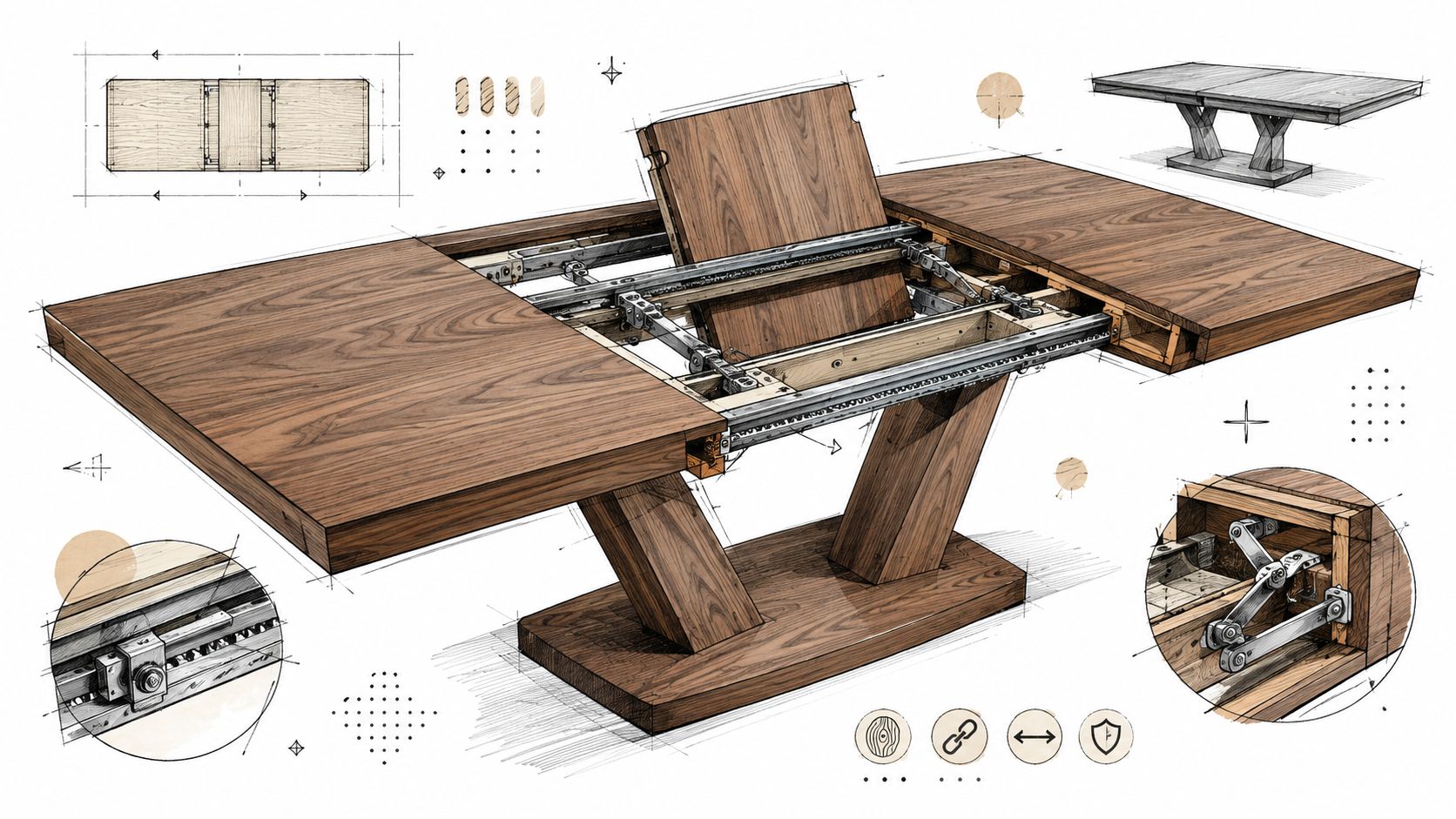
How the extension mechanism works
Most designs open at the center. The top separates, guided by internal slides, and a leaf fills the new gap. In a well-built table, the movement feels controlled rather than jerky, and the inserted section sits flush with the surrounding top.
A useful reference point comes from this look at oval extension construction. It describes a 60-inch round table expanding to a 76-inch oval with a 16-inch leaf, with examples engineered to support 88 lbs for the base and 60 lbs for the extension while keeping the surface stable and uniform.
Signs of a quality mechanism
Not every extension system ages the same way. A homeowner doesn't need to study joinery like a cabinetmaker, but a few details are worth attention:
- Smooth slide action: The table should open without forcing or twisting.
- Flush leaf alignment: The inserted section should sit level, with no raised lip at the joint.
- Stable support underneath: Once open, the table shouldn't feel bouncy at the center.
- Clear leaf handling: The storage plan should be simple if the leaf isn't self-storing.
A shopper who likes understanding wood species before buying may also enjoy this primer on wood selection for DIY projects, because material knowledge often makes furniture construction easier to evaluate.
Materials that support long-term use
For an heirloom-quality feel, the top and base need to do more than match. They need to respond well to daily use, seasonal movement, and repeated opening. Solid wood, carefully matched veneers, and stable engineered components all have a place in extension furniture when they're used thoughtfully.
Collections from names such as Lexington and Hooker Furniture often draw attention because finish depth and construction details feel more refined. Some homeowners also prefer a softer traditional look, while others want a cleaner silhouette that pairs with contemporary chairs and lighting.
Common material priorities include:
- Solid wood character: Often prized for warmth and natural variation.
- Quality veneers: Helpful for achieving beautiful grain matching across a larger top.
- Protective finishes: Important for daily dining, especially in family homes.
- Finish customization: Useful when matching flooring, case pieces, or existing chairs.
A table with internal storage can make ownership easier too. For readers comparing those designs, dining room tables with leaves stored in table offers a helpful overview of that feature.
A strong extension table should look intentional both open and closed. If one form feels like an afterthought, the engineering usually tells the same story.
Styling Tips for Your Versatile Dining Space
A round to oval dining table asks for two styling modes. One works when the table is closed for daily use. The other stretches out gracefully when guests arrive. The strongest rooms treat both forms as intentional, not as one “real” look and one temporary one.
Styling the round form
A closed round table usually looks best with a centered composition. One sculptural bowl, a low floral arrangement, or a single lantern-style accent can anchor the shape without making it feel busy.
The table also needs enough practical width to function. Dining table sizing guidance notes that a table should be at least 36 inches wide to accommodate place settings alongside serving pieces in the center. That's a styling point as much as a planning point. If the top is too narrow, every centerpiece competes with plates and serving dishes.
Styling the oval form
Once the leaf is in, the table's visual rhythm changes. A single small centerpiece can look lost on a longer surface. An oval shape usually benefits from a runner, two or three smaller arrangements, or a low linear grouping that follows the length of the top.
A few styling ideas work well:
- For everyday dining: Keep the center low and simple so the table stays usable.
- For entertaining: Use repeated elements, such as candleholders or small vessels, to carry the eye along the oval.
- For mixed chair styles: Let one detail unify the set, such as wood tone, upholstery color, or silhouette.
- For lighting: Center the fixture over the table's midpoint, then confirm it still feels balanced when the table is extended.
Some homeowners find that floor tone changes the whole mood of the room. Articles about Setauket home flooring decisions can be surprisingly useful for understanding how wood color and sheen affect dining furniture choices.
Keeping the room cohesive
Style works best when the dining table connects to the larger home, especially in coastal, farmhouse, or transitional interiors found across South Georgia and North Florida. A round top may feel relaxed and tucked in. The oval extension can suddenly make the room feel more formal if the surrounding elements don't support it.
That's where digital planning tools can help narrow the look. Style quizzes can help homeowners identify whether their room leans Coastal, Modern Farmhouse, or Traditional, and a mattress guide on the retail side often signals the same kind of practical, comfort-first support people appreciate when shopping for the rest of the home. For dining accessories that complete the scene, dining room accessory ideas beyond the table can spark useful finishing touches.
Customize Your Dining Experience with Lott's Furniture
A round to oval dining table works best when the choice is suited to the home, not pulled from a generic checklist. That's where thoughtful guidance matters. Lott's Furniture has served South Georgia and North Florida with a blend of small-town service and big-brand expertise, helping homeowners sort through the details that make one table feel just right and another feel like a near miss.
A better way to choose a table
Some households know they want a pedestal base. Others care most about finish color, chair pairing, or whether the leaf stores inside the table. Lott's helps narrow those decisions with a straightforward path between the digital catalog and the showroom in Fernandina Beach, FL, so shoppers can research online and then test scale, finish, and function in person.
The guidance goes beyond dining. Helpful tools such as style quizzes and the mattress guide reflect the same philosophy across the store. Better information leads to better furniture decisions, and in-store associates are available to translate measurements, layouts, and style preferences into practical recommendations.
Customization and trusted brands
Special ordering makes a major difference with dining furniture because proportions, finishes, and comfort details often need to work with the rest of the home. Through the custom order furniture process, many vendor collections support personalized designs, including finish choices and other specific details.
Shoppers exploring dining and whole-home design may recognize trusted names such as:
- Lexington
- Hooker Furniture
- La-Z-Boy
- Smith Brothers
- Stressless
That mix gives homeowners access to both statement-making design and long-term comfort, whether the goal is a refined dining room, a relaxed coastal retreat, or a curated sanctuary for everyday living.
The Lott's Delivery standard
Furniture ownership doesn't end at checkout. Every piece delivered through Lott's goes through a rigorous multi-point inspection before it reaches the home, and the team provides white-glove, in-home delivery rather than a simple doorstep drop. That matters with extension tables, where alignment, finish condition, and room placement all affect the final experience.
A round to oval dining table is one of the smartest choices for a home that needs flexibility without giving up beauty. The right one should feel polished, stable, and easy to live with, whether it's hosting a quiet dinner for two or a full table of guests.
For homeowners ready to find an investment-quality dining table with personalized comfort, expert guidance, and convenient delivery, Lott's Furniture offers an effortless way to shop online, explore custom options, and visit the showroom in Fernandina Beach, FL for hands-on help from knowledgeable associates.


