Save 50% Off MRSP on Lexington | Shop the Catalog >

Custom Sofa Guide How to Design Your Perfect Fit


A living room usually reveals the custom sofa question before anyone says it out loud. The sofa is too deep for easy conversation, too shallow for real lounging, too pale for everyday life, or the wrong scale for an open floor plan, a beachside retreat, or a busy family room. Homeowners across South Georgia and North Florida often don't need more furniture choices. They need better-fitting choices.
That's where a custom sofa becomes less about indulgence and more about livability. The right dimensions, cushion feel, fabric durability, and delivery plan can turn a room from almost right into a space that feels settled, useful, and lasting. With personalized options available through special-order programs, style guidance from quizzes and in-store associates, and the ability to move smoothly between an online catalog and the Fernandina Beach showroom, the process can feel far more approachable than many shoppers expect.
Why a Custom Sofa Is Worth the Investment
A standard sofa can look beautiful on a sales floor and still disappoint at home. A family may need seating that fits a long, narrow room without blocking a walkway. A couple furnishing a coastal home may want a lighter look without choosing a fabric that shows wear too quickly. A household with children, pets, and frequent guests may need comfort that holds its shape instead of softening too fast.
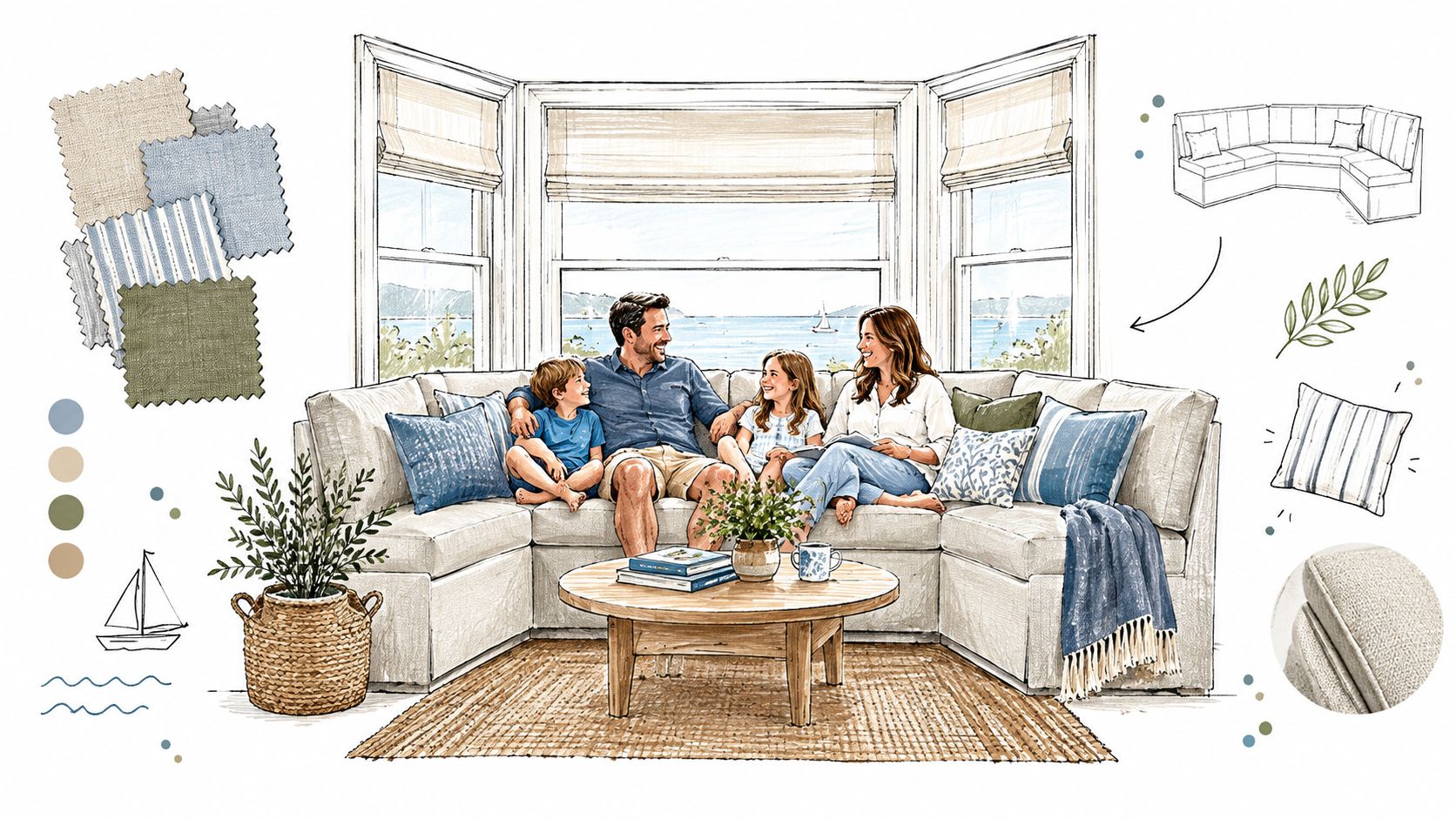
A custom sofa answers those frustrations at the source. It allows the shopper to shape the piece around the room, the household routine, and the desired feel of the home. That may mean a more compact frame, a longer bench seat, a cleaner arm profile, a performance fabric, or a firmer cushion that supports daily use.
Personalization Has Moved Into the Mainstream
Custom upholstery isn't a niche category anymore. One market projection estimates the global custom furniture market will rise from USD 38.78 billion in 2026 to USD 66.49 billion by 2033, with a 9.4% CAGR, and it notes that sofas and couches are expected to hold 34.9% market share by the end of 2026 according to this custom furniture market analysis. Another projection places the market at about USD 34.549 billion in 2025 and USD 74.5992 billion by 2033, with North America and the United States both forecast to grow substantially over that period in this market report on custom furniture.
Those projections matter because they reflect a broader shift in how people furnish their homes. Seating remains a dominant category because it carries so much of daily life. Reading, hosting, napping, watching movies, and gathering with family all happen there.
What Heirloom Quality Actually Means
Heirloom-quality doesn't have to mean formal or precious. It usually means the sofa keeps serving the household after the novelty of purchase fades.
Practical rule: A custom sofa earns its place when the tailored choices solve a real problem in the room or in daily use.
That's why many homeowners start with construction and support, then layer in style. Brands such as La-Z-Boy, Smith Brothers, and Lexington often give shoppers room to personalize fabrics, finishes, and comfort details through special-order pathways. For households that want American craftsmanship as part of that decision, this look at American-made furniture options can help frame what long-term value looks like in practice.
Why Guidance Matters More Than Endless Choice
Choice alone can become exhausting. Independent consumer research found that 41% of recent upholstered-furniture buyers said customization was extremely or very important, yet only 25% chose a custom sofa, loveseat, or sleeper in this upholstered furniture customization research. That gap often appears when shoppers can picture the result, but can't easily sort through the decisions.
The most helpful process makes the decisions feel sequential. Style first. Fit second. Comfort third. Fabric fourth. Home delivery last. Style Quizzes, a Mattress Guide, and knowledgeable showroom associates all support that kind of decision-making, especially for households trying to furnish a curated sanctuary without making the process feel complicated.
Finding Your Frame and Style Before You Customize
A sofa can be the right color and still be the wrong answer for the room.
We see that happen when a homeowner starts with fabric swatches and only later notices the frame blocks a window, shortens a walkway, or feels oversized beside everything else. Our better starting point is simpler. Set the architecture first, then customize inside it. That approach saves time, keeps the room balanced, and helps you decide whether a special-order piece is worth the wait or whether a ready-to-deliver sofa makes more sense for the way you live right now.

Measure the Room Before the Sofa
The frame works like the foundation of a house. If the proportions are off, every later choice has to work harder.
Start with the practical checks that affect fit and daily movement through the room. Measure entry doors, interior turns, stair width, and elevator access if relevant. Then map the living space itself. Leave comfortable walking paths, note the relationship to the rug, and mark sight lines to windows, fireplaces, and media walls.
A quick hand sketch is often enough. Draw the room, add dimensions, and mark where people walk. That small step makes it much easier to tell whether you need a standard sofa, a sectional, or a modular arrangement that can adapt over time.
This is also where livability tradeoffs become clear. If you expect to move, reconfigure often, or furnish a vacation property, modularity can justify a longer special-order timeline. If the room layout is settled and you need seating soon, a ready-to-deliver frame may be the smarter choice.
Choose the Silhouette That Matches the Home
Style gets easier once you break it into visible parts. The arm, back, and base do most of the visual work, and each one changes how large or relaxed the sofa feels in the room.
Start with the arms
A track arm usually gives a cleaner, more tailored outline. It often suits relaxed contemporary rooms and homes that want a lighter visual footprint. A rolled arm feels softer and more classic. It can warm up a formal space and make the sofa feel more rooted.
Arm width matters too. Slim arms save inches in smaller rooms. Fuller arms create a more lounge-oriented presence, but they also take up more of the overall width.
Then decide how polished you want the back to look
A tight back keeps the silhouette neat and orderly with less day-to-day fussing. Loose back cushions feel more casual and inviting, but they usually need occasional straightening.
A beautiful sofa should still look composed on an ordinary Tuesday.
Fixed frame or modular
This choice is less about trend and more about how the room needs to perform. A modular sofa gives you flexibility. That can be useful in family rooms, multipurpose spaces, and homes where layouts may change. The tradeoff is patience. Custom configurations often take longer because more pieces, fabrics, and layout decisions have to line up through the special-order process.
A fixed frame often suits homeowners who want a cleaner, uninterrupted profile and already know the room will stay arranged one way. In those cases, custom can still be the right path if you need a precise width, depth, or style detail that ready-to-deliver options do not offer.
At Lott's, our Special Order Program helps narrow that decision before you commit. We guide the frame choice first, then confirm proportions, and our white-glove inspection standard adds another layer of confidence before the piece ever comes home.
Build a Style Brief Before Comparing Fabrics
A style brief keeps the process focused. It does not need to be elaborate. It only needs to answer a few practical design questions so the customization stays tied to the room.
- Room mood. Relaxed coastal, softly modern, classic, or transitional.
- Frame preference. Clean-lined, gently traditional, or deep and lounge-driven.
- Seat format. Standard sofa, apartment scale, sectional, or modular.
- Visual weight. Airy on legs, grounded with a skirted base, or substantial with wood detail.
Homeowners often find that one category clarifies the next. If the room calls for a lighter look, that may point you toward raised legs and slimmer arms. If the space needs more presence, a fuller profile may serve the room better.
For households refining that middle ground between classic and current, our guide to transitional sofa styles can help turn inspiration into a practical shopping brief. In the showroom, that brief becomes even more useful because it lets us compare frames with intention, not just react to whichever silhouette looks appealing first.
Tailoring Comfort With Cushions Arms and Finishes
The frame sets the architecture. Comfort decides whether the sofa gets used the way the household imagined. That's where many shoppers get tripped up, because “soft” and “supportive” aren't opposites, and a plush first sit doesn't always lead to long-term satisfaction.
Start With the Duty Cycle
A custom sofa for a formal sitting room doesn't need the same seat engineering as the one where the household watches television every night. Independent upholstery guidance commonly recommends high-resilience foam in the 2.5 to 3.0 lb/ft³ range with an ILD of about 30 to 38 for daily-use seating, and notes that foam under 2.0 lb/ft³ is associated with sagging within a few years. The same guidance cites premium 2.8 lb HR foam for roughly 8 to 12 years of service life in sofa seats in this explanation of foam density and firmness.
That sounds technical, but the practical sequence is straightforward:
- Define how often the seat will be used.
- Match density to that use level.
- Fine-tune firmness for feel.
- Confirm thickness and recovery before ordering.
The most common mistake is choosing softness over density. Another is selecting foam suitable for a back cushion and expecting it to perform like a seat cushion.
Common mistake: A sofa can feel dreamy for five minutes in a showroom and still lose support too quickly if the seat core isn't matched to daily use.
Compare Seat Feel and Arm Style Together
Comfort isn't only inside the cushion. Arm shape changes posture more than many people expect.
- Firm seat with a moderate depth suits readers, upright sitters, and households that want easier standing support.
- Medium seat with a balanced depth fits mixed-use rooms where the sofa needs to handle both hosting and lounging.
- Plusher seat with deeper sit dimensions favors movie nights, casual family rooms, and laid-back spaces.
Arm styles matter too.
- Track arms support a crisp visual line and often save space.
- Padded arms feel softer under the elbow for long lounging sessions.
- Rolled arms add traditional character and can create a cocooning feel.
Finishes and Comfort Details Should Work as a Pair
Wood finish, leg style, and trim often come after cushion selection, but they influence the final personality of the sofa. A driftwood-inspired finish may suit a coastal retreat. A darker finish can add gravity in a traditional room. Comfort options from brands such as Stressless and Hooker Furniture can also help shoppers align support and aesthetics rather than treating them as separate decisions.
Testing matters here. In-store associates can watch how a shopper sits, whether feet touch the floor comfortably, whether the back is supported, and whether the chosen arm height feels natural. That kind of guidance often clarifies the tradeoff between a seat that looks plush and a seat that lives well over time. For readers interested in the support system beneath the cushions, this explanation of eight-way hand-tied springs adds useful construction context.
Choosing Fabrics Leathers and Performance Finishes That Last
The fabric decision usually feels overwhelming because it combines beauty, maintenance, touch, and durability all at once. Thousands of options can blur together fast. The easiest way to narrow the field is to ignore color for a moment and classify the sofa by traffic level first.
Use Abrasion Benchmarks as a Filter
A widely used technical benchmark for upholstery is 20,000 Martindale cycles or 15,000 double rubs for low-traffic residential use, while 40,000 Martindale cycles or 30,000 double rubs is recommended for heavy-use seating in this guide to reading sofa fabric specifications. The practical method is simple. Match the sofa to the household's use pattern, then confirm which testing method the vendor used before finalizing the order.
That matters because visible wear often shows up long before the frame has any issue. A beautiful fabric that's underspecified for children, pets, or frequent entertaining can shorten satisfaction with the piece even if the underlying construction is excellent.
Fabric Durability Quick Match for Your Household
| Household Traffic Level | Recommended Abrasion Benchmark | Best Fit Example |
|---|---|---|
| Low traffic residential | 20,000 Martindale cycles or 15,000 double rubs | A formal living room sofa used occasionally |
| Heavy-use seating | 40,000 Martindale cycles or 30,000 double rubs | A family room sofa used daily by kids, pets, and guests |
Performance Fabric, Leather, and Coastal Practicality
Many homeowners in South Georgia and North Florida want a room that feels polished without becoming high maintenance. Performance fabrics and leather both have a place, but they solve different problems.
- Performance fabric often suits family rooms, vacation rentals, and homes with frequent everyday use.
- Leather can be an investment-quality choice for households that appreciate patina and want a material that often wipes clean with ease.
- Textured upholstery can add warmth and richness, though it should still be checked against the room's actual wear pattern.
- Sun-exposed rooms call for extra caution with color and material selection, especially near large windows.
The smartest upholstery choice isn't the one with the most dramatic swatch. It's the one the household still enjoys after spills, sunlight, guests, and ordinary repetition.
Performance finishes from La-Z-Boy and Smith Brothers can help families protect both style and function. Special-order programs from many vendors also support personalized fabric, leather, and finish combinations, which reduces the need to settle for a standard floor sample that only partly fits the room.
Reduce Decision Fatigue Before Ordering
A strong filtering process keeps the fabric library from becoming a maze.
- Start with lifestyle. Daily family use, occasional entertaining, or a second-home setting.
- Then evaluate hand feel. Smooth, textured, cool, soft, crisp.
- Then review undertone. Warm beige, sandy taupe, soft gray, creamy ivory.
- Finally check scale. Large sectionals can carry more visual texture than compact sofas.
Swatches remain one of the most useful steps, especially when online browsing leads the process. Shoppers can explore digitally, then confirm color and texture in person in Waycross or Fernandina Beach. This comparison of performance fabric vs leather offers a useful next filter for households torn between softness, resilience, and maintenance habits.
Ordering Lead Times Financing and Omnichannel Ease
A custom sofa often feels easiest to choose in theory and hardest to order in real life. A homeowner may know the silhouette, the fabric family, and the cushion feel they want, then pause at the practical questions. How long will it take. What happens after the order is placed. Is the wait justified, or would a ready-to-deliver piece serve the room better right now.

At Lott's, we guide that part carefully through our Special Order Program, because clarity lowers stress. A custom order works best when each decision builds on the one before it, much like drafting a floor plan before choosing paint colors.
A Clear Order Path Helps Homeowners Choose With Confidence
Open-ended customization can feel exciting at first and tiring by the end. A structured special-order process helps narrow the field in the right order, which is one reason furniture retailers use guided configuration systems as described in this special-order retail guide.
Our role is to keep the process orderly and livable, not just decorative. We typically help homeowners confirm these decisions in sequence:
- Frame, scale, and orientation.
- Seat feel and back support.
- Arms, legs, and finish details.
- Fabric or leather selection.
- Final review before the order is released.
That order matters. Choosing fabric before scale is a bit like selecting window treatments before measuring the windows. The room may still look good, but the foundation is backward.
Lead Time Is Part of the Design Decision
Custom upholstery takes longer because the piece is being built around your specifications rather than pulled from existing inventory. Timelines vary by maker, material availability, and the number of details being changed. As noted earlier in the article, more personalized orders usually require more patience.
The better question is not only, “How long will this take?” It is, “What am I getting in return for the wait?”
For many households, the wait makes sense when the custom choices solve everyday friction. A modular layout can fit an awkward family room better than a standard sofa. Performance fabric can protect a light upholstery plan in a home with children, pets, or frequent guests. A comfort upgrade can matter every single evening if the sofa is the room's primary seat, not an occasional perch.
Sometimes ready-to-deliver is the wiser answer. If a move-in date is close, a renovation schedule is shifting, or the room's layout may change within a year, speed may carry more value than personalization. We help homeowners weigh that tradeoff through our Special Order Program instead of treating custom as the automatic upgrade.
Financing Should Support the Plan, Not Distort It
A well-chosen sofa should fit the household budget as comfortably as it fits the room. Financing can help spread out a larger furnishing investment, especially when a custom order is part of a broader update that includes rugs, lighting, or case goods.
Some homeowners also compare furniture spending with other home-improvement priorities before deciding how to pay. For readers sorting through those bigger-picture options, this guide to compare HELOC vs loans offers a useful outside reference.
The goal is simple. Choose the payment route that supports the home without pushing the project into regret.
Online Research and In-Store Confirmation Work Best Together
Custom ordering rarely happens in one sitting or in one channel. Many homeowners begin online, save silhouettes they like, narrow dimensions, and arrive in the showroom ready to test seat depth, arm height, and fabric hand in person.
That blended process is often the most comfortable one. Screens are good for comparison. Showrooms are good for confirmation.
Lott's Furniture supports both sides of that process with a digital catalog, style tools, and in-store guidance in Fernandina Beach, FL, serving South Georgia and North Florida. Homeowners can research at their own pace, then work with our team to confirm the order details before production begins. That extra review step matters with custom upholstery because accuracy at ordering shapes everything that follows, including the final inspection standards we apply before a piece is considered ready for the home.
Bringing Your Custom Sofa Home With White Glove Care
The final stage of a custom sofa purchase should feel calm, not chaotic. A carefully selected piece can still lose some of its appeal if delivery is rushed, packaging is left behind, or placement becomes the homeowner's problem.
What White-Glove Delivery Should Include
White-glove furniture delivery is commonly defined as full-service, in-home delivery that brings the item into the requested room, unpacks it, assembles or sets it up if needed, places it, removes packaging debris, and includes damage inspection during or after setup in this guide to white-glove furniture delivery. That level of service matters more with a custom sofa because there's often more emotional investment in the final result.
A careful delivery standard protects the purchase in practical ways.
- Room-of-choice placement keeps heavy upholstery from being shifted awkwardly after arrival.
- On-site inspection helps identify any issue while the professional team is present.
- Packaging removal leaves the room ready to enjoy instead of turning setup into another household task.
Why Inspection Is Part of the Value
A custom sofa isn't complete when production ends. It's complete when it arrives in the home looking and feeling the way it should. Every piece should be checked closely before final placement, especially upholstered furniture with seams, finish details, and configured components.
That's also the moment when room arrangement becomes real. Once the sofa is in place, many homeowners refine accent chairs, tables, and lighting around it. For anyone adjusting the whole living room after delivery, this focal point room arrangement guide can help align the sofa with fireplaces, views, or media walls in a more intentional way.
A custom piece deserves a landing that feels as considered as the order itself.
For local homeowners, that delivery experience is part of the overall shopping decision. A process that includes a rigorous multi-point inspection and white-glove delivery brings the project full circle, especially for families furnishing primary homes, vacation properties, or multi-room updates across South Georgia and North Florida. Over more than 78 years, that combination of customization, expert guidance, and omnichannel ease has remained the most practical way to turn a design into everyday comfort.
Lott's Furniture offers custom order options, fabric and leather libraries, performance-focused upholstery choices, and guided support that helps homeowners match a custom sofa to the way a room is used. Shoppers can browse online, use style tools, or visit the showrooms in Fernandina Beach and Waycross for hands-on help with comfort, scale, and delivery planning. Explore Lott's Furniture to start an online style consultation or see seating in person.