Save 50% Off MRSP on Lexington | Shop the Catalog >

How to Design Your Custom Upholstered Sofa


A custom upholstered sofa is an investment that typically starts in the mid-thousands and moves upward based on frame construction, fabric grade, and design complexity. Most made-to-order upholstery programs land in a roughly 6 to 16 week window from design approval to in-home delivery, though some simpler programs move faster and more complex orders can take longer.
Most shoppers arrive at custom upholstery the same way. They've walked a showroom, scrolled a digital catalog, saved a dozen screenshots, and still haven't found the piece that feels right in both scale and comfort. One sofa has the silhouette they like but the wrong seat feel. Another has the right fabric but the arms are too heavy for the room. A third almost works, until the leg finish fights the rest of the space.
That's where a custom upholstered sofa changes the conversation. It stops being a hunt for the least-wrong option and becomes a design decision built around the way a home lives. The best results come from looking at the sofa as a complete system. Frame, suspension, cushion density, upholstery material, tailoring, and finish all work together. Focusing on only one layer, especially fabric, is where many costly mistakes begin.
Across South Georgia and North Florida, homeowners often want a living room that feels polished but still easy to live with. They also want a process that feels manageable. That's why the strongest custom orders usually begin with clear priorities, practical measurements, and guidance that connects online research with in-person testing in Fernandina Beach, FL.
Why Your Custom Upholstered Sofa Starts With a Conversation
A shopper often knows the feeling they want before they know the specifications. They may want a sofa that looks refined enough for guests but soft enough for movie night. They may need something refined for a coastal living room, yet durable enough for everyday family use. Those aren't fabric questions first. They're lifestyle questions.
That early conversation matters because most vendors in a Special Order Program allow far more personalization than many buyers expect. Options often include fabrics, finishes, comfort levels, arm profiles, and configuration choices. A made-to-order sofa isn't just about selecting a color. It's about shaping the piece around the household's routines, visual preferences, and long-term expectations.
The Right Starting Questions
Before any swatch book opens, the useful questions are usually these:
- How is the sofa used daily. Primary family seating needs a different build than a formal room that sees occasional company.
- Who uses it most. Tall sitters, children, pets, and frequent guests all change the right seat depth and cushion feel.
- What should the room feel like. Relaxed, airy, grounded, or classic.
- What already exists nearby. Flooring, case goods, lighting, and wood tones should guide the finish details.
Practical rule: If a buyer starts with fabric alone, the process narrows too soon. If they start with use, comfort, and proportion, the right fabric becomes easier to choose.
This is also where digital tools save time. Style quizzes can clarify whether a room leans Coastal Chic, Modern Farmhouse, or Timeless Traditional before a shopper steps onto the floor. The Mattress Guide might seem unrelated at first glance, but it helps train buyers to think in comfort categories and support preferences, which translates well into sofa decisions. In-store associates then turn those preferences into actual specifications.
Why the Conversation Prevents Expensive Regret
The homeowners who tend to feel happiest with a finished custom order are usually the ones who pause before choosing the prettiest swatch. They talk through how they sit, whether they entertain, how much maintenance they'll tolerate, and whether they want a sofa that reads crisp or relaxed.
A design consultation also helps connect digital browsing to real-world testing. A shopper can save favorites online, then bring those ideas into a guided appointment through Lott's design consultation services. That bridge between screen and showroom is especially useful for homes across South Georgia and North Florida, where rooms range from compact cottages to open-concept family spaces.
A strong custom order begins long before the order form. It begins when the right questions reveal what the sofa needs to do.
Choosing Frame, Scale, and Proportion for Your Space
A custom upholstered sofa either settles into a room beautifully or dominates it for all the wrong reasons. That outcome is usually decided by frame and scale before anyone talks about fabric texture or trim.
The broader upholstery category is substantial enough to show why these decisions matter. Global upholstered furniture was valued at about USD 73 billion in 2024 and accounted for roughly 16% of the total furniture market. The same reporting also noted that global consumption rebounded by 22% in 2021 versus 2020, then contracted by 8% in 2023, which shows how sharply demand can move across cycles in a category this important to the home according to the world upholstered furniture industry landscape.
Measure the Room and the Route
Room size is only half the measurement job. Delivery access matters just as much.
Use this checklist before narrowing down frames:
- Wall space first. Measure the wall where the sofa will sit, then subtract space needed for end tables, lamps, or breathing room.
- Traffic paths next. Leave enough room for people to move naturally around the sofa.
- Entry access matters. Measure doorways, stair landings, hallway turns, and elevator clearances if needed.
- Depth changes the feel. A deep sofa can feel luxurious in a large room and crowded in a tighter one.
A practical planning step is to review living room furniture placement ideas before settling on width and depth. Scale doesn't live in isolation. It changes how every other piece in the room functions.
Match the Frame to the Architecture
A sofa with broad arms and a deep deck has visual weight. A tighter track arm or lifted leg creates more openness. Neither is automatically better. The right answer depends on the room's architecture and the homeowner's priorities.
For example, a larger open room may need a substantial silhouette to keep the seating area from drifting visually. A more intimate living room often benefits from a cleaner profile that preserves floor visibility and movement. Exposed legs can lighten the footprint. A skirted or lower-sitting frame can make the room feel more grounded and traditional.
Core brand distinctions can help buyers orient their search:
- La-Z-Boy often appeals to households prioritizing comfort and family use.
- Smith Brothers tends to fit shoppers who want upholstery details and broad customization.
- Lexington often speaks to buyers looking for a refined, collected look.
A sofa should fit the room twice. Once by measurement, and once by visual weight.
Don't Treat the Wood Finish as an Afterthought
On custom upholstery, the exposed wood is usually a small percentage of the piece, but it carries a lot of the style signal. Leg shape and finish can push a sofa more coastal, more traditional, or more transitional without changing the silhouette itself.
Useful questions include whether the finish should echo nearby tables, contrast with flooring, or disappear. A dark finish can anchor a pale room. A lighter tone can keep the piece from feeling too formal. Buyers using online style quizzes often find these finish choices much easier once the room's design direction is clear.
The frame sets the grammar of the sofa. Every other decision reads through it.
Selecting Cushions and Firmness for Lasting Comfort
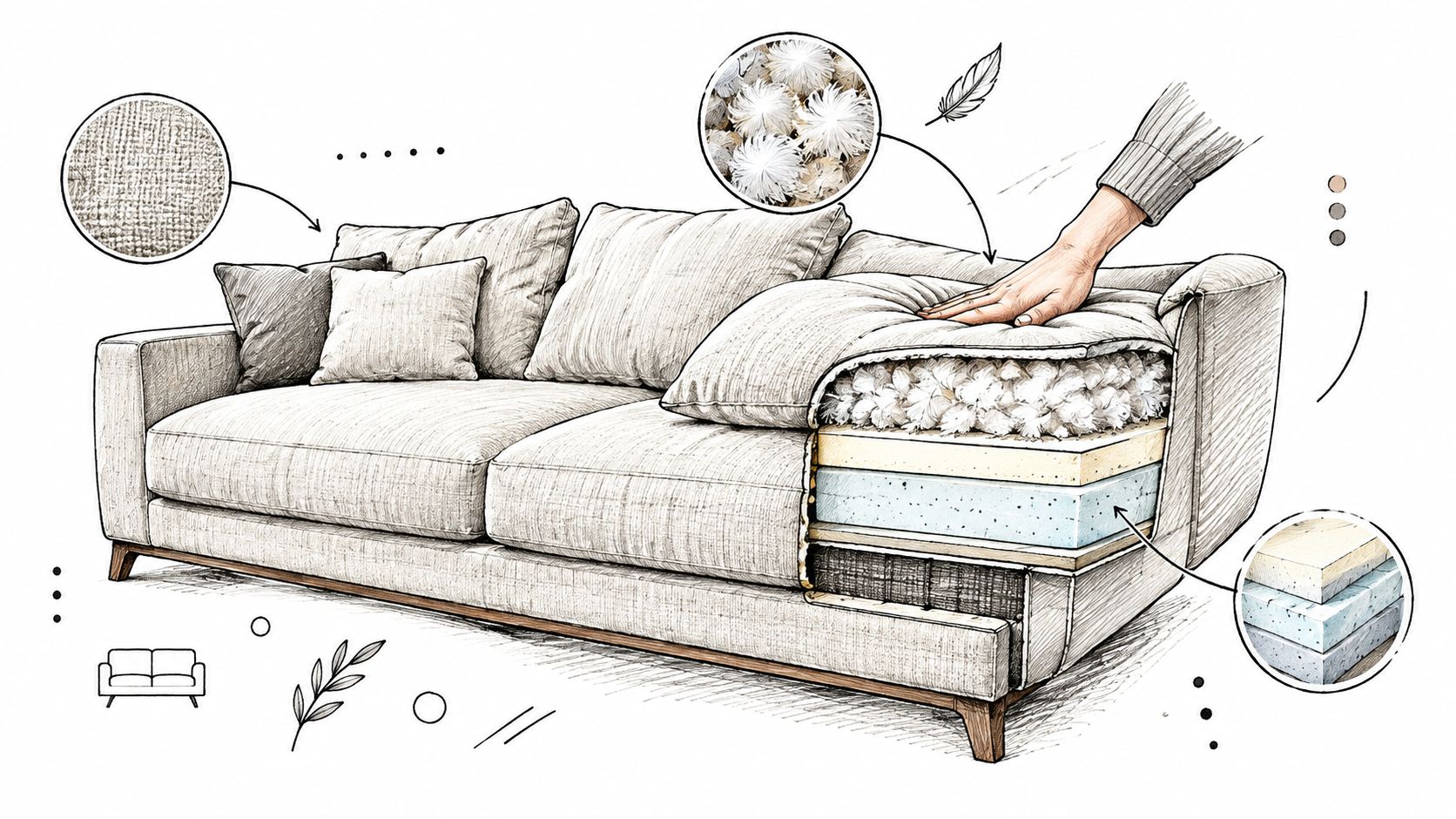
The fastest way to misunderstand a custom upholstered sofa is to judge it by surface softness alone. Comfort isn't one layer. It's the result of core density, cushion construction, suspension below, and the way the seat is expected to perform after regular use.
For daily-use sofa seats, independent upholstery guidance converges on high-resilience foam in the 1.8 to 2.5 lb/ft³ density range, with many guides placing the practical target at roughly 2.0 to 2.5 lb/ft³ and 25 to 35 ILD for a balance of support and comfort. The same guidance notes that cushions below about 2.0 lb/ft³ are more likely to sag or bottom out earlier, and some service-life charts estimate about 7 to 9 years for 1.8 to 2.0 lb/ft³ cushions versus roughly 9 to 16 years for 2.0 to 2.5 lb/ft³ cushions under heavier use in this upholstery foam selection guide.
Density First, Firmness Second
Buyers often confuse density with firmness. They're related, but they aren't the same thing.
- Density affects longevity and shape retention.
- Firmness affects how the seat feels in the moment.
- Construction layers decide whether the cushion feels structured, sink-in soft, or balanced.
That distinction matters because a very plush seat can still be built on a strong core, and a firmer seat can still break down too soon if the internal specification is weak. For primary family-room seating, the smarter approach is to choose density for use intensity first, then fine-tune feel.
How Soft, Medium, and Firm Actually Differ
One custom upholstery guide describes cushion options this way:
| Comfort level | Typical build | Best for |
|---|---|---|
| Soft | Fibers, feathers, and down blends | Buyers who want a cushiony, relaxed sit |
| Medium | Low-density foam with soft fibers | Balanced comfort and easier everyday support |
| Firm | Inner pocket coils with foam and fiber wrap | More resilient, structured seating |
That's why a showroom sit-test can mislead if the buyer doesn't ask what's inside the cushion. Two sofas can feel similar for five minutes and perform very differently over years.
The right cushion isn't the one that feels most dramatic on day one. It's the one that still feels right after daily use.
Why the Seat Stack Matters More Than the Cover
A quality custom build is layered. Technical guidance for high-end upholstery places emphasis on a kiln-dried hardwood or quality plywood frame, corner-blocked and glued joinery, and a suspension system matched to the intended seat feel. It also rejects staple-only construction and treats webbing-only bases as inadequate for high-end residential upholstery in this custom upholstery foam and build guide.
Buyers who want to understand how support systems affect the seat can compare eight-way hand-tied spring construction. The important point is that comfort and durability come from the full stack, not just the top cushion.
For households across South Georgia and North Florida, this is often the decision that separates a sofa that merely photographs well from one that keeps its comfort over time.
Choosing Between Performance Fabrics and Luxury Leathers
Material selection is where personality shows up fastest, but it still has to answer to real life. A custom upholstered sofa may look exquisite in a pale woven textile or a richly toned leather, yet the right choice depends on who uses the room and how much maintenance the household wants to manage.
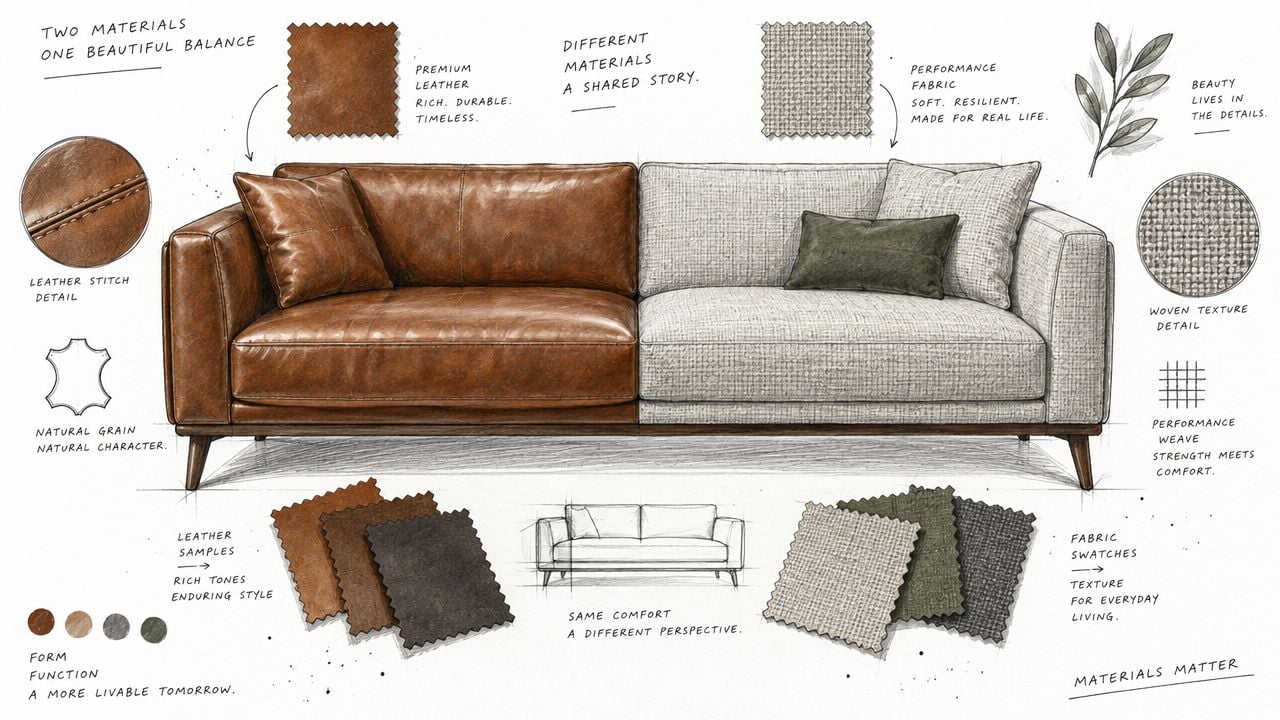
Performance fabrics are a specific customization category because they're designed for everyday durability. One upholstery guide states that performance fabric is intended to resist spills, friction, and frequent use, which makes it especially suitable for homes with children, pets, guests, or heavy daily use in this custom fabric upholstery overview.
Performance Fabric for Real-World Living
Performance textiles are often the most practical choice for active households. They tend to make sense when the sofa serves as the room's daily landing spot, not just an occasional accent.
They're especially worth considering for:
- Family rooms where snacks, blankets, and repeated use are part of the routine
- Pet-friendly homes where claws, hair, and spot cleaning are regular realities
- Vacation or guest settings where different users bring less predictable wear patterns
Many shoppers are surprised by how refined performance options look today. They no longer have to read overtly utilitarian to be sensible.
Leather for Character and Patina
Leather speaks to a different kind of value. It offers depth, natural variation, and a surface that often develops more character as it ages. For buyers creating a more collected, heirloom-quality room, leather can deliver warmth and visual richness that fabric doesn't mimic.
That said, leather asks for honest placement. It may be the right move for a sitting room, study-adjacent space, or polished main living area. In some family rooms, it also performs beautifully. The deciding factor isn't image. It's whether the household likes the feel, the evolving patina, and the care expectations.
A Better Way to Decide
A side-by-side comparison often clears up indecision:
- Choose performance fabric if stain resistance, lower stress, and everyday flexibility matter most.
- Choose leather if natural texture, long-term character, and a more refined presence carry more weight.
- Mix materials if the household wants durability on the main seating surface and softer contrast through pillows or companion pieces.
Shoppers weighing these choices can also review performance fabric versus leather considerations to sharpen the trade-offs before ordering.
Swatches should go home before the order goes in. Daylight, lamplight, flooring, and wall color often change the answer.
This is also where style support helps. Digital catalog browsing narrows the field, style quizzes clarify the room's direction, and in-store associates help test whether the beautiful option is also the livable one. Most vendors in a special order program support this level of personalization, which is why material choice should be handled as a lifestyle decision first and a color decision second.
Navigating Finish Options, Pricing, and the Ordering Timeline
By the time a buyer reaches finish selections, the major comfort decisions should already be in place. The custom upholstered sofa stops feeling theoretical and starts becoming a documented build.

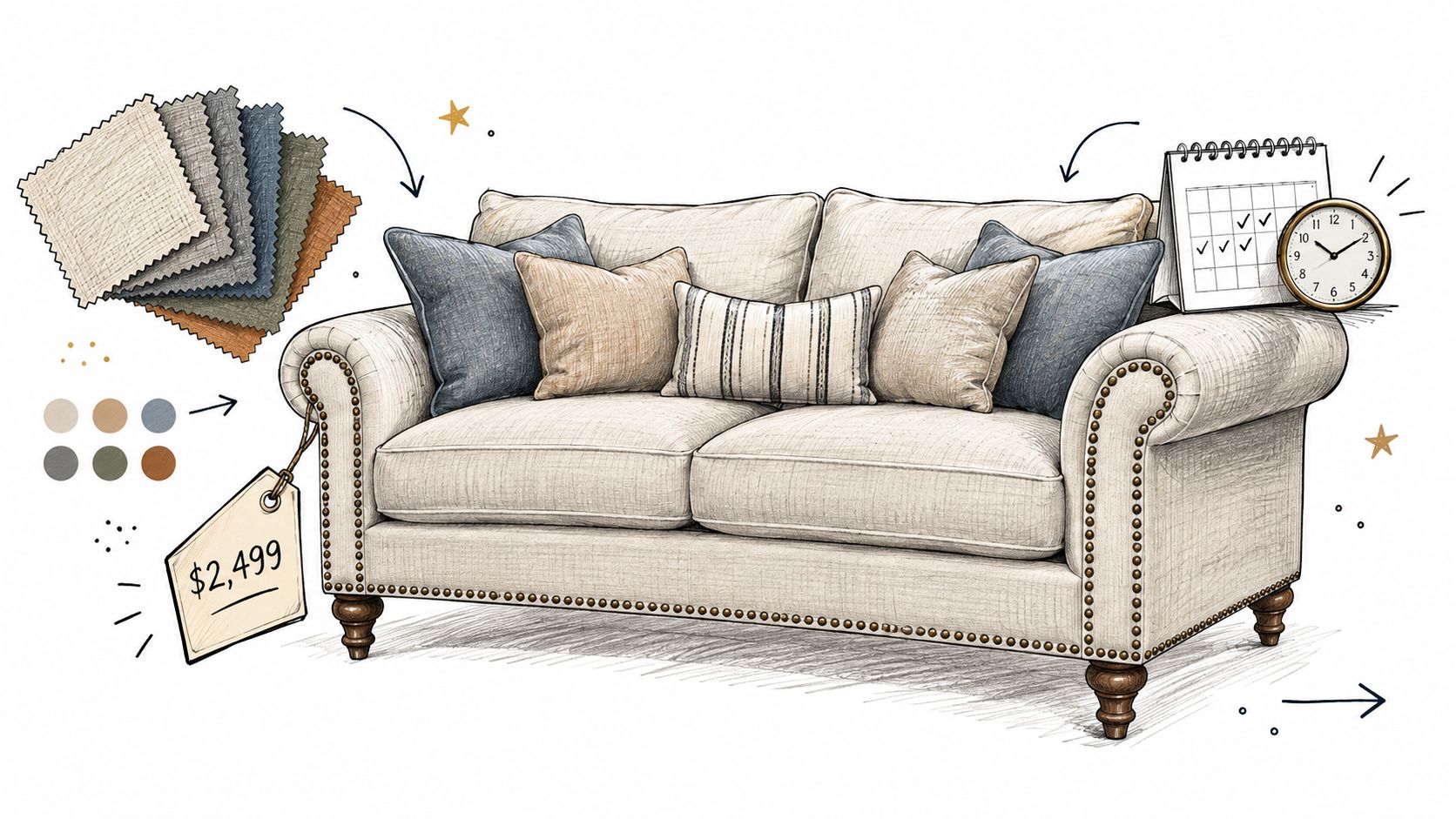
One of the most overlooked parts of custom upholstery is lead-time math. Independent industry guides in 2026 show a wide spread. Custom upholstery often runs about 6 to 12 weeks, 8 to 14 weeks, or 8 to 16 weeks depending on maker, fabric availability, and complexity, while higher-complexity or imported pieces can push to 16 to 24+ weeks. A recent trade report also notes that a made-to-order upholstery program can advertise 8 to 10 week lead times, but that still depends on the specific fabric and whether the piece is ready to ship as outlined in this furniture lead-time management report.
What Buyers Can Usually Customize
Custom doesn't stop at upholstery material. Made-to-order upholstery programs commonly allow buyers to personalize details such as:
- Arm style
- Cushion type
- Leg style
- Wood finish
- Overall configuration
- Seat feel and tailoring details
Those are the details that turn a familiar silhouette into a sofa that belongs in a specific home. Small finish changes can also alter the perceived formality of the piece more than buyers expect.
Why Pricing Moves So Much
Custom upholstery pricing shifts because each layer affects labor, material cost, and production flow. A straightforward frame in a standard fabric won't price the same way as a larger configuration with upgraded tailoring and more specialized materials.
The useful way to think about pricing is by stack, not sticker:
| Decision layer | How it affects the order |
|---|---|
| Frame complexity | Larger or more intricate silhouettes typically increase build demands |
| Upholstery grade | Fabric and leather selections can move the total significantly |
| Cushion specification | Different comfort builds change both feel and internal materials |
| Finish detailing | Legs, trim, and tailoring can add visual refinement and production steps |
That's why a custom upholstered sofa typically begins in the mid-thousands and climbs from there. It's less a single product than a composed set of decisions.
The Ordering Workflow That Works Best
The cleanest custom orders usually follow this sequence:
- Approve the frame and dimensions
- Lock in cushion construction and comfort level
- Choose fabric or leather based on use
- Finalize finish details and configuration
- Review the timeline with sourcing and delivery in mind
For shoppers who want one place to coordinate those layers, Lott's Furniture offers a special order process that connects digital catalog browsing with showroom decision-making in Fernandina Beach, FL. That omnichannel approach tends to reduce errors because buyers can start online, then confirm comfort and finish details in person with an associate. The same guidance can also pull in broader room context, including style quizzes and the Mattress Guide, so the order fits the home rather than standing apart from it.
A good timeline conversation should include design approval, fabric availability, factory queue, freight, and final delivery. That's what turns an estimate into a realistic plan.
Delivery, Installation, and Caring for Your Custom Sofa
A well-built sofa still needs a careful final mile. Delivery is the point where measurements, craftsmanship, and logistics all meet the conditions of the home.
White-glove delivery is more than curbside drop-off because it typically includes staged inspection and placement. One delivery process description explains that items are checked before loading, inspected again at arrival for transit damage, unpacked and assessed after delivery, and then positioned in the agreed location before final sign-off in this explanation of white-glove versus standard delivery.
Why White-Glove Handling Matters
The value isn't only convenience. It's protection.
A proper in-home process should include:
- Pre-delivery inspection so visible issues are caught before the piece leaves for the home
- Arrival review to identify any transit concerns before placement
- In-room positioning so the sofa is set where it will live
- Final sign-off after unpacking and placement are complete
This standard is especially important for large custom upholstery, where a damaged leg, compressed corner, or careless pivot through a narrow hallway can undo months of planning. Buyers who want to see how that process works can review white-glove delivery details.
Simple Care Habits That Protect the Investment
Once the sofa is placed, steady care matters more than occasional deep intervention.
Use a routine like this:
- Vacuum gently with an upholstery attachment to remove grit before it settles into fibers.
- Blot spills promptly instead of rubbing them deeper into the surface.
- Rotate cushions when the build allows so wear stays more even across favorite seats.
- Watch direct sunlight because some fabrics and leathers can fade over time.
- Use the manufacturer's care guidance for spot cleaning and maintenance products.
A custom sofa usually doesn't fail all at once. It shows neglect gradually through uneven wear, embedded debris, faded panels, and ignored spills.
For households dealing with occasional accidents, a practical stain resource can help. This guide for Kennesaw homeowners offers useful cleaning reminders that apply well to everyday upholstery mishaps, especially before marks have time to set.
The Final Standard Buyers Should Expect
Across South Georgia and North Florida, many homeowners want the reassurance that the service matches the purchase. That's where the Lott's Delivery standard matters. Every piece undergoes a rigorous multi-point inspection before it reaches the customer, and in-home placement helps ensure the sofa lands exactly where the room was planned around it.
That final step often gets less attention than swatches and seat cushions. It shouldn't. A custom upholstered sofa is a layered investment, and the last layer is how it enters the home and how it's cared for afterward.
For homeowners across South Georgia and North Florida, Lott's Furniture offers custom upholstery options, digital style tools, and in-store guidance that help turn a sofa from a nice idea into a well-specified piece for real daily living. Visit the Fernandina Beach showroom or start with an online style consultation to compare comfort levels, materials, and finishes with confidence.